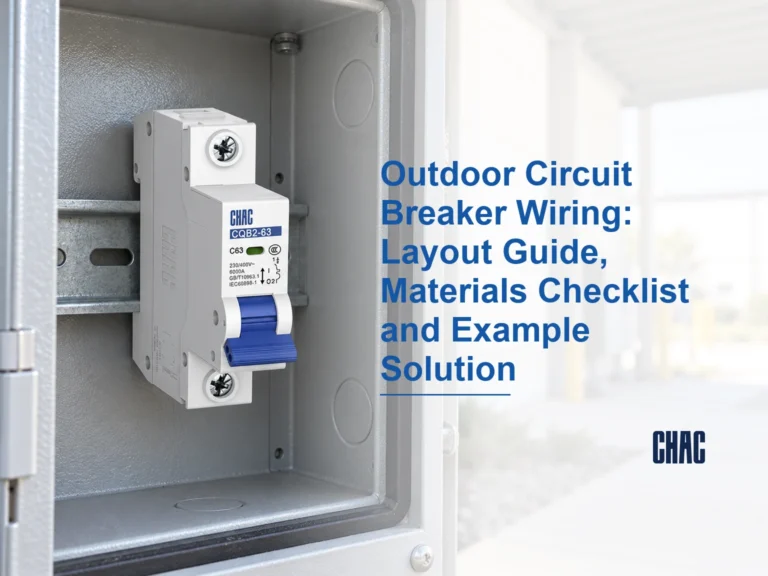
In a hypothetical workshop in Birmingham, a maintenance engineer fits a D-curve breaker to stop a transformer circuit tripping at startup. The nuisance trip disappears, but the design review finds that the far-end fault current was never checked. Solving the starting problem did not complete the protection design.
Резюме: A Type D circuit breaker is considered for high-inrush loads when its complete time-current characteristic suits the load and the installation still meets required fault-disconnection times. IEC 60898-1 D curves are commonly described by a 10–20 times rated-current magnetic band. Confirm the actual product standard and manufacturer curve; that band is not its breaking capacity.
A D curve changes the response to starting current
A Type D circuit breaker combines delayed thermal response to overload with magnetic response at higher current. Changing the letter changes a characteristic of that response; it does not allow the protected cable to carry a higher sustained current.
Transformers, motors and some power supplies can draw a short starting surge. Compare the surge magnitude and duration with the manufacturer’s time-current envelope, allowing for tolerances, starting frequency and ambient conditions. A load category alone does not prove that D is the right choice.
For IEC 60898-1 products, the familiar B, C and D descriptions commonly use magnetic bands of 3–5, 5–10 and 10–20 times rated current respectively. Industrial devices assessed under IEC 60947-2 can have model-specific characteristics. Always use the declared curve for the exact breaker, not a generic internet diagram.
Fault current must still produce timely disconnection
Increasing the magnetic threshold can make fault disconnection harder on a circuit with significant impedance. The design needs both the maximum prospective fault current for breaking-duty assessment and the minimum relevant fault current for disconnection-time assessment. These are different ends of the same installation problem.
For an illustrative 16 A device, multiplying 16 by the upper D-band factor of 20 gives 320 A. This is an arithmetic illustration of a generic characteristic boundary, not a guaranteed trip time or an approval calculation. The full curve, tolerances and applicable disconnection requirements remain necessary.
A tripping curve should be reviewed together with conductor length, cross-section and the earthing arrangement. Do not convert a nuisance-tripping complaint into an unverified curve change. A qualified person should first exclude overload, damaged insulation, loose connections and an incorrect operating sequence.
Breaking capacity and coordination need separate checks
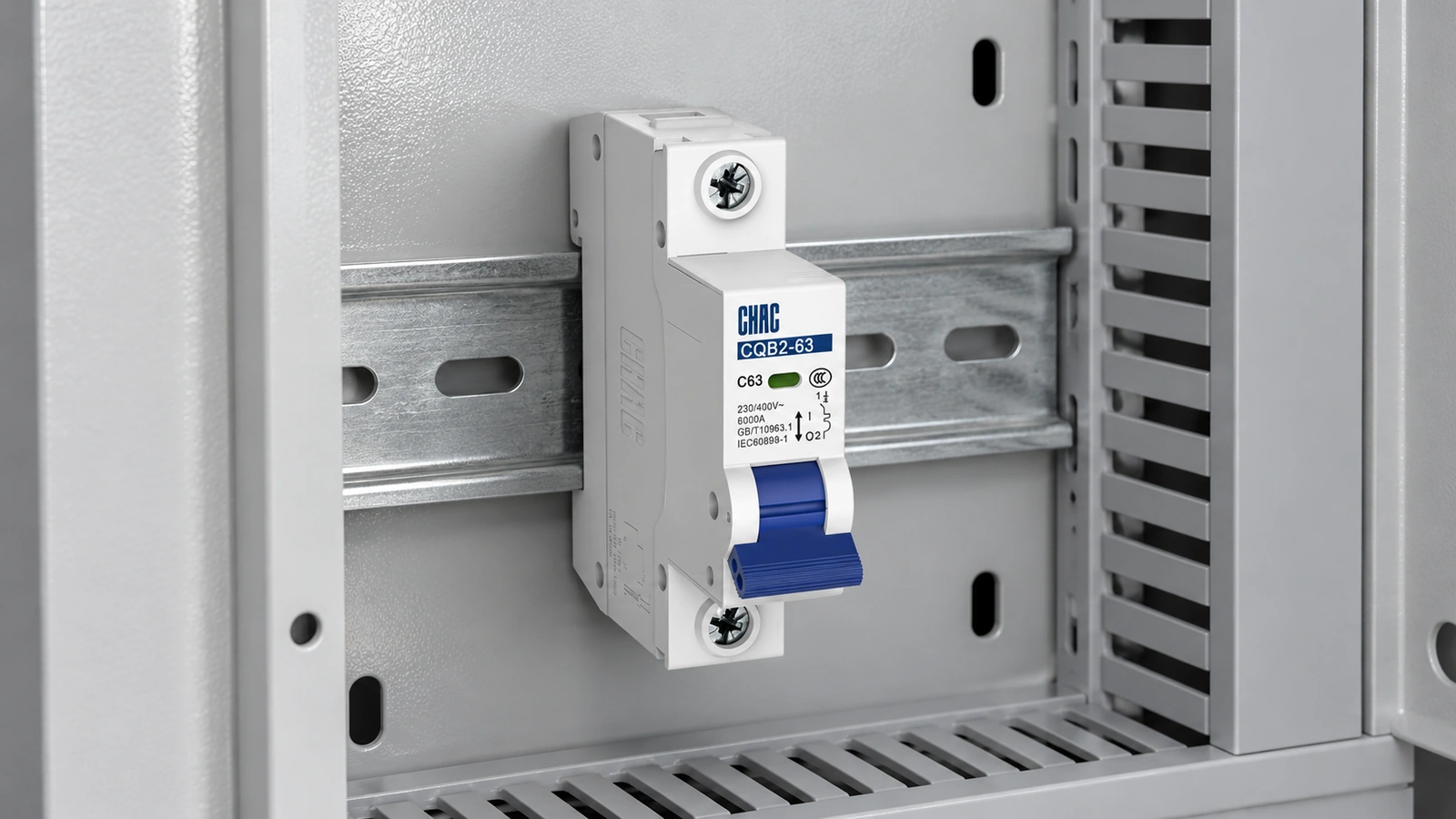
Breaking capacity states the fault duty a device can interrupt under specified conditions. It is independent of whether the breaker has a B, C or D characteristic. A higher magnetic threshold does not raise a 6 kA device’s declared fault-interruption rating.
Upstream and downstream protection also need coordination. Manufacturer-tested combinations can sometimes support backup protection or discrimination, but a common brand or matching letter does not establish either. Retain the exact coordination table and voltage conditions with the design.
The cost of changing a curve can include design review, fault-loop verification, labeling and replacement stock. An apparently cheap substitution becomes expensive if the installation must be retested or the intended upstream discrimination is lost. Compare the complete approved arrangement, not only the individual breaker.
Compare the selection criteria
| Characteristic | Common IEC 60898-1 magnetic band | Selection consideration |
|---|---|---|
| B | 3–5 × In | Lower inrush where suitable |
| C | 5–10 × In | Moderate inrush where suitable |
| D | 10–20 × In | Higher inrush with verified fault disconnection |
Check the conditions that change the selection
| Load situation | Check before choosing D | Possible alternative to investigate |
|---|---|---|
| Transformer startup | Inrush duration and minimum fault current | Starting arrangement or a different verified device |
| Motor starting | Start time, repeated starts and overload protection | Coordinated motor starter |
| Long cable run | Fault-loop conditions and voltage drop | Conductor or circuit redesign |
| Repeated unexplained trips | Actual trip cause and load records | Repair the underlying fault |
Apply the correct standards and approval scope
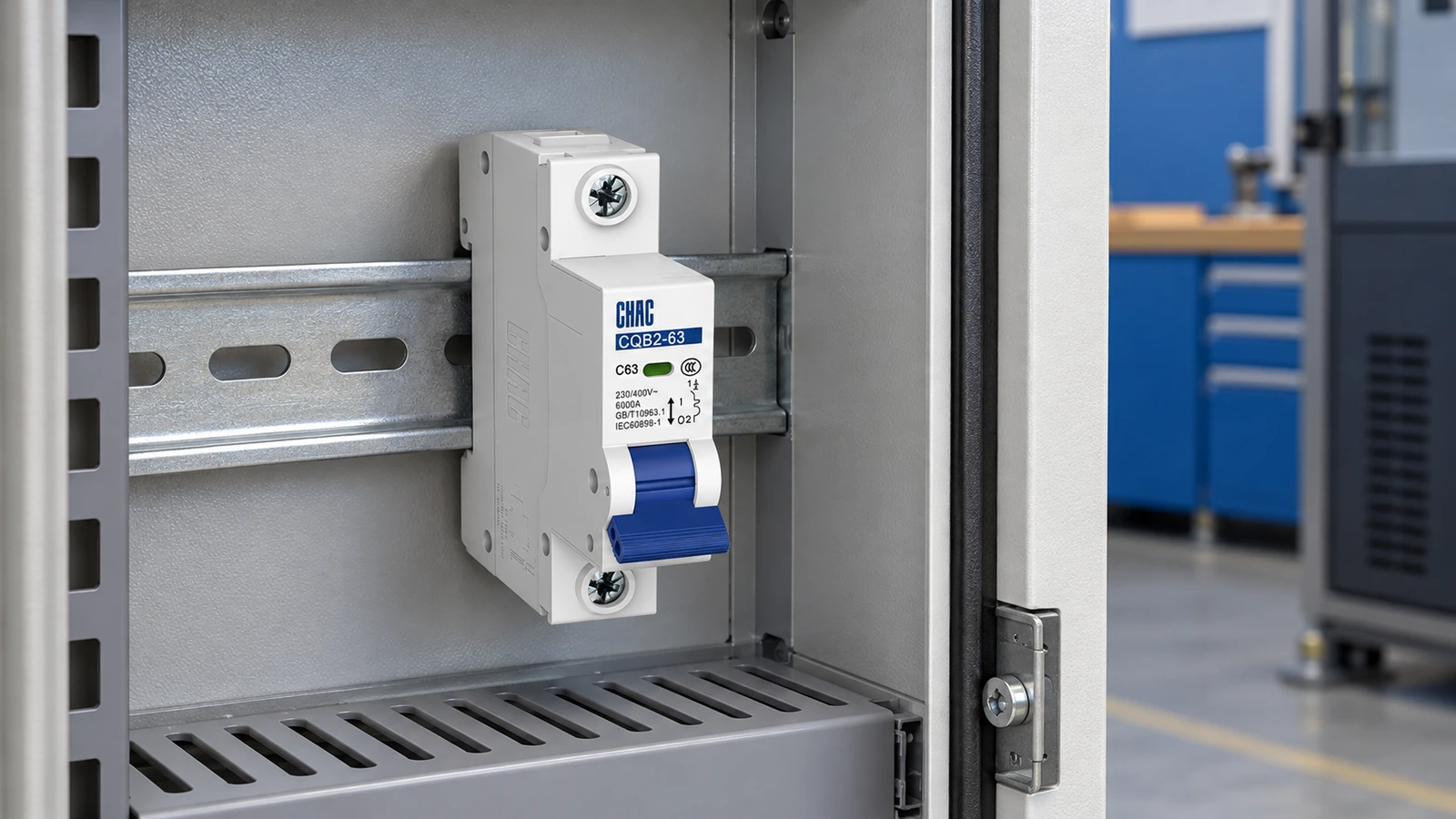
IEC 60898-1 covers certain AC circuit breakers for household and similar installations; IEC 60947-2 covers low-voltage circuit breakers for broader industrial use. The declared product standard, curve and voltage conditions must match the design. A D marking is not a destination-market approval or proof of interchangeability with another manufacturer’s panel.
What to confirm before placing an order
Ask CHAC to confirm the exact curve, pole configuration and documents for the CQB2-125 miniature circuit breaker before selecting a variant. Review MCB options against the load profile and short-circuit breaking capacity, then provide the project fault level and required coordination. Avoid requesting a D curve solely because the existing circuit trips.
For related selection details, read the guide to circuit breaker size and rating.
Часто задаваемые вопросы
What is the difference between Type C and Type D circuit breakers?
Their magnetic-trip bands differ. A D curve tolerates a higher short surge in the relevant characteristic range, but requires its own check of fault-disconnection performance.
What is the difference between B, C and D curve circuit breakers?
For common IEC 60898-1 curves the magnetic bands are 3–5, 5–10 and 10–20 times rated current. These do not replace the complete manufacturer time-current curves.
Are all Square D circuit breakers the same?
No. Square D is a brand name, while D curve describes a tripping characteristic. Panel family, ratings, poles and protective functions must all be checked.
What is a Type D MCB?
It is an MCB with the manufacturer’s declared D characteristic. Verify its governing standard and full curve rather than assuming every device uses identical thresholds.
What is a Type D circuit breaker used for?
It may suit loads with substantial starting current, such as certain transformers or motors. Application names alone do not establish suitability.
How does a Type D circuit breaker work?
Its thermal element responds to sustained overload and its magnetic element responds to high current. It does not automatically include motor overload, residual-current or arc-fault functions.
Ссылки
- Schneider Electric — miniature circuit breakers and B, C and D tripping ranges
- IEC standards catalogue — circuit-breaker standards IEC 60898-1 and IEC 60947-2
- OSHA 1910.303 — electrical equipment and installation requirements
For model-specific selection, review the CHAC product details and send the application conditions, quantity and destination requirements through the contact page.