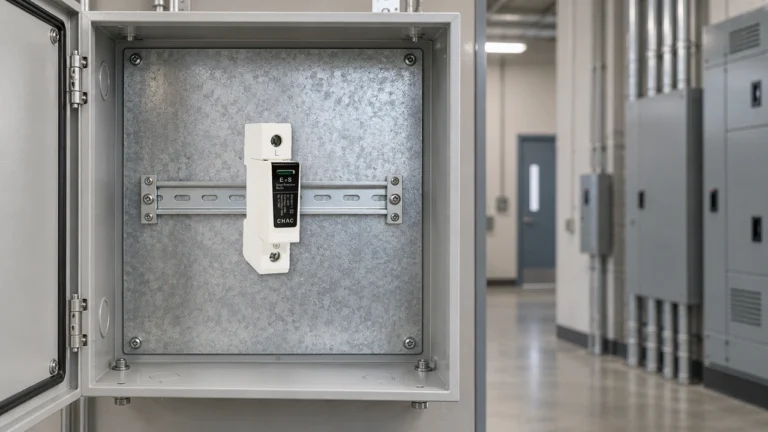
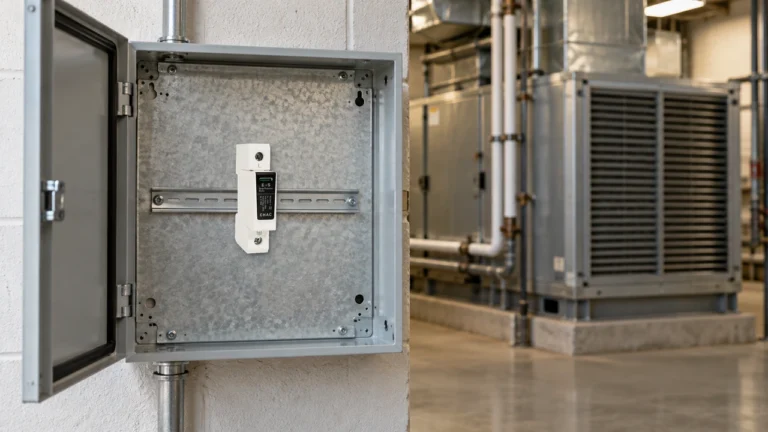
When a facilities electrician in Manila sees a refrigerator restart several times during a hot afternoon, the quickest temptation is to raise the trip limit or keep resetting the device. That can hide a loose neutral, a supply fluctuation, a compressor-start event, or a protector that is not matched to the circuit. A repeated trip is therefore a diagnostic signal, not proof that the appliance or the protector is defective. This guide explains the selection boundary between sustained-voltage protection and transient surge protection, the checks that should come before a reset, and the information a contractor or OEM buyer should record before specifying a replacement.
Tóm tắt: A voltage protector disconnects a load when measured voltage moves outside its configured or declared range, while an SPD diverts short-duration transient energy; they solve different problems. A refrigerator compressor can draw a brief starting current, but a protector should be selected for the appliance’s nominal voltage, current, frequency, neutral arrangement, delay behavior, and local installation rules—not for a label alone. If the device trips repeatedly, isolate the load, measure the supply under operating conditions, inspect neutral and termination integrity, and verify the product instructions before changing settings.
{{FEATURED_IMAGE}}
What does a voltage protector do, and why can it trip?
A voltage protector is a monitoring and switching device. It measures the voltage presented to a connected circuit and opens the circuit when the value is above or below its set limits, then reconnects according to its delay and reset logic. The device is intended to reduce exposure to sustained overvoltage, undervoltage, or an abnormal supply condition; it does not repair a damaged appliance or make an unstable distribution system acceptable.
Common trip causes include a real utility fluctuation, a loose or overloaded neutral, a poor termination, a shared circuit with a large motor load, a refrigerator compressor starting outside the device’s expected timing, or a threshold that does not suit the local nominal voltage. A protector can also trip because of internal heat, an incorrect wiring arrangement, or a failed sensing or switching component. Record the time, load state, measured line-to-neutral and line-to-line values where applicable, and any indicator code before replacing it.
The phrase what is voltage protector often appears in purchasing searches, but the answer depends on the device class. A voltage monitoring relay, an under/over-voltage release, a whole-panel voltage protection unit, and a plug-in appliance protector may have different ratings, reset behavior, and installation requirements. Ask for the exact model instructions and electrical diagram rather than treating those names as interchangeable.
Why are refrigerators especially sensitive to repeated trips?
Refrigerators and freezers combine electronic controls with a compressor motor. The compressor may draw a short inrush current at startup, and the control board may require a restart delay after power is removed. A protector with an unsuitable delay, current capacity, or switching method can open during normal cycling even when the steady-state voltage is acceptable. Conversely, a low-voltage condition can keep a compressor from starting correctly and cause repeated attempts that increase thermal stress.
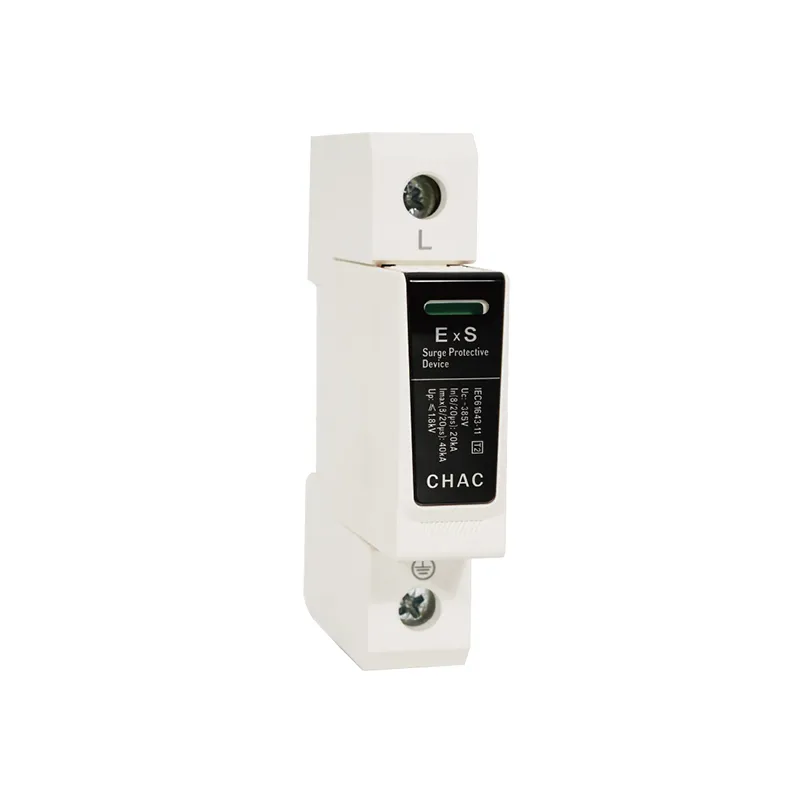
Do not diagnose from the appliance label alone. Check the branch-circuit voltage while the compressor starts, the protector’s continuous current rating, the specified delay or reconnection interval, and the manufacturer’s instructions for extension cords or shared outlets. If the refrigerator is on a circuit with pumps, air-conditioning equipment, welders, or other motors, capture the event at the distribution board as well as at the receptacle. A qualified person should make live measurements with properly rated equipment.
{{INLINE_IMAGE_1}}
Is a surge protector the same as an over voltage protector?
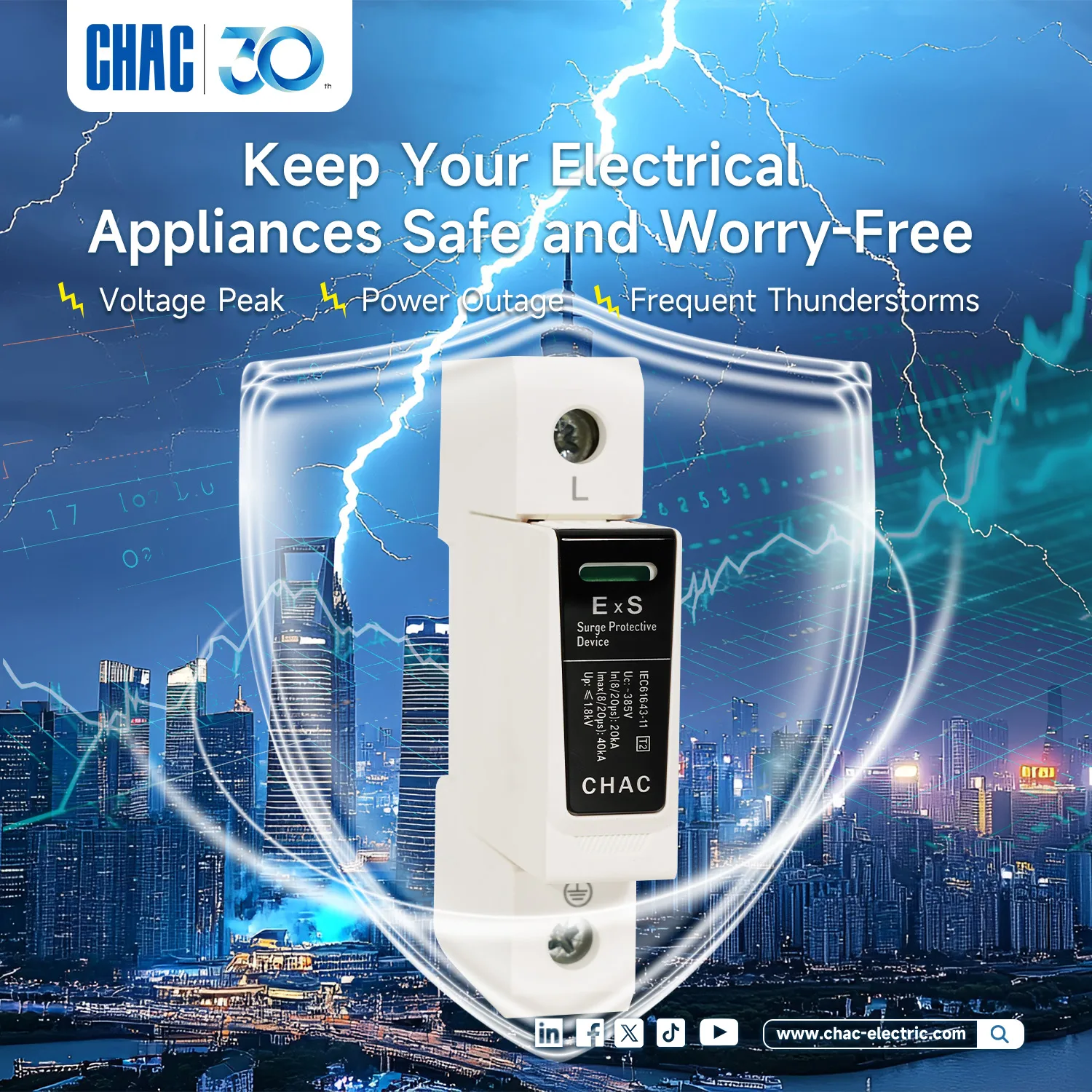
No. An over voltage protector is generally used for a sustained abnormal voltage and disconnects or controls the load. A surge protective device (SPD) addresses short-duration transients, such as those associated with switching or lightning-related events, by providing a lower-impedance path for the transient current when installed and coordinated correctly. An SPD is not a voltage regulator, and a voltage protector is not automatically an SPD.
Searches for surge protector tripping can describe several different events. A plug-in strip may open its breaker because the connected load exceeds its current rating; an SPD may show an end-of-life indication; or an upstream breaker may operate during a fault. Identify which device actually opened, whether the event was sustained or transient, and whether the circuit has a protective device with the correct short-circuit coordination. The [surge protection device category](https://chac-electric.com/spd/) is a useful starting point for reviewing SPD families, but the selected model and wiring arrangement control the final application.
| Protection option | Primary event addressed | What it does | What it does not prove |
|---|---|---|---|
| Voltage protector | Sustained overvoltage or undervoltage | Monitors voltage and disconnects or reconnects a load according to its settings | It is not a surge clamp, stabilizer, or substitute for correcting a loose connection |
| Đảng Dân chủ Xã hội Đức | Short-duration transient overvoltage | Diverts transient current through a protective path when correctly selected and installed | It does not hold a low utility voltage at nominal value |
| MCB or fuse | Overload and short circuit within its declared ratings | Interrupts excessive current | It does not detect every voltage abnormality or small leakage event |
| Voltage regulator or UPS | Voltage conditioning or continuity, depending on the design | May regulate output or provide stored energy | It still requires capacity, battery, bypass, and installation checks |
Where should the device be installed?
Installation location follows the protection objective and the product instructions. A point-of-use protector can protect one appliance when the receptacle, neutral, earthing arrangement, and enclosure are suitable. A panel-mounted device may monitor or protect a feeder or a group of circuits, but it must be coordinated with the upstream overcurrent device and the distribution system. An SPD is normally installed with short, correctly routed conductors; excessive lead length can affect its transient performance.
Keep refrigeration equipment clear of wet areas, heat sources, and inaccessible connection points. Do not place a plug-in device where condensation, washdown, or mechanical damage can defeat its enclosure or cord. For a fixed installation, a qualified electrician should verify conductor size, protective-device rating, disconnecting means, grounding and bonding, terminal torque, and required working space under the adopted electrical code. The device’s enclosure marking is not a blanket approval for every environment.
Overvoltage category is an installation classification used to describe the expected transient environment; it is not a current rating and does not by itself certify a protector for a refrigerator. The design team should match the category and impulse withstand assumptions to the location, equipment, and applicable product standard. A category statement without a declared voltage system and installation context is incomplete.
What rating should buyers check before replacing a tripping protector?
Start with the supply facts: nominal voltage, phase and pole arrangement, frequency, earthing system, and the highest expected continuous load. Then compare the protector’s permitted voltage range, current or power rating, switching or interrupting capability, delay and reconnection mode, temperature limits, terminal arrangement, and enclosure requirements. If the unit is intended for a motor-compressor load, ask how the manufacturer defines starting or inrush conditions; do not infer suitability from a larger-looking ampere number.
For an SPD, add the system’s maximum continuous operating voltage, discharge-current and short-circuit coordination data, mode of connection, status indication, and replacement method. The AC surge protection device page can help a buyer identify a product route, but it should not be represented as a sustained-voltage cut-off unless its documentation says so.
| Selection dimension | Refrigerator or appliance check | Evidence to request |
|---|---|---|
| Supply compatibility | Nominal voltage, frequency, phase, poles, neutral and earthing arrangement | Single-line diagram, site measurement and product wiring diagram |
| Load behavior | Running current, compressor or motor start, duty cycle and simultaneous loads | Nameplate, manufacturer data and measured start behavior where safe |
| Trip and reset logic | Under/over-voltage thresholds, delay, manual or automatic reset and indication | Exact model datasheet and installation instructions |
| Coordination | Upstream MCB or fuse, available fault current and isolation method | Protection study or panel schedule and local code review |
| Môi trường | Moisture, condensation, temperature, access and mechanical exposure | Location assessment and enclosure or mounting requirements |
How should a contractor troubleshoot repeated tripping?
- Make the circuit safe. Stop repeated resets. Isolate the appliance or feeder and use lockout and verification procedures appropriate to the installation.
- Identify the operating event. Note whether the trip occurs at compressor start, after a storm, during a high-load period, or at random intervals.
- Measure the supply. Compare voltage at the panel and at the load under steady state and, where a qualified person can do so safely, during the suspected event. A single no-load reading is not enough.
- Inspect connections. Check neutral continuity, conductor terminations, overheating, moisture, damaged insulation, and shared loads. Correct the installation defect before changing a trip threshold.
- Verify the device. Compare the exact model marking, rating, wiring, delay and status indication with the manufacturer’s instructions. Replace a failed device with a documented equivalent, not merely a device with a higher nominal current.
Escalate to the utility or a qualified electrical professional when the measured supply is outside the service expectation, a neutral fault is suspected, the enclosure shows heat or arcing, or the device trips with the load disconnected. Appliance replacement is not the first response until the circuit and protection path have been verified.
What do NEC and IEC references actually establish?
Phần NFPA 70 National Electrical Code is adopted and enforced by jurisdictions, so the applicable edition and local amendments determine installation requirements. It can guide equipment use, conductor protection, grounding, working space, and special locations, but a general NEC link does not certify a particular protector or prove that a refrigerator installation is compliant.
The IEC Webstore publication record for IEC 61858-1:2014 is a standards reference, not a product certificate. Standards should be cited only for the scope that the referenced edition actually covers; product certification, test reports, and declarations must be checked against the exact model and destination market. If a project specifies an SPD, voltage monitor, or appliance protection device, request the relevant product standard and installation evidence rather than substituting a different standard’s title.
Unsupported claims such as “protects every appliance,” “surge-proof,” or “works in all voltage systems” create technical and commercial risk. The destination market, intended use, declared ratings, and installation instructions define the claim boundary.
How can buyers avoid another nuisance trip?
- Write the nominal supply and measured operating range into the request for quotation; include phase, frequency, neutral and earthing information.
- Separate sustained-voltage protection from transient protection in the specification, and state whether an SPD, a voltage monitor, or both are required.
- Describe the load profile, including compressor or motor starting, duty cycle, simultaneous loads and any critical restart delay.
- Request the exact wiring diagram, threshold tolerances, reset behavior, temperature limits, short-circuit coordination and installation instructions.
- Plan commissioning checks: terminal inspection, voltage measurement, functional test, status indication and a record of the installed model and settings.
CHAC Electric supports low-voltage equipment sourcing and technical review for contractors, panel builders, distributors and OEM teams. The practical starting point is the documented application and supply data; after those are defined, CHAC’s engineering team can respond through the technical support route without turning a general category statement into an unverified product claim.
{{INLINE_IMAGE_2}}
Các câu hỏi thường gặp
What is a voltage protector?
A voltage protector monitors supply voltage and disconnects a load when it moves outside the device’s declared limits, then reconnects according to its delay and reset logic. It addresses sustained overvoltage or undervoltage; it is not automatically a surge protective device or voltage regulator. Confirm the exact model’s range, current rating and wiring instructions before installation.
Do voltage protectors really work?
They can disconnect a load when the sensed voltage reaches their specified trip conditions, provided the device is correctly selected, wired, and maintained. They cannot correct a loose neutral, a damaged circuit, or a utility problem, and they do not guarantee protection from every transient or fault. Verify operation with the manufacturer’s test procedure and a qualified installation review.
What is the difference between a surge protector and a voltage protector?
A surge protector or SPD is intended for short-duration transient overvoltage, while a voltage protector monitors sustained voltage outside a permitted range and switches the load off. An SPD does not regulate a low or high utility voltage, and a voltage protector does not automatically provide transient diversion. The protection schedule should identify which event the project is trying to control.
What should you never plug into a surge protector?
Do not connect a load that exceeds the strip or device’s current, voltage, or power rating, and do not use a plug-in strip in a wet, damaged, or inaccessible location. High-inrush equipment, heating loads, motors, and refrigeration appliances require the manufacturer’s instructions and an appropriate circuit; a generic strip is not automatically suitable. Never defeat a protective device or daisy-chain power strips.
What is voltage protector and what does it protect?
It is a voltage-sensing disconnect device that can reduce a connected load’s exposure to a sustained high- or low-voltage condition. It does not protect against every short circuit, residual-current event, transient, or mechanical failure. The answer depends on the device class, setpoints, load rating and installation context.
Where should voltage protector be installed?
Install it at the point defined by the protection design—at the appliance connection or in a distribution panel—using the exact wiring, clearance, environmental and overcurrent requirements in its instructions. A fixed installation should be completed and tested by a qualified person under the adopted code. Keep the device accessible for status checks and replacement, and do not assume an indoor rating permits outdoor, wet, or condensation-prone use.
Tham khảo
- NFPA 70, National Electrical Code (NEC) resource — consult the edition adopted by the authority having jurisdiction.
- IEC 61858-1:2014 publication record — verify the standard’s actual scope before applying it to a product or installation claim.
- OSHA electrical safety resources — general safety guidance for de-energization, qualified work and electrical hazards.
Conclusion
A protector that keeps tripping is telling the project team to investigate the supply, load behavior, wiring and device class in that order. First distinguish a sustained voltage problem from a transient event; then confirm nominal voltage, compressor or motor starting behavior, thresholds, delay, current capacity, coordination and environmental conditions. Do not raise a setting or substitute an SPD until the measured condition and the manufacturer’s instructions support that choice. A documented installation and functional test are more valuable than a larger number on a label. Once those facts are available, CHAC Electric can help contractors and OEM buyers review a suitable low-voltage protection route and provide technical support for the final specification.