Lighting contactor selection should begin with documented project conditions and the selected model’s evidence, not with an assumed rating or a similar-looking enclosure. This guide helps panel teams prepare a reviewable RFQ while keeping the final approval with the project design and product documentation.
Part 1. What does a lighting contactor decision need to control?
A lighting contactor is an electrically operated switching device used to open and close lighting circuits from a separate control signal. For a commercial or industrial panel, the selection question is not simply whether the load is called lighting; it is whether the documented switching duty, number of circuits, control method, and installation conditions match the proposed device.
Start with the lighting schedule and the control narrative. A time switch, photocell, building-management output, or local control station can all create different command and feedback requirements, so the control arrangement belongs in the first review.
Part 2. Which load facts belong in the first review?
List each lighting circuit, its load technology, connected-load information supplied by the project, and the intended switching pattern. LED drivers, discharge-lighting gear, and other electronic equipment can have switching characteristics that are not established by a fixture count alone; request the load manufacturer’s documented information where it affects selection.
Keep the load-side record separate from the coil-side record. The power contacts switch the lighting circuits, while the coil and any auxiliary contacts must suit the documented control circuit and signalling plan.
| مدخل | لماذا هذا مهم | Do not infer |
|---|---|---|
| Lighting load documentation | Defines the duty to verify | A fixture count proves switching duty |
| Circuit grouping | Defines poles and operating zones | All circuits should operate together |
| Control narrative | Defines coil command and feedback | Any accessory fulfils every control role |
CHAC AC ContactorRecommended:
مصنع OEM للموصلات الصناعية AC من سلسلة CQC6 | CHAC Electric
Part 3. How should poles and circuit grouping be decided?
Pole count follows the project circuit arrangement and the required isolation or switching scheme; it should not be guessed from a product photograph. Grouping circuits can simplify control, but it also changes the load placed on a single switching device and the consequence of a single control failure.
Use the panel drawing to identify which circuits are intended to operate together. Where zoning, maintenance, or emergency operating sequences require separate control, preserve that distinction in the RFQ.
Part 4. What must match on the control side?
The control supply, commanded operating sequence, and required status signals must be documented before a coil or accessory is chosen. Confirm the available control voltage and current type from the design documents, then verify the selected model’s coil and accessory data rather than assuming that adjacent variants share the same interface.
If a control system needs proof of position or interlocking, identify the required feedback function and the receiving system. An auxiliary contact is not interchangeable with every signalling or safety function without the applicable product documentation.
Part 5. Which documents reduce an avoidable mismatch?
The RFQ should carry the single-line diagram, lighting schedule, control diagram, circuit grouping, installation environment, required documentation, and any project-standard requirements. This gives a supplier a reviewable basis for a proposed product route without turning a category page into a model-specific approval.
IEC 60947-4-1 is relevant standards context for contactors and motor-starters, but citing a standard does not establish that an unspecified model is certified, rated, or suitable for a project.
| يجب على المشتري توفير | لماذا هذا مهم | خطأ شایع |
|---|---|---|
| Application and circuit role | Defines the function to review | Naming a device without a drawing |
| Control and installation data | Defines interfaces and assembly context | Assuming a family variant is interchangeable |
| Required documentation | Makes the request auditable | Treating a catalogue page as approval evidence |
Part 6. Which CHAC product route is appropriate to review?
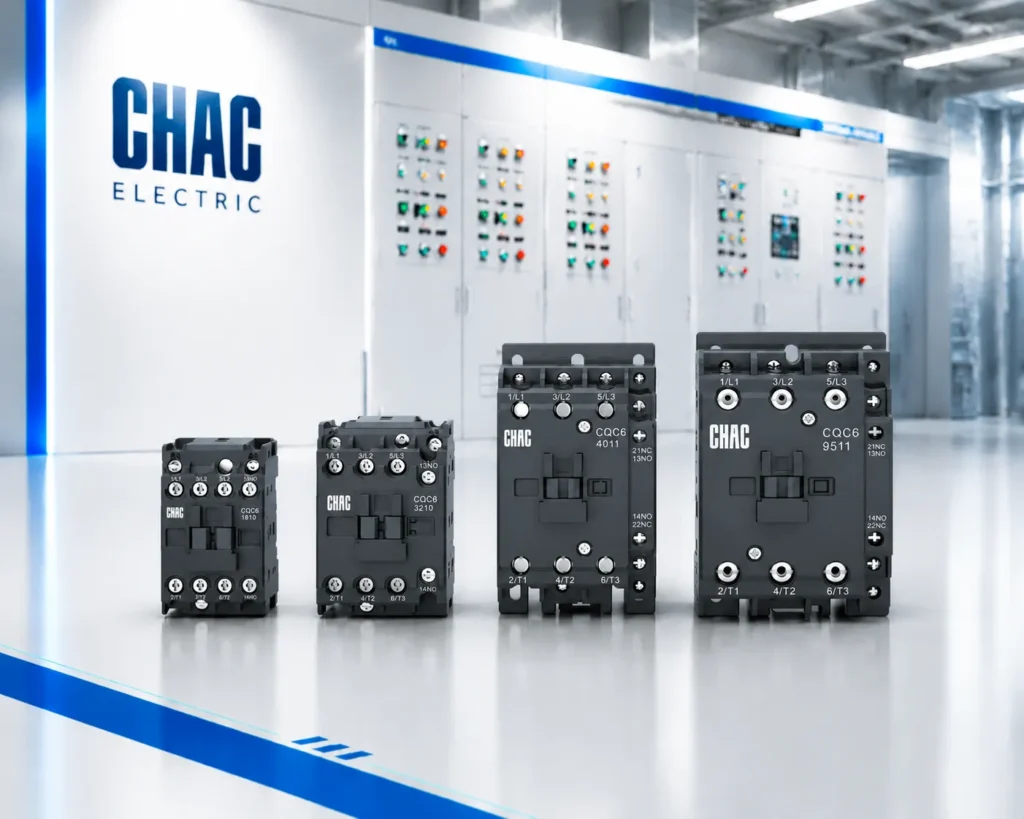
For an early product-route discussion, review CHAC Electric’s published AC contactor range together with the application data. The category route identifies the product family; final selection still requires a model-specific review against the project documents.
Do not select a generic substitute just because it has a similar enclosure or terminal layout. Similar appearance does not evidence the same lighting duty, coil interface, accessories, or project acceptance basis.
توصية بالمنتج
استخدم المنشور product route only as a starting point for a documented product review. For branding, packaging, or panel-program discussion, use CHAC Electric’s relevant customization route after the engineering inputs are complete.
Part 7. Where is the fit boundary for this guide?
Fit Boundary: this guide supports specification preparation for commercial and industrial lighting panels. It is not live-work instruction, a final protection-coordination study, or evidence that a particular contactor is compatible with every fixture, control system, or enclosure.
Before issuing a purchase order, confirm the chosen model’s documentation, the panel design, the lighting-load evidence, and the applicable project requirements.
الأسئلة المتكررة
What is a lighting contactor used for?
Begin with the documented circuit or connection function, site conditions, and the project drawing or schedule.
How do I choose a lighting contactor?
No. A category page can identify a product family, but the selected model documentation controls the final review.
How many poles are needed for a lighting contactor?
Provide the application, drawing, control or entry arrangement, installation conditions, required documentation, and project requirements.
What control voltage should a lighting contactor use?
The requested function must be shown in the control or installation design before an accessory or enclosure route is chosen.
Do LED drivers change contactor selection?
Ask for the exact selected-model evidence rather than inferring ratings, approvals, or compatibility from a generic product family.
What should be included in a lighting-control-panel RFQ?
The final review is needed before a purchase decision or installation approval, after the project inputs and selected-model data are available.