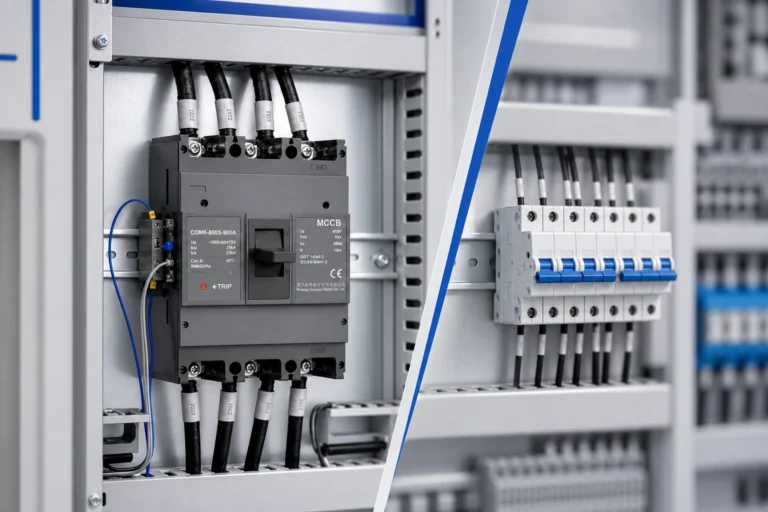
Shunt trip selection should begin with documented project conditions and the selected model’s evidence, not with an assumed rating or a similar-looking enclosure. This guide helps panel teams prepare a reviewable RFQ while keeping the final approval with the project design and product documentation.
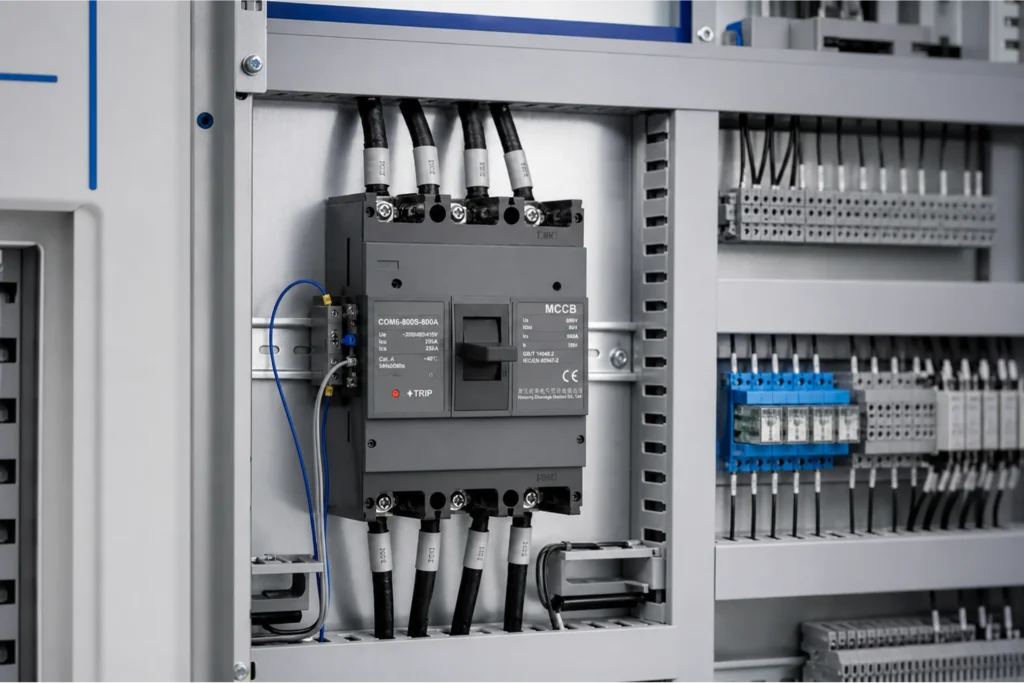
Part 1. What is the practical difference between the two functions?
A shunt trip is an opening release that operates when its specified control signal is applied. An undervoltage release is an opening release whose operation depends on the control supply being present at the required level; the two functions therefore create different control logic and different loss-of-supply behaviour.
Neither function is automatically the safer or more suitable choice. The required trip command, desired response to loss of control power, breaker model, and project safety design determine the appropriate function.
Part 2. When does a shunt trip fit the control intent?
Use shunt-trip logic when the design requires a deliberate external command to open the breaker. The initiating device may be a documented relay output, emergency-control circuit, or another approved control interface, but the article does not assume that any specific signal or system is compatible with a CHAC MCCB.
The control circuit must identify the source, the command type, the accessory’s documented control requirements, and the required reset or reclose sequence. Those details belong on the schematic and in the RFQ.
| Review item | Shunt-trip question | Undervoltage-release question |
|---|---|---|
| Opening trigger | Which external command is intended to trip? | What must happen when control supply is lost? |
| Control drawing | Where does the command originate? | Where is the maintained supply shown? |
| Model evidence | Which release is documented for the frame? | Which retained/closing behaviour is documented? |
Part 3. When does an undervoltage release fit the control intent?
An undervoltage release is used where the control philosophy requires the breaker’s closing or retained state to depend on an available control supply. This makes the loss-of-control-power question explicit: the project team must decide whether loss of that supply is intended to produce an opening action or prevent closing.
Confirm the selected breaker and release documentation before relying on any interlock or restart behaviour. Release characteristics, permitted combinations, and control-voltage details are model-specific.
Part 4. Which comparison points belong on the panel schematic?
Show the normal control state, the event that is intended to open the breaker, the source of the command or supply, and the expected behaviour after the event clears. Also show any external interlocks, feedback contacts, and the path used for testing.
A plain accessory name is not enough for a build review. The schematic should make clear whether a signal is meant to command an opening action or whether the continuing presence of voltage is part of the control condition.
Part 5. What must be checked before choosing an MCCB accessory?
Verify the MCCB frame and the documented accessory options, the control-circuit voltage and current type, the wiring diagram, the required operating sequence, and any project-standard or safety requirements. IEC 60947-2 includes marking and characteristics for shunt and undervoltage releases, but it does not substitute for the selected manufacturer’s instructions.
Do not infer accessory compatibility from a family name, a frame photograph, or a different MCCB model. The supplier should confirm the requested combination against the exact product documentation.
| يجب على المشتري توفير | لماذا هذا مهم | خطأ شایع |
|---|---|---|
| Application and circuit role | Defines the function to review | Naming a device without a drawing |
| Control and installation data | Defines interfaces and assembly context | Assuming a family variant is interchangeable |
| Required documentation | Makes the request auditable | Treating a catalogue page as approval evidence |
Part 6. Which CHAC route should an OEM panel team review?
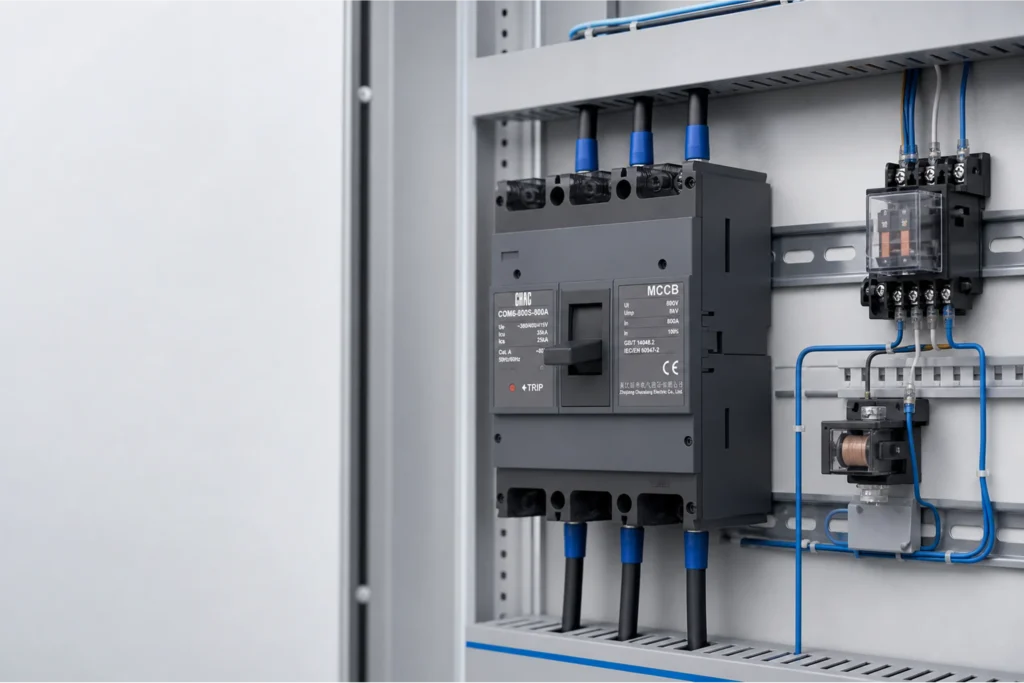
CHAC Electric’s MCCB category and published CQM6 product route are suitable starting points for a controlled RFQ discussion. Supply the accessory function and schematic with the request so that the product route is reviewed as an assembly question rather than as a generic breaker purchase.
Do not recommend an adjacent MCCB or a generic accessory as an equivalent without documentation. Whether a release can be fitted, powered, wired, and tested depends on the selected model and the panel design.
توصية بالمنتج
استخدم المنشور product route only as a starting point for a documented product review. For branding, packaging, or panel-program discussion, use CHAC Electric’s relevant customization route after the engineering inputs are complete.
CHAC MCCB Recommended:
CQM6 Standard Molded Case Circuit Breaker (MCCB) OEM Manufacturer | CHAC Electric
Part 7. Where is the fit boundary for this comparison?
Fit Boundary: this comparison helps OEM panel teams define the intended control function before requesting a product review. It does not approve a fire, emergency, machine-safety, restart-prevention, or protection scheme, and it does not establish a release’s thresholds or compatibility.
Use the final schematic, selected MCCB documentation, and applicable project requirements for the approval decision.
الأسئلة المتكررة
What is a shunt trip on an MCCB?
Begin with the documented circuit or connection function, site conditions, and the project drawing or schedule.
What is an undervoltage release?
No. A category page can identify a product family, but the selected model documentation controls the final review.
What is the difference between shunt trip and undervoltage release?
Provide the application, drawing, control or entry arrangement, installation conditions, required documentation, and project requirements.
Can a shunt trip prevent breaker closing?
The requested function must be shown in the control or installation design before an accessory or enclosure route is chosen.
Does an undervoltage release need continuous control power?
Ask for the exact selected-model evidence rather than inferring ratings, approvals, or compatibility from a generic product family.
What information is required for an MCCB accessory RFQ?
The final review is needed before a purchase decision or installation approval, after the project inputs and selected-model data are available.