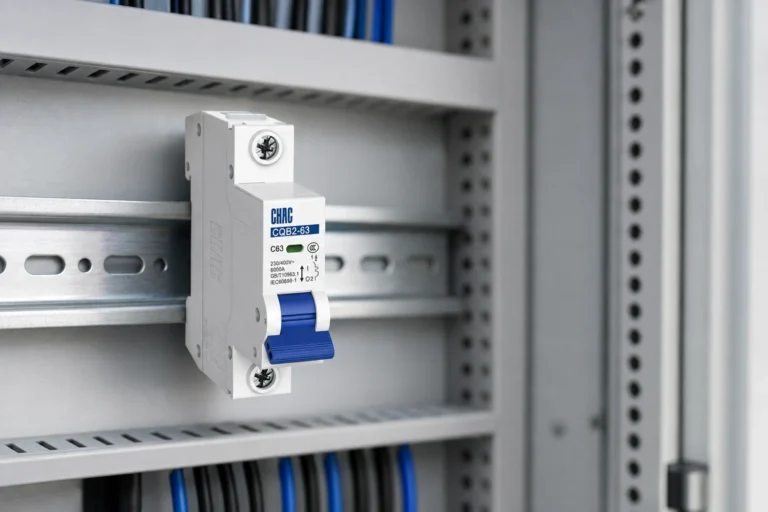
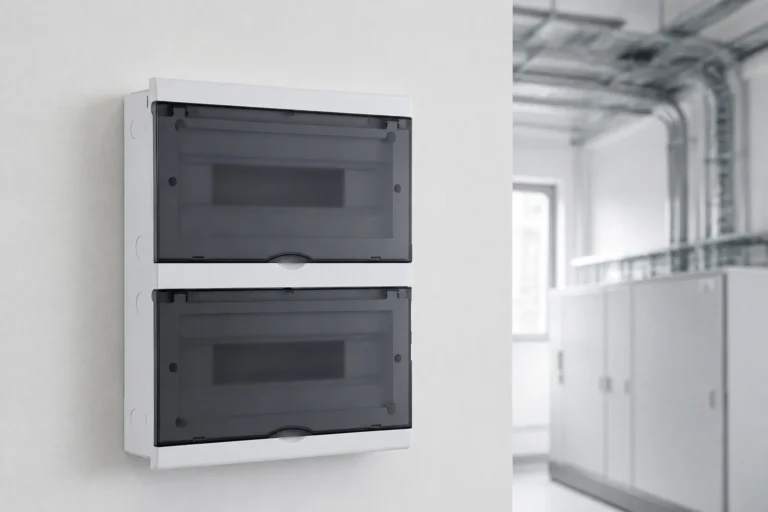
When electrical designer Elena Vos in Rotterdam added two office circuits, a compact breaker fitted and the revised directory looked complete. Minutes later, the panel diagram showed that bus position was not approved for a tandem. The breaker was not necessarily defective; the selection process had mistaken physical fit for documented compatibility.
ملخص: A tandem breaker provides two protected 120 V branch circuits in one approved panel space, but it does not raise circuit, bus, service, or interrupting limits. Match the panel label, permitted position, catalog number, conductors, neutral arrangement, protection, and calculated load before specifying one.
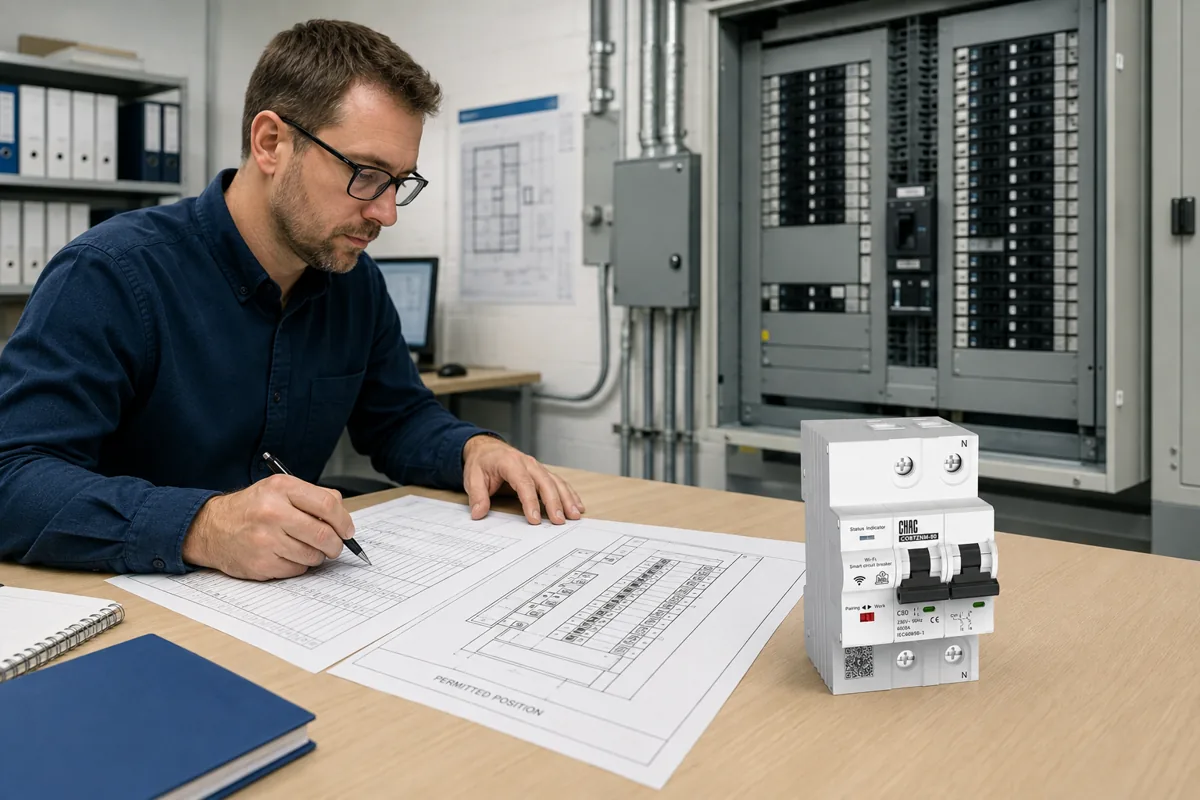
What Is a Tandem Breaker and What Does It Change Inside the Panel?
One physical space can serve two branch circuits
A tandem, duplex, or half-size breaker contains two independent single-pole overcurrent devices in one full-size breaker width. That is the practical answer when a buyer asks what is a tandem breaker: it changes how circuits use an approved bus position, not the enclosure or assembly rating.
That distinction leaves three figures to check separately. “Spaces” are physical positions; “circuits” are the protected branches the panel permits; “capacity” covers main, feeder, bus, and service ratings. A 20-space panel may allow more than 20 circuits, but a 100 A nameplate does not indicate tandem acceptance.
| Panel attribute | What a tandem may change | What remains unchanged |
|---|---|---|
| Physical spaces | Two circuits may share one approved space | Bus positions and enclosure size |
| Permitted circuits | The listed compact-device allowance | The label’s maximum circuit count |
| Electrical capacity | Additional branch allocation | Main, feeder, service, and bus ratings |
| Fault duty | Branch-circuit interruption | Available fault current and required interrupting rating |
| Two-pole loads | Only a specifically listed configuration | Correct pole connection and common trip |
Two handles do not make a 240 V breaker
A typical tandem supplies two independent 120 V circuits from one bus connection; it is not a substitute for a two-pole common-trip breaker on a 240 V load. A quad may combine single- and two-pole functions across two spaces, but its trip arrangement is model-specific. UL 489 evaluates molded-case breakers; citing it alone does not establish panel compatibility.
The Panel Label Determines Whether a Tandem Breaker Is Permitted
The position diagram matters more than an empty opening
The nameplate, diagram, position map, and instructions form the compatibility record. Some panels identify certain compact-breaker spaces; others allow none. A sound tandem breaker compatibility review records the panel catalog, breaker family, position, rating, bus connection, and terminals. Similar dimensions do not demonstrate a listed combination.
Class CTL defines where compact breakers are permitted
Class CTL means Circuit Total Limitation. CTL equipment historically used markings and rejection features to constrain circuit totals. A non-CTL legacy replacement is not permission to defeat those features or exceed a current label. Equipment generations vary, so buyers need the original label and current manufacturer guidance.
NFPA 70 Sections 110.3(B) and 408.54 require attention to equipment instructions and the panelboard’s designed and listed device count. The authority having jurisdiction makes the project-specific acceptance decision.
Electrical and Protection Limits Remain After Space Is Saved
Higher circuit density requires a thermal review
More handles do not mean more usable amperes. The load calculation still covers feeder demand, continuous loads, conductor ampacity, and panel rating. Greater circuit density can concentrate terminations and loads locally; a properly approved tandem is not inherently unsafe, but torque, conductor condition, ventilation, and heavily loaded adjacent devices matter. Product-standard temperature-rise evaluation and manufacturer instructions govern; an infrared survey may reveal a hotspot but cannot prove compatibility.
Neutral arrangements can rule out a compact solution
Map every grounded and ungrounded conductor before moving circuits. A multiwire branch circuit may need simultaneous disconnecting and opposite-leg connections; unrelated tandem poles provide neither automatically. Nonlinear loads can raise neutral RMS current or weaken simple diversity assumptions when harmonic content is material. Because topology and load spectrum control the effect, assess shared-neutral circuit risks from measured or specified characteristics.
Special protection and fault duty still apply
Required AFCI, GFCI, or dual-function protection may be unavailable in a compatible tandem and cannot be waived. NFPA 70 Section 110.9 also calls for adequate interrupting ratings. A tandem does not reduce available fault current; its rating must still meet the documented value at the line terminals.
A Capacity Review Should Compare a Tandem With a Panel Upgrade
The least disruptive option may not carry the lowest risk
A tandem can work when the panel accepts it, the load calculation has margin, required protection is available, and expansion is modest. A panel capacity upgrade is stronger when circuit limits are exhausted, heat or neutral conditions are uncertain, fault-duty data is missing, or future loads need unsupported devices.
| Project condition | Likely direction | Procurement evidence |
|---|---|---|
| Approved slot and load margin | Consider a tandem | Label, position map, datasheet, and load schedule |
| 240 V or shared disconnect | Specified two-pole or approved quad | Wiring and common-trip documentation |
| AFCI, GFCI, or dual function | Verify the exact device | Family listing and neutral instructions |
| No allowance or circuit total reached | Subpanel or panel redesign | Load, feeder, fault-current, and approval records |
Total installed cost includes engineering, shutdowns, relabeling, conductor work, inspection, and the next expansion. A compact retrofit with no maintainable path for another circuit may cost more over its life than a planned subpanel.
Procurement Should Preserve the Retrofit Record
Catalog traceability protects future maintenance
Before release, capture the panel and breaker manufacturer, complete catalog numbers, series, ratings, permitted slot, and instructions. A later “equivalent” may share a frame size but differ in rejection features, terminals, or protection. If the approved family is becoming obsolete or lacks needed variants, redesign may offer better lifecycle support.
After installation, update the panel directory and permitted-slot record; retain approved submittals, label images, and remaining compact positions in the asset file. NFPA 70 Section 408.4(A) supports specific circuit identification. IEC 60898-1 and IEC 60947-2 distinguish breaker scopes, but neither title proves assembly approval; destination rules, manufacturer documents, and the معدات التوزيع الكهربائي system govern.
CHAC Electric supports OEM/ODM low-voltage selection with application documentation. Final acceptance remains tied to the receiving panel, project design, verified ratings, and local requirements.
أسئلة متكررة
How can a technician tell whether a panel accepts tandem breakers?
Read the panel label, position map, catalog number, and manufacturer instructions. Confirm marked compact positions and the approved breaker type; an empty slot or matching width is not evidence.
What does Class CTL mean on a breaker?
Class CTL is a circuit-total-limitation system that constrains compact breakers to designed counts and locations. It does not override the panel label; legacy non-CTL replacements need exact manufacturer and local guidance.
Can a tandem breaker be used for 240 V?
A conventional tandem uses two independent 120 V poles on one bus position, so it does not replace a listed two-pole common-trip device. An approved quad or two-pole product may fit, subject to its diagram and panel compatibility.
How many tandem breakers are allowed in one panel?
The 100 A, 125 A, or 200 A rating does not answer this. Permitted numbers and locations come from the label, design, listing, manufacturer instructions, and local rules; never exceed the marked circuit total.
What is a tandem breaker used for in a 100-amp panel?
It can add a protected 120 V circuit without another physical space only when that exact panel permits it and the load calculation supports it. Neither the panel’s marked rating nor the service rating increases, and required AFCI or GFCI protection still applies.
المراجع
- NFPA 70: National Electrical Code
- UL 489: Molded-Case Circuit Breakers, Molded-Case Switches, and Circuit-Breaker Enclosures
- IEC 60898-1: Circuit-breakers for overcurrent protection for household and similar installations
- IEC 60947-2: Low-voltage switchgear and controlgear—Circuit-breakers
The right compact breaker is the one the panel record, electrical design, and future maintenance plan can all support. For new low-voltage applications—not as a claim of tandem compatibility—review the CQB2-63 miniature circuit breaker documentation with CHAC Electric’s technical team before final selection.