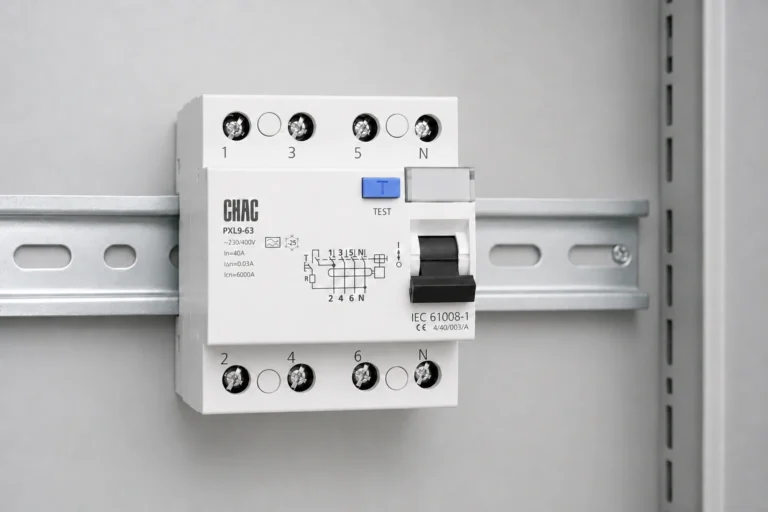
A familiar breaker brand can still be the wrong choice for a panel, export market or recurring OEM order. The useful comparison is between the proposed models and the evidence supplied with them, not a reputation score applied to an entire company. An attractive unit price can lose its advantage if approval, traceability or replacement support is missing. This guide explains which requirements should be pass/fail conditions, which supplier capabilities can be compared, and how to keep an approved sample tied to later production.
The short answer is: The best circuit breaker brands are not established by name recognition alone. Buyers should compare application fit, evidence to standards such as IEC 60898-1 or IEC 60947-2, breaking capacity, batch traceability, production consistency, and technical support. A practical shortlist scores every supplier against the same evidence package, then validates samples and one production batch before a broad rollout.

Online rankings of circuit breaker brands often mix residential panels, industrial devices, regional approvals, and retail availability. They rarely establish technical equivalence. For procurement, the relevant question is whether a supplier fits the circuit, assembly, destination market, and documentation obligations.
What makes a circuit breaker supplier suitable for a specific project?
A brand can be strong in one segment and unsuitable in another. IEC 60898-1 addresses circuit breakers for overcurrent protection in household and similar installations, generally for operation by uninstructed people. IEC 60947-2 covers circuit breakers used in industrial and similar low-voltage applications. These standards have different scopes and test concepts, so a familiar brand name cannot bridge a specification mismatch.
Start with voltage, frequency, poles, current, trip characteristic, breaking capacity, isolation function, environment, and accessories. Within an IEC 60947-2 product comparison, ultimate short-circuit breaking capacity, Icu, and service short-circuit breaking capacity, Ics, describe different performance points. Do not compare either value directly with a rating declared under another product standard or at different voltage and test conditions.
| Comparison area | أدلة مطلوبة | Risk if overlooked |
|---|---|---|
| Application fit | Data sheet, wiring diagram, load and system limits | Incorrect protection or unsuitable installation conditions |
| Standards and approvals | Exact standard edition, certificate scope, reports where appropriate | Rejected submittals, inspection delay, or unsupported claims |
| Breaking performance | Marked ratings and test-standard definitions | Device selected below prospective fault current |
| Production consistency | Control plan, inspection records, calibrated test equipment | Approved sample differs from delivered production |
| Traceability | Batch code, factory identity, material and test records | Slow containment and an unnecessarily broad recall |
| Technical support | Response process, coordination data, change notification | Engineering delays and undocumented substitutions |
Compare price only after establishing technical equivalence. Retesting, rejected panels, emergency freight, troubleshooting, or a poorly contained recall can erase a unit-price saving. Total cost includes evidence and supplier response.
How should buyers verify approvals and production traceability?
A product standard, test report, third-party certificate, certification mark, and regulatory listing are not interchangeable. IEC publications define requirements and test methods; IEC does not approve individual products. A third party may certify or list a defined product scope, but buyers must verify the issuer, factory, product family, covered ratings, current status, and acceptance in the destination market.
Examine routine production controls as well as type-test evidence. Ask how tripping, dielectric strength, mechanical operation, terminal torque, markings, and final inspection are checked. The approved sample should have a controlled identity, and incoming inspection should confirm that each lot matches it in construction, markings, terminals, key dimensions, and declared ratings.
Traceability is an overlooked commercial control. A batch code should lead to the production date, line or factory, inspection status, and relevant material and test records. Define record-retention and retrieval times so a field issue can be contained to one lot rather than forcing a recall across unrelated shipments.
Require notice before changes to critical materials, trip components, terminals, tooling, factory, labels, or certified construction. An “approved equivalent” should not be substituted only because its headline rating and outline dimensions look similar. Define which changes trigger document review, new samples, assembly checks, or renewed testing; otherwise the first-order approval baseline can quietly disappear.
When does a broad product range help the buyer?
A broad catalog helps only when it covers project needs with documented compatibility: auxiliaries, shunt trips, undervoltage releases, alarm contacts, busbars, enclosures, residual-current options, and stable mounting dimensions. A long model list without selection boundaries creates engineering work.
MCBs commonly protect final circuits, while MCCBs extend into higher-current and adjustable applications, but labels are insufficient. Compare trip settings, isolation suitability, temperature and altitude derating, terminals, and coordination. Selectivity and backup protection require manufacturer tables or tested combinations.
| Project need | Product and supplier question | Commercial implication |
|---|---|---|
| Final-circuit protection | Are curve, poles, breaking capacity, busbar, and enclosure fit documented? | Fewer panel changes and installation queries |
| Industrial feeder | Are Icu, Ics, adjustable settings, accessories, and coordination data available? | More defensible protection design and commissioning |
| Harsh environment | What temperature, altitude, humidity, pollution, and vibration limits apply? | Avoids hidden derating or premature service problems |
| Multi-market program | Which exact variants carry the required regional approvals and markings? | Prevents one global SKU from being specified incorrectly |
| Private label | How are artwork, model identity, factory traceability, and approved construction controlled? | Reduces labeling errors and sample-to-order drift |
In replacement work, similar dimensions do not prove panel approval. Manufacturer listings, panel instructions, bus design, and local rules govern. Guides to breaker types and compatibility و breaker letter designations show why identifiers need context.
How do documentation and support affect lifetime cost?
Strong suppliers control data sheets, drawings, wiring diagrams, installation instructions, declarations, and compliance evidence by revision. After sale, they should be able to retrieve the document set supplied with a specific batch and issue controlled corrections or change notices. Record document numbers and dates in the vendor file; translations and market-specific labels also need technical review.
Test support with a realistic query on derating, accessory wiring, or coordination; assess accuracy, evidence, and response time. Define escalation contacts, failure-analysis steps, warranty boundaries, replacement lead times, and responsibility for diagnostic work. Useful after-sales documentation includes case records, returned-product identification, corrective-action reports, and revised technical notices—not only an informal email answer.
Packaging is frequently missed. Specify inner protection, carton strength, pallet pattern, needed humidity controls, and barcode content. For demanding routes, use a transport simulation or trial shipment and inspect packaging and product function.
Compare lead time, surge capacity, order minimums, spare policy, and end-of-life notice. Transparent constraints and early warnings are more credible than unlimited-capacity promises.
How should buyers build a defensible shortlist?
Freeze the application and market requirements, issue one evidence checklist to every candidate, review document scope, and test traceable samples against defined acceptance criteria. For private-label products, lock the relationship among the underlying factory model, buyer model number, artwork, packaging, certificate scope, and change approvals. Audit production controls in proportion to risk, then verify the first lot and periodic later lots against the approved baseline.
Weighted scoring makes tradeoffs visible, but mandatory requirements remain pass/fail gates. A high total can never compensate for inadequate breaking capacity or an approval outside its scope.
CHAC Electric can be included in this evidence-led process. An قاطع دائرة مصغر comparison for final-circuit applications and an thermal-magnetic adjustable MCCB documentation review should each assess the exact model against project ratings, applicable standards, installation conditions, accessory compatibility, and coordination needs.

What does a CE mark or certification logo actually prove?
The European Commission’s CE marking guidance states that the manufacturer declares conformity with the applicable legal requirements. It also says the mark does not mean the EU or another authority has approved a product as safe. Ask for the declaration and its exact product identity; do not score a CE logo as equivalent to an independently verified breaking-capacity result.
For a UL-related claim, the Product iQ database overview explains how file numbers, category codes and other identifiers support record searches. Verify the actual model, category and conditions, not just a certificate image supplied for a different series. UL’s panelboard guidance further distinguishes Listed and Classified scopes. A valid component record does not establish unrestricted replacement compatibility.
Apply those checks before assigning weighted supplier scores. Insufficient fault capacity, an unsuitable market approval or an undocumented panel combination is a rejection condition, not a weakness that low price or fast delivery can offset. Commercial scoring belongs only among candidates that satisfy the mandatory requirements. This is also why the comparison should be dated and tied to document revisions: a later factory, construction or label change may require renewed review even if the brand name remains unchanged.
Circuit Breaker Brand and Supplier Questions
Which circuit breaker brand is best?
There is no universal best brand. Choose an exact model that meets the application, fault level, adopted standards, approval requirements, and support needs with verifiable evidence.
How can buyers verify a circuit breaker certificate?
Check the issuing body, status, factory, model family, ratings, standard edition, and covered variants. Compare searchable database records with product markings and supplier documents.
Should buyers compare Icu or Ics for an MCCB?
Both may matter when comparing MCCBs within IEC 60947-2. Read the declared voltage and test conditions, then assess Icu and Ics against fault current, continuity objectives, and applicable rules; do not treat unlike standards as one rating scale.
Does a higher breaking capacity always mean a better breaker?
No. A higher number does not prove better coordination, endurance, terminals, traceability, or suitability. Compare ratings under the same standard and conditions, then review the full specification.
What should be checked before approving a private-label breaker?
Confirm factory, model identity, markings, artwork control, test evidence, batch coding, change notification, and sample-to-production controls. Never imply approvals beyond supporting documents.
How many samples should a buyer test?
No single quantity fits every risk level. Base sampling on product criticality, order size, supplier history, the test plan, and materially different constructions.
Does CE marking mean a breaker has been approved by the EU?
No. The manufacturer declares conformity with the applicable legislation. The European Commission states that CE marking is not an EU or authority approval of product safety; verify the declaration and exact product scope.
Can a low price compensate for a missing model approval?
No. Mandatory technical and market requirements are pass/fail conditions. Compare price and service only after the offered model and assembly satisfy those requirements.
Official References
- European Commission: CE marking; manufacturer declaration responsibilities and limits of the mark.
- UL Solutions: Product Sourcing and Certifications Database; record-search guidance; no exact CHAC listing is inferred.
- UL Solutions: Panelboard Application Guide; certification categories, accepted components and assembly conditions.
- Schneider Electric: Fundamental characteristics of a circuit-breaker; rating definitions and limits, updated August 5, 2026.
The durable rule is simple: choose the breaker and the supplier as one documented protection system.
To assess a candidate against your ratings, destination market, documentation list, and delivery plan, review the PXB2-63 miniature circuit breaker information above and contact CHAC Electric with the project specification. Suitability and compliance should be confirmed for the exact application; no certification or approval is implied beyond the evidence supplied.