Installing a GFCI outlet does not necessarily remove the need for a circuit breaker. Keeping an ordinary breaker does not necessarily provide the ground-fault protection required at a bathroom, outdoor outlet or other specified location. The confusion comes from using “breaker” as if it described every protection function. In practice, product categories overlap: a GFCI receptacle serves one role, while a GFCI circuit breaker combines functions. This comparison separates the hazards and the devices so a buyer can specify protection accurately, avoid duplicate assumptions and identify the product documents needed for a particular circuit and destination market.
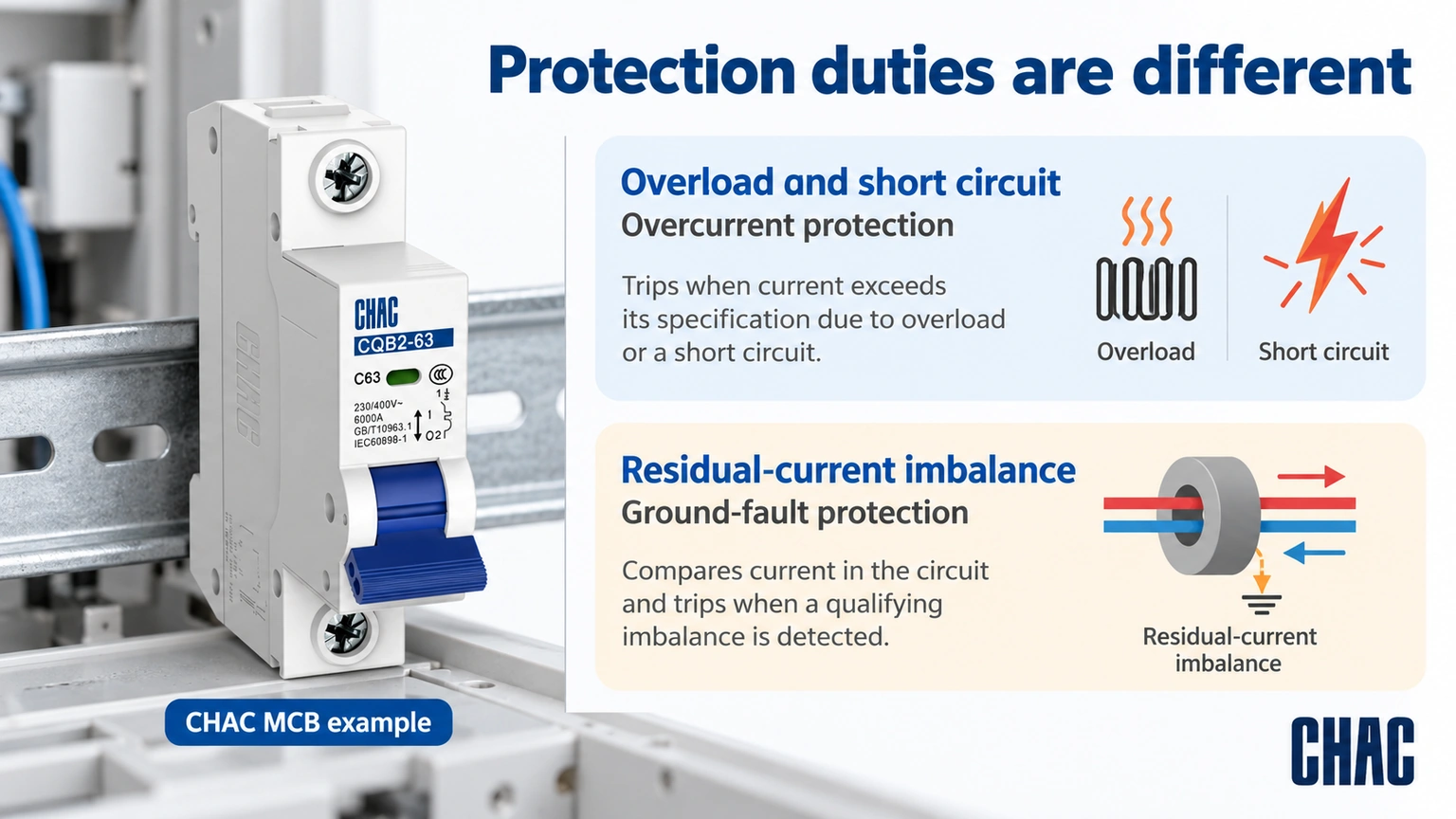
The practical difference between a circuit breaker and ground-fault circuit interrupter is the condition each detects. An ordinary breaker provides overload and short-circuit protection. A GFCI detects qualifying residual-current imbalance for personnel protection. A GFCI receptacle usually depends on upstream overcurrent protection, while a suitable GFCI breaker combines both functions. Neither designation automatically includes arc-fault protection. Determine the required functions from the locally adopted rules and equipment instructions, then select approved devices and verify the protected circuit rather than choosing between “breaker” and “GFCI” as mutually exclusive options.
Which faults does an ordinary circuit breaker detect?
An ordinary thermal-magnetic breaker responds to overload and short-circuit conditions according to its characteristics. Overload response depends on current and time; short-circuit interruption also requires an adequate fault rating. A circuit drawing should state the applicable voltage, poles, current and protective characteristics, not just a physical breaker size.
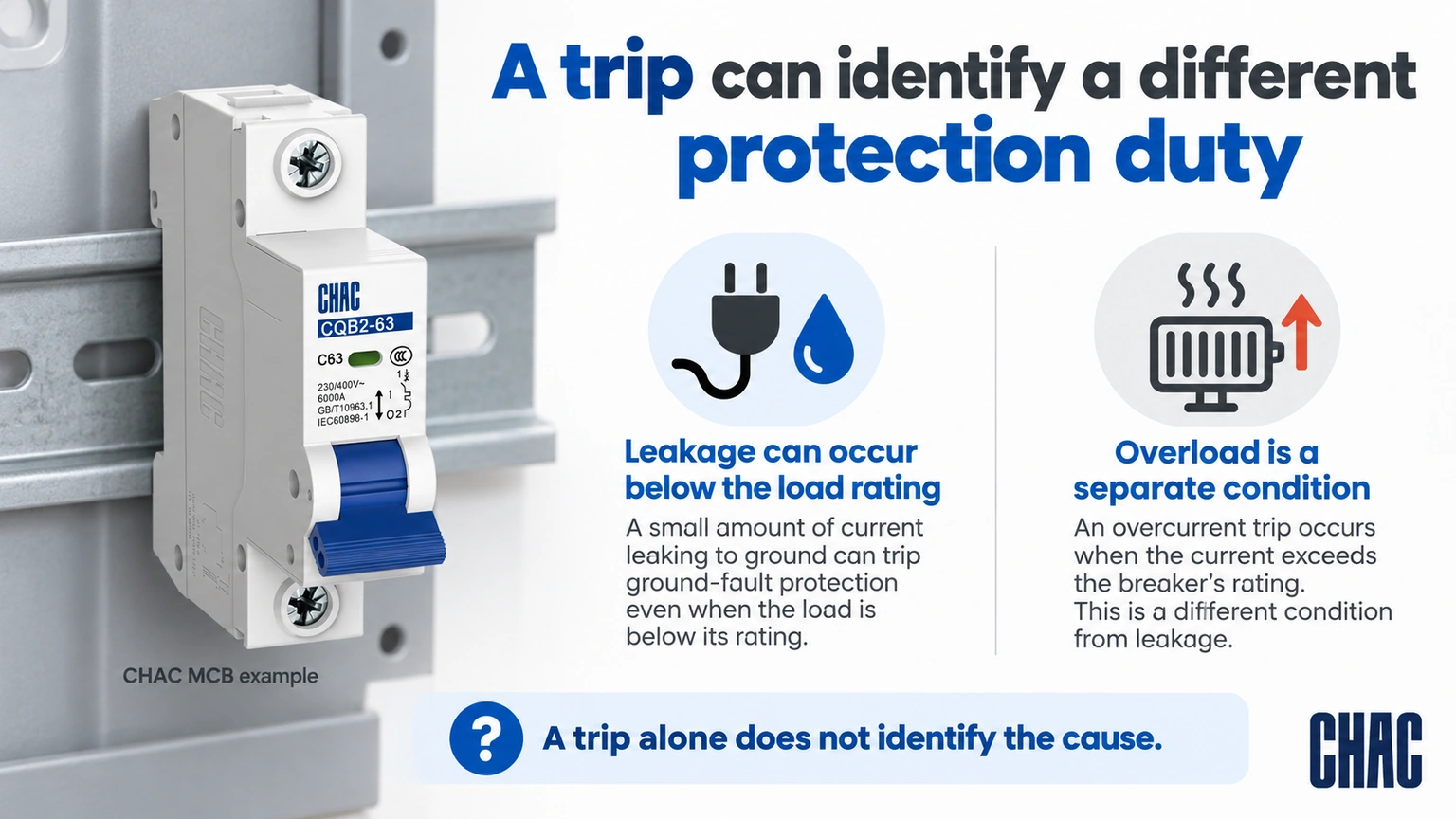
A modest leakage current can be far below the ordinary breaker’s operating current. That is why a standard breaker is not automatically personnel ground-fault protection. Conversely, a GFCI receptacle should not be expected to provide the complete conductor-overload function of the upstream branch-circuit device. The distinction concerns protection duties, not which product appears more sophisticated.
What does GFCI protection add?
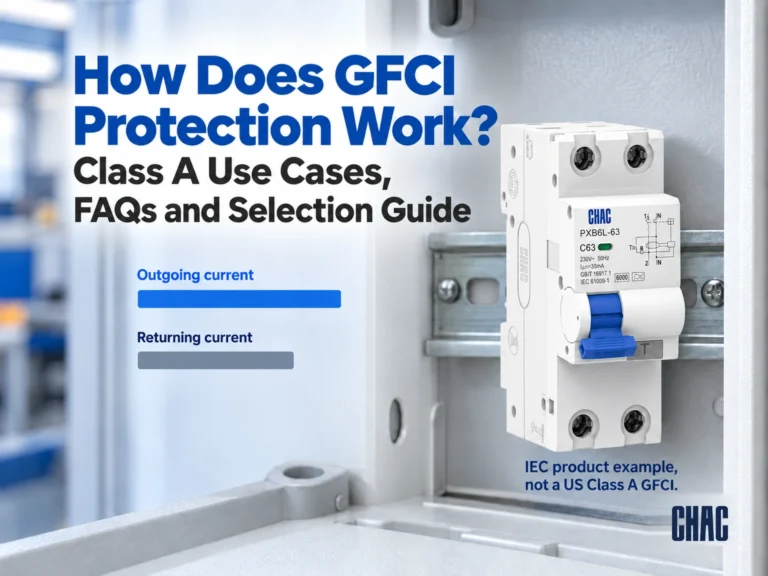
A GFCI compares currents in its monitored circuit and responds to a qualifying imbalance. In the US Class A context, Leviton’s technical guidance identifies the 4–6 mA threshold. This residual-current sensitivity should not be confused with a 15 A or 20 A branch rating.
| Protection function | Ordinary breaker | GFCI receptacle | GFCI breaker |
|---|---|---|---|
| تحميل زائد | Yes, within its specification | Not a replacement for upstream protection | Yes, when specified |
| Short circuit | Yes, within interrupting rating | Requires suitable upstream protection | Yes, within interrupting rating |
| Personnel ground-fault protection | Not implied | Yes, within its approval and installation | Yes, within its approval and installation |
| Arc-fault protection | Not implied | Not implied | Only if the model also provides it |
When does a circuit need both overcurrent and GFCI protection?
Where the installation rules require personnel ground-fault protection, the circuit still needs the appropriate overcurrent protection. The functions can be provided by separate approved devices or a combined device. The permitted arrangement depends on the circuit, equipment, panel and local code. Required protection is not optional because a particular appliance has occasionally tripped it.
An AFCI adds another distinction. It addresses specified arc-fault conditions rather than simply duplicating GFCI leakage detection. A laundry installation may therefore involve more than one required protective function. Check the adopted code edition and amendments before concluding that a GFCI alone satisfies the design.
| Selection question | لماذا هذا مهم | أدلة مطلوبة |
|---|---|---|
| Which protection functions are required? | Overcurrent, ground fault and arc fault differ | Design and adopted installation requirements |
| Where will interruption occur? | Determines circuit coverage and access | Verified circuit arrangement |
| Does the breaker match the panel? | Mechanical fit alone is insufficient | Panel instructions and device approval |
| How will users test and reset it? | Maintenance access affects usability | Exact device instructions |
What does a simple protection schedule reveal?
For each circuit, list the overcurrent device, any GFCI or AFCI function, the outlets or equipment covered and the test/reset location. Keep “provided” separate from “required”: the first describes the installed equipment, while the second must be established from the project rules. A panel schedule that says only “kitchen, 20 A” does not document all of those functions.
As a hypothetical example, an ordinary breaker can supply a GFCI receptacle and outlets connected through its permitted protected output. Losing power at those outlets while the breaker stays closed does not contradict the schedule: the ground-fault device may have interrupted its part of the circuit. The real boundary must still be checked against the actual wiring and instructions. This function-by-function record is more useful for a future replacement than identifying every protective device simply as a breaker.
Why might the GFCI trip when the breaker does not?
That pattern can be consistent with leakage rather than overload. Moisture, damaged insulation, cumulative leakage or wiring outside the intended sensing arrangement may be involved. It does not, by itself, prove the GFCI is faulty. Likewise, an overcurrent trip without GFCI operation does not prove the GFCI is defective; the two mechanisms evaluate different conditions.
Use the model’s troubleshooting guidance, including reset lockout and indicators. Leviton’s device support information identifies LINE/LOAD reversal and loss of supply among issues that can affect resetting. Do not generalize one manufacturer’s indicator colors to another product.
Which evidence should be collected when more than one device can trip?
Before resetting, note which device operated and preserve any model-specific trip indication. On a combined-function breaker, use its documented diagnostics to distinguish the reported function; the handle position alone may not identify it. If there is another protective device downstream, record its state too. Do not assume that the device nearest an appliance must always operate first or that two devices with similar labels provide coordinated operation.
Ask the qualified investigator to compare that record with the protection schedule and equipment operating stage. An overcurrent event calls for a different review from a residual-current event, even when both disconnect the same appliance. Correcting the circuit should follow the identified cause and permitted device combination. Changing the breaker amperage cannot be justified merely because it is the most familiar number on the panel.
How should buyers compare GFCIs with IEC residual-current products?
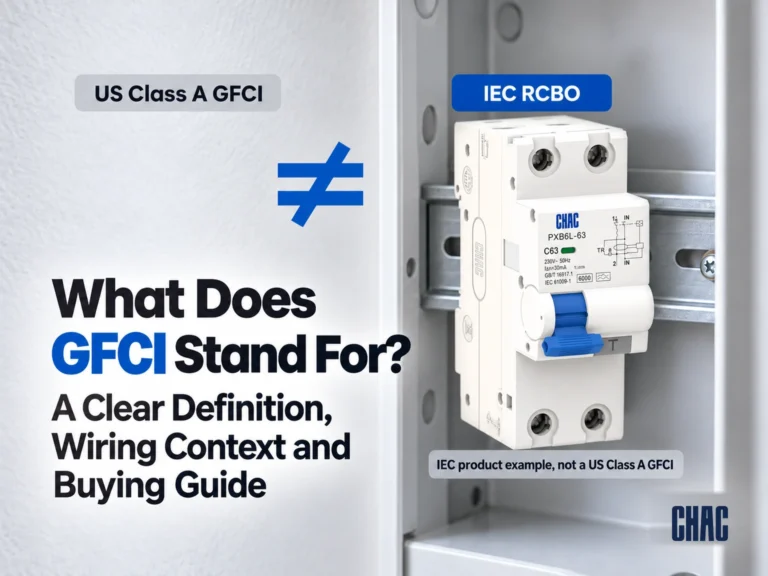
Specifications for ground-fault circuit protection can refer to quite different devices across markets. Write the requested standard and function in the specification. In IEC terminology, an RCCB provides residual-current protection without integral overcurrent protection, while an RCBO combines residual-current and overcurrent functions. These descriptions do not establish equivalence to US GFCI products.
For IEC distribution projects, CHAC’s قاطع دائرة مصغر و residual-current breaker with overcurrent protection illustrate separate product families. The latter is a useful category comparison for GFCI protection discussions, but a US application still requires the actual approval and ratings of the selected US device. Never substitute products solely because both mention leakage.
What questions help distinguish breakers from GFCIs?
What is GFCI and why is it tripping?
A GFCI is a ground-fault circuit interrupter. A trip indicates operation of its protection or monitoring function; investigate leakage, moisture, wiring and the specific device instructions rather than assuming overload.
Does the laundry room need AFCI?
It may, depending on the adopted code, occupancy, circuit and local amendments. Check AFCI and GFCI requirements separately because one function does not automatically satisfy the other.
What should not be plugged into a GFCI?
Do not create a general exemption for appliances that trip. Verify the equipment instructions and required protection, and have the cause of repeated trips investigated.
Where should a ground-fault circuit interrupter be installed?
Use the required circuit coverage, accessible test/reset location and the applicable installation rules. The permitted location depends on the device type and wiring arrangement.
How do a circuit breaker and ground-fault circuit interrupter work?
An ordinary breaker evaluates overcurrent conditions, while a GFCI evaluates qualifying residual-current imbalance. A combined device incorporates both functions within its stated approval.
Where are circuit breaker and ground-fault circuit interrupter protection required?
Overcurrent and personnel ground-fault requirements come from the applicable installation rules and equipment instructions. Confirm the jurisdiction and circuit rather than applying a universal list.
المراجع
- Leviton GFCIs for Personnel Safety, including dated code examples; accessed October 19, 2026
- Leviton GFCI Outlets and Receptacles, self-test and troubleshooting guidance; accessed October 19, 2026
- Leviton commercial GFCI receptacles; accessed October 19, 2026
Conclusion
Start with the required protection functions and only then choose the devices that provide them. An ordinary circuit breaker, a GFCI receptacle and a GFCI breaker are not three interchangeable labels. Each must be evaluated for its actual duties, circuit coverage and approval, with arc-fault requirements considered separately. Investigate unexplained trips before changing protection, and verify panel compatibility and the adopted installation rules before replacing a breaker. The published CHAC MCB and RCBO records can support the IEC side of an international specification review. A clear function-by-function comparison helps purchasing teams avoid treating an apparently similar product as an approved substitute.
For the relevant model drawings and project documentation, contact CHAC with the circuit requirements.