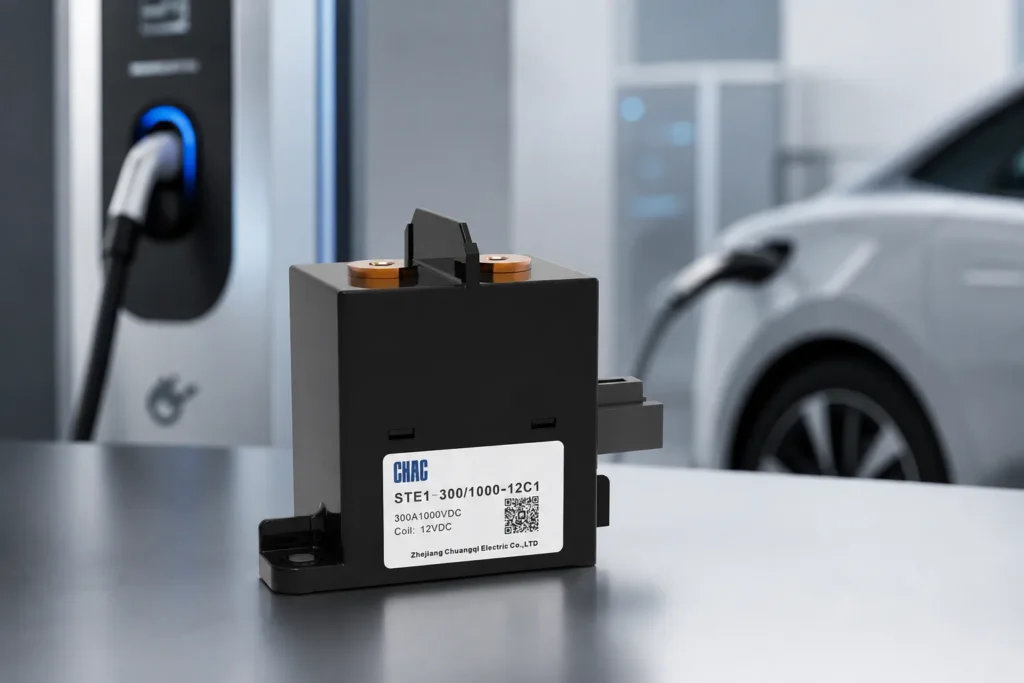
Eine Hochspannungs-Gleichstromleitung Kontaktor Die RFQ für EV-Ladestationen beginnt mit dem Gleichstromsystem und ausgewählten Modellnachweisen, nicht mit einem Familiennamen. Der Panel- oder Ladegeräte-Datensatz muss die Betriebsart, die Behandlung der Lastpolarität, die Spulenversorgung, den Hilfsbedarf, den Montagekontext sowie die vom Lieferanten einzureichenden Dokumente beschreiben.
Inhaltsverzeichnis
Teil 1. Beginnen Sie mit dem Gleichstromsystem und nicht mit einer Kontaktorfamilie.
Die Auswahl eines Hochspannungs-Gleichstromschützes für das Laden von Elektrofahrzeugen beginnt mit der Systembeschreibung: dem Gleichstrombussystem, der Funktion im Stromkreis, der erforderlichen Betriebsart sowie dem Einsatzort des Schützes. Diese Faktoren machen ein Angebot überprüfbar und verhindern, dass eine pauschale Typbezeichnung zu einem ungeprüften Ersatz für das tatsächliche Design wird.
Die Zeichnung sollte zudem die Steuerungsschnittstelle sowie etwaige Überwachungsanforderungen kennzeichnen. Insgesamt bilden diese Angaben die Grundlage für eine überprüfungsbasierte Auswahl des Modells, anstatt von einer bloßen Annahme hinsichtlich der Passgenauigkeit des Ladegeräts auszugehen.
Teil 2. Dauerbetrieb von der Unterbrechungsüberprüfung trennen
Kontinuierliche Betriebsanforderungen und unterbrechungsbezogene Fragestellungen sollten als separate Prüfbereiche behandelt werden. Das System, das gewählte Modell sowie die jeweils geltenden Projektanforderungen bestimmen, welche Nachweise für jeden dieser Bereiche erforderlich sind; eine allgemeine Marketingbeschreibung kann diese Lücke nicht schließen.
Dokumentieren Sie die Schaltkreisfunktion, die geforderten Betriebsbedingungen sowie die Aufzeichnungen über das ausgewählte Gerät, die einer Lieferantenantwort beizufügen sind. Das IEC-Normensystem bietet den Dokumentkontext, während Projekt- und Modellauswahlinformationen maßgeblich bleiben.
Wichtig: Ein angegebener Gleichspannungs- oder Stromwert allein rechtfertigt nicht die Zulassung eines Schützes für ein EV-Ladesystem. Führen Sie bei der Prüfung die Systemaufgabe und die Dokumentation des ausgewählten Modells zusammen.Katalog der IEC-Dokumente für Gleichstromschaltungen — Kontext des ausgewählten Modellschemas)
Teil 3. Bringe Polung, Spule und Signalanforderungen auf einem Prüfblatt unter.
Die RFQ wird stärker, wenn jede Anforderung auf der Steuerungs- und Lastseite eine klare Zuordnung erhält. Vermeiden Sie das Platzieren von Ladepolarität in einer Zeichnungsnotiz, die Spulenspeisung in einer E-Mail und die Anforderungen an das Hilfssignal in einem späteren Änderungsauftrag.
| Bewertungsfeld | Was der Käufer angeben sollte | Was der Lieferant zurückerstatten sollte |
|---|---|---|
| Funktion des Gleichstromsystems und der Schaltung | Zeichnungsreferenz und Gerätegrenze | Vorgeschlagenes Modell, das auf den festgelegten Prüfumfang abgestimmt ist |
| Erforderliche Pflicht | Bedingungen, die eine überprüfung nach ausgewählten Modellen erfordern | Dokumentation, die sich mit den geforderten Bedingungen befasst |
| Lastpolaritätsbehandlung | Was die Zeichnung für den Lastanschluss vorsieht | Polaritätsinformationen für ausgewählte Modelle |
| Spulenversorgung | Verfügbare Steuerstromversorgung und Schnittstellenkontext | Spulenbezogene Informationen für das vorgeschlagene Modell |
| Zusätzliche Anforderung | Benötigtes Status- oder Steuersignal | Veröffentlichte Zusatzkontaktinformationen, soweit zutreffend |
| Montage- und thermischer Kontext | Informationen zu Gehege und Umgebung zur Überprüfung | Stated installation information and limits |
Treat this sheet as an evidence index. It does not create an EV charging architecture or select a model without the exact project conditions.
Teil 4. Lesen Sie die ausgewählte Modelltabelle, ohne sie als Genehmigung zu betrachten.
The public STE3 product route presents model rows with working-voltage, working-current, load-polarity, coil-polarity, and auxiliary-contact fields. These fields are useful for narrowing a supplier conversation, but the chosen row and project conditions must still be checked before a BOM is released.
The practical rule is to compare each proposed row against the RFQ sheet, then request the documents required by the project. Do not derive a charger approval, interruption result, or local acceptance from a single published field.
For adjacent DC-selection context, see the battery and DC distribution MCB guide und das DC MCB compatibility evidence guide.
Teil 5. Senden Sie eine EV-Kontaktor-Anfrage, die vergleichbare Nachweise beibehält.
Send the current system drawing, circuit role, requested duty description, polarity treatment, coil supply, auxiliary requirement, mounting context, required documents, and any branding request. Ask each supplier response to identify the selected model and the evidence used for the comparison.
Der high-voltage DC contactor category is the upward product-family route. The broader Industrielle Steuerung elektrischer Geräte can help when the equipment review includes related control components.
Teil 6. Verwenden Sie die CHAC-Hochspannungs-Gleichstromschützleitung für die Modellüberprüfung.
After the RFQ evidence is complete, use the STE3 high-voltage DC contactor product route to begin a selected-model discussion. Its published table is a useful starting point for comparing stated model fields to the project record, not a blanket EV charger recommendation.
Produktempfehlung
STE1 Series High-voltage DC contactor (Square Ceramic Sealing)STE1 Series High-voltage DC contactor (Square Ceramic Sealing) – CHAC Electric
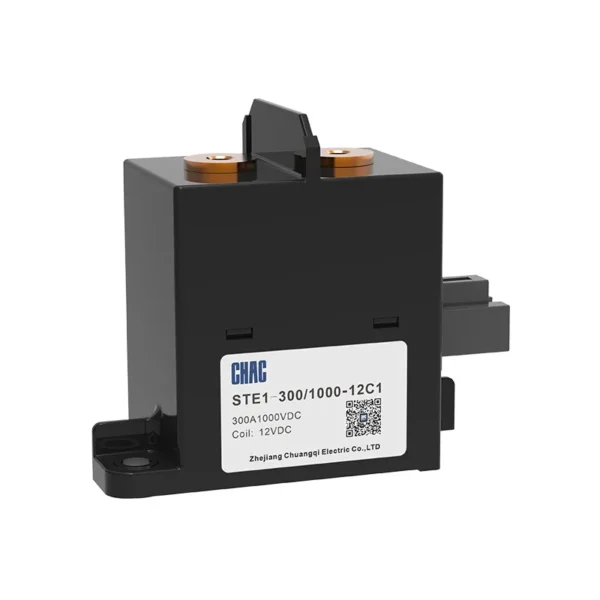
Use the STE3 route when the buyer can supply the DC system and evidence sheet. Do not choose another model merely by family name: working voltage, current, load polarity, auxiliary requirement, and project duty need confirmation for the selected row. OEM and documentation needs can be raised through the industrial-control customization page.
Teil 7. Definieren Sie die Passungsgrenze, bevor Sie eine Stückliste freigeben.
This guide supports early EV-charging equipment sourcing and document comparison. It does not provide charger architecture, live-work direction, protection coordination, local approval, or a final release decision for a contactor model.
Fit Boundary: retain final choice with the approved system drawing, selected-model documents, applicable project requirements, and qualified engineering review. Share the RFQ evidence with CHAC Electric when requesting a documented product route.
Which DC contactor inputs affect an EV charging design?
A Hochspannungs-DC-Kontaktor request needs more than nominal voltage and current. The RFQ should identify continuous and transient duty, load polarity, switching frequency, pre-charge sequence, auxiliary feedback, environmental conditions and the fault-management strategy. The vehicle, battery and charger documentation must agree before a model is approved.
| RFQ-Eingabe | Warum es wichtig ist | Nachweis zu beantragen |
|---|---|---|
| DC voltage and current | Defines the electrical duty and thermal review | System limits and model ratings |
| Pre-charge sequence | Controls inrush before the main path closes | Timing, voltage criterion and failure response |
| Feedback and interlock | Prevents the controller from assuming a contact is closed | Auxiliary-contact logic and wiring diagram |
Der EV charging contactor decision is part of the complete control sequence, not a timer copied from another system. The useful check is DC contactor pre-charge: define the voltage or diagnostic condition that permits main-contact closure. CHAC’s STE2 high-voltage DC contactor page can support a model discussion; exact switching duty remains product-specific.
Can a high-voltage DC contactor be selected from continuous current alone?
No. Interrupting and making duty, inrush, polarity, pre-charge, ambient conditions and fault response also need review.
Does a pre-charge timer prove that the DC link is ready?
No. A timer is only one control input. The system should define the voltage or diagnostic condition that permits main-contact closure and the action taken on timeout.
FAQs
What does a high-voltage DC contactor do in an EV charging system?
It is reviewed as part of a defined DC circuit role. The project drawing and selected-model documents establish the actual function and suitability.
Which voltage and current fields must be reviewed?
State the DC system requirements and requested duty, then compare them with the exact selected-model information rather than a product-family summary.
Why does load polarity need to be checked?
Load-polarity treatment is a model and system review input. Put the drawing requirement in the RFQ so the supplier can respond against the correct context.
What coil supply information should be sent to a supplier?
Provide the available control supply and interface context shown on the current design. Ask for selected-model coil information in the supplier response.
When is an auxiliary contact required?
List it whenever the charger or panel design needs a defined status or control signal. The selected model must document the requested arrangement.
What documents should accompany an EV contactor RFQ?
Include the system drawing, circuit role, duty description, polarity requirement, coil supply, auxiliary need, installation context, and the evidence expected for the proposed model.