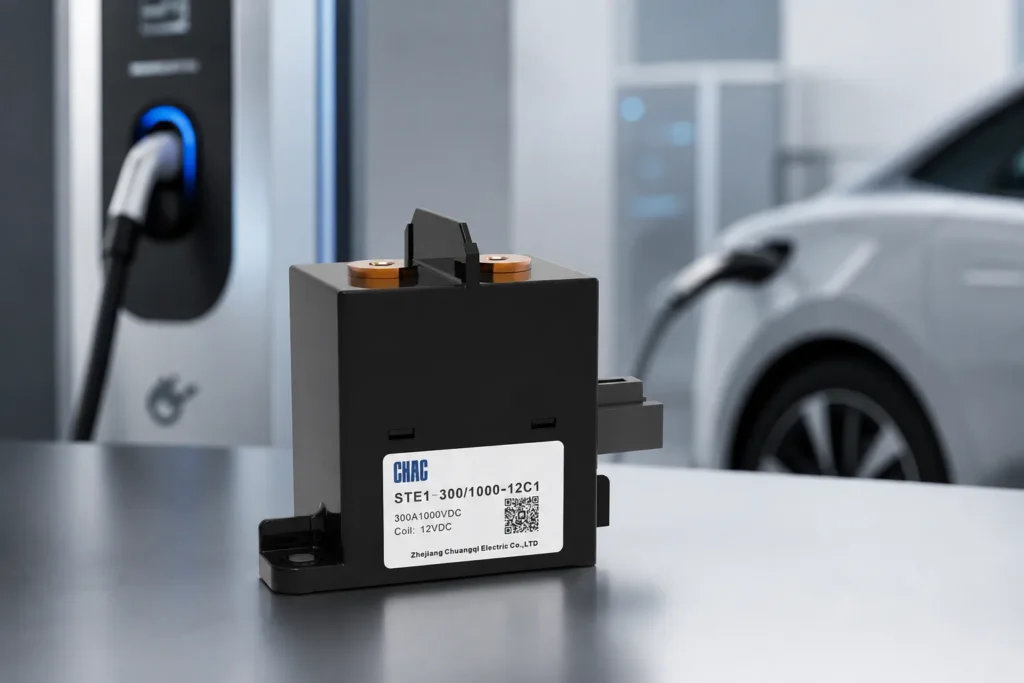
Una corriente continua de alto voltaje contactor La solicitud de cotización (RFQ) para la carga de vehículos eléctricos debe comenzar con el sistema de corriente continua y con pruebas de modelos seleccionados, no con un nombre de familia. El registro del panel o del cargador debe especificar la función, el tratamiento de la polaridad de la carga, la alimentación de la bobina, los requisitos auxiliares, el contexto de montaje y los documentos que el proveedor debe devolver.
Índice
Parte 1. Comience desde el sistema de CC en lugar de una familia de contactores
La selección de contactores de corriente continua de alta tensión para la carga de vehículos eléctricos comienza con el análisis del sistema: el contexto del bus de CC, la función del circuito, la tarea requerida y el punto en el que se considera la instalación del contactor. Estos datos hacen que la cotización sea verificable y evitan que una designación genérica se convierta en un sustituto no probado del diseño real.
El plano también debe identificar la interfaz de control y cualquier requisito de monitoreo. En conjunto, estos insumos constituyen la base para una revisión del modelo seleccionado, en lugar de partir de una suposición sobre la compatibilidad del cargador.
Parte 2. Separe el servicio continuo de la revisión de interrupciones
Los requisitos de funcionamiento continuo y las cuestiones relacionadas con las interrupciones deben mantenerse como campos de revisión claramente diferenciados. El sistema, el modelo seleccionado y los requisitos aplicables del proyecto determinan qué pruebas son necesarias para cada uno; una descripción general de marketing no puede cubrir esa brecha.
Documente la función del circuito, las condiciones de funcionamiento solicitadas y los registros del dispositivo seleccionado que deben acompañar la respuesta del proveedor. El sistema de normas IEC proporciona el contexto documental, mientras que la información del proyecto y del modelo seleccionado sigue siendo determinante.
Importante: Un campo de voltaje o corriente de CC indicado por sí solo no autoriza el uso de un contactor en un sistema de carga para vehículos eléctricos. Mantenga la documentación relativa a la tarea del sistema y al modelo seleccionado junto con los documentos de revisión.Catálogo de documentos de conmutación de CC de la IEC — contexto de evidencia del modelo seleccionado)
Parte 3. Coloca los requisitos de polaridad, bobina y señal en una sola hoja de revisión.
La solicitud de cotización se vuelve más sólida cuando cada requisito del lado del control y del lado de la carga tiene un lugar específico. Evite colocar polaridad de carga En una nota del dibujo, el suministro de la bobina en un correo electrónico y las necesidades de señalización auxiliar en una orden de cambio posterior.
| Campo de revisión | Lo que debe indicar el comprador | Lo que debe devolver el proveedor |
|---|---|---|
| DC system and circuit role | Drawing reference and equipment boundary | Proposed model tied to the stated review scope |
| Required duty | Conditions that require selected-model review | Documentation addressing the requested conditions |
| Load-polarity treatment | What the drawing requires for the load connection | Selected-model polarity information |
| Coil supply | Available control supply and interface context | Coil-related information for the proposed model |
| Auxiliary requirement | Needed status or control signal | Published auxiliary-contact information where applicable |
| Mounting and thermal context | Enclosure and environment information to review | Stated installation information and limits |
Treat this sheet as an evidence index. It does not create an EV charging architecture or select a model without the exact project conditions.
Parte 4. Lea la tabla del modelo seleccionado sin considerarla como una aprobación.
The public STE3 product route presents model rows with working-voltage, working-current, load-polarity, coil-polarity, and auxiliary-contact fields. These fields are useful for narrowing a supplier conversation, but the chosen row and project conditions must still be checked before a BOM is released.
The practical rule is to compare each proposed row against the RFQ sheet, then request the documents required by the project. Do not derive a charger approval, interruption result, or local acceptance from a single published field.
For adjacent DC-selection context, see the battery and DC distribution MCB guide y el DC MCB compatibility evidence guide.
Parte 5. Envíe una RFQ de contactor EV que conserve pruebas comparables
Send the current system drawing, circuit role, requested duty description, polarity treatment, coil supply, auxiliary requirement, mounting context, required documents, and any branding request. Ask each supplier response to identify the selected model and the evidence used for the comparison.
El high-voltage DC contactor category is the upward product-family route. The broader gama de aparatos eléctricos de control industrial can help when the equipment review includes related control components.
Parte 6. Utilice la ruta del contactor de CC de alto voltaje CHAC para la revisión del modelo.
After the RFQ evidence is complete, use the STE3 high-voltage DC contactor product route to begin a selected-model discussion. Its published table is a useful starting point for comparing stated model fields to the project record, not a blanket EV charger recommendation.
Recomendación de producto
STE1 Series High-voltage DC contactor (Square Ceramic Sealing)STE1 Series High-voltage DC contactor (Square Ceramic Sealing) – CHAC Electric
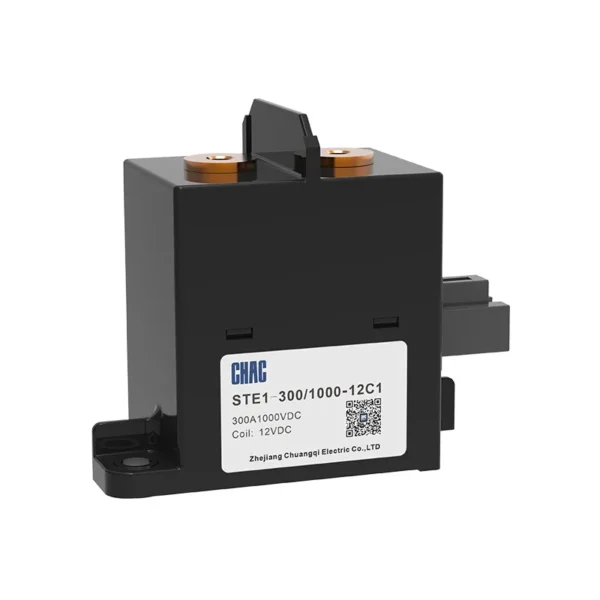
Use the STE3 route when the buyer can supply the DC system and evidence sheet. Do not choose another model merely by family name: working voltage, current, load polarity, auxiliary requirement, and project duty need confirmation for the selected row. OEM and documentation needs can be raised through the industrial-control customization page.
Parte 7. Defina el límite de ajuste antes de emitir una lista de materiales.
This guide supports early EV-charging equipment sourcing and document comparison. It does not provide charger architecture, live-work direction, protection coordination, local approval, or a final release decision for a contactor model.
Fit Boundary: retain final choice with the approved system drawing, selected-model documents, applicable project requirements, and qualified engineering review. Share the RFQ evidence with CHAC Eléctrico when requesting a documented product route.
Which DC contactor inputs affect an EV charging design?
A Contactor de alta tensión de CC request needs more than nominal voltage and current. The RFQ should identify continuous and transient duty, load polarity, switching frequency, pre-charge sequence, auxiliary feedback, environmental conditions and the fault-management strategy. The vehicle, battery and charger documentation must agree before a model is approved.
| Entrada de RFQ | Por qué importa | Pruebas para solicitar |
|---|---|---|
| DC voltage and current | Defines the electrical duty and thermal review | System limits and model ratings |
| Pre-charge sequence | Controls inrush before the main path closes | Timing, voltage criterion and failure response |
| Feedback and interlock | Prevents the controller from assuming a contact is closed | Auxiliary-contact logic and wiring diagram |
El EV charging contactor decision is part of the complete control sequence, not a timer copied from another system. The useful check is DC contactor pre-charge: define the voltage or diagnostic condition that permits main-contact closure. CHAC’s STE2 high-voltage DC contactor page can support a model discussion; exact switching duty remains product-specific.
Can a high-voltage DC contactor be selected from continuous current alone?
No. Interrupting and making duty, inrush, polarity, pre-charge, ambient conditions and fault response also need review.
Does a pre-charge timer prove that the DC link is ready?
No. A timer is only one control input. The system should define the voltage or diagnostic condition that permits main-contact closure and the action taken on timeout.
Preguntas frecuentes
What does a high-voltage DC contactor do in an EV charging system?
It is reviewed as part of a defined DC circuit role. The project drawing and selected-model documents establish the actual function and suitability.
Which voltage and current fields must be reviewed?
State the DC system requirements and requested duty, then compare them with the exact selected-model information rather than a product-family summary.
Why does load polarity need to be checked?
Load-polarity treatment is a model and system review input. Put the drawing requirement in the RFQ so the supplier can respond against the correct context.
What coil supply information should be sent to a supplier?
Provide the available control supply and interface context shown on the current design. Ask for selected-model coil information in the supplier response.
When is an auxiliary contact required?
List it whenever the charger or panel design needs a defined status or control signal. The selected model must document the requested arrangement.
What documents should accompany an EV contactor RFQ?
Include the system drawing, circuit role, duty description, polarity requirement, coil supply, auxiliary need, installation context, and the evidence expected for the proposed model.