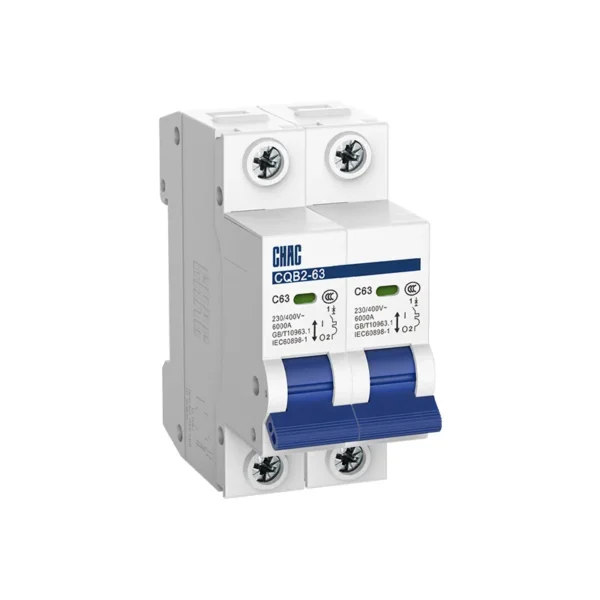
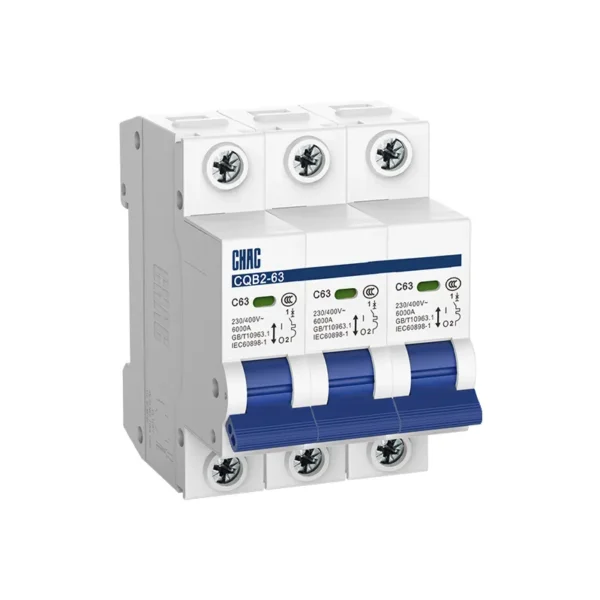
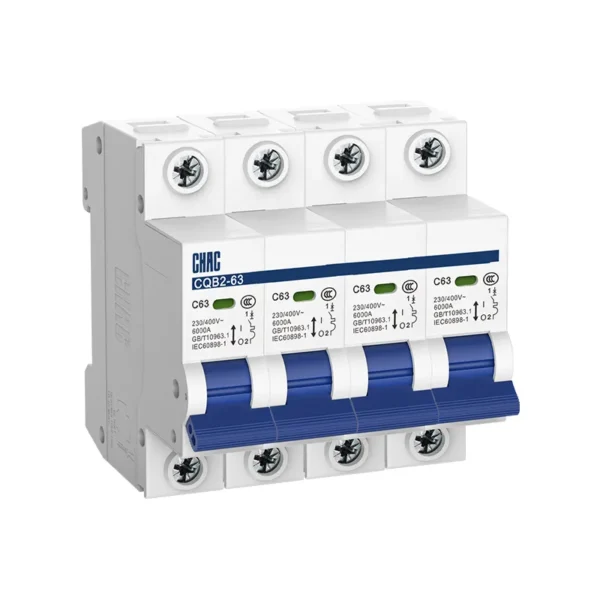
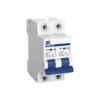
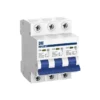
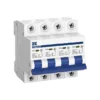
CQB2-63 Miniatur-Schutzschalter
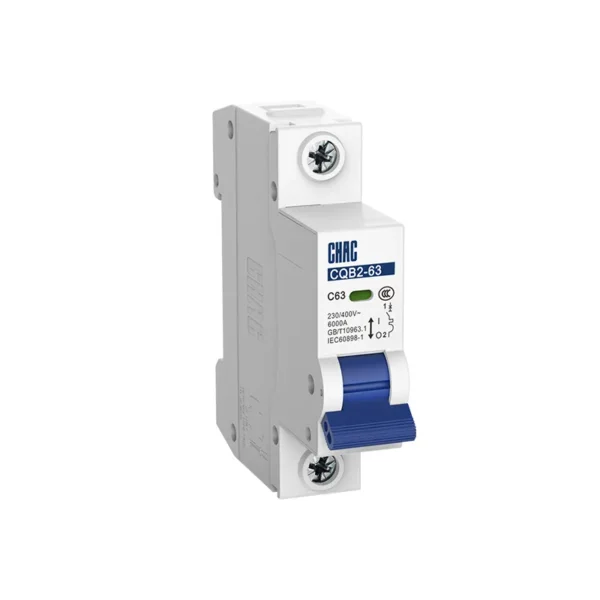
Der CQB2-63 Miniatur-Schutzschalter ist für den Überlast- und Kurzschlussschutz in 230/400V AC Endverteilungssystemen ausgelegt. Es umfasst 6A bis 63A, die Auslösekurven B, C und D sowie die Konfigurationen 1P, 1P+N, 2P, 3P, 3P+N und 4P. Seine Nennkurzschlussausschaltleistung beträgt 6kA, wobei Icn gleich Ics ist. Die Serie entspricht der Norm IEC 60898-1, und auf der Modellseite ist die CCC-Zertifizierung aufgeführt. Sie bietet Verteilern, Schaltschrankbauern und OEM-Käufern eine klar definierte Plattform für Wohn-, Gewerbe- und leichte Industrieverteilungsprojekte.
Produktübersicht
Der CQB2-63 ist ein 6kA-Miniaturleistungsschalter für Endverteilungsstromkreise, die einen Überlast- und Kurzschlussschutz benötigen. Er ist für 230/400V Wechselstrom bei 50 oder 60Hz ausgelegt und in Nennströmen von 6A bis 63A erhältlich. Käufer können die Auslösecharakteristiken B, C oder D festlegen und die Konfigurationen 1P, 1P+N, 2P, 3P, 3P+N oder 4P wählen, um den Anforderungen des Stromkreises und den örtlichen Installationsvorschriften gerecht zu werden.
Für Käufer, die einen 6kA-MCB vergleichen, bietet der CQB2-63-Leistungsschalter innerhalb seiner veröffentlichten MCB-Auslösekurvenoptionen die Auswahl zwischen B, C und D.
Für Distributoren, Schaltanlagenbauer und elektrische OEMs kombiniert die Serie eine konsistente 6kA-Ausschaltleistung mit einem breiten Konfigurationsangebot. Die Auswahl sollte weiterhin auf der Leiterstrombelastbarkeit, dem Lastverhalten, dem voraussichtlichen Kurzschlussstrom, den Umgebungsbedingungen und dem Zielmarkt basieren. Der CQB2-63 ist gemäß IEC 60898-1 spezifiziert, und die CCC-Zertifizierung ist für dieses Modell auf der aktuellen Produktseite bestätigt.
Hauptmerkmale
Typische Anwendungen
The CQB2-63 is intended for final circuits in residential, commercial and light-industrial distribution systems. Typical uses include lighting, socket-outlet, small HVAC, pump and other branch circuits when the selected rating and trip curve match the conductor, load and fault-current study. An MCB primarily protects the circuit conductors, so selection must account for cable size, installation method, ambient temperature, grouping and upstream coordination rather than the appliance name alone.
Antragsformular und Auswahlhinweis
| Auswahlobjekt | Wie man es bewertet | CQB2-63 options |
|---|---|---|
| Bemessener Strom | Confirm design current, conductor ampacity, installation method, ambient temperature and grouping. Do not increase the breaker rating to solve repeated tripping without diagnosing the cause. | 6A, 10A, 16A, 20A, 25A, 32A, 40A, 50A, 63A |
| Auslösekurve | Vergleichen Sie den normalen Betriebsstrom, den Anlauf- oder Einschaltstrom sowie den Fehlerstromwert, der für einen rechtzeitigen magnetischen Auslösevorgang erforderlich ist. | B, C or D |
| Anzahl der Pole | Match the supply system and determine which live conductors—and, where required, the neutral—must be disconnected together. | 1P, 1P+N, 2P, 3P, 3P+N, 4P |
| Ausschaltvermögen | Verify that the prospective short-circuit current at the installation point does not exceed the device rating. Use another protective solution if the study requires a higher value. | 6kA, Icn = Ics |
| Standard and market documents | Check the product standard, destination-market rules and the exact documents required by the customer or approval body. | IEC 60898-1; CCC confirmed on this page |
Compare breaking capacity, tripping curves, pole configurations and protection functions before selecting the right miniature circuit breaker for your application.
6kA vs 10kA MCB
Select breaking capacity according to the prospective short-circuit current at the installation point, not only the rated current of the circuit.
B Curve vs C Curve vs D Curve
Select the tripping curve according to load inrush characteristics, not by current rating alone.
1P+N vs 2P MCB
Both options can be used in single-phase circuits, but their switching and protection arrangements are different.
MCB vs RCBO
An MCB protects against overload and short circuit, while an RCBO also provides residual-current protection.
Need Help Selecting an MCB Configuration?
Share your pole configuration, rated current, tripping curve and quantity. Our team will help confirm a suitable CQB2-63 option for your application.
Anleitung zum Bestellen
Professional MCB product pages commonly identify operating and storage conditions, mounting format, conductor capacity, tightening torque, dimensions and weight. These values vary by product family, rated current and pole configuration, so figures from another brand or series should not be applied to the CQB2-63. Confirm the following items on the approved CQB2-63 datasheet, installation instructions or project quotation before final selection:
For a project-specific confirmation, send CHAC the rated current, trip curve, pole configuration, destination market, expected quantity and panel or conductor constraints.
How to choose between B, C and D curves
The curve identifies the instantaneous magnetic-trip range, not a general quality grade. The CQB2-63 tripping table gives 3–5 × In for B curve, 5–10 × In for C curve and 10–20 × In for D curve. B curve is commonly considered for low-inrush circuits, C curve for moderate inrush, and D curve for higher-inrush equipment. The final choice must still provide adequate fault protection; selecting a slower curve only to avoid nuisance trips can delay operation when fault current is limited.
How to choose the pole configuration
Select the pole arrangement from the actual supply and isolation requirements rather than from panel space alone. A 1P device switches one conductor, while multi-pole versions provide mechanically linked operation for the specified conductors. Neutral switching and isolation rules vary by system and market, so 1P+N, 3P+N and 4P options should be confirmed against the project drawings and local requirements.
When 6kA is not enough
A 6kA marking means the breaker is rated to interrupt a prospective short-circuit current of up to 6,000A under the applicable test conditions; it is not the normal load-current rating. If the calculated or measured prospective fault current at the installation point exceeds 6kA, use equipment with a suitable rating or a verified coordinated solution rather than assuming every MCB is interchangeable.
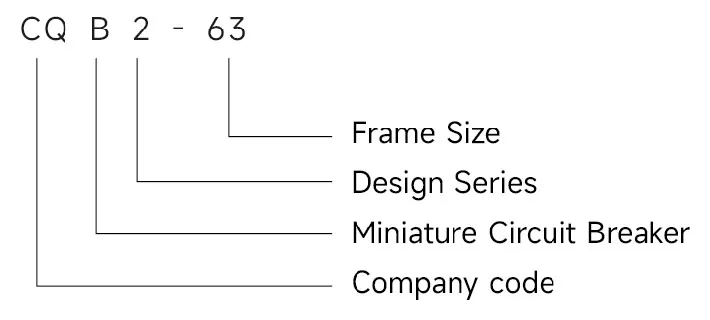
Typbezeichnung
Kurvenverlauf

Abmessungen (Einheit: mm)

Technische Spezifikationen
| Parameter | |
| Rated insulation voltage | 500 V |
| Rated impulse withstand voltage (Uimp) | 4000 V |
| Bemessener Strom | 6A, 10A, 16A, 20A, 25A, 32A, 40A, 50A, 63A |
| Nennfrequenz | 50 Hz / 60 Hz |
| Anzahl der Pole | 1P, 1P+N, 2P, 3P, 3P+N, 4P |
| Rated breaking capacity (Icn = Ics) | 6000 A |
| Mechanical life | ≥ 10,000 operations |
| Electrical life | ≥ 6,000 operations |
| Auslöseeigenschaften | B, C, D |
| Terminal center distance | 45 mm |
| Schutzgrad | IP20 |
| Standards | IEC 60898-1, GB/T 10963.1 |
| Zertifizierung | CCC |
Table 1 Tripping characteristics (Reference temperature 30°C)
| Artikel | Tripping Curve | Strommesswert in A | Erste Statusmeldung | Zeitrahmen für Auslösen oder Nichtauslösen | Erwarteter Ergebnis | Bemerkungen |
| a | B, C und D | 1.13ln | Kalt | t≤1h | Nicht-Verletzung | Die Stromstärke steigt innerhalb von 5 Sekunden problemlos auf den vorgegebenen Wert an. |
| b | B, C und D | 1.45ln | Folgende Prüfung erfolgt nach Artikel a | t<1h | Tripping | |
| c | B, C und D | 2.55ln | Kalt | 1s<t<60s(ln≤32A) 1s<t<120s(ln>32A) |
Tripping | |
| d | B | 3In | Kalt | t ≤ 0,1 s | Nicht-Verletzung | Schalten Sie die Stromversorgung ein, indem Sie den Hilfsschalter schließen. |
| C | 5In | |||||
| D | 10ln | |||||
| e | B | 5In | Kalt | t<0.1s | Tripping | Schalten Sie die Stromversorgung ein, indem Sie den Hilfsschalter schließen. |
| C | 10ln | |||||
| D | 20ln |
Note: The term “cold” means that the test is carried out at a reference calibration temperature without load before the test.
Leitungseigenschaften und Querschnitt
| Leiterquerschnitt (mm²) | Nennstrom In(A) |
| 1 | In ≤6 |
| 1.5 | 6 In≤13 |
| 2.5 | 13 In≤20 |
| 4 | 20 In≤25 |
| 6 | 25 In≤32 |
| 10 | 32 In≤50 |
| 16 | 50 In≤63 |
Warum CHAC wählen?
Mit mehr als 30 Jahren Erfahrung in der Fertigung, 1100 Mitarbeitern und 100 Millionen Polen
Mit einer jährlichen Kapazität von 90% automatisierten Produktionslinien bietet CHAC eine stabile Produktionskapazität und strenge Qualitätskontrollen.
Qualitätskontrolle für globale OEM-/ODM-Kunden. Unser internes Fertigungssystem ermöglicht eine langfristige Zusammenarbeit.
Kooperation für Elektrohersteller, Importeure und Händler.

30+
JAHRE ERFAHRUNG
Specialisiert auf die Herstellung von Niederspannungselektronik

1100+
ARBEITER
Das professionelle Team gewährleistet eine stabile Qualität und Lieferfähigkeit.

100 Millionen+
JAHRESTERNE VON POLES
Großserienfertigung zur Deckung der weltweiten Nachfrage

90%
AUTOMATISCHE PRODUZIERUNG
Erweiterte Automatisierung für hohe Effizienz und Konsistenz

Automatisierte Montagelinie

Testlabor

Injektion und Stempeln

Qualitätskontrolle



Ein strenges Qualitätskontrollsystem gewährleistet, dass jedes Produkt den globalen Standards entspricht.
Was können wir anpassen?
CQB2-63 OEM/ODM options are reviewed per project rather than assumed to be available for every configuration. The published 6–63A ratings, B/C/D curves and listed pole arrangements are the starting platform. Marking, packaging, labels, manuals, appearance requests, engineering work and certification support depend on technical feasibility, order quantity, tooling requirements and the destination market. Changes to internal construction, breaking capacity, terminals, dimensions or certified ratings require separate engineering and compliance confirmation.

Logo & Branding
Logo and marking requests are reviewed against the available print area, required regulatory markings and approved artwork.


Verpackung
Anpassung
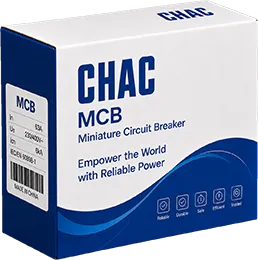
Color boxes, cartons, labels and manuals can be reviewed by language, destination market and order quantity.

Elektrisch
Anpassung
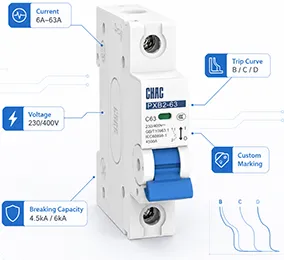
Available rated-current, pole and B/C/D curve combinations are reviewed within the validated CQB2-63 platform.

Produkt
Aussehen
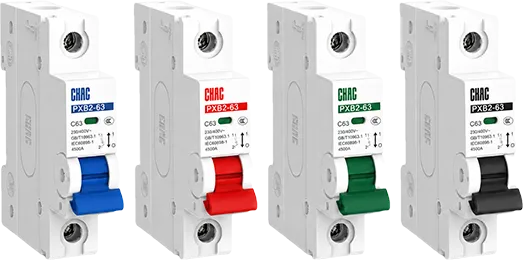
Housing or handle color requests require technical, material, tooling and compliance review before sampling.

Zertifizierung
Support
Destination-market documents and certification requirements are reviewed for the exact model and configuration before sample approval.


Ingenieurwesen
Entwicklung
Drawing, prototype and validation support is scoped per project; internal construction or rating changes are not assumed.

Herunterladen
CQB2-Serie Miniaturstromschutzschalter
Komplettes Produktüberblick für Niederspannungselektronikkomponenten und Referenz zur Produktauswahl.
Brauchen Sie technische Dokumente?
Kontaktieren Sie uns für Datenblätter, Zertifikate, Zeichnungen, Auswahlberatung oder Unterstützung bei OEM-/ODM-Projekten.
CQB2-63 Miniature Circuit Breaker FAQ
How to choose the correct MCB?
Start with the conductor ampacity and circuit design current, then check the supply voltage, pole configuration, load inrush, ambient conditions and prospective short-circuit current. For the CQB2-63, select within 6–63A, match the B/C/D curve to the load and fault conditions, and verify that the installation point does not exceed the 6kA breaking-capacity rating.
What are the different types of poles in an MCB?
MCBs may switch one or several conductors together. The CQB2-63 is offered in 1P, 1P+N, 2P, 3P, 3P+N and 4P configurations; the correct option depends on the single- or three-phase system and whether the neutral must be switched or isolated under the applicable rules.
What does kA mean on circuit breakers?
kA indicates short-circuit breaking capacity, not continuous load current. The CQB2-63 has a 6kA rating, meaning it is designed to interrupt up to 6,000A of prospective short-circuit current under the stated IEC 60898-1 test conditions; the installation must be checked to confirm that this rating is sufficient.
What is the difference between a 1-pole MCB and a 2-pole MCB?
A 1-pole MCB operates one conductor, while a 2-pole MCB provides linked operation across two conductors. The choice depends on the supply arrangement and disconnection rules; two unrelated single-pole breakers should not be assumed to provide the same common operation as a purpose-designed 2P device.
What is the C curve and D curve in an MCB?
For the CQB2-63, the published instantaneous magnetic-trip ranges are 5–10 × In for C curve and 10–20 × In for D curve. D curve tolerates more starting current, but it should only be used when the load profile and available fault current allow the protective device to operate within the required disconnection time.
When should a B-curve MCB be used?
B curve is generally considered for circuits with relatively low starting or inrush current. The CQB2-63 data gives a B-curve magnetic-trip range of 3–5 × In; engineers should still confirm conductor protection, normal transients and fault-loop conditions rather than choosing the curve from the load label alone.
Build the Right CQB2-63 Configuration for Your Market
Send us your required current rating, B/C/D curve, pole configuration, destination market and estimated quantity. CHAC will review the specification and provide the relevant technical documents and commercial proposal.