When a project manager in Rotterdam followed a wiring tutorial and accepted a low-cost quotation for a new control panel, the commissioning checklist looked complete. Within two hours, nuisance trips stopped a conveyor, a sensor loop showed unstable readings, and the panel failed its insulation test. The devices were not “bad”; the selection mixed signal, switching, and protection functions under the wrong circuit assumptions. That is why the practical question is not only what an electronic device is, but how electron devices and circuits should be diagnosed as one coordinated system.
Summary: Start troubleshooting by separating power, control, and signal paths; verify voltage, current, polarity, grounding, and load type; then test the protective device against the applicable IEC requirement. A five-minute measurement sequence can prevent hours of rewiring, while correctly coordinated MCB, RCCB/RCBO, SPD, and control components reduce downtime and compliance risk.
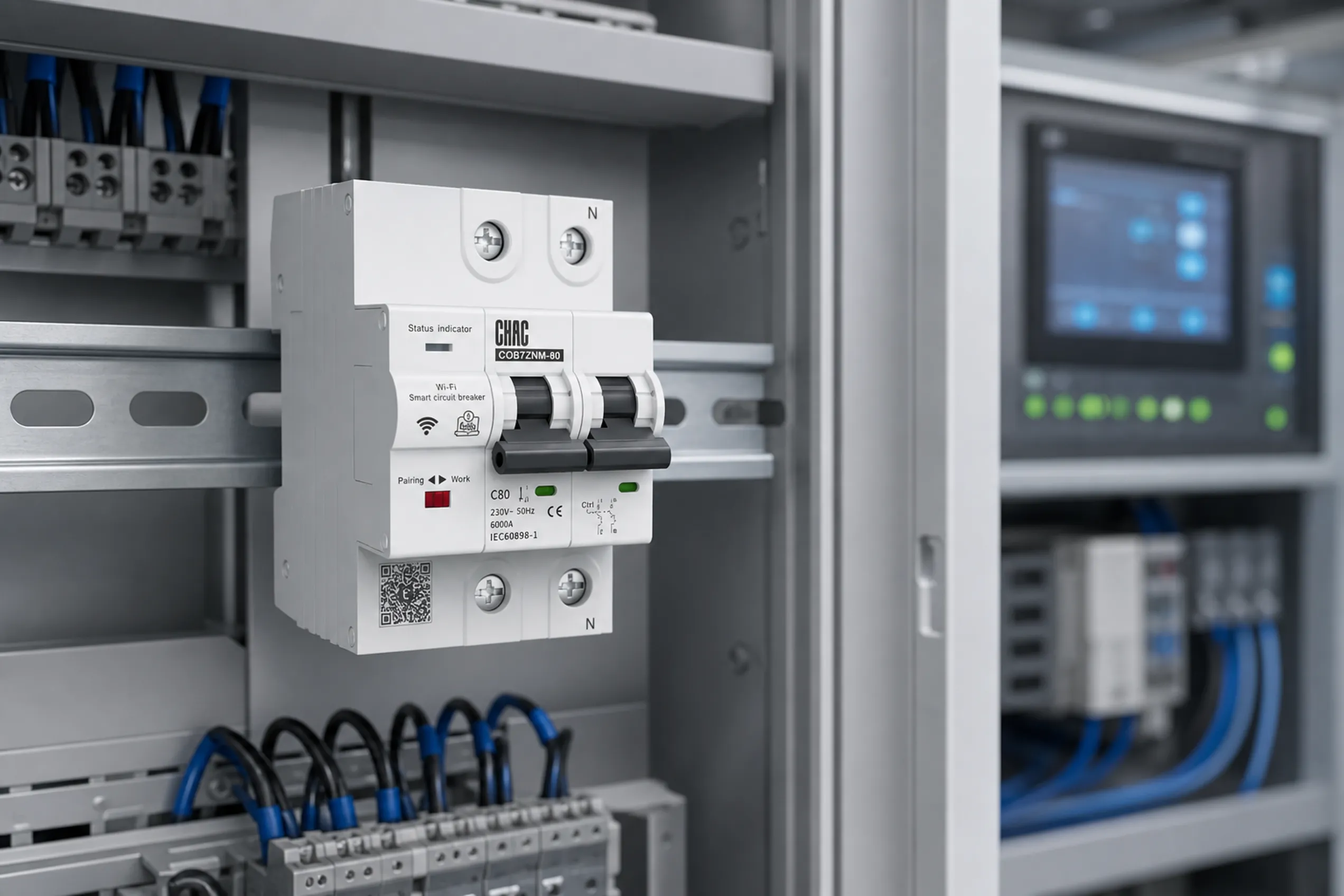
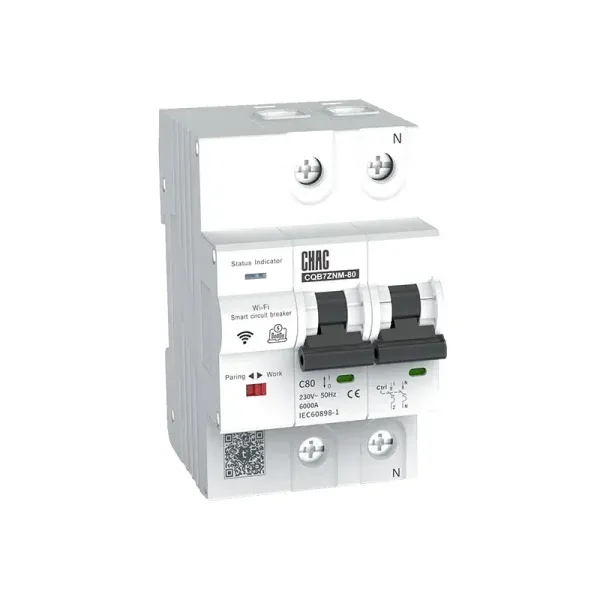
Application view: a smart circuit breaker integrated into a DIN rail control cabinet.
What Is an Electronic Device, and What Is an Electronic Circuit?
An electronic device is a component that controls, converts, senses, or protects electrical energy; an electronic circuit is the connected path that makes those functions work together. In a panel, the useful boundary is functional rather than academic, and a clear view of electronic circuitry helps separate power from signal paths:
Power path: supply, isolation, overcurrent protection, and the final load.
Control path: contactors, relays, motor protection, timers, and PLC I/O.
Signal path: sensors, indicators, communication interfaces, and low-level feedback.
This distinction explains many faults that appear to be mysterious. A 24 VDC sensor can be healthy while a shared 0 V reference is noisy; a contactor can pull in while an upstream MCB is undersized; and an SPD can protect the panel while a poor earthing path still allows damaging residual voltage.
How Many Types of Electronic Devices Are in a Typical Control Panel?
For field troubleshooting, four groups cover most industrial and commercial assemblies. The categories overlap, but each points to a different measurement method.
Passive devices: resistors, capacitors, inductors, terminals, and filters. Check value, polarity where applicable, heating, and mechanical connections.
Active devices: diodes, transistors, ICs, sensors, and controllers. Check bias voltage, reference voltage, switching state, and input/output limits.
Switching and control devices: MCBs, contactors, relays, and motor-protection devices. Check trip curve, coil voltage, contact rating, and coordination.
Protection devices: RCCBs/RCBOs and SPDs. Check residual-current sensitivity, short-circuit rating, leakage path, clamping class, and the installation standard.
In practice, electronics and devices fail as a chain: an overvoltage event may damage a controller, but the visible symptom can be a relay that no longer energizes. Record the first abnormal measurement, not just the last component that stopped working. The same discipline applies whenever electronic devices share a control reference.
What Are the Three Fastest Checks for Electronic Circuitry?
1. Confirm the reference points
Measure line-to-neutral, line-to-earth, and control-voltage-to-0 V; the three readings should match the design intent. For a 230 VAC circuit, IEC 60364 practice requires protective measures to be verified at the installation level, not inferred from a nameplate.
2. Separate a supply fault from a load fault
Open the load branch and re-test. If the protective device holds with the load disconnected, inspect inrush, insulation, motor starting current, or a reversed connection. If it still trips, the fault is upstream or in the protective-device choice.
3. Check the device against its ratings
Compare rated current, breaking capacity, trip curve, frequency, temperature derating, and terminal torque. A 6 kA device is not interchangeable with a 10 kA device simply because both are marked “C16.”
Electronic Devices vs. Electronic Circuits: Which Value Should Be Compared?
Procurement teams often compare a single device price; engineering teams should compare the installed result. The table below keeps the decision focused on performance and total cost of ownership.
Dimensión de decisión
Single-device view
Whole-circuit view
Recommended check
Protección
Rated current and poles
Coordination with cable and load
IEC 60898-1 / IEC 61009-1
Reliability
Bench test result
Heat, vibration, inrush, and duty cycle
Record operating temperature and switching cycles
Compatibilidad
Terminal fit
System voltage, neutral arrangement, accessories
Confirm wiring diagram and interface class
TCO
Purchase price
Downtime, replacement, labor, and spares
Use a five-year cost estimate
The honest answer is that the lower purchase price wins only when the device remains stable under the real duty cycle. For high-utilization panels, preventing one unplanned stop can outweigh a modest component premium; the total result depends on how electronics and devices perform together.
Where Do Electronic Devices Appear in Electrical Protection?
Solicitud
Typical devices
Riesgo primario
Useful design action
Residential and light commercial
MCB, RCCB, RCBO, indicator
Shock, overload, nuisance tripping
Match sensitivity and circuit grouping
Automation panel
MCB, contactor, thermal relay, PLC I/O
Inrush, heat, control-voltage loss
Separate power and signal references
Outdoor or renewable system
DC breaker, isolator, SPD
Transient overvoltage and polarity error
Verify DC rating and earthing path
Motor-driven equipment
Contactor, overload relay, motor protector
Locked rotor and phase imbalance
Set protection from motor nameplate data
Which Standards Apply to Electronic Devices and Electronic Circuitry?
Compliance is a design input, not a final sticker. The following references are commonly relevant to low-voltage assemblies:
IEC 60364-4-41 — protection against electric shock in low-voltage installations.
IEC 60898-1 — circuit-breakers for overcurrent protection in household and similar installations.
IEC 61009-1 — residual current operated circuit-breakers with overcurrent protection.
IEC 61643-11 — surge protective devices connected to low-voltage power systems.
Ignoring the applicable standard can lead to failed type tests, rejected site inspections, warranty disputes, and expensive rework. CE or CB evidence is valuable only when the selected product, circuit arrangement, and installation method remain within the certified scope.
How Should a Buyer Select Electronic Devices?
Write the electrical baseline first: system voltage, frequency, prospective short-circuit current, load type, ambient temperature, and enclosure class.
Specify the failure action: trip, alarm, controlled shutdown, or continued operation with redundancy.
Reserve at least 20% panel space and spare terminals for expansion; crowded wiring hides heat and makes inspection harder.
Ask for test reports, wiring diagrams, and traceable batch information—not only a product photograph.
For repeated projects, standardize the interface and accessories so replacement stock remains interchangeable.
At this stage, CHAC provides aparatos eléctricos de terminal with CE and CB certification options, supported by in-house R&D, tooling, testing, automated assembly, and more than 30 years of low-voltage manufacturing experience. Buyers can also review the equipos de distribución eléctrica range and aparatos eléctricos de control industrial when the project needs coordinated protection and control. For a connected project, the selection should keep electron devices and circuits aligned with the same ratings and documentation.
Electronic circuit troubleshooting works best as a controlled comparison: establish the reference point, confirm the supply under the correct load condition, inspect the signal path, and compare the device with its documented ratings. Disconnect power before any inspection that requires opening equipment, and follow the responsible person’s safety procedure.
Control-panel evidence For a control-panel review, separate the electronic device from the protective and switching equipment around it. CHAC’s terminal protection, distribution equipment, y industrial-control products help frame that system boundary without implying that a breaker diagnosis identifies a failed electronic component.
Device-versus-circuit diagnosis should end with a documented observation: what was measured, under which condition, against which reference, and what remains unverified. That record is more useful for repair and procurement than replacing parts based on a symptom alone.
They are the passive, active, switching, sensing, control, and protection components that create a defined electrical function. The correct list depends on the circuit purpose and voltage level; in a real panel, electron devices and circuits are diagnosed together.
What are the four types of electronic devices?
A practical field grouping is passive devices, active devices, switching/control devices, and protection devices. This is more useful for troubleshooting than memorizing a single academic taxonomy, and it gives procurement teams a common language for electronics and devices.
What are the seven basic electrical devices?
Common basics include a source, conductor, switch, resistor, capacitor, inductor, and load; a real control panel adds protection and measurement devices.
What are the three types of electronic circuits?
Most introductory explanations use analog, digital, and mixed-signal circuits. Industrial panels often contain all three, plus a separate power-protection layer.
How can a technician tell whether a device or circuit is faulty?
Isolate the load, verify reference voltages, test continuity and insulation safely, then compare measured values with the device rating and the approved wiring diagram. Stop and involve the manufacturer when a repeated trip, heat damage, or uncertain compliance boundary remains.
Referencias y Decisión Final
Utilice estas fuentes al revisar un diseño, plan de prueba o especificación de adquisición:
The difference is not just in the device on the rail—it is in the measurements, standards, and decisions that let the whole circuit keep working. CHAC builds coordinated low-voltage protection and control solutions for that moment; explore the CHAC product center or contact the engineering team for a project-specific selection review.