Une commande à distance de déclenchement n’est utile que si le disjoncteur peut la recevoir et l’exécuter en cas de besoin. Dans le cas d’un disjoncteur à déclencheur shunt, l’alimentation de commande, la compatibilité des accessoires et la procédure de réarmement font donc partie intégrante du dispositif de protection, et non des détails secondaires ajoutés après le choix du disjoncteur.
Un disjoncteur à déclencheur shunt est équipé d’un déclencheur compatible qui ouvre le disjoncteur lorsqu’un signal électrique externe l’active. Les fonctions de protection contre les surcharges et les courts-circuits demeurent indépendantes. Un déclencheur shunt classique nécessite une alimentation de commande spécifique pour déclencher ; la perte de cette alimentation ne génère pas, en règle générale, un ordre de déclenchement. Un déclencheur à sous-tension repose sur un principe de fonctionnement différent.
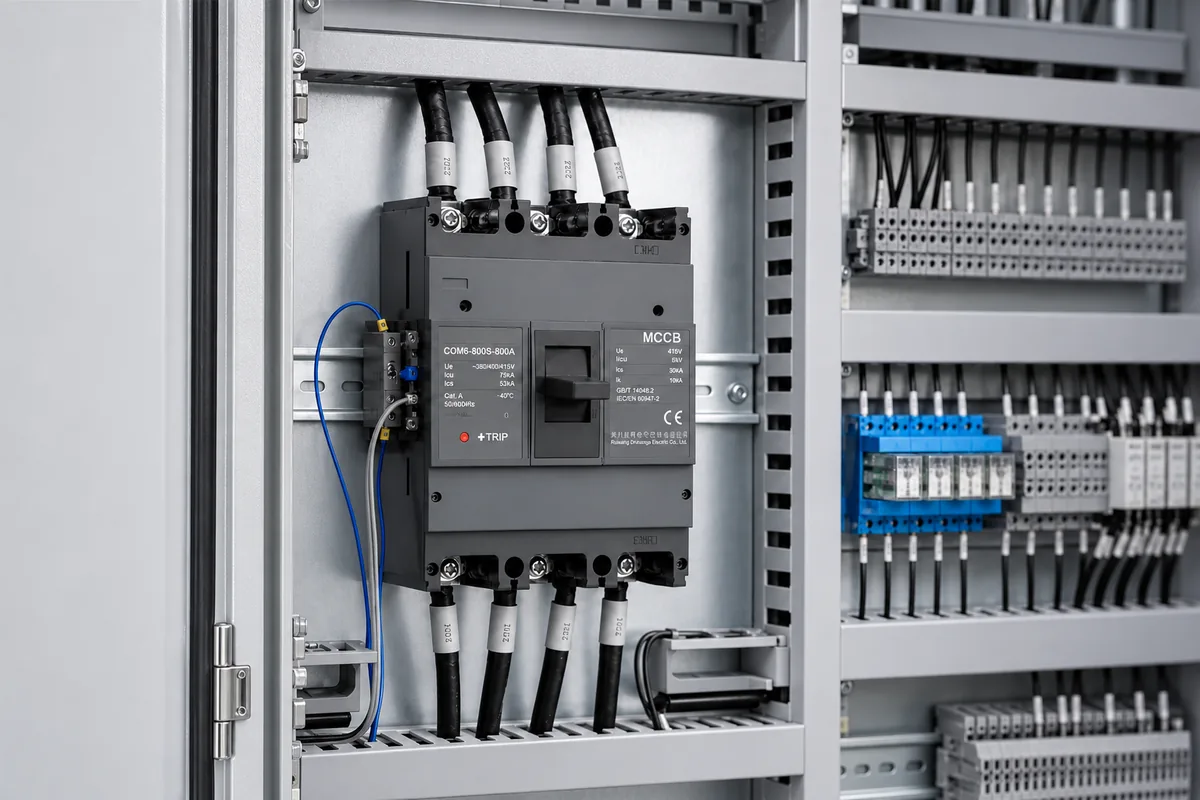
Comment un déclencheur de shunt ouvre-t-il un disjoncteur ?
Un système de commande externe applique la tension spécifiée à la Déverrouillage du shunt. Le déclencheur actionne le mécanisme de déclenchement du disjoncteur, ouvrant ses contacts principaux. Le signal d’activation peut provenir d’un dispositif de commande d’arrêt homologué, d’un relais de protection ou d’une interface avec le système du bâtiment. L’accessoire ne permet pas, à lui seul, de déterminer la cause du signal de déclenchement.
Ceci diffère du fonctionnement normal d’un disjoncteur, dans lequel le déclencheur réagit aux conditions de courant. Le Guide du déclenchement des disjoncteurs explique les principales causes de déclenchement dues aux surintensités et autres. Un disjoncteur équipé d’un déclencheur shunt peut se déclencher même en l’absence de surcharge sur le circuit d’alimentation.
En quoi le déclencheur de shunt diffère-t-il d’un déclencheur à sous-tension ?
| Question | Déclencheur de shunt conventionnel | Décharge de la sous-tension |
|---|---|---|
| Qu’est-ce qui déclenche le fonctionnement ? | Application d’un signal de déclenchement approprié | Une chute ou une perte de la tension d’alimentation de commande surveillée dans les conditions spécifiées. |
| Que se passe-t-il en l’absence d’alimentation de commande ? | La déclenchement ne peut pas être considéré comme entraînant un déclenchement électrique. | L’accessoire est conçu pour réagir en cas de sous-tension ; son comportement précis est décrit dans la notice d’utilisation. |
| La fermeture à distance est-elle incluse ? | Non ; il nécessite un mode de fonctionnement spécifié séparément, le cas échéant. | Non ; la fonction de déverrouillage et la fonction de fermeture sont distinctes. |
| Qu’est-ce qui doit être documenté ? | Source de commande, commande, puissance nominale de la bobine, service et séquence de réarmement | Conditions d’approvisionnement, tout retard approuvé ainsi que le comportement de fermeture/interverrouillage. |
Do not describe a conventional shunt-trip scheme as fail-safe merely because it is connected to an emergency button. A broken control wire, failed supply or unsuitable interface can prevent the release from operating. If the design must detect those failures, the system needs an appropriate supervised or otherwise validated arrangement.
Why does the source of control power matter?
The trip circuit needs enough voltage at the accessory terminals during the event, not simply the right nominal voltage on the control drawing. Supply interruptions, conductor voltage drop and the interface contact’s switching capability may matter. The designer should establish what remains available during the fault or shutdown condition the system is expected to handle.
Power taken from the circuit being opened can disappear after the breaker trips. That may be intentional, but it affects indication, testing and reset behavior. An independent source can create a different maintenance issue because the trip circuit may remain energized after the main breaker is open. Both arrangements require a clear source diagram and isolation instructions.
The command duration is another easily missed boundary. Some releases have intermittent coil duty; others include a cutoff arrangement or permit a maintained signal. Do not assume that a trip coil can remain energized indefinitely. Use the exact accessory instructions and test the specified command duration.
Can a shunt trip serve as an emergency-stop system?
A shunt release can be one component in an engineered shutdown function. It is not, on its own, a complete emergency-stop or fire-safety system. The required behavior depends on the machine or installation, applicable standards, risk assessment and local approval.
In particular, determine whether the function must remove power immediately, stop equipment in a controlled sequence, maintain another supply or prevent automatic restart. An auxiliary contact that reports handle position may not prove that every required power path has been removed. The relevant system design determines the feedback and test requirements.
A specification should describe the initiating condition and required response without asserting that all kitchens, elevators or commercial buildings universally require the same shunt-trip arrangement. Installation requirements and exceptions must be checked for the actual jurisdiction and equipment.
How is accessory compatibility verified?
Le UL Solutions guide’s accessory section addresses accessory markings, ratings and identification of the breakers with which separately shipped accessories may be used. Mechanical fit alone is insufficient. Record the exact breaker family, frame, release reference and AC/DC control rating.
For modular equipment, CHAC’s Déverrouillage du shunt PXB6-MX is a model-specific product reference. Check its stated compatible breaker arrangement and available control variants. The existence of that accessory does not establish compatibility with unrelated MCBs or MCCBs.
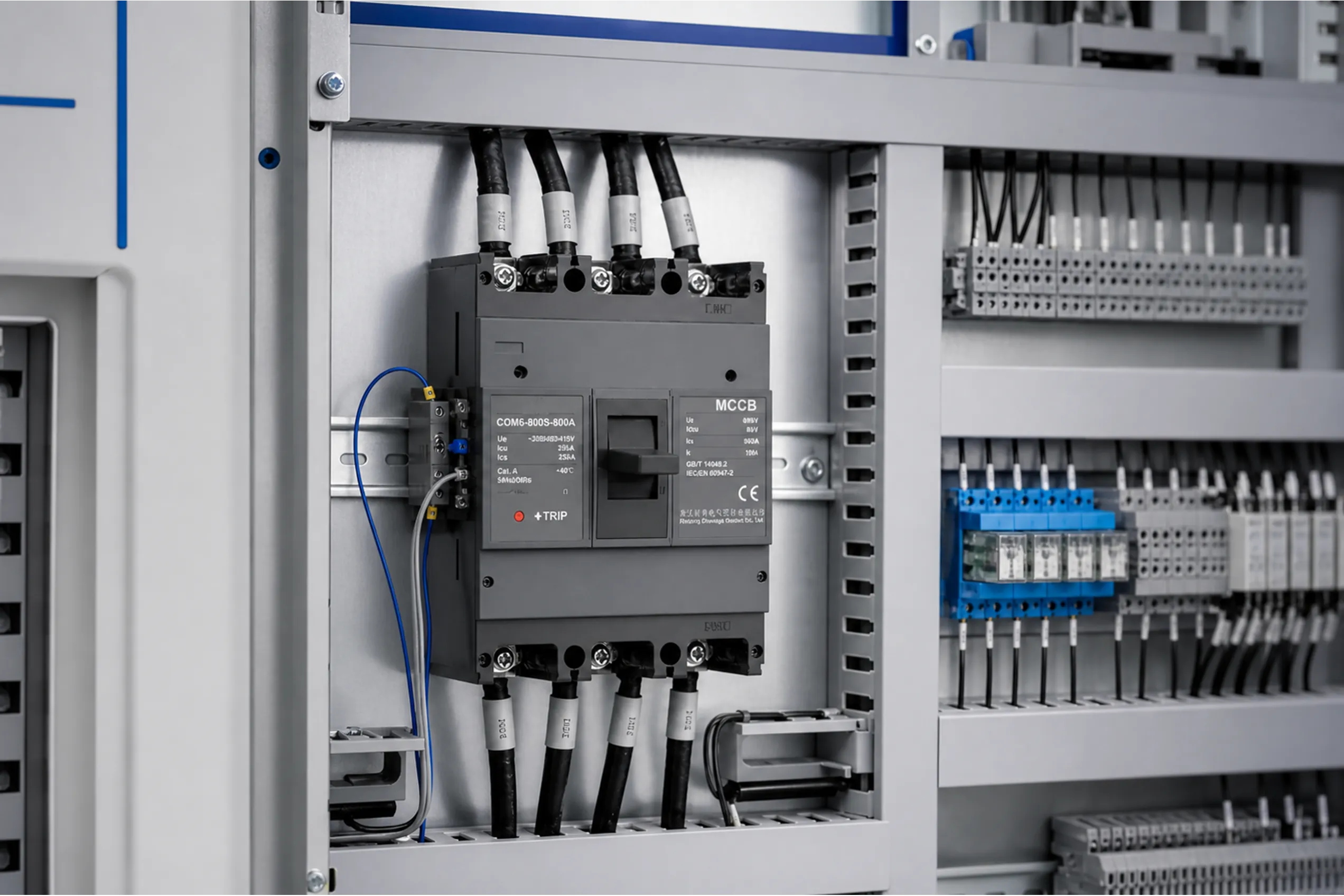
What should a commissioning test demonstrate?
- The approved initiating signal reaches the correct interface under controlled test conditions.
- The release receives its specified control supply and the breaker opens.
- The required indication, interlocks and downstream shutdown behavior occur.
- Loss of control power produces the behavior documented in the design.
- Clearing the command does not cause an unintended restart, and the authorized reset sequence works.
Keep the test results with the circuit identification, accessory reference and control drawing. Where feedback or alarm functions are also needed, the auxiliary-contact, alarm-contact and shunt-trip guide helps distinguish commands from status signals.
What else do buyers ask about shunt-trip breakers?
Does a shunt-trip breaker need power?
A conventional electrical shunt release needs its specified control power to operate. This is separate from the breaker’s ordinary overcurrent mechanism.
Will it trip if the control supply fails?
Do not assume so. A conventional shunt release is energized to trip. If supply loss must initiate opening, specify and validate the appropriate release or supervised control arrangement.
Can a regular breaker be converted to shunt trip?
Only if the manufacturer provides an approved compatible accessory and installation method for that exact breaker. It is not a universal field modification.
Can a shunt-trip breaker be reset remotely?
The shunt release itself provides a trip function. Remote reset or closing requires a separately supported operator and an approved control sequence; many arrangements require local manual reset.
Is shunt trip the same as an alarm contact?
No. A shunt release acts on the breaker. An alarm or auxiliary contact reports a defined status. The status and permitted contact duty depend on the accessory.
Can a trip signal be held continuously?
Only if the accessory instructions permit that duty or provide the specified cutoff arrangement. An unsupported maintained signal can damage an intermittent-duty coil.
Références
- UL Solutions : Disjoncteur à boîtier moulé – Guide de marquage et d’application — release ratings, compatible accessories and instructions.
- IEC 60947-2:2024: low-voltage circuit breakers — official product-standard scope.
- OSHA 1910.303: approved equipment and installation requirements.
What makes a remote-trip arrangement dependable?
A shunt-trip circuit breaker must be selected as part of the complete command path. Define what initiates the shutdown, establish which control source remains available and match the release to the exact breaker. Then test opening, indication and reset under the conditions the design is supposed to handle. The most important boundary is that loss of power to a conventional trip coil is not itself a reliable trip command. Preserve that distinction in the operating instructions so future maintenance does not undermine the design. CHAC’s MCCB options can support a breaker-family review where higher-duty distribution is involved; confirm the compatible release and operating sequence separately.