Un automate de commande reçoit une indication d’ouverture après avoir envoyé une commande d’ouverture à distance. Le disjoncteur s’est-il effectivement ouvert, a-t-il déclenché, ou le circuit de retour d’information a‑t‑il perdu sa alimentation ? Considérer ces situations comme un même événement peut masquer l’échec d’une commande ou générer des alarmes trompeuses. Pour les ingénieurs en conception d’armoires OEM, la distinction utile se situe entre le retour de position, le retour de déclenchement et l’ouverture commandée. Chacun de ces cas nécessite sa propre séquence de fonctionnement documentée.
La réponse courte est qu'un contact auxiliaire signale la position de l’interrupteur, un contact d'alarme signale une condition de déclenchement définie, et un déclenchement par shunt Les commandes s’activent lorsqu’elles sont alimentées par la tension de commande spécifiée. Il s’agit de trois fonctions distinctes, et non d’accessoires interchangeables. Les états exacts des contacts, les causes de déclenchement détectées, le comportement au réarmement ainsi que la compatibilité de montage dépendent du disjoncteur sélectionné et des documents techniques de l’accessoire. Aucun de ces signaux ne permet de garantir l’absence de tension.
En quoi les trois fonctions accessoires se différencient-elles ?
L’indication de position précise si le mécanisme se trouve dans l’état ouvert ou fermé tel que défini dans la documentation. L’indication de déclenchement indique si un événement de déclenchement spécifique s’est produit. Une commande de déclenchement à distance accepte une instruction ; elle ne fournit pas, en soi, de confirmation de l’exécution réussie de l’action demandée.
| Accessoire | Rôle principal | Informations utiles sur le contrôle | Limite importante |
|---|---|---|---|
| Contact auxiliaire | Rétroaction de position | Indication d'ouverture/fermeture ou verrouillage de séquence | N'identifie pas la raison de l'ouverture. |
| Contact d'alarme | Retour d'expérience sur le voyage | Alarme de trajet nécessitant une enquête | Les événements détectés et le comportement de réinitialisation sont propres au modèle. |
| Débarquement de shunt | Ouverture commandée | Ouverture à distance initiée par un circuit de commande | Requires the specified supply and separate feedback |
Schneider Electric FAQ FA115016, modified 21 October 2022, distinguishes alarm contacts that change only on a trip from auxiliary contacts that change whenever breaker contacts change. Its listed scope includes PowerPact H-, J- and P-frame breakers. It explains the distinction, but does not establish identical behavior for CHAC accessories.
Que peut réellement établir le retour d’information du disjoncteur ?
An open-position signal cannot distinguish manual opening from protective tripping without additional information. A trip signal does not necessarily identify overload, short circuit or a remote release command. Obtain the manufacturer’s event-to-contact table rather than inferring the cause from one PLC input.
Define contact states for closed, manually open, tripped and reset conditions. For changeover contacts, identify the common terminal and verify what the drawing means by normally open or normally closed. The reference state must be explicit.
A de-energized PLC input is also ambiguous: it may indicate the intended state, broken wiring, a lost signal supply or an input fault. A normally closed circuit can reveal some interruptions, but cannot independently identify their cause. Document how the controller handles unknown or conflicting indications.
Neither position nor trip feedback is an absence-of-voltage measurement. Backfeeds and other supplies may remain present. Electrical work still requires the applicable isolation procedure and verification of voltage absence by competent personnel.
Pourquoi une commande de déplacement à distance pourrait-elle échouer ?
A shunt release depends on energy reaching its terminals. A controller output can operate while a fuse, connection, supply or intervening relay prevents the coil from receiving the required voltage. Confirm the release’s AC/DC designation, voltage range, command duration and duty restrictions before designing the circuit.
Loss of its control supply is not itself a guaranteed opening command. A shunt release should not be treated as an undervoltage release, which has a different operating purpose. If opening is required during supply failure, assess that requirement explicitly rather than relying on the accessory name.
Monitor the resulting breaker state separately from the command. A command-without-confirmation condition should trigger the engineered fault response; an assumed successful trip is not a substitute for feedback.
Comment doit-on vérifier la compatibilité des accessoires ?
Confirm the exact breaker series, accessory reference, mounting interface and permitted accessory combinations. Similar housings or abbreviations do not demonstrate interchangeability. For an MCCB auxiliary contact, include the frame reference as well as the series. Circuit breaker auxiliary contacts also need model-specific contact-state information so the panel designer can distinguish normal opening, a trip indication and loss of feedback power. Also check contact switching ratings against the actual signal circuit, including any documented minimum switching requirements.
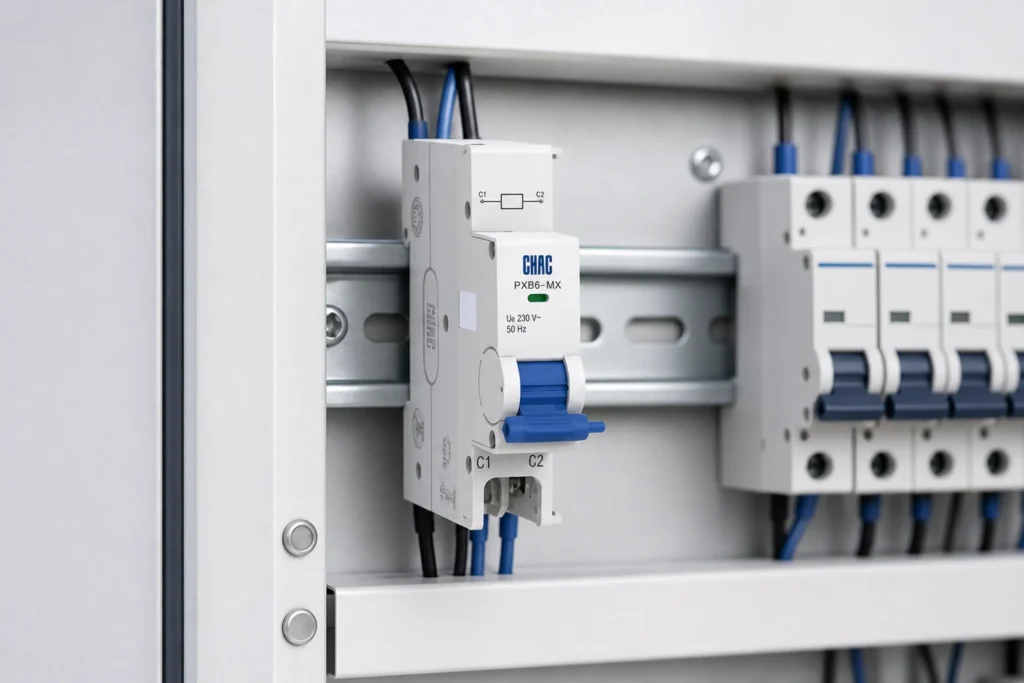
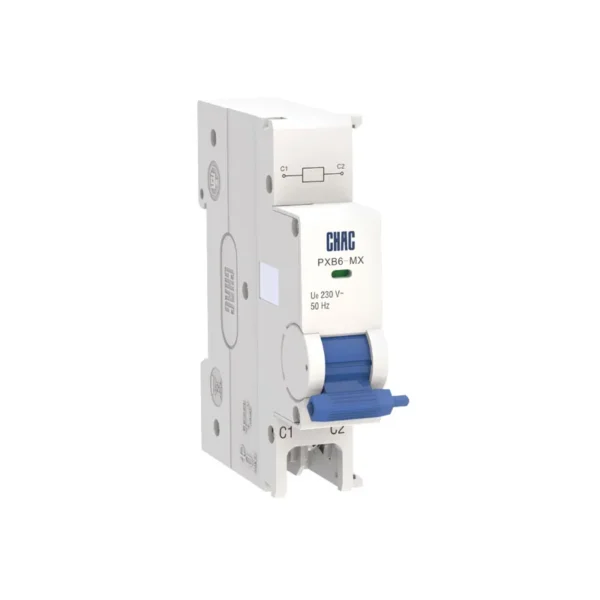
CHAC’s PXB6-OF contact auxiliaire and PXB6-MX déclenchement par shunt pages provide relevant product starting points. The latter describes a remote release for the compatible PXB6 interface. Confirm the selected assembly and wiring instructions before approval; these listings do not establish compatibility with unrelated breaker or alarm-switch families.
Quelles preuves la commission devrait-elle recueillir ?
Use a controlled commissioning plan appropriate to the assembly and manufacturer’s instructions. Retain evidence that connects physical operation, terminal states and controller interpretation:
- Record the installed breaker/accessory references and approved wiring diagram.
- Verify manual open/close indications against the documented contact table.
- Check trip indication using a manufacturer-approved procedure, without deliberately creating a live fault.
- Record release-terminal voltage during the command and the resulting position feedback.
- Verify reset behavior, loss-of-signal handling and the response to command/feedback disagreement.
This record is more useful than an unchecked statement that the remote-trip circuit works. It also reduces later troubleshooting caused by undocumented terminal assignments or inverted software logic.
Quelles questions se posent lors de la conception d’un système de contrôle ?
Can an auxiliary contact distinguish OFF from TRIPPED?
Position feedback alone generally cannot identify why the breaker opened. Use documented trip indication when the controller must distinguish those events.
Does a trip alarm identify the fault?
Not necessarily. Confirm which events operate the contact; identifying a specific cause may require additional protection-system information.
Does an open indication prove the circuit is safe to touch?
No. Feedback is not verification of voltage absence and does not exclude other sources of energization.
Will a shunt trip open the breaker if control power fails?
Do not assume so. Opening requires the specified energy at the release; assess supply-failure behavior separately.
What should be checked when a remote trip fails?
Under a safe diagnostic procedure, check the command path, release supply, wiring and mechanical compatibility. Compare the actual breaker state with the feedback rather than relying solely on a controller command bit.
Does removing the trip command reset or reclose the breaker?
Do not assume either action. Follow the selected model’s reset instructions and identify any separate mechanism needed for remote reclosing.
Qu’est-ce qui devrait déterminer le choix final des accessoires ?
Select the function before selecting the accessory: position feedback for operating state, trip feedback for the documented trip event, and a release for commanded opening. Then verify the exact assembly, control supply and contact logic against model documentation. Finally, commission the complete command-and-feedback chain, including its loss-of-signal response and reset sequence. An indication that appears correct must not replace voltage-absence verification or a required safety assessment. CHAC product information can support component review, but unresolved event behavior or compatibility needs confirmation before the panel design is released. Contacter CHAC Electric with the breaker reference, control schematic and required operating sequence.
Which product documents support further review?
- CHAC PXB6-MX shunt release product information: review the published control-supply data alongside installation instructions.
- CHAC CQAS2 alarm switch product information: a separate product reference, not evidence of compatibility with the PXB6 assembly.