Une surface de contact rugueuse ou noircie peut entraîner une commande de remplacement immédiate, mais une photographie seule suffit rarement à déterminer si le contacteur a atteint sa limite d’usure. L’erreur inverse est tout aussi coûteuse : installer un nouveau dispositif sans vérifier pourquoi l’ancien cliquetait, surchauffait ou commutait une charge pour laquelle il n’avait pas été dimensionné. Le meulage de la surface jusqu’à ce qu’elle paraisse propre peut faire disparaître les indices sans pour autant rétablir la conception du contact. Ce guide distingue l’usure visible de la défaillance fonctionnelle et présente les informations nécessaires pour choisir un remplacement adapté à la charge réelle et au circuit de commande.
A contacteur à contacts encastrés Présente une érosion des surfaces de contact due aux arcs d’interruption et à l’usure. L’état apparent ne constitue pas un critère universel de rejet ; il convient d’évaluer les limites d’usure définies par le fabricant, le comportement en service ainsi que l’état de l’appareil dans son ensemble. Des contacts soudés, un défaut de déclenchement, des dommages importants ou un état électrique inacceptable imposent la mise hors service de l’équipement jusqu’à ce que les mesures correctives appropriées aient été mises en œuvre. Ne procédez jamais au limage ou au polissage des contacts comme réparation générique. Vérifiez si le modèle exact dispose d’un kit de contacts homologué ou nécessite un remplacement complet, et recherchez la cause du problème avant de remettre le circuit en service.
Pourquoi les surfaces de contact présentent-elles des piqûres ?
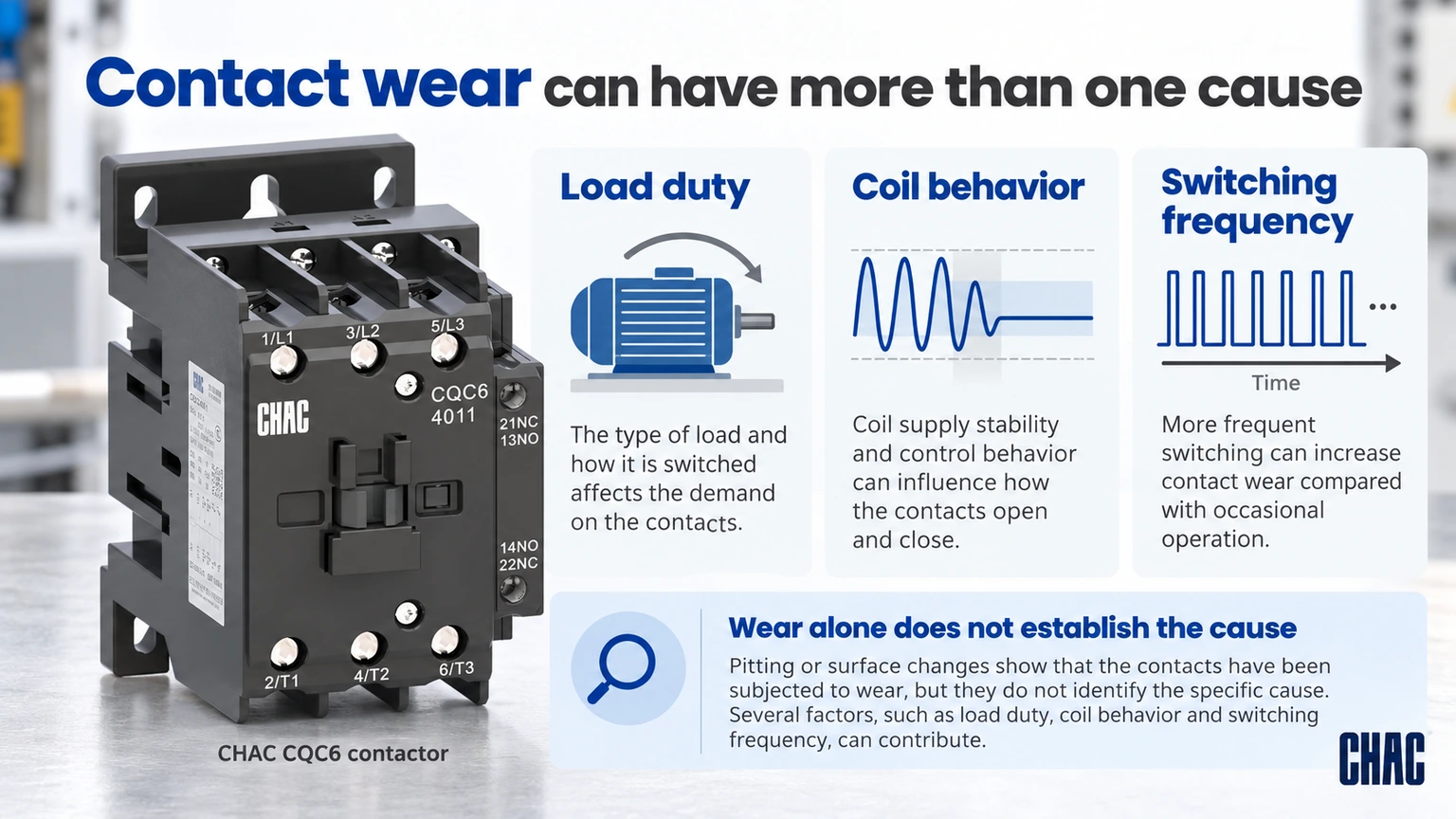
Les contacts créent et interrompent le courant dans des conditions susceptibles de provoquer des arcs électriques et un transfert de matière. La charge et le type de manœuvre déterminent l’exigence du service. Le démarrage d’un moteur, suivi de son ouverture une fois qu’il a atteint son régime nominal, diffère de la manoeuvre répétée en marche-arrêt ou du freinage par inversion de phase du moteur.
Schneider’s Guide des catégories d’utilisation de TeSys Giga, le document DOCA0189EN-05 distingue le service moteur AC-3 du démarrage, du freinage électrique et du mouvement par à-coups AC-4. La catégorie fait partie de la désignation de puissance, et non d’une étiquette décorative. Une valeur de courant tirée d’une désignation pour charge résistive ne peut pas être utilisée automatiquement pour la commutation de moteurs, et une désignation CA ne doit pas être appliquée à une application CC.
| Observation | Problème potentiel à examiner | Preuve utile |
|---|---|---|
| Opération rapide et répétée | Instabilité de commande ou charge de commutation inadaptée | Séquence de fonctionnement et alimentation de la bobine |
| Uneven wear between poles | Connection or pole condition | Isolated inspection and qualified assessment |
| Overheating near a terminal | Termination or conductor problem | Manufacturer tightening and conductor requirements |
| Contacts remain closed | Welding or mechanical failure | Isolation and the model’s diagnostic procedure |
| Only surface discoloration | Une usure normale peut être possible. | Critères réels d’usure du fabricant |
Les contacts piqués doivent-ils être lissés ou nettoyés ?
Pas en tant que traitement de maintenance générique. Schneider Electric FAQ FA122535, dernière modification le 1 mai 12, 2026, traite de ses contacteurs et démarreurs NEMA et à usage défini. Il déconseille de nettoyer ou de limer les contacts, car cela réduit la surface de contact en argent, et décrit leur action d’essuyage pendant le fonctionnement.
Il s’agit des instructions spécifiques d’un fabricant pour les gammes de produits concernées, et non d’une preuve que tous les contacteurs sont fabriqués avec le même matériau ou suivent la même procédure de maintenance. La leçon pratique est d’obtenir les instructions relatives au modèle précis en question. Une amélioration esthétique ne constitue pas la preuve que la pression de contact, la géométrie, l’épaisseur du matériau ou les performances électriques ont été rétablies.
Comment le comportement des bobines peut-il accélérer l’usure des contacts ?
Chattering or incomplete closing can make the switching event repeat or prevent normal contact engagement. Possible causes include an unsuitable coil supply, control-circuit voltage drop, loose connections or a mechanical problem. The relevant question is the supply at the coil under the permitted operating conditions, not just the nominal voltage printed on the panel transformer.
Do not assume the coil voltage from the main-circuit voltage. Confirm AC or DC, frequency where relevant, the exact coil code and any suppression accessory. Diagnostic measurements and inspection should be carried out by qualified personnel using the appropriate isolation and test procedures. This article does not prescribe live probing or bypassing the control circuit.
How can switching frequency explain why calendar age is misleading?
Start with a clearly defined duty count. As a hypothetical estimate, suppose the application completes 20 close-and-open cycles per hour, runs 16 hours per day and operates 250 days per year. That gives 20 × 16 × 250 = 80,000 cycles per year under this definition. The values are assumed, not CHAC service data or a recommended maintenance interval.
Compare the application’s actual load duty with the manufacturer’s endurance conditions before using the estimate. A mechanical endurance figure, an electrical endurance figure and a controller’s operation counter may use different definitions or test conditions. Do not translate the example directly into years of remaining life. Inching, plugging, abnormal chatter or repeated unsuccessful starts can also make an ordinary production count a poor description of the contact duty. Record those events separately instead of hiding them inside an average.
Which checks matter before a replacement is ordered?
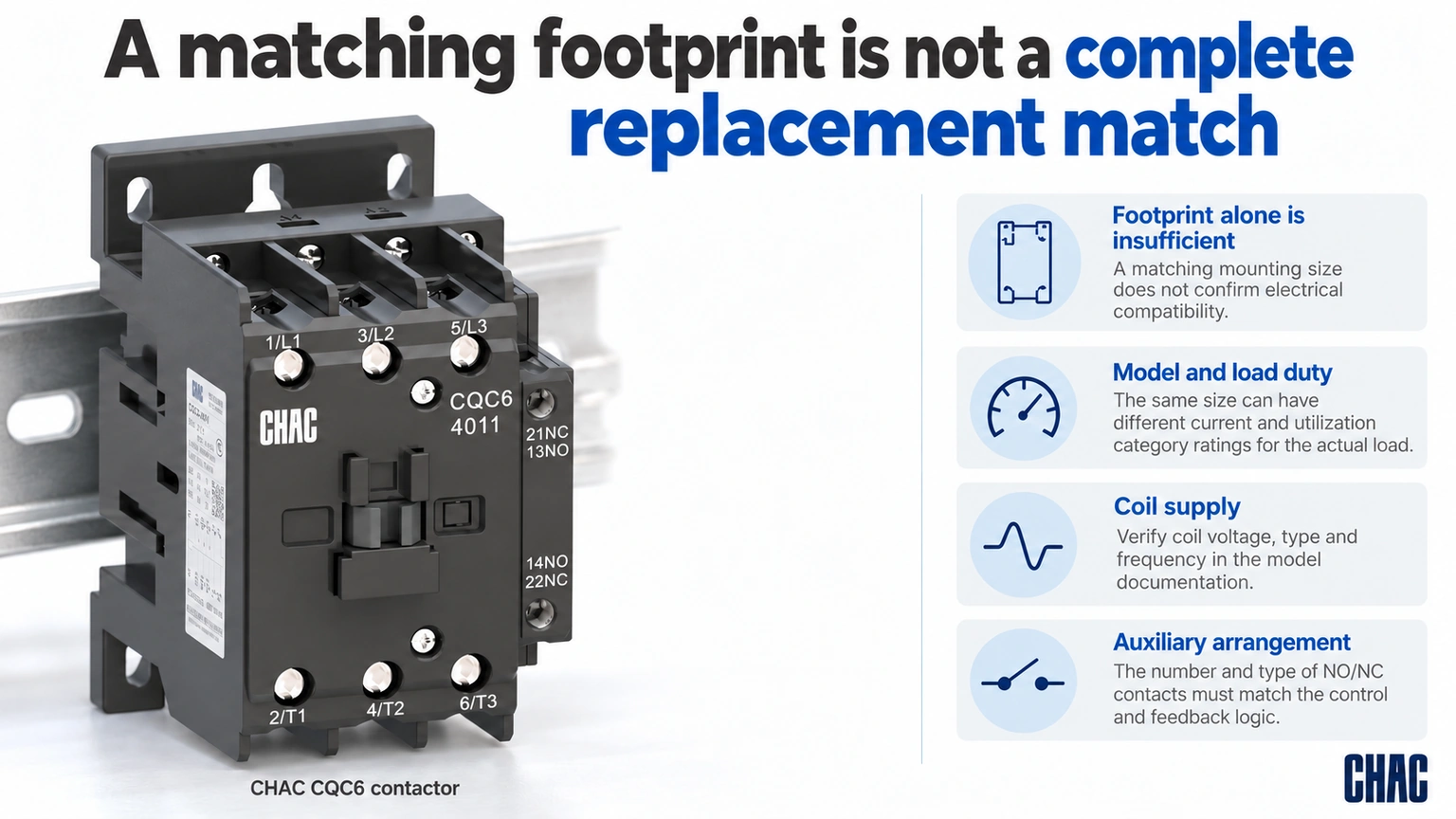
Record the full part number, load current, operational voltage, utilization category, starts or switching operations, coil supply, pole arrangement and auxiliary contacts. Include enclosure conditions, upstream protection and any overload relay. A replacement that shares only the footprint and headline amperage can still be wrong electrically.
| Replacement item | Pourquoi c'est important | What to request |
|---|---|---|
| Main contacts | Ratings depend on voltage and duty | Utilization-category data for the actual load |
| Coil | Controls reliable operation | Exact voltage, type and frequency |
| Auxiliary arrangement | Maintains control and feedback logic | NO/NC configuration and contact rating |
| Repair parts | Not every model is serviceable the same way | Approved kit or complete replacement instruction |
| Coordination | Fault response depends on the complete combination | Applicable tested combination and conditions |
There is no defensible universal lifespan in years or pit-depth threshold for all contactors. Mechanical endurance and electrical endurance describe different conditions; neither becomes a field replacement interval without considering the actual duty. Replacement cost also depends on the part, access, testing and downtime, so a generic online price should not substitute for a defined maintenance scope.
What should be checked after a short-circuit event?
Determine what the specified coordination permits before restarting. Schneider’s Type 1 and Type 2 coordination FAQ FA105974, modified April 20, 2026, explains that Type 1 may require repair or replacement after a short circuit, while Type 2 addresses suitability for further use under the stated conditions. It still recognizes possible contact welding and manufacturer maintenance measures.
Type 2 therefore does not mean “reset and run without inspection.” The fault level, protective device and starter combination must match the relevant documentation. A visibly intact enclosure does not establish that the contacts or overload assembly are ready for service.
What evidence should be retained before the worn contactor is removed?
After safe isolation, retain the device identity and an authorized condition record before cleaning or dismantling obscures the evidence. Compare all poles, terminal areas and the available manufacturer wear indicators using the permitted inspection method. Keep observations separate from conclusions: “darkening at one terminal” is an observation, whereas “overload caused the damage” requires further evidence.
Attach the load duty, recent control symptoms, protection events and any relevant qualified measurements. If the device is replaced, identify which underlying condition was corrected and which checks support its return to service. Retaining this small before-and-after record makes a recurrence easier to investigate. It also prevents a successful restart from being treated as proof that the original cause was found or that an arbitrary pit-depth or resistance limit has been met.
How can a replacement specification avoid the same problem?
CHAC CQC6 contacteur industriel CA page provides model-specific AC-3 current and voltage data, coil options and accessory configurations. Match those records to the actual application rather than selecting the largest printed current. If motor overload protection is part of the starter, evaluate the Relais de surcharge thermique CQR2 separately and confirm the actual combination.
For broader symptoms beyond contactor pitting, the AC contactor failure symptoms guide provides related diagnostic context. Treat the contactor replacement as an engineering match: correct the load or control issue, select the documented configuration and verify the permitted return-to-service checks.
What do maintenance teams ask about pitted contactors?
What is a pitted contactor?
It is a contactor whose contact surfaces show erosion or cratering from switching wear. The condition must be evaluated using the actual model instructions and functional evidence rather than appearance alone.
What are the symptoms of a bad contactor?
Symptoms can include failure to close or release, chattering, overheating and damaged or welded contacts. These observations can also involve control-supply or connection problems, so the cause needs investigation.
What is the typical lifespan of a contactor?
There is no universal service life in years. Load duty, switching frequency, environment and the manufacturer’s electrical and mechanical endurance conditions affect the result.
How much does it cost to replace an AC contactor?
The cost depends on the exact device, access, local labor, testing and any underlying fault correction. Request a quotation tied to the part number and maintenance scope.
What does pitted contactor do in a control circuit?
Pitting describes a wear condition, not a separate control function. The contactor still performs the switching duty for which it was designed, but damage may prevent reliable operation.
How is pitted contactor different from a relay?
Pitting is a condition that can affect switching contacts in either product category. Compare the actual relay or contactor ratings, load duty, coil and configuration rather than treating pitting as a device type.
Références
- Schneider Electric FA122535: cleaning magnetic-starter contacts; modified May 12, 2026
- Schneider Electric DOCA0189EN-05: contactor utilization categories; accessed October 19, 2026
- Schneider Electric FA105974: Type 1 and Type 2 coordination; modified April 20, 2026
Conclusion
Contact pitting should trigger a condition assessment, not an automatic cosmetic repair. Establish whether the contactor is operating correctly, compare wear with the model instructions and identify any load, coil or connection issue that could accelerate damage. Then determine whether the approved solution is a service kit or a complete replacement. After a fault, the documented coordination and maintenance requirements still govern the return to service. Do not transfer another manufacturer’s cleaning method, endurance figure or repairability to the installed unit. CHAC publishes model-specific CQC6 ratings and accessory information that can support a defined replacement review. Matching those details to the actual motor duty and control supply is more useful than ordering a similar-looking contactor and leaving the original cause unresolved.