Una superficie di contatto ruvida o annerita può determinare l’immediato ordine di sostituzione, ma una semplice fotografia raramente consente di stabilire se il contattore ha raggiunto il limite di usura. L’errore opposto è altrettanto costoso: installare un nuovo apparecchio senza verificare perché quello vecchio produceva rumori di contatto, si surriscaldava o commutava un carico per il quale non era stato dimensionato. Levigare la superficie fino a renderla apparentemente pulita può far scomparire le evidenze senza ripristinare il corretto funzionamento del contatto. Questa guida distingue l’usura visibile dal guasto funzionale e illustra le informazioni necessarie per scegliere una soluzione di sostituzione adeguata al carico effettivo e al circuito di comando.
A contattore a contatti stagni Presenta erosione delle superfici di contatto associata agli archi di commutazione e all’usura. L’aspetto visivo da solo non costituisce un criterio universale di scarto; valutare i limiti di usura indicati dal costruttore, il comportamento in esercizio e lo stato dell’intero dispositivo. Contatti saldati, mancato sgancio, danni gravi o una condizione elettrica inaccettabile richiedono che l’apparecchiatura rimanga fuori servizio fino all’esecuzione degli interventi correttivi appropriati. Non limare né lucidare i contatti come intervento generico di riparazione. Verificare se il modello specifico prevede un kit di contatti approvato oppure se è necessaria la sostituzione completa, e accertare la causa prima di rimettere il circuito in servizio.
Perché le superfici di contatto si presentano con avvallamenti?
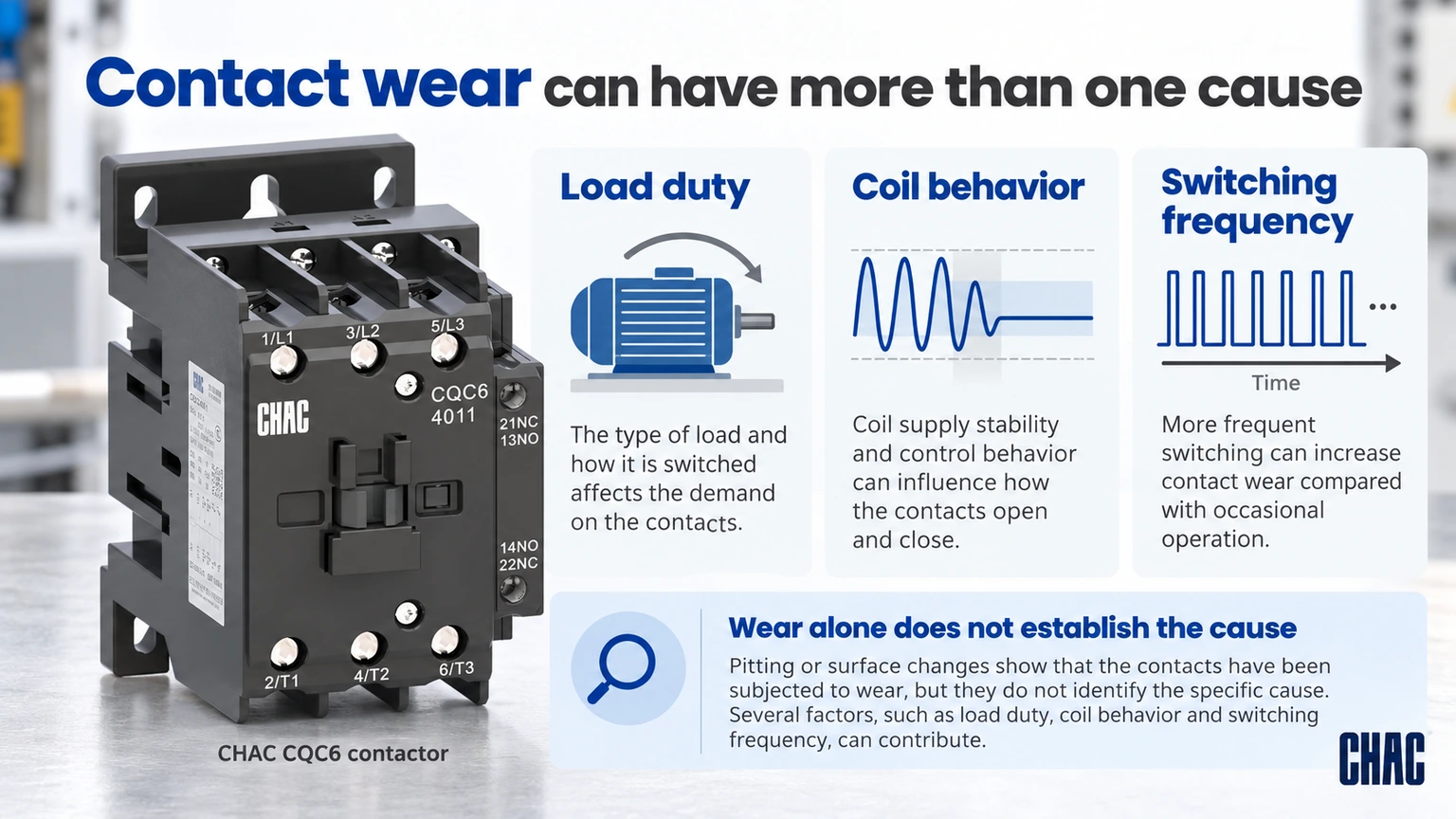
I contatti stabiliscono e interrompono la corrente in condizioni che possono generare archi elettrici e trasferimento di materiale. Il carico e il tipo di commutazione determinano l’entità delle sollecitazioni a cui sono sottoposti. Avviare un motore e poi aprirlo una volta raggiunte le condizioni di funzionamento normale è diverso dal procedere con ripetuti movimenti a scatti o dal frenare il motore tramite inversione di marcia.
Di Schneider TeSys Giga utilization-category guide, document DOCA0189EN-05, distinguishes AC-3 motor duty from AC-4 starting, plugging and inching. The category is part of the rating, not a decorative catalog label. A current figure taken from a resistive-load rating cannot automatically be used for motor switching, and an AC rating should not be carried into a DC application.
| Observation | Possible issue to investigate | Prova utile |
|---|---|---|
| Rapid repeated operation | Control instability or unsuitable switching duty | Operating sequence and coil supply |
| Uneven wear between poles | Connection or pole condition | Isolated inspection and qualified assessment |
| Overheating near a terminal | Termination or conductor problem | Manufacturer tightening and conductor requirements |
| Contacts remain closed | Welding or mechanical failure | Isolation and the model’s diagnostic procedure |
| Only surface discoloration | Normal wear may be possible | Actual manufacturer wear criteria |
Should pitted contacts be filed or cleaned?
Not as a generic maintenance treatment. Schneider Electric’s FAQ FA122535, last modified May 12, 2026, addresses its NEMA and definite-purpose contactors and starters. It advises against cleaning or filing the contacts because this removes the silver contact surface, and describes their wiping action during operation.
That is a specific manufacturer’s instruction for the stated product lines, rather than proof that every contactor has the same material or maintenance procedure. The practical lesson is to obtain the instructions for the actual model. A cosmetic improvement is not evidence that contact pressure, geometry, material thickness or electrical performance has been restored.
How can coil behavior accelerate contact wear?
Chattering or incomplete closing can make the switching event repeat or prevent normal contact engagement. Possible causes include an unsuitable coil supply, control-circuit voltage drop, loose connections or a mechanical problem. The relevant question is the supply at the coil under the permitted operating conditions, not just the nominal voltage printed on the panel transformer.
Do not assume the coil voltage from the main-circuit voltage. Confirm AC or DC, frequency where relevant, the exact coil code and any suppression accessory. Diagnostic measurements and inspection should be carried out by qualified personnel using the appropriate isolation and test procedures. This article does not prescribe live probing or bypassing the control circuit.
How can switching frequency explain why calendar age is misleading?
Start with a clearly defined duty count. As a hypothetical estimate, suppose the application completes 20 close-and-open cycles per hour, runs 16 hours per day and operates 250 days per year. That gives 20 × 16 × 250 = 80,000 cycles per year under this definition. The values are assumed, not CHAC service data or a recommended maintenance interval.
Compare the application’s actual load duty with the manufacturer’s endurance conditions before using the estimate. A mechanical endurance figure, an electrical endurance figure and a controller’s operation counter may use different definitions or test conditions. Do not translate the example directly into years of remaining life. Inching, plugging, abnormal chatter or repeated unsuccessful starts can also make an ordinary production count a poor description of the contact duty. Record those events separately instead of hiding them inside an average.
Which checks matter before a replacement is ordered?
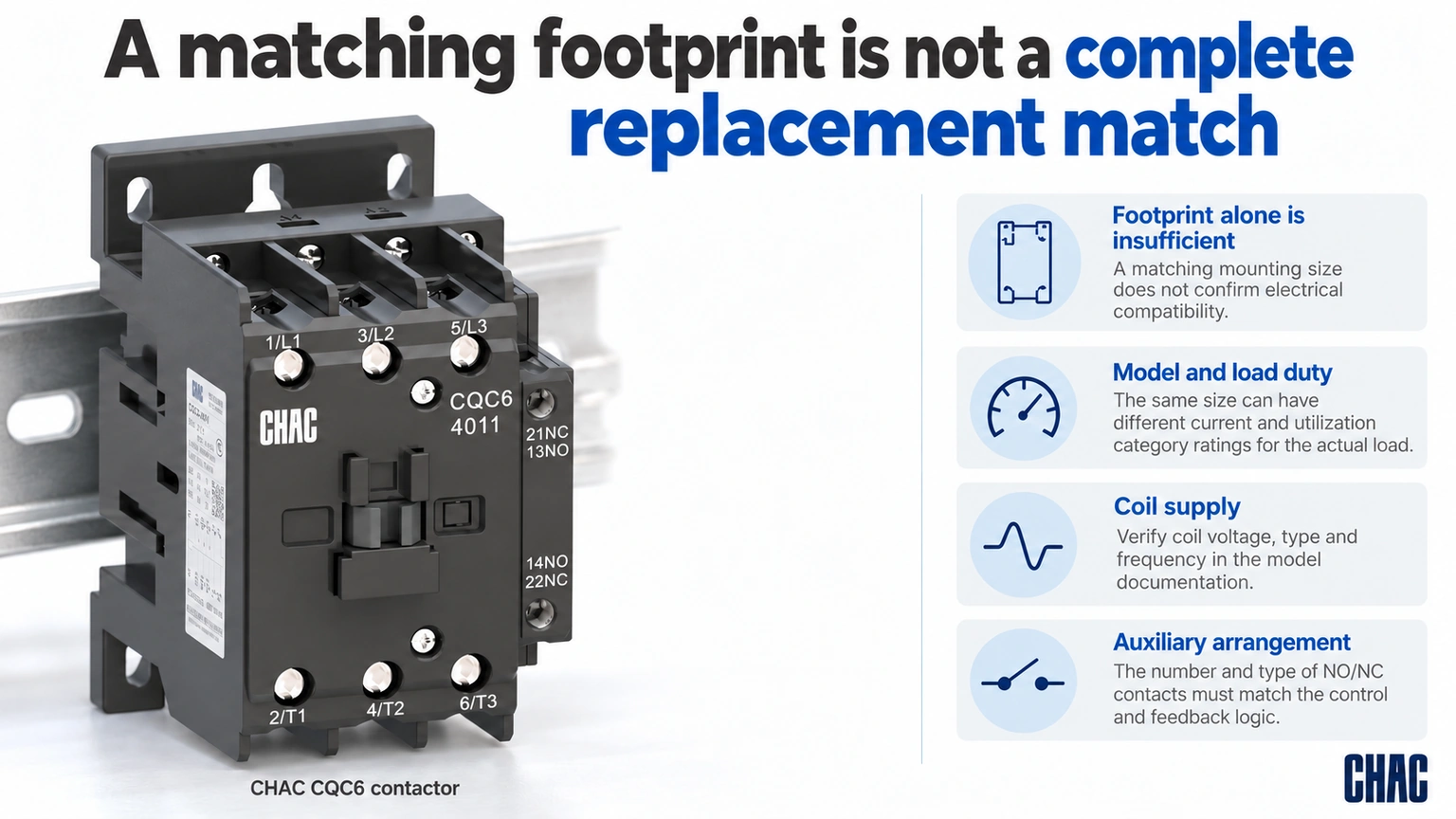
Record the full part number, load current, operational voltage, utilization category, starts or switching operations, coil supply, pole arrangement and auxiliary contacts. Include enclosure conditions, upstream protection and any overload relay. A replacement that shares only the footprint and headline amperage can still be wrong electrically.
| Replacement item | Perché è importante | What to request |
|---|---|---|
| Main contacts | Ratings depend on voltage and duty | Utilization-category data for the actual load |
| Coil | Controls reliable operation | Exact voltage, type and frequency |
| Auxiliary arrangement | Maintains control and feedback logic | NO/NC configuration and contact rating |
| Repair parts | Not every model is serviceable the same way | Approved kit or complete replacement instruction |
| Coordinamento | Fault response depends on the complete combination | Applicable tested combination and conditions |
There is no defensible universal lifespan in years or pit-depth threshold for all contactors. Mechanical endurance and electrical endurance describe different conditions; neither becomes a field replacement interval without considering the actual duty. Replacement cost also depends on the part, access, testing and downtime, so a generic online price should not substitute for a defined maintenance scope.
What should be checked after a short-circuit event?
Determine what the specified coordination permits before restarting. Schneider’s Type 1 and Type 2 coordination FAQ FA105974, modified April 20, 2026, explains that Type 1 may require repair or replacement after a short circuit, while Type 2 addresses suitability for further use under the stated conditions. It still recognizes possible contact welding and manufacturer maintenance measures.
Type 2 therefore does not mean “reset and run without inspection.” The fault level, protective device and starter combination must match the relevant documentation. A visibly intact enclosure does not establish that the contacts or overload assembly are ready for service.
What evidence should be retained before the worn contactor is removed?
After safe isolation, retain the device identity and an authorized condition record before cleaning or dismantling obscures the evidence. Compare all poles, terminal areas and the available manufacturer wear indicators using the permitted inspection method. Keep observations separate from conclusions: “darkening at one terminal” is an observation, whereas “overload caused the damage” requires further evidence.
Attach the load duty, recent control symptoms, protection events and any relevant qualified measurements. If the device is replaced, identify which underlying condition was corrected and which checks support its return to service. Retaining this small before-and-after record makes a recurrence easier to investigate. It also prevents a successful restart from being treated as proof that the original cause was found or that an arbitrary pit-depth or resistance limit has been met.
How can a replacement specification avoid the same problem?
di CHAC CQC6 contattore industriale CA page provides model-specific AC-3 current and voltage data, coil options and accessory configurations. Match those records to the actual application rather than selecting the largest printed current. If motor overload protection is part of the starter, evaluate the Relè di sovraccarico termico CQR2 separately and confirm the actual combination.
For broader symptoms beyond contactor pitting, the AC contactor failure symptoms guide provides related diagnostic context. Treat the contactor replacement as an engineering match: correct the load or control issue, select the documented configuration and verify the permitted return-to-service checks.
What do maintenance teams ask about pitted contactors?
What is a pitted contactor?
It is a contactor whose contact surfaces show erosion or cratering from switching wear. The condition must be evaluated using the actual model instructions and functional evidence rather than appearance alone.
What are the symptoms of a bad contactor?
Symptoms can include failure to close or release, chattering, overheating and damaged or welded contacts. These observations can also involve control-supply or connection problems, so the cause needs investigation.
What is the typical lifespan of a contactor?
There is no universal service life in years. Load duty, switching frequency, environment and the manufacturer’s electrical and mechanical endurance conditions affect the result.
How much does it cost to replace an AC contactor?
The cost depends on the exact device, access, local labor, testing and any underlying fault correction. Request a quotation tied to the part number and maintenance scope.
What does pitted contactor do in a control circuit?
Pitting describes a wear condition, not a separate control function. The contactor still performs the switching duty for which it was designed, but damage may prevent reliable operation.
How is pitted contactor different from a relay?
Pitting is a condition that can affect switching contacts in either product category. Compare the actual relay or contactor ratings, load duty, coil and configuration rather than treating pitting as a device type.
Referenze
- Schneider Electric FA122535: cleaning magnetic-starter contacts; modified May 12, 2026
- Schneider Electric DOCA0189EN-05: contactor utilization categories; accessed October 19, 2026
- Schneider Electric FA105974: Type 1 and Type 2 coordination; modified April 20, 2026
Conclusione
Contact pitting should trigger a condition assessment, not an automatic cosmetic repair. Establish whether the contactor is operating correctly, compare wear with the model instructions and identify any load, coil or connection issue that could accelerate damage. Then determine whether the approved solution is a service kit or a complete replacement. After a fault, the documented coordination and maintenance requirements still govern the return to service. Do not transfer another manufacturer’s cleaning method, endurance figure or repairability to the installed unit. CHAC publishes model-specific CQC6 ratings and accessory information that can support a defined replacement review. Matching those details to the actual motor duty and control supply is more useful than ordering a similar-looking contactor and leaving the original cause unresolved.