Một bề mặt tiếp xúc gồ ghề hoặc bị đen có thể dẫn đến việc lập tức đặt hàng thay thế; tuy nhiên, chỉ dựa vào ảnh chụp thì hiếm khi đủ để xác định liệu tiếp điểm đã đạt đến giới hạn mòn hay chưa. Sai lầm ngược lại cũng gây tốn kém không kém: lắp đặt một thiết bị mới mà không kiểm tra nguyên nhân khiến thiết bị cũ kêu rít, quá nhiệt hoặc đóng cắt công suất vượt quá khả năng thiết kế của nó. Việc mài phẳng bề mặt cho đến khi trông sạch sẽ có thể làm mất dấu vết nhưng không khắc phục được vấn đề về thiết kế tiếp điểm. Hướng dẫn này phân biệt giữa hiện tượng mòn nhìn thấy được và sự cố chức năng, đồng thời nêu rõ các thông tin cần thiết để lựa chọn sản phẩm thay thế phù hợp với tải thực tế và mạch điều khiển.
A contactor không có tiếp điểm Các tiếp điểm bị mài mòn do hồ quang chuyển mạch và hao mòn. Ngoại quan đơn thuần không phải là tiêu chí loại bỏ mang tính phổ quát; cần đánh giá các giới hạn hao mòn do nhà sản xuất quy định, tình trạng vận hành cũng như trạng thái của toàn bộ thiết bị. Trường hợp các tiếp điểm bị hàn dính, không thể ngắt mạch, hư hỏng nghiêm trọng hoặc có tình trạng điện không thể chấp nhận được, thiết bị phải ngừng vận hành cho đến khi thực hiện các biện pháp khắc phục phù hợp. Không được giũa hoặc đánh bóng tiếp điểm như một biện pháp sửa chữa chung. Cần xác minh xem model cụ thể đó có bộ tiếp điểm thay thế được phê duyệt hay phải thay thế toàn bộ, đồng thời tìm hiểu nguyên nhân trước khi đưa mạch trở lại vận hành.
Tại sao các bề mặt tiếp xúc lại bị rỗ?
Các tiếp điểm đóng – mở dòng điện trong những điều kiện có thể gây ra hồ quang và sự dịch chuyển vật liệu. Mức tải và chế độ đóng cắt quyết định mức độ khắc nghiệt của ứng dụng đó. Việc khởi động một động cơ rồi ngắt mạch sau khi động cơ đạt trạng thái vận hành bình thường khác với việc liên tục cho động cơ chạy giật từng bước hoặc hãm bằng cách đảo chiều dòng điện.
Schneider’s Hướng dẫn về danh mục sử dụng của TeSys Giga, tài liệu DOCA0189EN-05, phân biệt chế độ làm việc của động cơ AC-3 với khởi động, hãm và chạy từng bước AC-4. Danh mục này là một phần của định mức, chứ không phải là nhãn danh mục mang tính trang trí. Một giá trị dòng điện lấy từ định mức tải thuần trở không thể tự động được sử dụng cho việc đóng cắt động cơ, và định mức AC không nên được áp dụng cho ứng dụng DC.
| Quan sát | Vấn đề có thể cần điều tra | Bằng chứng hữu ích |
|---|---|---|
| Vận hành nhanh lặp lại | Kiểm soát sự bất ổn hoặc chế độ đóng cắt không phù hợp | Trình tự hoạt động và nguồn cấp cho cuộn dây |
| Mòn không đều giữa các cực | Điều kiện kết nối hoặc điều kiện cực | Kiểm tra độc lập và đánh giá đạt yêu cầu |
| Quá nhiệt gần một nhà ga | Vấn đề về việc ngắt kết nối hoặc dây dẫn | Yêu cầu về siết chặt của nhà sản xuất và yêu cầu đối với dây dẫn |
| Các liên hệ vẫn bị đóng. | Hàn hoặc hỏng hóc cơ khí | Sự cô lập và quy trình chẩn đoán của mô hình |
| Chỉ có sự đổi màu trên bề mặt | Hao mòn thông thường có thể xảy ra. | Tiêu chí hao mòn thực tế của nhà sản xuất |
Should pitted contacts be filed or cleaned?
Not as a generic maintenance treatment. Schneider Electric’s FAQ FA122535, last modified May 12, 2026, addresses its NEMA and definite-purpose contactors and starters. It advises against cleaning or filing the contacts because this removes the silver contact surface, and describes their wiping action during operation.
That is a specific manufacturer’s instruction for the stated product lines, rather than proof that every contactor has the same material or maintenance procedure. The practical lesson is to obtain the instructions for the actual model. A cosmetic improvement is not evidence that contact pressure, geometry, material thickness or electrical performance has been restored.
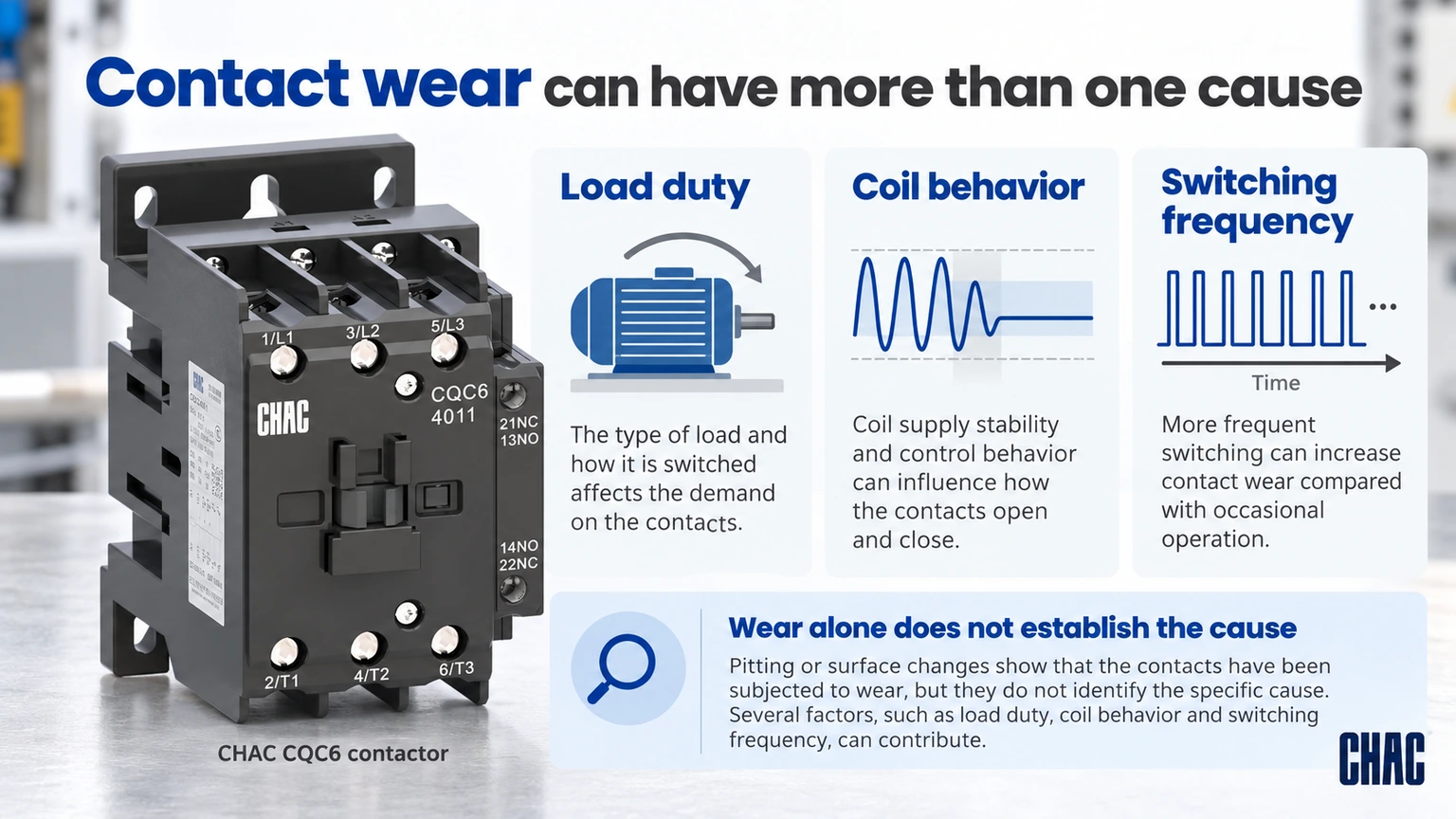
How can coil behavior accelerate contact wear?
Chattering or incomplete closing can make the switching event repeat or prevent normal contact engagement. Possible causes include an unsuitable coil supply, control-circuit voltage drop, loose connections or a mechanical problem. The relevant question is the supply at the coil under the permitted operating conditions, not just the nominal voltage printed on the panel transformer.
Do not assume the coil voltage from the main-circuit voltage. Confirm AC or DC, frequency where relevant, the exact coil code and any suppression accessory. Diagnostic measurements and inspection should be carried out by qualified personnel using the appropriate isolation and test procedures. This article does not prescribe live probing or bypassing the control circuit.
How can switching frequency explain why calendar age is misleading?
Start with a clearly defined duty count. As a hypothetical estimate, suppose the application completes 20 close-and-open cycles per hour, runs 16 hours per day and operates 250 days per year. That gives 20 × 16 × 250 = 80,000 cycles per year under this definition. The values are assumed, not CHAC service data or a recommended maintenance interval.
Compare the application’s actual load duty with the manufacturer’s endurance conditions before using the estimate. A mechanical endurance figure, an electrical endurance figure and a controller’s operation counter may use different definitions or test conditions. Do not translate the example directly into years of remaining life. Inching, plugging, abnormal chatter or repeated unsuccessful starts can also make an ordinary production count a poor description of the contact duty. Record those events separately instead of hiding them inside an average.
Which checks matter before a replacement is ordered?
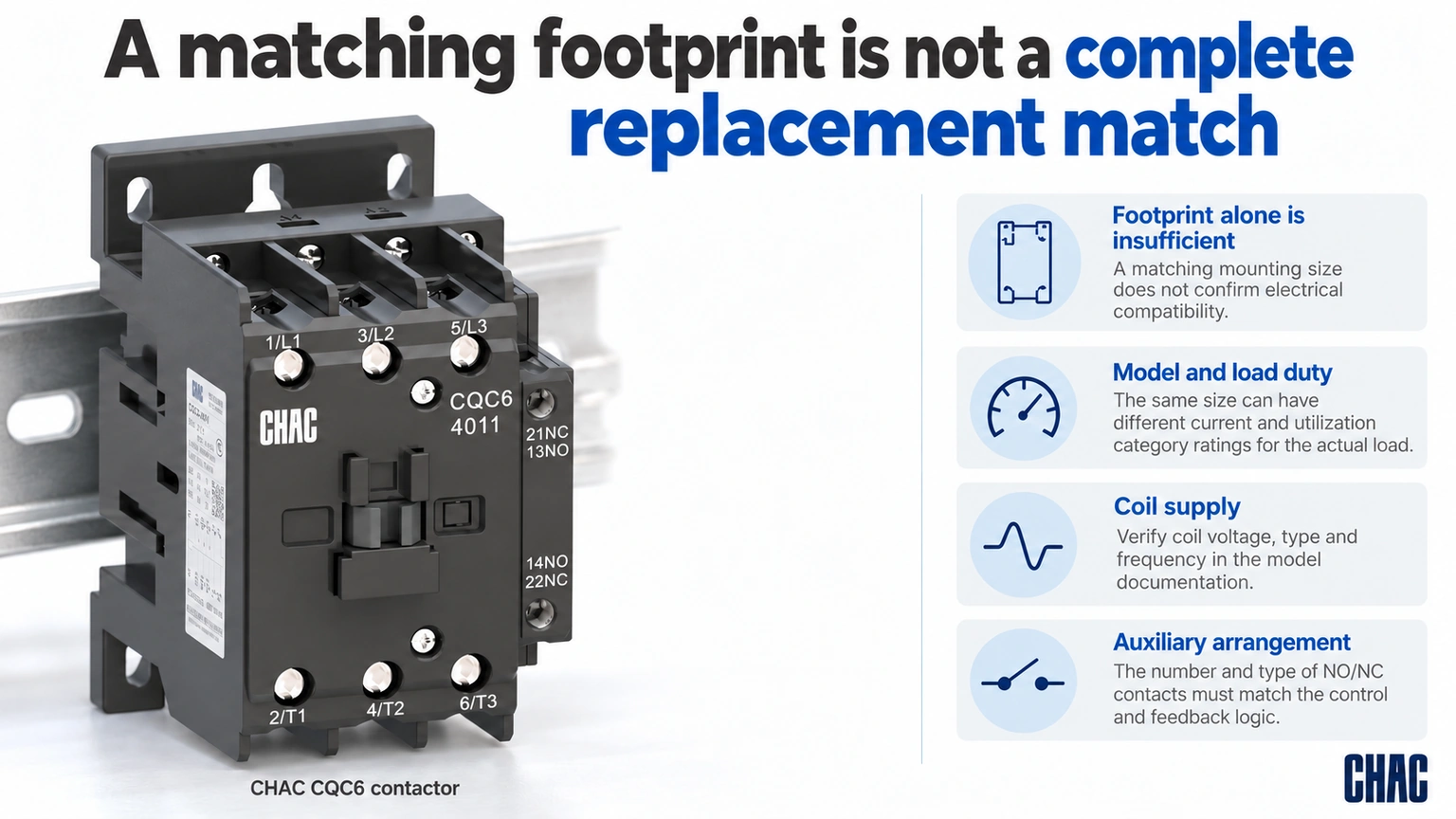
Record the full part number, load current, operational voltage, utilization category, starts or switching operations, coil supply, pole arrangement and auxiliary contacts. Include enclosure conditions, upstream protection and any overload relay. A replacement that shares only the footprint and headline amperage can still be wrong electrically.
| Sản phẩm thay thế | Tại sao điều đó lại quan trọng | Yêu cầu gì |
|---|---|---|
| Liên hệ chính | Đánh giá phụ thuộc vào điện áp và chế độ làm việc. | Utilization-category data for the actual load |
| Cuộn dây | Controls reliable operation | Exact voltage, type and frequency |
| Auxiliary arrangement | Maintains control and feedback logic | NO/NC configuration and contact rating |
| Repair parts | Not every model is serviceable the same way | Approved kit or complete replacement instruction |
| Sự phối hợp | Fault response depends on the complete combination | Applicable tested combination and conditions |
There is no defensible universal lifespan in years or pit-depth threshold for all contactors. Mechanical endurance and electrical endurance describe different conditions; neither becomes a field replacement interval without considering the actual duty. Replacement cost also depends on the part, access, testing and downtime, so a generic online price should not substitute for a defined maintenance scope.
What should be checked after a short-circuit event?
Determine what the specified coordination permits before restarting. Schneider’s Type 1 and Type 2 coordination FAQ FA105974, modified April 20, 2026, explains that Type 1 may require repair or replacement after a short circuit, while Type 2 addresses suitability for further use under the stated conditions. It still recognizes possible contact welding and manufacturer maintenance measures.
Type 2 therefore does not mean “reset and run without inspection.” The fault level, protective device and starter combination must match the relevant documentation. A visibly intact enclosure does not establish that the contacts or overload assembly are ready for service.
What evidence should be retained before the worn contactor is removed?
After safe isolation, retain the device identity and an authorized condition record before cleaning or dismantling obscures the evidence. Compare all poles, terminal areas and the available manufacturer wear indicators using the permitted inspection method. Keep observations separate from conclusions: “darkening at one terminal” is an observation, whereas “overload caused the damage” requires further evidence.
Attach the load duty, recent control symptoms, protection events and any relevant qualified measurements. If the device is replaced, identify which underlying condition was corrected and which checks support its return to service. Retaining this small before-and-after record makes a recurrence easier to investigate. It also prevents a successful restart from being treated as proof that the original cause was found or that an arbitrary pit-depth or resistance limit has been met.
How can a replacement specification avoid the same problem?
CHAC CQC6 công tắc tơ AC công nghiệp page provides model-specific AC-3 current and voltage data, coil options and accessory configurations. Match those records to the actual application rather than selecting the largest printed current. If motor overload protection is part of the starter, evaluate the Rơle quá tải nhiệt CQR2 separately and confirm the actual combination.
For broader symptoms beyond contactor pitting, the AC contactor failure symptoms guide provides related diagnostic context. Treat the contactor replacement as an engineering match: correct the load or control issue, select the documented configuration and verify the permitted return-to-service checks.
What do maintenance teams ask about pitted contactors?
What is a pitted contactor?
It is a contactor whose contact surfaces show erosion or cratering from switching wear. The condition must be evaluated using the actual model instructions and functional evidence rather than appearance alone.
What are the symptoms of a bad contactor?
Symptoms can include failure to close or release, chattering, overheating and damaged or welded contacts. These observations can also involve control-supply or connection problems, so the cause needs investigation.
What is the typical lifespan of a contactor?
There is no universal service life in years. Load duty, switching frequency, environment and the manufacturer’s electrical and mechanical endurance conditions affect the result.
How much does it cost to replace an AC contactor?
The cost depends on the exact device, access, local labor, testing and any underlying fault correction. Request a quotation tied to the part number and maintenance scope.
What does pitted contactor do in a control circuit?
Pitting describes a wear condition, not a separate control function. The contactor still performs the switching duty for which it was designed, but damage may prevent reliable operation.
How is pitted contactor different from a relay?
Pitting is a condition that can affect switching contacts in either product category. Compare the actual relay or contactor ratings, load duty, coil and configuration rather than treating pitting as a device type.
Tham khảo
- Schneider Electric FA122535: cleaning magnetic-starter contacts; modified May 12, 2026
- Schneider Electric DOCA0189EN-05: contactor utilization categories; accessed October 19, 2026
- Schneider Electric FA105974: Type 1 and Type 2 coordination; modified April 20, 2026
Kết luận
Contact pitting should trigger a condition assessment, not an automatic cosmetic repair. Establish whether the contactor is operating correctly, compare wear with the model instructions and identify any load, coil or connection issue that could accelerate damage. Then determine whether the approved solution is a service kit or a complete replacement. After a fault, the documented coordination and maintenance requirements still govern the return to service. Do not transfer another manufacturer’s cleaning method, endurance figure or repairability to the installed unit. CHAC publishes model-specific CQC6 ratings and accessory information that can support a defined replacement review. Matching those details to the actual motor duty and control supply is more useful than ordering a similar-looking contactor and leaving the original cause unresolved.