Une prise de courant dans la salle de bains qui disjoncte peut ressembler à un simple problème de surcharge, surtout lorsque l’appareil branché fonctionne encore sur un autre circuit. Remplacer le dispositif ou déplacer l’appareil peut rétablir l’alimentation sans pour autant résoudre le problème sous-jacent de fuite de courant ou de câblage. La première étape consiste à comprendre ce que le dispositif de protection est réellement censé détecter. L’abréviation “ GFCI ” désigne une fonction de protection des personnes, et non pas simplement une prise munie de deux boutons supplémentaires. Ce guide explique cette abréviation, le déséquilibre de courant qui en est à l’origine, la différence entre une prise GFCI et un disjoncteur GFCI, ainsi que les informations dont un acheteur a besoin avant de choisir un dispositif adapté à un marché donné.
GFCI signifie Disjoncteur de protection contre les défauts à la terre. Il surveille le courant circulant dans les conducteurs du circuit et déconnecte le circuit protégé lorsqu’un déséquilibre qualifié se produit. Dans les applications de classe A aux États-Unis, les recommandations du fabricant définissent une plage de fonctionnement de 4–6 mA conformément à la norme UL 943. Cette sensibilité est distincte de l’intensité nominale du circuit de branchement. Une prise GFCI ne remplace généralement pas la protection contre les surcharges ou les courts-circuits ; un disjoncteur GFCI combine ces fonctions en un seul appareil approuvé. Vérifiez le type d’appareil, la valeur nominale du circuit et les exigences d’installation adoptées localement avant d’acheter.
Que signifie GFCI en termes électriques ?
Le terme correct est “ interrupteur ”, et non “ interférence ”. Par conséquent, l’affirmation selon laquelle “ GFCI signifie ”ground fault circuit interference” » est fausse. L’abréviation GFI est également utilisée de manière informelle pour désigner la protection contre les défauts à la terre, mais les documents d’achat devraient préciser le dispositif et la norme réels plutôt que de se contenter d’une abréviation.
Le signification de GFCI Il est plus facile de comprendre cela en distinguant les ampères des milliampères. Une valeur de 20 pour un circuit décrit la charge du circuit dérivé dans son contexte. Quelques milliampères de déséquilibre résiduel relèvent d’une fonction de protection différente. Un dispositif peut donc se déclencher en cas de fuite, tandis que la charge totale reste bien inférieure au seuil de surcharge habituel du disjoncteur. Les recommandations de Leviton en matière de sécurité des personnes identifie le seuil de classe A et distingue les contextes d’application pertinents.
Comment un dispositif de protection différentielle (GFCI) détecte-t-il un courant empruntant un chemin non prévu ?
L’appareil compare les courants circulant dans les conducteurs passant à travers son dispositif de détection. En fonctionnement normal, ces courants s’équilibrent. Un courant revenant par un autre chemin peut créer un déséquilibre, ce qui déclenche la coupure lorsque les critères de fonctionnement de l’appareil sont atteints. Il s’agit d’une explication fonctionnelle, et non d’un schéma de câblage ni d’une affirmation selon laquelle chaque choc électrique possible sera détecté.
En particulier, un dispositif de protection différentielle (GFCI) ne remplace ni l’isolation sûre, ni la mise à la terre et le liaisonnement corrects, ni un équipement adapté. Un choc électrique impliquant un courant qui quitte et revient par les conducteurs du circuit surveillé peut ne pas provoquer le déséquilibre nécessaire au déclenchement. Un équipement ne doit pas être considéré comme sûr simplement parce qu’un GFCI est installé.
En quoi une prise GFCI diffère-t-elle d’un disjoncteur GFCI ?
| Appareil | Rôle principal | Limitation importante |
|---|---|---|
| Disjoncteur ordinaire | Protection contre les surcharges et les courts-circuits | N’implique pas la protection de classe A des DDR. |
| Prise GFCI | Ground-fault personnel protection at the device and permitted downstream connections | Requires appropriate upstream overcurrent protection |
| GFCI circuit breaker | Overcurrent and GFCI protection in one listed device | Must be approved for the panel and circuit |
| Dual-function AFCI/GFCI device | Two distinct protective functions | Verify both functions and compatibility explicitly |
A downstream outlet is protected only when the circuit has been connected in the arrangement permitted by the GFCI instructions. The presence of a nearby TEST button does not prove which outlets are covered. Qualified personnel should identify the circuit, verify the manufacturer instructions and test the protected locations. The GFCI ground fault interrupter designation should always be tied to the exact protected circuit.
How do you find out which outlets one GFCI actually protects?
Turn the protection boundary into a location record. During an authorized check following the device instructions, identify the GFCI, the outlets supplied through its permitted downstream connection and the location where it can be tested and reset. Record the result by room or outlet identifier. A device in a garage may protect another location; proximity to the outlet is not a reliable way to identify that relationship.
Keep the record with the circuit schedule and repeat the relevant checks after an outlet or GFCI is replaced. Compare the actual terminal markings with the new model’s instructions, rather than copying the physical position of wires from the old device. Leviton’s support guidance specifically identifies reversed LINE and LOAD connections as a replacement problem. This verification establishes the intended protection coverage; it does not replace safe isolation or prove that every aspect of the circuit is compliant.
Why might a GFCI trip or refuse to reset?
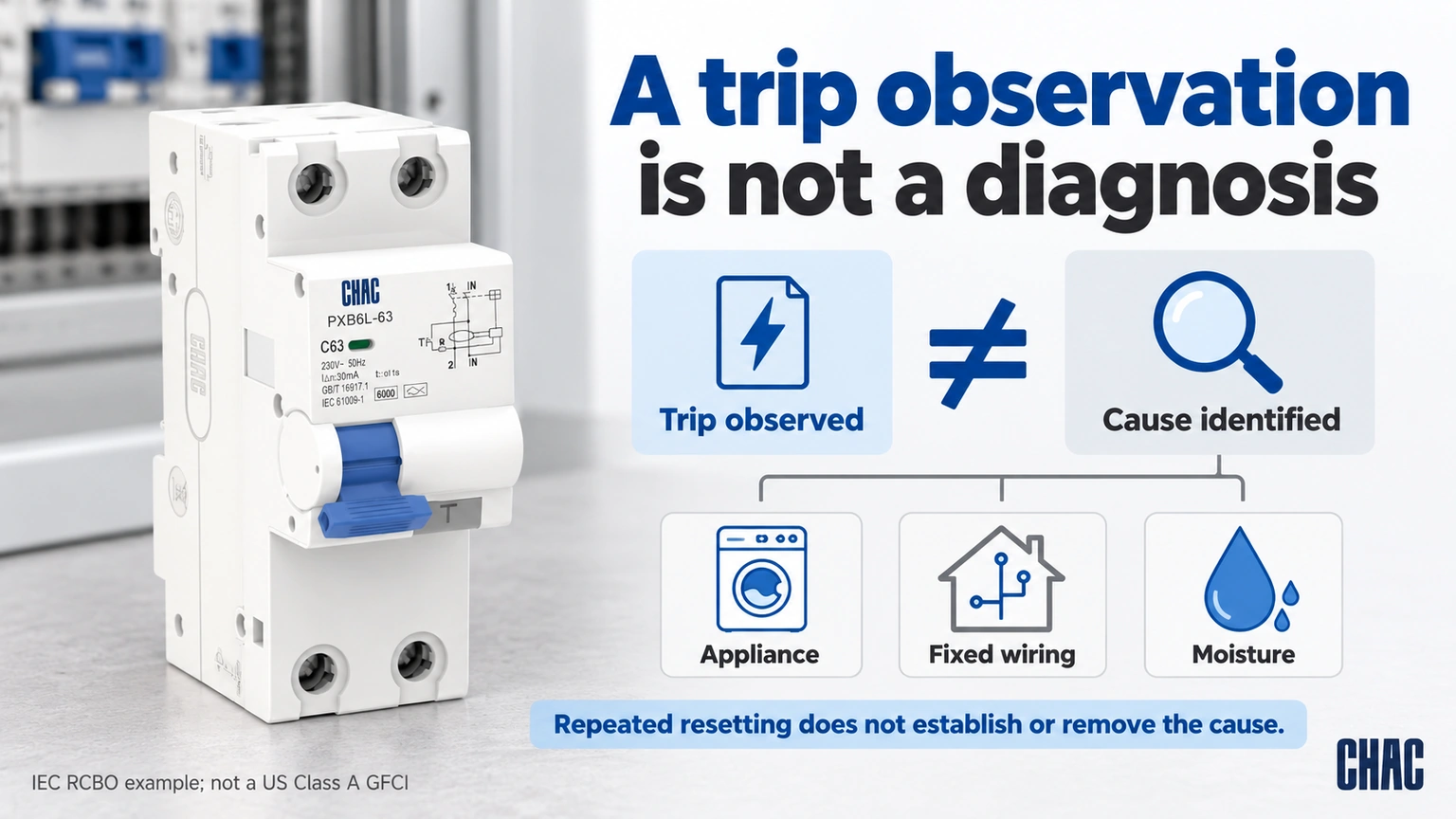
Moisture, damaged appliance insulation, cumulative equipment leakage and downstream wiring faults can all require investigation. A new installation that will not reset may also have LINE and LOAD reversed, no supply power or a device that cannot provide protection. Leviton’s GFCI support page describes reset lockout, self-testing and model-dependent indicator behavior. Do not assign the same LED meaning to every brand.
Do not repeatedly reset an unexplained trip, bypass protection or move a suspect appliance to an unprotected outlet. Disconnecting plug-in loads can help a qualified investigation distinguish the load from the fixed circuit, but opening boxes and changing wiring should follow proper isolation and verification procedures. Intermittent faults deserve attention even when the reset button appears to restore normal service.
| Observation | Useful question | Prochaines vérifications |
|---|---|---|
| Trips with one appliance | Does the event follow that appliance? | Appliance insulation and operating conditions |
| Trips after rain or cleaning | Could moisture reach equipment or wiring? | Ingress source and suitability for location |
| New device will not reset | Is supply present and wiring correct? | Manufacturer instructions and LINE/LOAD identification |
| Trips with several loads together | Are leakage currents accumulating? | Measured leakage and circuit arrangement |
What should be planned for a GFCI serving an unattended appliance?
For an appliance that may run while nobody is present, plan how a loss of supply will be noticed and who can investigate it. Keep the required test and reset point accessible. Where appropriate, evaluate a product with an audible alert or a suitable monitoring arrangement using its actual instructions. An alarm is a notification feature, not another protective function or permission to omit required GFCI protection.
Leviton’s range includes audible-alert and connected GFCI options, but those features are model-specific. Do not promise an alert from an ordinary receptacle, or assume a network notification will remain available during a power or communications failure. The practical specification separates required personnel protection, circuit coverage and notification needs. This addresses the consequence of an unnoticed outage without treating repeated trips as a reason to move an appliance to an unprotected supply.
Where is GFCI protection required, and can an IEC device substitute?
Bathrooms, kitchens, garages, outdoor locations and other specified areas are common US code contexts, but the adopted NEC edition, occupancy, circuit and local amendments determine the exact requirement. Older manufacturer summaries are useful background, not proof of the current rule in every jurisdiction. Confirm the applicable edition with the authority having jurisdiction.
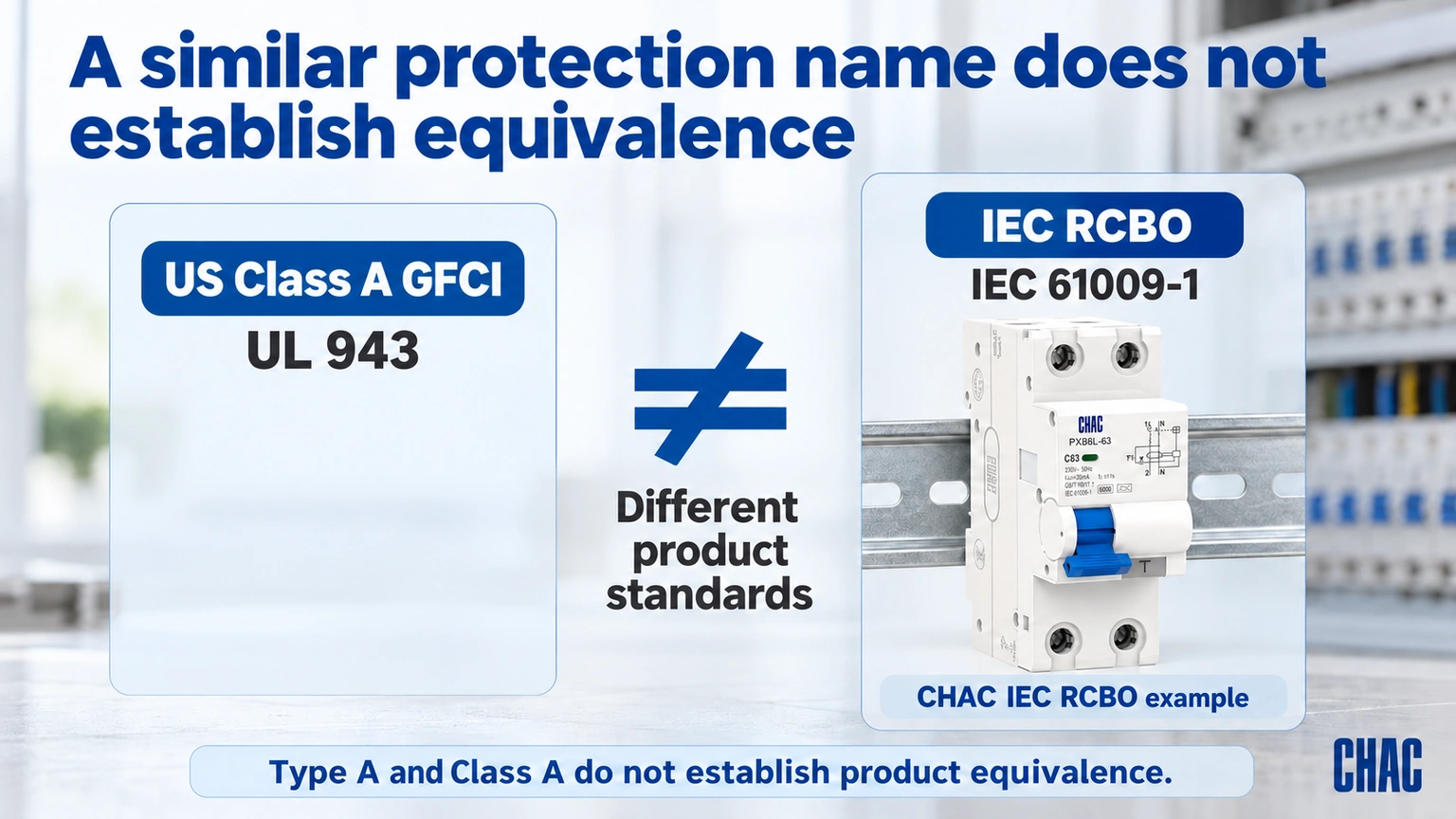
For international projects, compare the protection functions before comparing product names. CHAC publishes residual-current circuit breakers with overcurrent protection and separate Disjoncteurs miniatures. An IEC RCBO or a Type A residual-current device must not be described as a UL 943 Class A GFCI without the relevant product evidence. The words “Type A” and “Class A” do not establish equivalence.
What do buyers ask about GFCI protection?
What should not be plugged into a GFCI?
There is no universal appliance blacklist that justifies bypassing required GFCI protection. Check the equipment instructions, correct circuit and adopted rules; investigate repeated tripping rather than removing protection.
Do I need an electrician to replace a GFCI outlet?
Local rules determine who may perform the work, and correct isolation, LINE/LOAD identification and testing are essential. Use a qualified electrician when the circuit, supply, grounding or downstream arrangement is uncertain.
What causes GFCI outlet to trip?
A qualifying current imbalance can result from moisture, damaged insulation, leakage from connected equipment or wiring faults. A trip alone does not identify which cause is present.
What is a ground fault circuit interrupter?
It is a device that interrupts the protected circuit when its ground-fault detection conditions are met. For US personnel protection, verify the appropriate Class A device and product standard.
What is a ground fault circuit interrupter and how does it work?
It monitors the balance of current in the circuit conductors and operates when an imbalance meets its trip criteria. It does not replace all other forms of circuit or shock protection.
Where is a ground fault circuit interrupter required?
The adopted installation code and local amendments determine the required locations and circuits. Wet or damp locations are common contexts, but the answer also depends on occupancy, equipment and code edition.
Références
- Les dispositifs de protection contre les surtensions de Leviton pour la sécurité du personnel, comprenant des exemples de codes datés ; consulté le 19 octobre 2026
- Sorties et conteneurs GFCI de Leviton, guide d’auto-test et de dépannage ; consulté le 19 octobre 2026
- Raccords commerciaux GFCI de Leviton ; accès le 19 octobre 2026
Conclusion
GFCI means ground-fault circuit interrupter, and its purpose is to detect a qualifying current imbalance rather than simply a large load. Establish the required protection function before choosing between a receptacle, breaker or dual-function device. Then verify the circuit arrangement, panel compatibility, installation instructions and locally adopted code. Do not treat a successful reset as proof that an unexplained fault has disappeared, or substitute a differently standardized device because its name sounds similar. CHAC provides published MCB and RCBO information for projects evaluating IEC distribution products. That information supports a clearly specified comparison, while US Class A GFCI suitability still requires evidence for the exact device and intended installation.
Pour les dessins de modèle et la documentation de projet correspondants, contactez CHAC pour connaître les exigences du circuit.