Une commande d’un “ contacteur NC ” peut revêtir deux sens très différents : soit un contacteur doté d’un contact auxiliaire normalement fermé, soit un dispositif dont les contacts de puissance sont normalement fermés. Les confondre peut entraîner un comportement de commande erroné ou soumettre un petit contact auxiliaire à un circuit pour lequel il n’a jamais été dimensionné. Il convient donc de déterminer la configuration des contacts à partir du schéma électrique proprement dit, et non de l’interpréter à partir d’une photographie du produit. Ce guide explique l’état normal, distingue les fonctions de puissance et de commande, et indique comment spécifier la configuration des contacts, la bobine ainsi que les caractéristiques nominales, sans faire d’hypothèses infondées sur les systèmes d’interverrouillage ou les fonctions de sécurité.
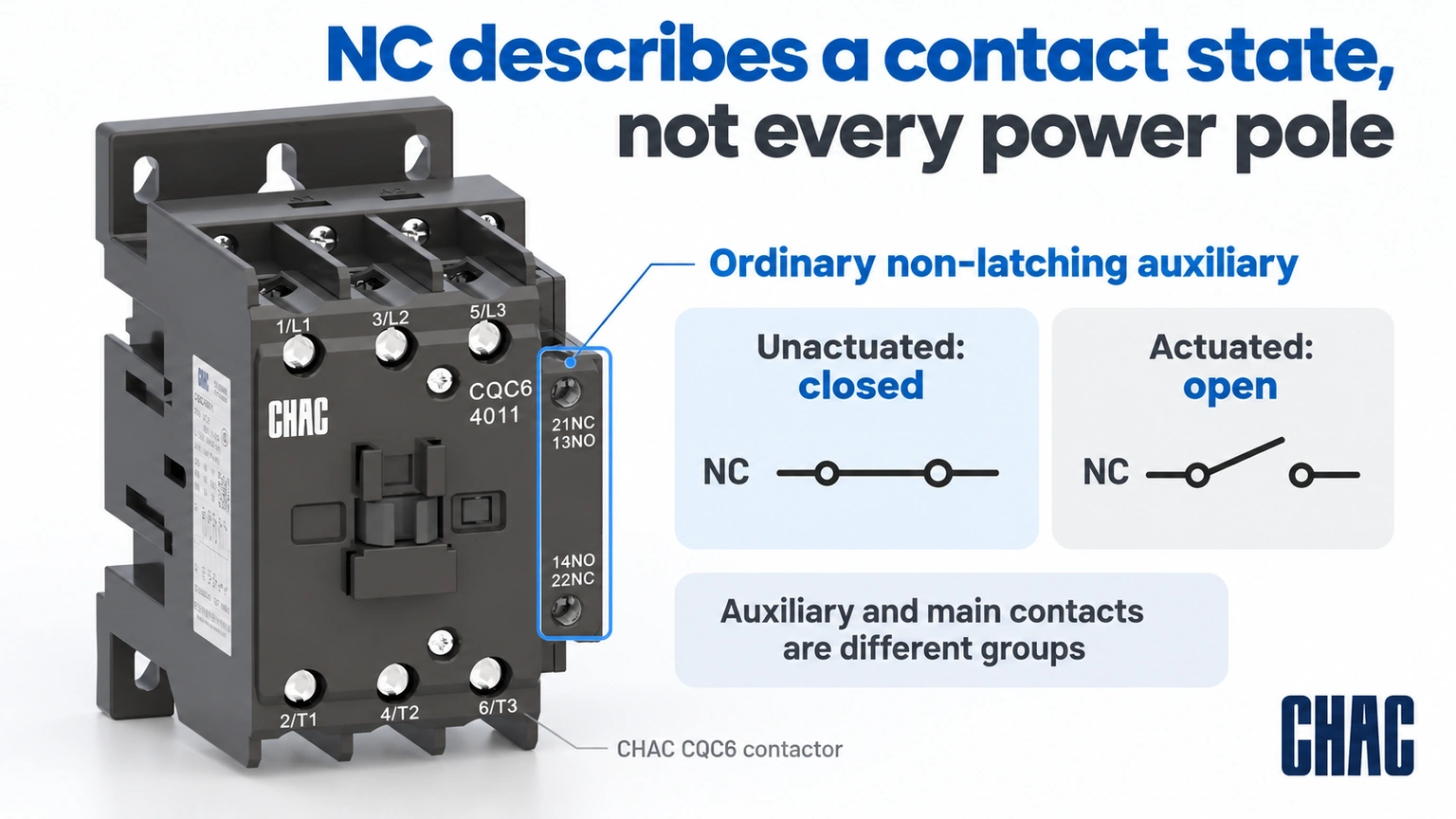
Un Contacteur à contacts normalement fermés La description doit être précisée. NC signifie « normalement fermé » : pour un dispositif électromagnétique ordinaire sans verrouillage, le contact indiqué est fermé à l’état normal de non-alimentation et s’ouvre lorsqu’il est actionné. La description pourrait ne concerner qu’un contact auxiliaire, tandis que les pôles principaux restent normalement ouverts. Vérifiez le schéma de connexion réel, le nombre de pôles, la catégorie d’utilisation et l’alimentation de la bobine. Ni les lettres NC ni un contact fermé au repos ne garantissent une fonction de sécurité, un état de défaillance contrôlée ni l’aptitude à supporter le courant du moteur.
Quel est l’état normal d’un contact NC ?
Dans un contacteur ordinaire sans verrouillage, l’état « normal » correspond à l’état non actionné et hors tension tel que décrit dans la documentation du dispositif. Un contact normalement ouvert est ouvert dans cet état ; un contact normalement fermé est fermé. Lorsque le mécanisme est activé, leurs états changent en fonction de la conception réelle.
Ne généralisez pas cette description simplifiée à tous les dispositifs de commutation à verrouillage, à maintien mécanique ou spécialisés. L’état mécanique mémorisé ou un mécanisme de fonctionnement différent peuvent modifier la manière dont le schéma doit être interprété. Référez-vous au schéma et à la notice de fonctionnement du fabricant plutôt que de supposer qu’une perte d’alimentation de la bobine ramène systématiquement chaque appareil à la même position.
| Description du contact | État ordinaire non actionné | Ce qui reste à vérifier |
|---|---|---|
| Auxiliaire normalement ouvert | Ouvrir | Classification de commande et circuit prévu |
| Auxiliaire normalement fermé | Fermé | Classification de commande et circuit prévu |
| Contact principal d'alimentation | Comme indiqué sur le schéma exact | Puissance, tension et courant |
| Dispositif à verrouillage ou dispositif spécialisé | Défini par son mécanisme et sa documentation | Réinitialiser le comportement et l’état stocké |
Un contact auxiliaire NC rend-il le circuit de puissance normalement fermé ?
Non. Les contacts principaux commutent la charge spécifiée ; les contacts auxiliaires assurent des fonctions de commande, d’indication ou de verrouillage, dans les limites de leurs caractéristiques nominales. Un contacteur de puissance à trois pôles normalement ouvert peut comporter un contact auxiliaire normalement fermé. Désigner l’ensemble du produit comme NF sans préciser le groupe de contacts fait perdre cette distinction.
Schneider Electric FAQ FA112430, modifié le 12, 2026, identifie 13–14 comme des contacts auxiliaires normalement ouverts et 21–22 comme des contacts auxiliaires normalement fermés sur les contacteurs TeSys D mentionnés. Il s’agit d’un exemple de famille de produits traçable, et non d’une autorisation à inférer la disposition des bornes d’un appareil sans lien avec celui-ci. Vérifiez le marquage et le schéma du modèle sélectionné.
Pourquoi les valeurs nominales des contacts auxiliaires diffèrent-elles des valeurs nominales des contacts principaux ?
Les groupes de contacts remplissent des fonctions différentes. Un contacteur de moteur peut avoir une puissance nominale de AC-3, tandis que ses contacts auxiliaires sont soumis à des valeurs nominales distinctes pour le circuit de commande. Le courant pertinent dépend également de la tension de fonctionnement et du fait que la charge de commande soit en courant alternatif ou en courant continu. Une valeur de courant thermique n’est pas une valeur nominale de commutation automatique pour une charge de commande inductive.
Pour contacts normalement fermés, Cela revêt une importance particulière lors du commutage d’une bobine, d’un indicateur ou d’un circuit d’entrée. Les charges d’entrée électroniques très faibles doivent également faire l’objet d’une vérification de la compatibilité avec la charge minimale des contacts. Le fait de choisir un contact uniquement parce que son courant nominal dépasse la charge en régime permanent peut conduire à ignorer à la fois les exigences relatives au service de commutation et celles relatives à la fiabilité aux faibles niveaux de signal.
Comment les contacts NC sont-ils utilisés dans les systèmes d’interverrouillage et de retour d’information ?
Un contact auxiliaire NC peut faire partie d’un interverrouillage électrique qui empêche la commande d’un contacteur lorsque l’autre est enclenché. Il peut également fournir un signal d’état interprété par un contrôleur. Le circuit réel et l’analyse des défaillances déterminent la signification de ce signal ; un simple état du contact auxiliaire ne constitue pas la preuve que tous les pôles principaux sont ouverts.
Lorsque la conception exige un verrouillage mécanique, des contacts en miroir, des contacts reliés mécaniquement ou une fonction certifiée pour la sécurité, procurez-vous la documentation justificative exacte. Une simple désignation NF ne garantit pas ces caractéristiques. De même, un signal de retour d’information ne doit pas être qualifié de “ sûr ” simplement parce qu’il change d’état lorsque l’alimentation de la bobine est coupée.
| Fonction proposée | Vérification pertinente | Ce que le NC à lui seul ne prouve pas |
|---|---|---|
| Verrouillage électrique | Actual sequence and compatible contact arrangement | Mechanical prevention of simultaneous closure |
| Controller feedback | Signal rating and interpretation | All power poles are positively open |
| Control-coil switching | AC/DC duty and contact rating | Motor-load switching capacity |
| Safety function | Required certified components and system design | A guaranteed safe state after any failure |
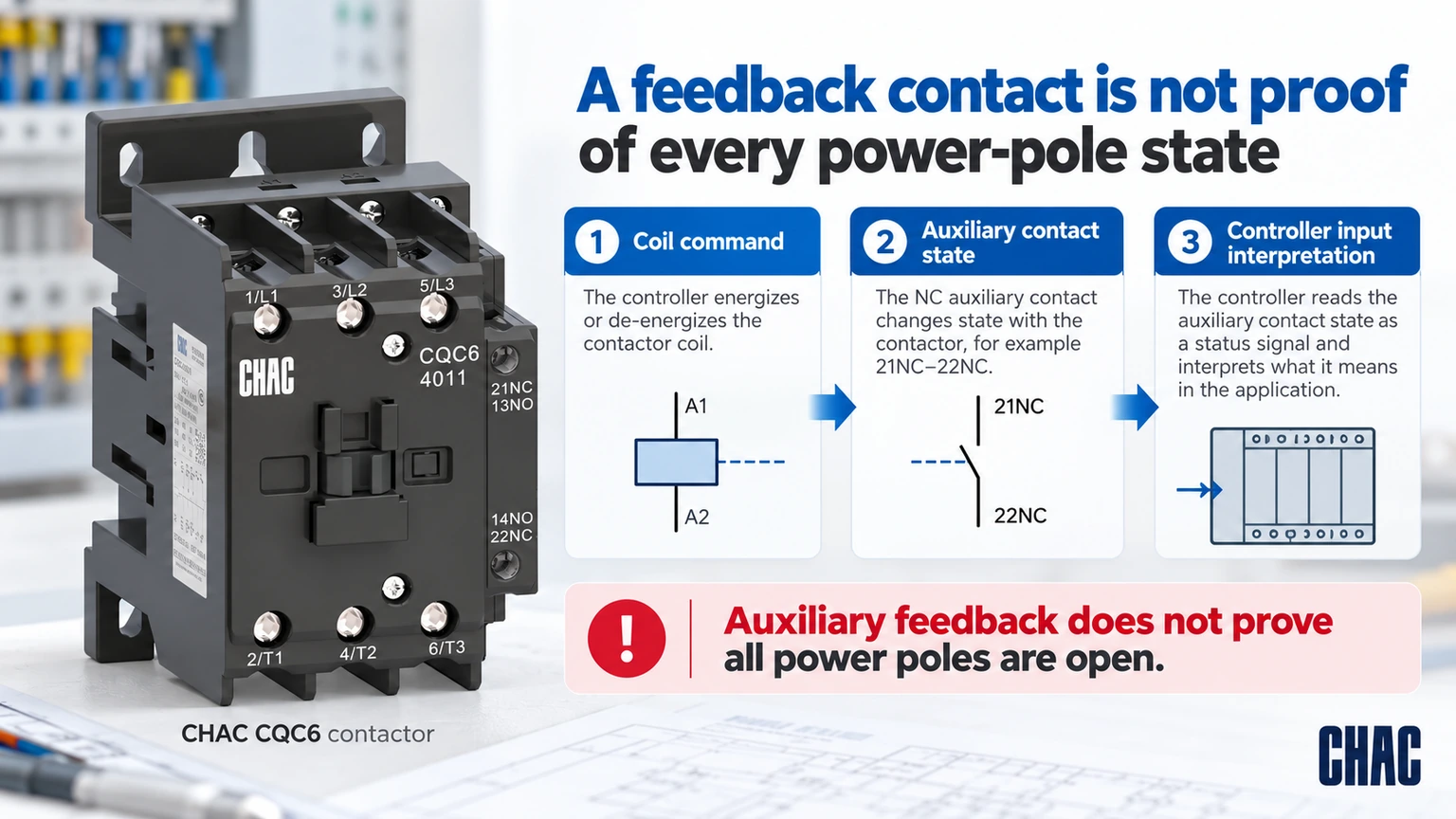
Why should the coil command, auxiliary state and controller input be checked separately?
They describe three different things: what the controller requests, what the contact mechanism does and what the input circuit reports. For a healthy ordinary non-latching NC auxiliary, the expected unactuated contact is closed and the actuated contact is open, as defined by its diagram. The PLC’s displayed zero or one also depends on its input wiring and logic; NC does not automatically mean a displayed zero.
Put those expected states beside the control drawing before the approved functional check. If the command changes but the reported state does not, investigate the actual coil supply, contact configuration, wiring and input interpretation rather than immediately declaring the main poles welded. The auxiliary’s behavior alone cannot establish the condition of every power contact. This separation is particularly useful after replacing a block or changing a controller program without changing the contactor body.
How should a buyer specify the contact configuration?
State the main power-pole arrangement separately from the auxiliary NO/NC count. Then specify operational voltage, utilization category, current, coil supply and the exact accessories. Schneider’s utilization-category guide, DOCA0189EN-05, shows why a contactor’s load duty is part of its selection. Its coordination guidance also makes clear that short-circuit behavior belongs to a documented combination, not to the NC label.
CHAC CQC6 auxiliary contact options include published F4 combinations such as F4-11 with 1NO + 1NC, F4-20 with 2NO and F4-02 with 2NC. These accessory descriptions do not convert the main poles into NC power contacts. Confirm the accessory’s compatibility and its own control ratings before ordering.
For related industrial switching requirements, review the CQC1 AC contactor family against its own model data. Do not infer an NC power variant from the availability of an auxiliary block in another series. The normally open versus normally closed contactor guide provides a related explanation of the operating-state distinction.
What should be rechecked when a suppression module or auxiliary block changes?
Review the expected transition as well as the final state. Coil suppression can affect how quickly stored energy decays after the control signal is removed. Durakool’s Note technique sur l’atténuation des bobines explains the release-time trade-off. Its relay examples do not supply a release-time specification for a CHAC contactor.
Use the exact contactor, accessory and control-output instructions to define the permitted behavior. Under an approved commissioning procedure, check the command sequence, contact feedback and any required interlock response. Do not invent a universal delay or increase a software timeout simply to hide unexplained feedback. Keep the accepted component references and control-program revision with the result. A final NC continuity check cannot establish that a timed interlock or safety-related sequence has been validated.
What should be checked before an NC contact is replaced?
Record the original diagram, accessory code and circuit function before removing the device. With the system properly isolated and stored energy addressed, qualified personnel can compare the contact behavior with the specified states and inspect for damage. A continuity check alone does not establish the contact’s permitted switching duty or overall service condition.
The replacement auxiliary contact block must preserve the intended logic as well as the mechanical fit. Check coil suppression and control timing where they affect the sequence. Investigate unexpected behavior rather than rewiring around an interlock or treating an NC contact as a universal substitute for a relay.
What do buyers ask about NC contactors?
What is a NC contactor?
It is an ambiguous shorthand that may mean a contactor with an NC auxiliary contact or a device with NC power contacts. Specify which contact group is meant and verify the actual diagram.
What is the difference between a NC contactor and a NO contactor?
NC and NO describe the stated contact’s normal unactuated condition. The main and auxiliary contacts may have different arrangements, so the complete device cannot always be described by one label.
What is a NO NC contactor switch?
The expression usually refers to a switching device or contact set with normally open and normally closed functions. Confirm the exact product, contact diagram and ratings rather than relying on the phrase.
What is the difference between NC and NO contacts?
For an ordinary non-latching device, an NC contact is closed at rest and an NO contact is open at rest. Actuation changes their states according to the device design.
What does nc contactor do in a control circuit?
An NC auxiliary may be used for interlocking, indication or control within its rating. Its presence does not prove a safety function or that the main power poles are normally closed.
How is nc contactor different from a relay?
NC describes a contact state that can appear in either product. Select a relay or contactor by its actual load duty, ratings, coil, configuration and required approvals.
Références
- Schneider Electric FA112430: TeSys D NO/NC auxiliary-terminal identification; modified May 12, 2026
- Schneider Electric DOCA0189EN-05: contactor utilization categories; accessed October 19, 2026
- Schneider Electric FA105974: short-circuit coordination; modified April 20, 2026
- Durakool: A Layman’s Guide to Coil Suppression; accessed October 19, 2026. Relay examples explain the mechanism, not CHAC contactor timing.
Conclusion
The useful distinction is between the state of a particular contact and the function of the complete switching device. Define whether NC refers to an auxiliary or a power contact, then verify the diagram, control or power duty, coil supply and compatible accessories. An NC contact can support an interlock or feedback circuit without establishing a certified safety function or proving that every main pole is open. Preserve the intended logic when replacing parts, and do not infer contact ratings from another group on the same device. CHAC publishes CQC6 auxiliary configurations and model-specific contactor information for this review. Using those records alongside the actual circuit drawing gives buyers a precise configuration to confirm instead of an ambiguous request for an NC contactor.