Imagine replacing a damaged appliance control board and then discovering that the home’s surge strip protected only a television. The air-conditioning controller and other hard-wired equipment had no comparable point-of-use device. This illustrative situation explains why the value of surge protection depends on coverage and installation, not simply the price of a power strip.
Résumé : A whole-home surge protector can be worthwhile where sensitive equipment and exposure justify the installed cost. Use it as part of layered protection, confirm the correct device for the electrical system and inspect its status as instructed. It cannot guarantee protection against every event or replace proper grounding and bonding.
Which electrical events can a whole-home surge protector address?
A surge protective device, or SPD, limits transient overvoltage by providing appropriate paths for surge current within its design. Transients can arrive from outside the building or arise from switching equipment inside it. The number of lightning storms is therefore not the only consideration when assessing exposure.
Surges also differ from sustained overvoltage, undervoltage and loss of supply. A device specified for transient suppression is not automatically a voltage regulator, backup power supply or remedy for a damaged neutral. An electrician should investigate recurring electrical symptoms rather than assuming an SPD will correct their underlying cause.
NEMA’s surge guidance distinguishes device types, application locations and ratings such as maximum continuous operating voltage, voltage protection rating and short-circuit current rating. These describe different aspects of performance. A large advertised surge-current number alone does not establish that a device is the best match for a particular panel.
The replacement value of vulnerable electronics is relevant, but it is not a prediction of future losses. List the equipment that matters: HVAC controls, appliances, networking equipment, security systems and home-office electronics. Then identify which loads are hard-wired and which can also receive local protection.
Why panel and point-of-use surge protection work together
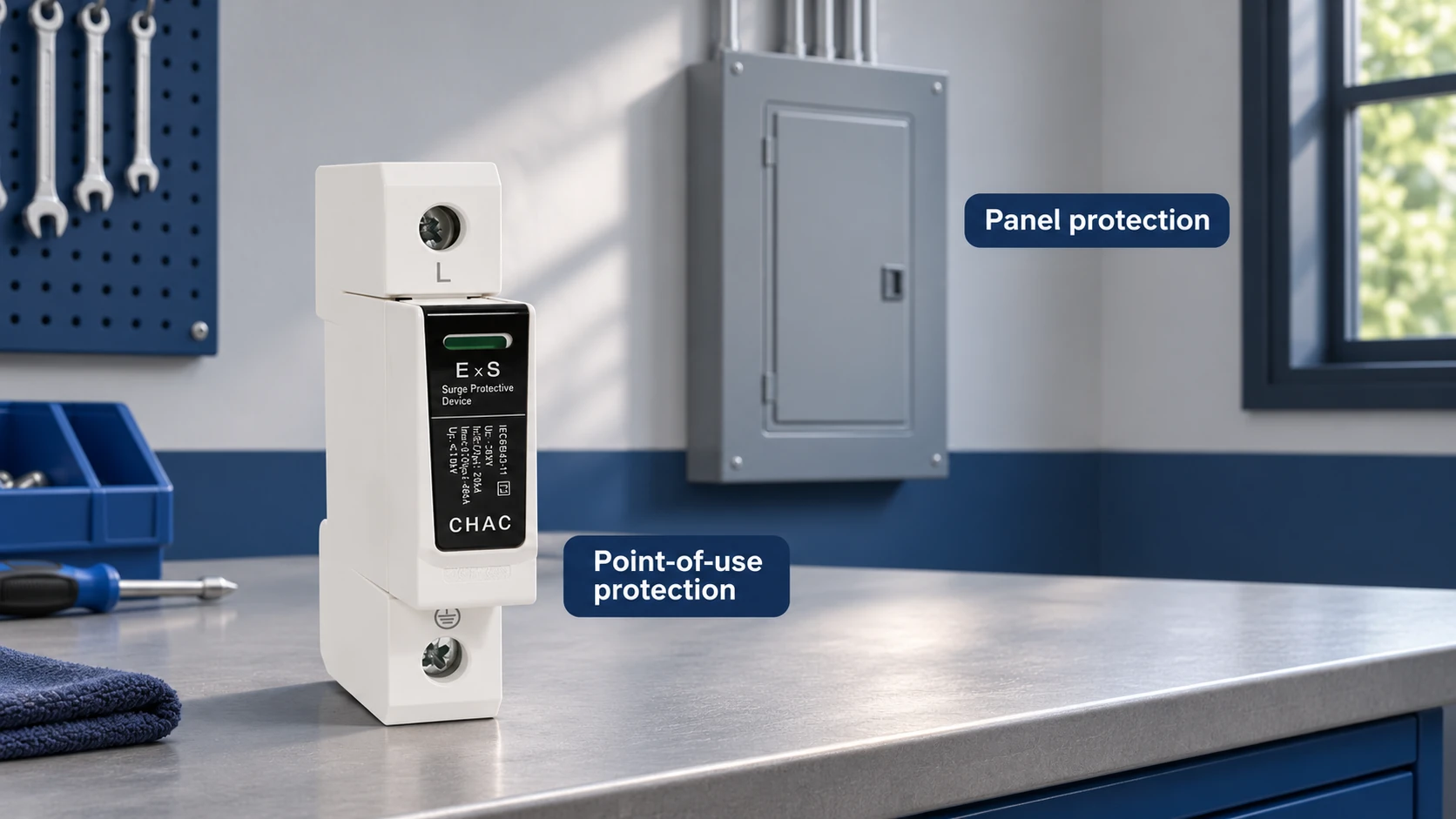
Layered protection combines a suitable service or distribution-panel SPD with appropriate protection close to sensitive equipment. The two locations have different jobs. The upstream device addresses surges at that installation point, while local devices can limit remaining exposure at connected equipment when applied correctly.
| Location | Useful role | Limitation to remember |
|---|---|---|
| Service or distribution panel | Protect connected circuits at a common distribution point | Installation details and downstream wiring affect results |
| Suitable point-of-use outlet device | Add local protection for connected electronics | Does not cover unrelated hard-wired loads |
| Communications or signal entry | Address relevant non-power entry paths with compatible devices | Power-circuit SPDs do not automatically protect signal wiring |
| Grounding and bonding system | Support the intended electrical and surge-protection arrangement | Cannot be replaced by adding a surge strip |
For a US installation, Type 1, Type 2 and Type 3 descriptions refer to defined applications under the relevant product framework. Follow the device’s instructions and required listing rather than selecting an installation point from the name alone. IEC type or class terminology should not be assumed to establish an identical listing or installation permission.
Keep communications pathways in the assessment. A computer connected to power and an external signal cable may have more than one exposure route. Protection must be compatible with each circuit and coordinated with the building’s bonding arrangement; an ordinary power strip cannot solve every pathway.
What should a whole-home surge protector installation quote include?
The installed quotation should identify the SPD model, permitted panel connection, required protective device if any, conductor arrangement, labor and inspection scope. Panel access, available space and necessary corrective work can change the total. A product-only online price is not directly comparable with a completed installation quotation.
Use a transparent cost exercise rather than a universal payback claim. For example, if a hypothetical installed quotation is $450 and one possible equipment repair is $900, the installation costs half that repair amount. This does not establish a two-year payback or a guaranteed saving: the likelihood of damage and the portion prevented remain unknown.
| Quotation item | Ask the electrician | Why it changes the comparison |
|---|---|---|
| System and panel compatibility | Is this exact model permitted for this supply and panel? | A similar voltage label alone is insufficient |
| Connection arrangement | What mounting and conductor route will be used? | Lead length and routing affect installed performance |
| Included work | Are labor, required components and inspection included? | Exclusions can make a low quotation misleading |
| Status and servicing | How will the owner check status and arrange replacement? | Maintenance access affects continuing usefulness |
| Coverage and warranty | What equipment and conditions are actually covered? | Warranty conditions are not a performance guarantee |
NEMA emphasizes installation practices because connection impedance can affect the voltage seen by equipment during a surge. Ask for a practical mounting plan, not just a specification sheet. The appropriate arrangement must still follow the manufacturer’s instructions and applicable electrical rules.
When should you check or replace a whole-home surge protector?
There is no dependable single lifespan for every whole-house surge protector. Exposure, device design, operating conditions and failure mode influence service life. A calendar estimate without those conditions can give false confidence. Check the status indication at the interval stated by the manufacturer and after significant events when instructed.
A status light is useful only when its meaning is understood. It may indicate protection availability, power presence or a particular failure condition depending on the product. Read the label and instructions before interpreting an illuminated indicator as proof that all protection modes remain functional.
A severe or direct lightning event can exceed the protection provided by an individual SPD. Buildings with relevant exposure may need a coordinated lightning-protection approach in addition to power and signal SPDs. No ordinary whole-home device should be sold as an absolute promise that every connected appliance will survive any strike.
There are practical downsides: initial cost, periodic checks, possible replacement and the need for correct installation. Those are manageable when included in the purchase decision. They become disappointing when a device is marketed as a permanent, maintenance-free cure for every electrical problem.
Check the SPD's approval for the destination market and electrical panel
For US residential work, verify the required UL 1449 listing and applicable adopted NEC requirements with the installer. An IEC-oriented SPD listing from another market is not proof of approval for that dwelling. Certification must attach to the exact offered model and configuration.
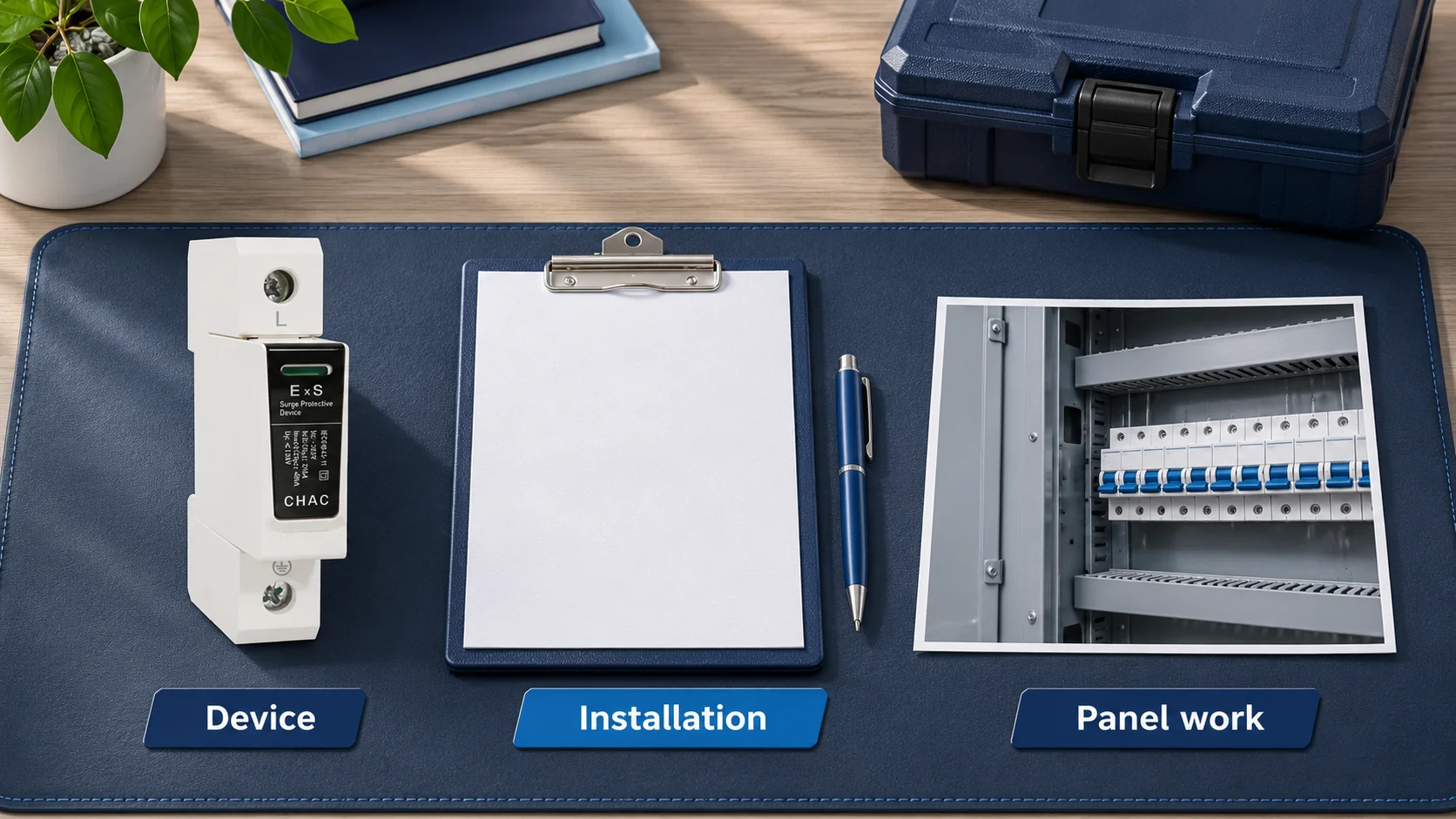
CHAC EXS-T1T2 AC surge protector is relevant to an AC SPD sourcing discussion. Its inclusion here does not claim that it is UL 1449-listed or approved for every US residential panel. Importers should identify the target market and obtain model-specific documents before approving an order.
For a broader explanation of device terminology, read what SPD means in electrical protection. A useful procurement brief then brings together the supply arrangement, intended mounting location, required approval and maintenance expectations. These details make competing offers easier to compare.
Common questions about the value and limits of whole-home surge protection
Do I really need a whole-house surge protector?
Its value depends on exposure, connected equipment and applicable installation requirements. It can protect circuits beyond those served by plug-in strips, including relevant hard-wired loads. Ask an electrician to assess the whole installation rather than deciding only from local storm frequency.
How much should a whole-house surge protector cost to install?
There is no reliable universal installed price. Compare quotations that include the exact device, panel work, required components, labor and any inspection. The $450 example above is a budgeting illustration, not a current market price survey.
What are the downsides of a whole-house surge protector?
It adds installation cost and may require checking and replacement. It also has defined limits and does not correct sustained supply problems. Properly setting expectations is as important as choosing the device.
What is the typical lifespan of a whole-house surge protector?
Service life varies with design, exposure and operating conditions. Follow the product’s status and replacement instructions instead of assuming a fixed number of years. A device can need attention sooner after a significant event.
Do I still need plug-in surge protectors with whole-house protection?
Appropriate point-of-use protection can complement a panel SPD for sensitive equipment. Follow each device’s instructions, including placement requirements. Do not connect surge strips in improvised chains to create additional outlets.
Will a whole-house surge protector protect against a direct lightning strike?
No individual SPD guarantees protection against every direct lightning event. Severe exposure may require a broader lightning-protection and bonding design. Treat whole-home surge protection as one part of risk reduction.
Which hard-wired appliances can benefit from whole-house surge protection?
Equipment such as HVAC controls, certain cooking appliances and other permanently connected electronic controls may benefit when served by the protected installation. Actual protection depends on the SPD arrangement and event. Confirm coverage with the electrician rather than assuming every circuit and signal path is included.
Références
- NEMA Surge Protection Institute: SPD application FAQs
- NEMA Surge Protection Institute: protection guidance
- NFPA 70: applicable edition information
Buy a defined protection plan, not a promise that nothing can fail. Contact CHAC about AC SPD sourcing with the destination market, supply arrangement and required product approvals.