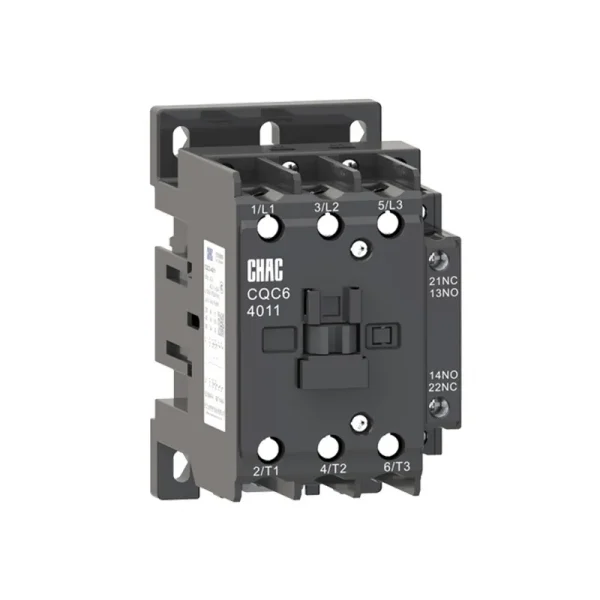
Calculateur de sélection de contacteurs — AC-1 / AC-3
Évaluez la puissance de contacteur AC et comparez les charges triphasées AC-3 avec les tableaux de courant et de puissance moteur CHAC CQC6 à 230, 400 ou 690 V.
Comparez une charge triphasée AC-3 avec les colonnes publiées de courant et de puissance moteur CQC6. AC-1 fournit une référence de courant pour une vérification sur une fiche technique distincte.
Résultat
Liste restreinte du tableau AC-3
CQC6-25Match de table uniquement ; aucune coordination des départs n’a été vérifiée.CQC6-25 est le premier modèle répertorié répondant à la fois aux exigences de courant AC-3 et de puissance moteur à 400 V.
I = Pshaft × 1,000 / (√3 × V × PF × η); compare AC-3 Ie et la puissance du moteur en kWLe match de référence CQC6 utilise à la fois les colonnes du courant publié et des kW à la tension sélectionnée. Confirmez le courant nominal réel, la tension de la bobine, le service de démarrage, la fréquence de commutation et la coordination avant de commander.
Pourquoi ce résultat ?
Obligatoire AC-3 Ie ≥ 20.75 A ; puissance nominale du moteur ≥ 11 kW. Le courant est estimé à partir de la puissance sur l’arbre, du facteur de puissance et du rendement.
Référence sélectionnée et options adjacentes répertoriées. Les valeurs sont arrondies pour l’affichage ; les vérifications utilisent des valeurs non arrondies.
| Contrôleur | AC-3 actuel | Puissance moteur à 400 V | Motif |
|---|---|---|---|
| CQC6-18 | 18.00 A · Exigence ci-dessous | 7.5 kW · Exigence ci-dessous | AC-3 courant inférieur aux exigences ; puissance nominale du moteur inférieure aux exigences |
| CQC6-25Référence sélectionnée | 25.00 A · Répond à l'exigence | 11 kW · Répond aux exigences | Premier match inscrit pour ces contrôles |
| CQC6-32 | 32.00 A · Répond à l'exigence | 15 kW · Répond aux exigences | Chèques honorés ; option répertoriée ultérieurement |
Voir toutes les options vérifiées de 12
| Contrôleur | AC-3 actuel | Puissance moteur à 400 V | Motif |
|---|---|---|---|
| CQC6-6 | 6.00 A · Exigence ci-dessous | 2.2 kW · Exigence ci-dessous | AC-3 courant inférieur aux exigences ; puissance nominale du moteur inférieure aux exigences |
| CQC6-9 | 9.00 A · Exigence ci-dessous | 4 kW · Exigence ci-dessous | AC-3 courant inférieur aux exigences ; puissance nominale du moteur inférieure aux exigences |
| CQC6-12 | 12.00 A · Exigence ci-dessous | 5.5 kW · Exigence ci-dessous | AC-3 courant inférieur aux exigences ; puissance nominale du moteur inférieure aux exigences |
| CQC6-18 | 18.00 A · Exigence ci-dessous | 7.5 kW · Exigence ci-dessous | AC-3 courant inférieur aux exigences ; puissance nominale du moteur inférieure aux exigences |
| CQC6-25Référence sélectionnée | 25.00 A · Répond à l'exigence | 11 kW · Répond aux exigences | Premier match inscrit pour ces contrôles |
| CQC6-32 | 32.00 A · Répond à l'exigence | 15 kW · Répond aux exigences | Chèques honorés ; option répertoriée ultérieurement |
| CQC6-38 | 38.00 A · Répond à l'exigence | 18.5 kW · Meets requirement | Chèques honorés ; option répertoriée ultérieurement |
| CQC6-40 | 40.00 A · Meets requirement | 18.5 kW · Meets requirement | Chèques honorés ; option répertoriée ultérieurement |
| CQC6-50 | 50.00 A · Meets requirement | 22 kW · Meets requirement | Chèques honorés ; option répertoriée ultérieurement |
| CQC6-65 | 65.00 A · Meets requirement | 30 kW · Meets requirement | Chèques honorés ; option répertoriée ultérieurement |
| CQC6-80 | 80.00 A · Meets requirement | 37 kW · Meets requirement | Chèques honorés ; option répertoriée ultérieurement |
| CQC6-95 | 95.00 A · Meets requirement | 45 kW · Meets requirement | Chèques honorés ; option répertoriée ultérieurement |
Encore à confirmer
- Confirm coil supply, actual nameplate data and switching duty.
- Ambient derating, endurance and short-circuit coordination have not been verified.
Source des données : CHAC CQC6 AC-3 rating table (s’ouvre dans une nouvelle fenêtre)
Formule et méthode
Évaluez la puissance de contacteur AC et comparez les charges triphasées AC-3 avec les tableaux de courant et de puissance moteur CHAC CQC6 à 230, 400 ou 690 V.
Comment utiliser cette calculatrice
- Choose AC-3 for normal squirrel-cage motor starting/stopping, or AC-1 for a suitable non-inductive load.
- Use the stated line voltage and shaft power for AC-3. Enter actual nameplate current when available.
- Compare the table shortlist with the exact variant, control-coil voltage and required switching duty.
Limites de calcul
Three-phase reference only. AC-4, reversing, plugging, frequent inching, capacitor switching, derating and tested starter coordination are not assessed. AC-1 gives a numeric Ie comparison without model selection.
Contactor sizing for AC-1 and AC-3 loads
A contactor’s AC-3 operating current depends on voltage and utilization duty. This tool reads the published CQC6 current and three-phase motor-kW columns at 230, 400 or 690 V. It checks both columns; a matching ampere value alone is insufficient.
Notes de saisie
| Entrée | Qu’est-ce qu’il faut vérifier |
|---|---|
| AC-3 or AC-1 | AC-3 uses shaft output and efficiency. AC-1 uses electrical input and gives an operational-current reference without selecting a model. |
| Nameplate current | A positive entry overrides the calculated current. The entered shaft kW still remains part of the AC-3 table check. |
| Voltage and allowance | Select the table’s line-voltage column. A user allowance changes the current reference; it is not a universal required margin. |
Exemple de travail · Valeurs initiales des formulaires
11 kW three-phase motor at 400 V
AC-3 · PF 0.85 · efficiency 90% · no current override · allowance 1.00
I = 11,000 / (√3 × 400 × 0.85 × 0.90) = 20.75 A
At 400 V, CQC6-25 lists AC-3 Ie 25 A and motor output 11 kW.
CQC6-25
This is the first loaded table row meeting both entered conditions. Confirm the actual motor nameplate, coil supply, switching rate and installation duty.
Contactor sizing: motor current, voltage and duty
Start with the motor nameplate current at the intended supply voltage. When only shaft output is known, estimate three-phase current as I = P × 1,000 / (√3 × V × PF × η), using efficiency η as a decimal. A lower power factor or efficiency increases the estimated current for the same shaft kW.
For an AC-3 shortlist, compare that current and the motor output with the same voltage column in the contactor table. At 400 V, an 11 kW motor in this example draws 20.75 A; CQC6-25 meets both the 25 A operational-current rating and the 11 kW motor rating. A current-only comparison would miss the second requirement.
AC-1 vs AC-3: choose the utilization category first
AC-1 covers non-inductive or slightly inductive loads, such as resistance heating. AC-3 applies to starting squirrel-cage motors and switching them off while running. These duties impose different making and breaking demands, so one contactor can have different ratings for each category.
For AC-1, compare the load with an operational Ie rating explicitly declared for the application. Conventional thermal current Ith describes a different test condition. This calculator does not turn an Ith value into an AC-1 model recommendation.
An AC contactor’s coil voltage is a separate choice
The main contacts carry the load; the coil belongs to the control circuit. A 400 V motor supply does not by itself specify the coil voltage. Check the available control supply, AC or DC coil type, frequency where applicable, auxiliary contacts and mounting arrangement.
Use the model result to open the CQC6 technical data and complete those checks. Frequent jogging, plugging, reversing or capacitor switching needs its own duty assessment rather than the normal AC-3 selection used here.
What the table match does not decide
- Conventional thermal current Ith is not interchangeable with operational current Ie. The published AC-1-labelled thermal row is deliberately not used to choose AC-1 models.
- Starting/stopping duty, AC-4 operation, electrical endurance, ambient derating and short-circuit coordination still require the exact product instructions.
Foire aux questions
Why can the same contactor have a lower current at 690 V?
Operational current is voltage- and duty-specific. The CQC6 table lists separate AC-3 columns; the calculator does not carry a 400 V current value into the 690 V column.
Does AC-3 cover reversing or frequent inching?
Do not assume so. Plugging, inching and some reversing duties require a different utilization assessment. This tool is limited to normal AC-3 motor starting and stopping.
Can I enter the actual motor current?
Yes. Enter a positive nameplate current to replace the power-based estimate. Keep the correct shaft kW so the motor-power column is also checked.
Why is there no AC-1 model result?
The available source row is conventional free-air thermal current. The tool instead compares your current with an entered, independently verified AC-1 operational Ie.
What is a contactor used for in a motor circuit?
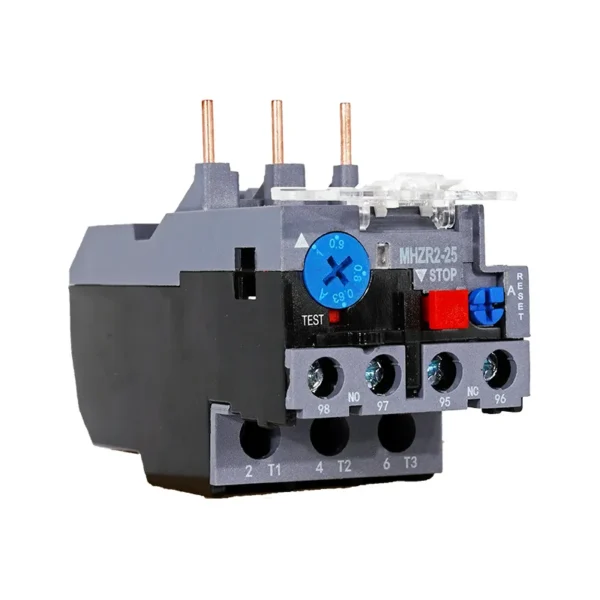
A contactor switches the motor supply through electrically operated main contacts. Its coil is controlled by the control circuit. It does not replace the overload relay or the short-circuit protective device.
Does the motor voltage determine the contactor coil voltage?
No. Main-circuit voltage and coil supply are separate specifications. Check the actual control voltage, coil type and frequency where applicable when ordering the selected contactor.
Vous avez besoin d'aide pour choisir un produit CHAC ?
Envoyez-nous le voltage du système, la charge électrique et les conditions d’installation avec votre demande.
CQC6 AC contactor ratings
Published AC-3 operational current and controlled three-phase squirrel-cage motor power. The voltage groups below retain the labels used in the CHAC product table.
Données de référence. Effectuez le calcul pour mettre en évidence la ligne correspondante.
Faites défiler horizontalement sur les petits écrans pour afficher toutes les colonnes.
| Numéro de modèle | 220V/230V | 380V/400V | 660V/690V | |||
|---|---|---|---|---|---|---|
| AC-3 Ie (A) | Motor power (kW) | AC-3 Ie (A) | Motor power (kW) | AC-3 Ie (A) | Motor power (kW) | |
| CQC6 -6Référence actuelle | 6 | 1.5 | 6 | 2.2 | 4.8 | 3 |
| CQC6 -9Référence actuelle | 9 | 2 | 9 | 4 | 6.6 | 5.5 |
| CQC6 -12Référence actuelle | 12 | 3.5 | 12 | 5.5 | 8.9 | 7.5 |
| CQC6 -18Référence actuelle | 18 | 4 | 18 | 7.5 | 12 | 10 |
| CQC6 -25Référence actuelle | 25 | 6 | 25 | 11 | 18 | 15 |
| CQC6 -32Référence actuelle | 32 | 7.5 | 32 | 15 | 20.2 | 18.5 |
| CQC6 -38Référence actuelle | 38 | 9 | 38 | 18.5 | 20.2 | 18.5 |
| CQC6 -40Référence actuelle | 40 | 11 | 40 | 18.5 | 34 | 30 |
| CQC6 -50Référence actuelle | 50 | 15 | 50 | 22 | 39 | 33 |
| CQC6 -65Référence actuelle | 65 | 18.5 | 65 | 30 | 42 | 37 |
| CQC6 -80Référence actuelle | 80 | 22 | 80 | 37 | 49 | 45 |
| CQC6 -95Référence actuelle | 95 | 25 | 95 | 45 | 49 | 45 |
Lire cette référence
- The calculator uses the 230, 400 or 690 V selection within the corresponding published voltage group.
- This table covers AC-3 only. The separate conventional free-air thermal current row is not an AC-1 operational Ie selection table.
- Confirm the exact coil supply, switching duty and installation conditions in the product documentation.
Source : CHAC CQC6 product technical table (s’ouvre dans une nouvelle fenêtre)
Source vérifiée : . Il s’agit de la date de récupération, et non d’une date d’édition standard ou de révision du produit.
Exemple d'application · Informations illustratives
Matching a 15 kW motor to both CQC6 AC-3 columns
For a pump-control example, enter 15 kW shaft output, 400 V, AC-3 duty and an illustrative 28 A nameplate current, with no added current allowance. The calculator shortlists CQC6-32: the CHAC table lists 32 A and 15 kW in the 380V/400V group. CQC6-25 is below both requirements at 25 A and 11 kW. This is why checking only the model’s ampere value can be misleading. Use the table match to continue the selection, then confirm the coil supply, switching duty, installation conditions and required protection for the actual motor circuit.
Données du produit : Fabricant OEM de contacteurs industriels AC de la série CQC6
Produits connexes de CHAC
Open the CQC6 ratings and CQR2 pairing tables to continue the motor-circuit selection.