Quando un supervisore della manutenzione ad Atlanta ha collegato due stufe portatili a un circuito da 20 amp, la presa rimaneva fredda, ma l’interruttore si è aperto dopo un funzionamento prolungato. La prima ipotesi è stata quella di un interruttore difettoso; un’analisi più approfondita ha rivelato che il carico nominale complessivo, il funzionamento continuo e la condivisione del circuito erano le vere cause.
Riepilogo: A 120 volt, un circuito da 20 ampere ha una potenza teorica di 2,400 watt, calcolata come tensione moltiplicata per la corrente. Per un tipico limite del 80 percento a carico continuo, i progettisti spesso considerano 1,920 watt come il tetto massimo per i carichi che si prevede funzionino per tre ore o più. La risposta a come molti watt su un circuito amplificatore 20 dipende ancora dalla tensione, dalla portata in ampere del conduttore, dalle istruzioni dell’apparecchiatura, dalle condizioni ambientali e dal NEC adottato a livello locale.
In che modo la tensione, la corrente e il ciclo di lavoro influiscono sulla potenza in watt?
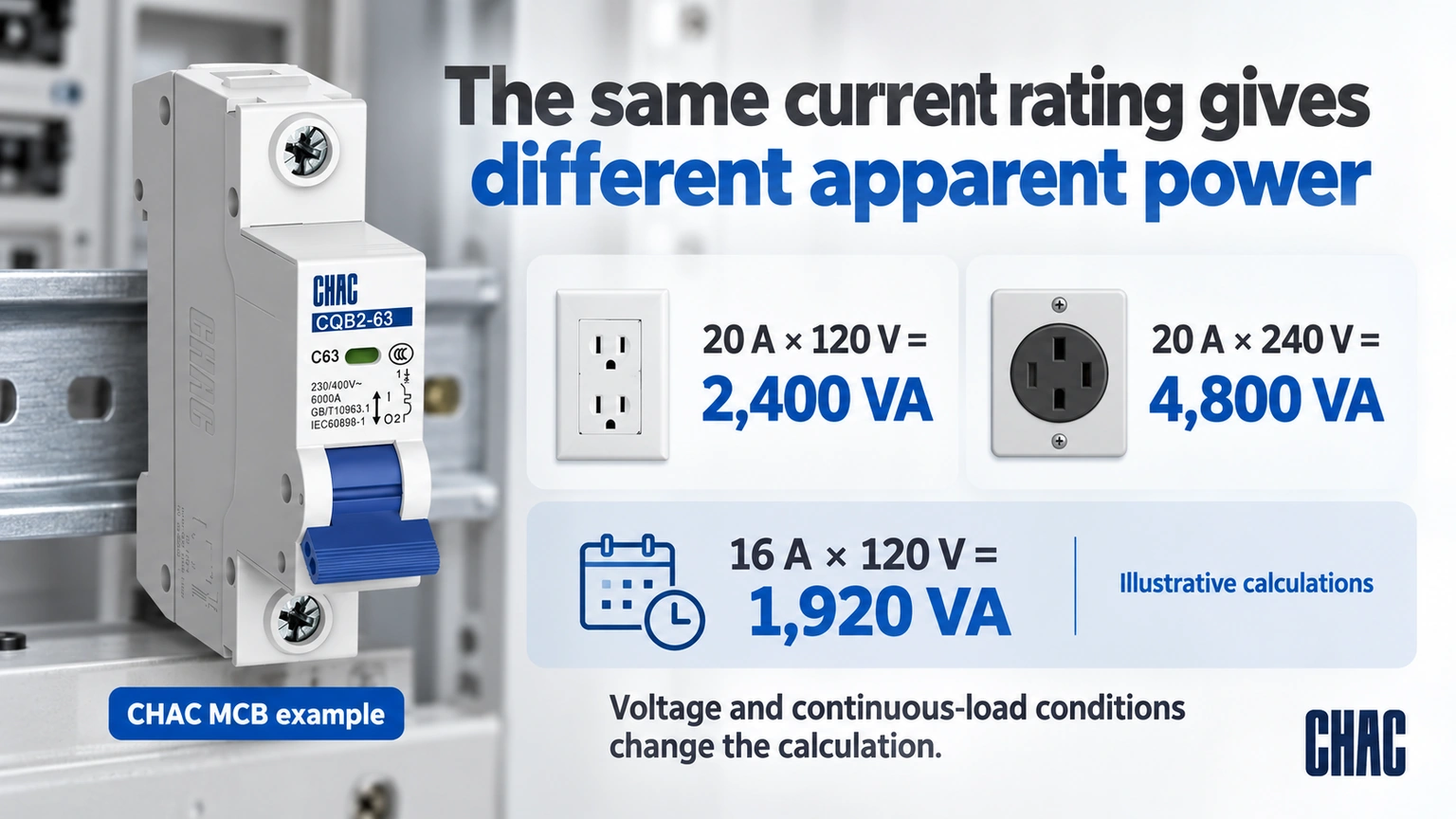
La potenza in watt non è una caratteristica fissa dell'interruttore. Per un carico resistivo, utilizzare la formula P = V x I; per motori, alimentatori elettronici ed apparecchiature HVAC, tenere poi conto del fattore di potenza e dell'efficienza. Un circuito monofase da 20 ampère e 120 volt corrisponde nominalmente a 2,400 VA, mentre un circuito monofase da 20 ampère e 240 volt corrisponde nominalmente a 4,800 VA. La configurazione dei poli dell'interruttore e la targhetta dell'apparecchiatura devono corrispondere all'alimentazione.
La NEC 210.20(A) richiede in genere che il dispositivo di sovracorrente del circuito derivato sia dimensionato almeno al 125 percento del carico continuo più il carico non continuo. Ecco perché un circuito da 20 ampere viene spesso progettato per gestire circa 16 ampere di corrente continua, ovvero 1,920 watt a 120 volt, piuttosto che i teorici 2,400 watt. Le modifiche locali e le norme specifiche per l’apparecchiatura determinano la progettazione finale.
| Fase di calcolo | Esempio su 120 V | Cosa verificare |
|---|---|---|
| Capacità nominale del circuito | 20 A x 120 V = 2,400 VA | Tensione di alimentazione effettiva e disposizione dei poli |
| Valore della pianificazione continua | 16 A x 120 V = 1,920 VA | Se il carico soddisfa la definizione di continuo |
| Carichi misti | Riscaldatore più strumenti o elettronica | Funzionamento simultaneo e corrente di spunto |
| Verifica della caduta di tensione | A lungo termine può ridurre le prestazioni utili. | Lunghezza, resistenza del conduttore e caduta di tensione nominale |
Possono funzionare contemporaneamente due riscaldatori da 1,500 watt?
Due riscaldatori da 1,500 watt assorbono 3,000 watt a 120 volt, ovvero 25 ampere, prima di qualsiasi altro carico. Ciò supera la soglia di un interruttore da 20 ampere e normalmente provoca l'apertura del circuito. Persino un singolo riscaldatore da 1,500 watt consuma circa 12.5 ampere, lasciando una capacità limitata per altre apparecchiature; se funziona in modo continuativo, il valore di progettazione del 80 percento diventa rilevante.
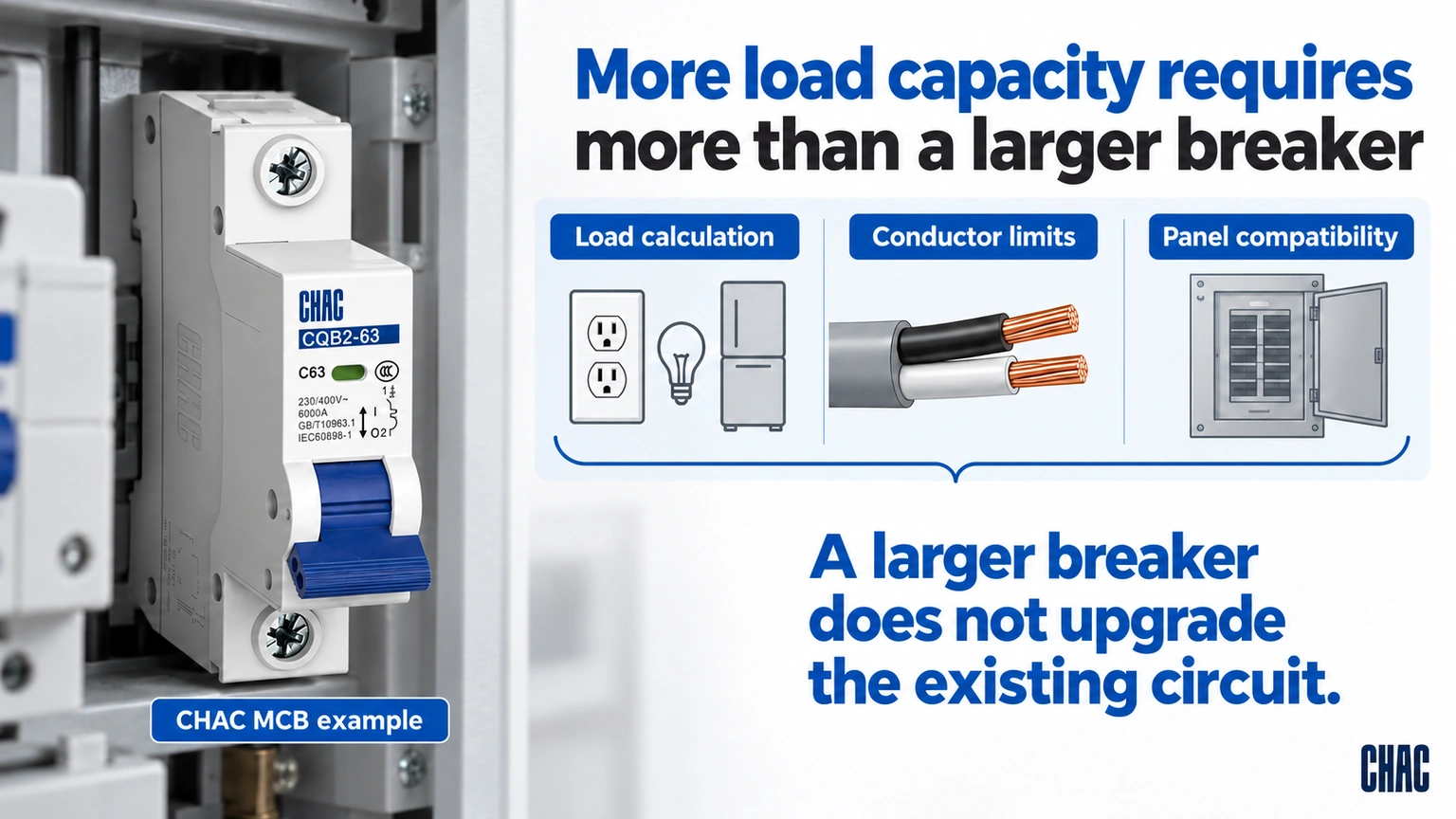
Do not solve an overload by installing a larger breaker. The conductor, receptacles, panel bus, and wiring method may be rated only for 20 amps. Instead, separate the heaters onto correctly designed circuits, reduce simultaneous demand, or follow the equipment manufacturer’s installation instructions.
How do wire gauge, distance and material affect wattage?
12 AWG copper is commonly associated with 20 amp branch circuits, but the complete ampacity calculation still applies. A 20 amp breaker protects the conductor; it does not authorize any 12 AWG cable in any environment. Ambient heat, bundling, insulation temperature, terminals, and cable type can change the answer.
Voltage drop becomes more visible as distance increases. Informational guidance often targets 3 percent on a branch circuit and 5 percent for the feeder-plus-branch path. Use the actual route and load current. A larger conductor may improve voltage at a distant motor or heater, while a longer extension cord can create heating and performance problems even when the breaker does not trip.
| Load type | Wattage behavior | Planning concern | Better check |
|---|---|---|---|
| Resistive heater | Near nameplate watts at rated voltage | Continuous operation and thermal load | 125 percent continuous-load calculation |
| Motore o compressore | Starting current exceeds running current | Nuisance trips and voltage sag | Nameplate, locked-rotor data, start method |
| Electronic equipment | Power factor and harmonics vary | Shared neutral and waveform effects | Manufacturer data and measured demand |
| Mixed receptacle circuit | Users can add loads unpredictably | Unknown simultaneous demand | Load schedule and dedicated circuits |
Protection and panel coordination
Check the breaker interrupting rating, panel compatibility, receptacle rating, grounding path, and AFCI or GFCI requirements for the location. Test devices using the manufacturer’s procedure. A residual-current device detects imbalance; an overcurrent breaker responds to excessive current. Some products combine functions, but the data sheet must say so.
For an organized panel, a listed 20 amp miniature circuit breaker can be matched to a suitable enclosure such as the CQMG20B distribution box. Where leakage protection is required, review a product such as the PXB6L-63 RCBO only after confirming system voltage, pole count, residual-current type, and local requirements.
Standards and a practical selection method
Use the adopted NFPA 70 NEC for U.S. work. IEC 60898-1 addresses certain Interruttore di circuito requirements, while IEC 61009-1 covers residual-current circuit breakers with integral overcurrent protection. A standard’s scope matters: a product standard is not a blanket approval for a building installation.
Before buying, record every load, its voltage, running current, duty cycle, starting behavior, and manufacturer instructions. Calculate conductor ampacity and voltage drop, then check the breaker and panel listings. Keep the calculation and inspection record so future operators understand the actual capacity rather than relying on a wattage guess.
Domande frequenti
Can I run two 1500 watt heaters on a 20 amp breaker?
No, not on a 120 volt 20 amp circuit. Together they draw about 25 amps, which exceeds the breaker rating and the conductor design. Use separately designed circuits or reduce the simultaneous load.
Can a 20 amp breaker handle 1800 watts?
At 120 volts, 1,800 watts is about 15 amps. It may fit a 20 amp circuit if the conductor, receptacle, ambient conditions, and duty cycle are suitable; continuous operation still needs the 125 percent calculation. Check other loads on the same circuit.
How far can I run 12/2 wire on a 20 amp breaker?
There is no single distance limit. Calculate voltage drop with the actual route and current, and apply ampacity corrections for the wiring method. A long run may justify a larger conductor while retaining a 20 amp protective device.
Can I run 240V on a 20 amp breaker?
Yes, when the panel, two-pole breaker, wiring, disconnects, and load are all rated for 240 volts. A 20 amp, 240 volt circuit has a different wattage capacity than a 120 volt circuit. Follow the equipment nameplate and local code.
What wire size is normally used for how many watts on a 20 amp circuit?
12 AWG copper is a common reference for a 20 amp branch circuit, but wattage alone does not select wire. Ampacity, installation conditions, terminals, and voltage drop still govern. Have the final circuit reviewed by a qualified electrician.
How does copper compare with aluminum for how many watts on a 20 amp circuit?
Conductor material changes resistance, ampacity, termination, and sometimes the practical gauge. Use the correct table and listed lugs; do not swap aluminum for copper at the same gauge without recalculating. Follow preparation and torque instructions.
Quali fonti ufficiali devono verificare gli acquirenti?
The useful answer is not a single watt number; it is a documented load calculation that respects voltage, duty cycle, wiring, and protection. For coordinated 20 amp protection, review CHAC Electric’s 20 amp breaker options with your schedule and contact the technical team when product documentation must match a specific market.