In an illustrative maintenance call, two motor starters carry the same current rating but use different coil voltages and auxiliary contacts. The technician finds the correct-sized spare yet cannot complete the replacement without checking the control circuit. The delay comes from an incomplete equipment standard, not necessarily a faulty spare.
Riepilogo: Il principale motor control center standardization benefits come from repeatable documentation, approved component choices, sensible spares and familiar service procedures. Standardize what can safely be shared, while preserving application-specific fault duty, motor protection and environmental requirements. Similar-looking MCC buckets are not automatically interchangeable.
How consistent MCC records and approved spares simplify maintenance
A useful standard tells maintenance staff what to expect before they open the drawing set. It defines device identification, drawing references, approved component families, control-voltage conventions and the records required after a change. Buying the same enclosure color or using the same label style is only a small part of that work.
Start with an asset register for the installed motor control centers. Record lineup manufacturer, series, year or generation where known, incoming supply, bus ratings, available fault current and unit functions. Then connect each motor circuit to its starter, overload device, protective device and control drawings.
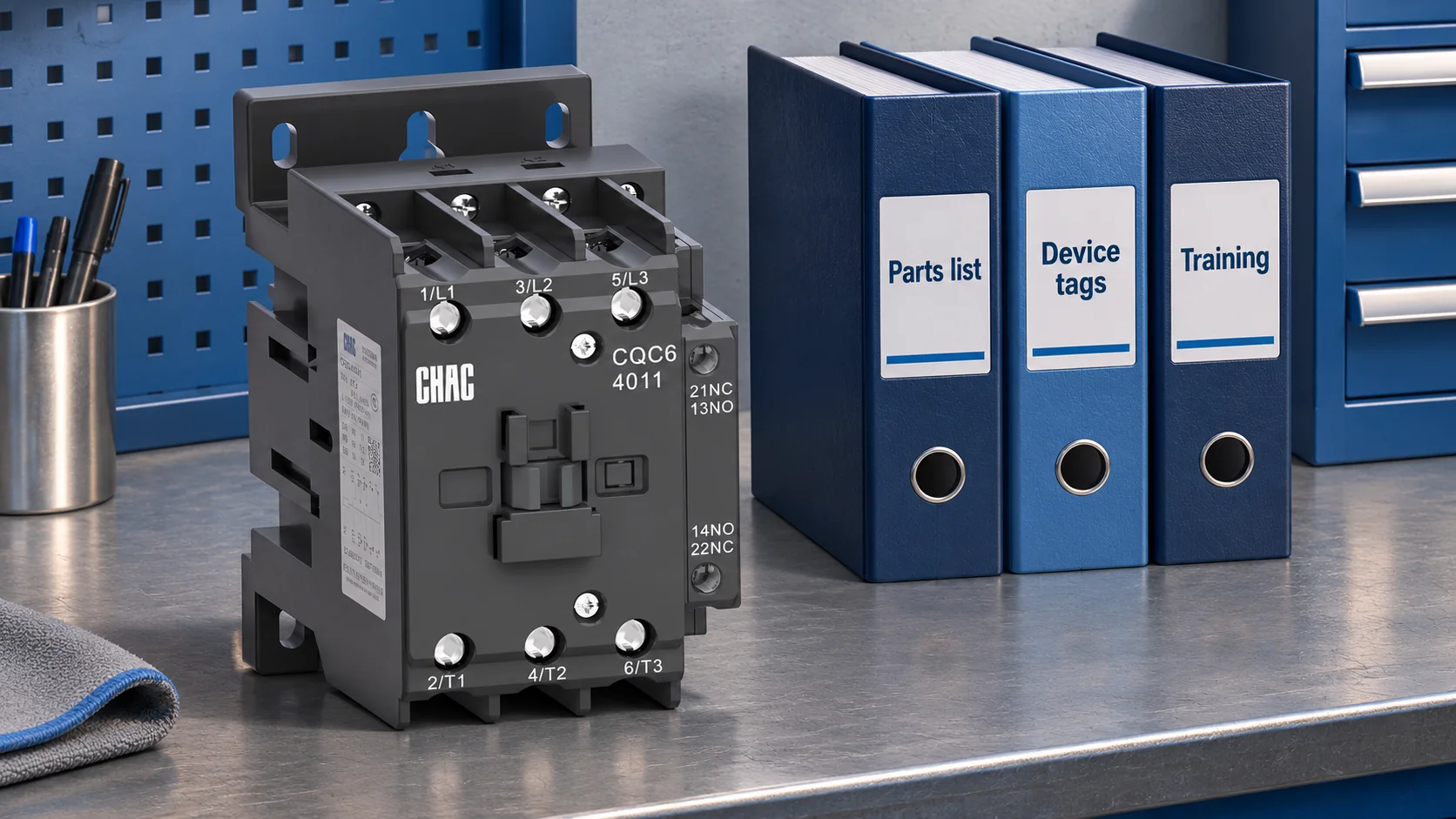
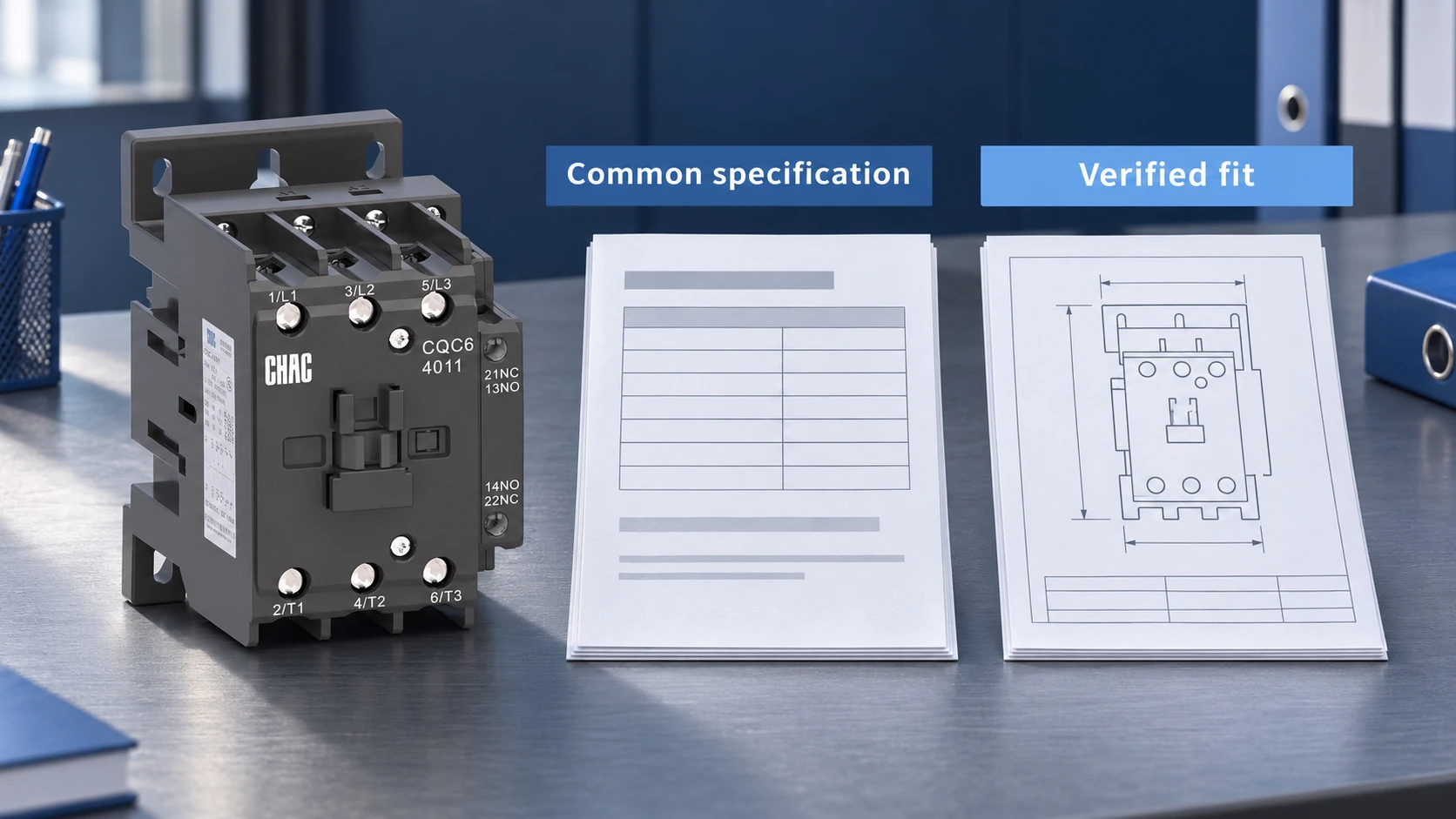
For spare parts, separate components that are truly common from those that merely share a frame size. A contactor may need the correct coil voltage, frequency, contact arrangement and utilization category. An overload device must suit the motor and starter arrangement. Stocking one superficially similar part cannot replace this compatibility check.
| Item to standardize | Practical benefit | Keep application-specific |
|---|---|---|
| Device tags and drawing references | Faster navigation between equipment and documents | Actual circuit function and location |
| Approved starter components | Clearer purchasing and spare-parts decisions | Duty, ratings and tested combinations |
| Control-voltage conventions | Fewer avoidable coil and interface mismatches | Existing system constraints and approved exceptions |
| Test and handover records | Repeatable acceptance evidence | Required tests for each circuit and assembly |
| Training and service procedures | More consistent maintenance decisions | Equipment-specific hazards and isolation steps |
Inventory policy should reflect consequence as well as quantity. A rarely used component may deserve a spare if its failure stops a critical process and replacement lead time is long. Conversely, stocking many versions of an obsolete part without a replacement plan ties up money without solving the underlying support problem.
Why similar MCC buckets are not automatically interchangeable
An MCC bucket is an assembly with mechanical and electrical interfaces. Physical height and width are only the first checks. Bus connections, contact engagement, shutters, interlocks, protective earth arrangements, control plugs and fault ratings can differ across manufacturers and product generations.
Bucket interchangeability therefore requires documented approval for the relevant lineup and unit. A bucket that slides into an opening may still be unsuitable. Do not modify an interface to make it fit without an engineering review that addresses the assembly’s ratings, protection and applicable conformity requirements.
IEC 61439-1 provides general rules for low-voltage switchgear and controlgear assemblies and is applied with the relevant assembly-specific part. For North American MCC projects, UL 845 may be a relevant product standard. Neither a component’s standard reference nor a familiar brand establishes that a modified complete assembly retains its original approval.
The same caution applies to starter substitutions. Component current ratings alone do not establish the short-circuit performance of a protective-device and starter combination. Obtain the manufacturer’s applicable coordination or combination data and compare it with the available fault current at the installation.
Define MCC signal meanings and network conventions consistently
Control consistency reduces a different kind of troubleshooting effort: discovering what a signal means. Define who owns each command and status signal, what the normal and fault states represent, and which drawing identifies the terminal or network object. A shared naming convention helps only if its meaning is consistent.
For example, distinguish a run command from feedback that the contactor has operated, and distinguish both from proof that a motor is actually turning. These signals may have different sources. Treating them as one generic running bit can hide the reason a process failed to start.
Document the network arrangement, device addressing, supported firmware and backup procedure where communications are used. Standardization should make replacement and recovery more predictable, but it should not force incompatible legacy devices onto one network without checking capacity, support and operational requirements.
Assign responsibility for changes. The electrical team, controls team and equipment supplier need a clear handover point for I/O lists and software revisions. Without that ownership, a standardized naming format can still contain obsolete information after the first retrofit.
How to standardize legacy MCCs through planned retrofit phases
A full replacement shutdown is not the only route. A plant can first standardize records and spare-parts identification, then replace selected units during planned outages and address entire lineups where their condition or supportability justifies it. The phases should follow risk and operational access, not an arbitrary calendar.
| Phase | Main work | Release condition |
|---|---|---|
| Indagine | Identify lineups, circuits, ratings and document gaps | Verified asset register and known exceptions |
| Define the standard | Approve component, label, drawing and control conventions | Engineering approval and exception process |
| Pilot a suitable circuit | Trial the approved replacement and service process | Recorded fit, function and protection checks |
| Expand during planned outages | Apply the proven scope to selected circuits | Outage, materials and commissioning readiness |
| Close out | Update drawings, software records, spares and training | Accepted as-built package and maintenance handover |
Retain a formal exception list. A high-duty motor, corrosive area or unusual supply may legitimately need different equipment. A controlled exception is more useful than hiding the difference behind a standard part number and leaving maintenance staff to discover it later.
Measure results with comparable records. Track time spent identifying parts, emergency substitutions, obsolete stock and drawing discrepancies before and after the changes. Do not attribute every reduction in downtime to standardization when production loading or maintenance staffing also changed.
Include approved replacements and maintenance records in MCC purchasing requirements
The procurement package should identify the exact application, required ratings, approved component configuration, documentation and replacement policy. Ask how proposed substitutions will be reviewed. A general phrase such as equivalent contactor gives the supplier too little information to preserve control and protection requirements.
CHAC CQC6 industrial AC contactor range can be considered at the component-selection stage, subject to model-specific checks. This does not mean CHAC supplies or approves every complete MCC assembly. The panel or MCC designer remains responsible for the integrated arrangement and its required verification.
Il Gamma di MCCB is a separate starting point for discussing circuit protection. Check proposed protective devices and starters together using applicable combination data. Standardization is most useful when the purchasing list preserves the engineering relationship between those components.
Total cost includes engineering review, spares, training, planned outage work and future support. A small reduction in component variety can be valuable, but replacing functioning equipment solely to make every label identical may not be justified. Prioritize changes that remove a documented maintenance or reliability problem.
Common questions about motor control center standardization
What are the main benefits of motor control center standardization?
It can simplify parts identification, maintenance procedures, documentation and training. The benefits depend on controlling approved configurations and keeping records current. It does not remove the need for circuit-specific engineering.
How can standardized MCC layouts reduce troubleshooting time and downtime?
Consistent device tags, drawing references and control conventions help technicians locate the relevant information sooner. Repeatable layouts also reduce unfamiliarity. Actual downtime improvement should be measured rather than promised as a universal percentage.
How does MCC standardization simplify spare-parts inventory and training?
It reduces unnecessary variations and gives staff an approved replacement list. Training can then focus on a smaller set of documented arrangements. Keep critical exceptions visible so simplification does not lead to incorrect substitutions.
Are MCC buckets interchangeable across manufacturers or product generations?
Not automatically. Mechanical fit, bus interfaces, interlocks, control connections and ratings all require confirmation. Obtain documented compatibility for the exact lineup and bucket combination.
Which ratings and standards should be checked before standardizing an MCC?
Check system voltage, current, available fault current, assembly ratings, motor duty and environmental conditions. Apply the relevant destination-market standards, such as the appropriate IEC 61439 parts or UL 845 where required. Component compliance alone does not establish complete-assembly compliance.
How do common I/O and network conventions improve MCC integration?
They make signal meaning, addressing and ownership more consistent across circuits. Document commands, feedback, faults and software revisions separately. Confirm compatibility and support before applying a common network arrangement to legacy devices.
How can a plant standardize legacy MCCs without a full replacement shutdown?
Begin with records and spares, then upgrade suitable circuits during planned outages. Pilot the replacement process and retain approved exceptions. Complete each phase with commissioning records and updated as-built documentation.
Referenze
- IEC 61439-1: general rules for low-voltage assemblies
- IEC 60947-2: ambito di applicazione della norma sugli interruttori automatici
- 29 CFR 1910.147: hazardous-energy control during covered servicing
A useful standard makes the correct replacement easier to identify. Discuss your contactor and breaker requirements with CHAC using the approved component matrix and application details.