Un’apertura nel soffitto può accogliere una scatola rotonda, ma l’installazione può comunque non superare il controllo più importante: verificare se la scatola e il sistema di supporto sono adeguati al carico che dovrà essere sostenuto. Sostituire un apparecchio d’illuminazione con un ventilatore rende tale distinzione particolarmente rilevante. Il diametro nominale, lo spazio interno per i cablaggi, la compatibilità del coperchio e l’omologazione del sistema di supporto rispondono a domande diverse, eppure vengono spesso ridotti alla semplice espressione “scatola da soffitto da quattro pollici”. Questa guida illustra quali dimensioni misurare, fa riferimento a un’unica documentazione produttore rintracciabile e mostra perché non si dovrebbe mai dare per scontato che un comune contenitore di giunzione possa assolvere la funzione di sostegno propria di un prodotto specificamente certificato per l’uso a soffitto.
A scatola di derivazione rotonda da soffitto dovrebbe essere selezionato in base al suo modello esatto, e non solo in base al diametro. Per fare un esempio, RACO 299 è descritto come un 4 in una scatola da soffitto rotonda certificata, con larghezza e altezza dichiarate di 4.25 pollici, profondità di 2.125 pollici e capacità di 22.4 pollici cubi. Nel relativo record sono inoltre riportate valutazioni specifiche per il modello relative al supporto per ventilatori e apparecchi. Tali valori non costituiscono valutazioni universali per le scatole da soffitto né rappresentano un modello per il taglio del foro. Prima dell’installazione, verificare il disegno corrente, le istruzioni di montaggio, il riempimento dei cavi e l’approvazione del supporto relativi all’apparecchio o al ventilatore effettivi.
Perché una scatola da quattro pollici ha un’altra larghezza indicata?
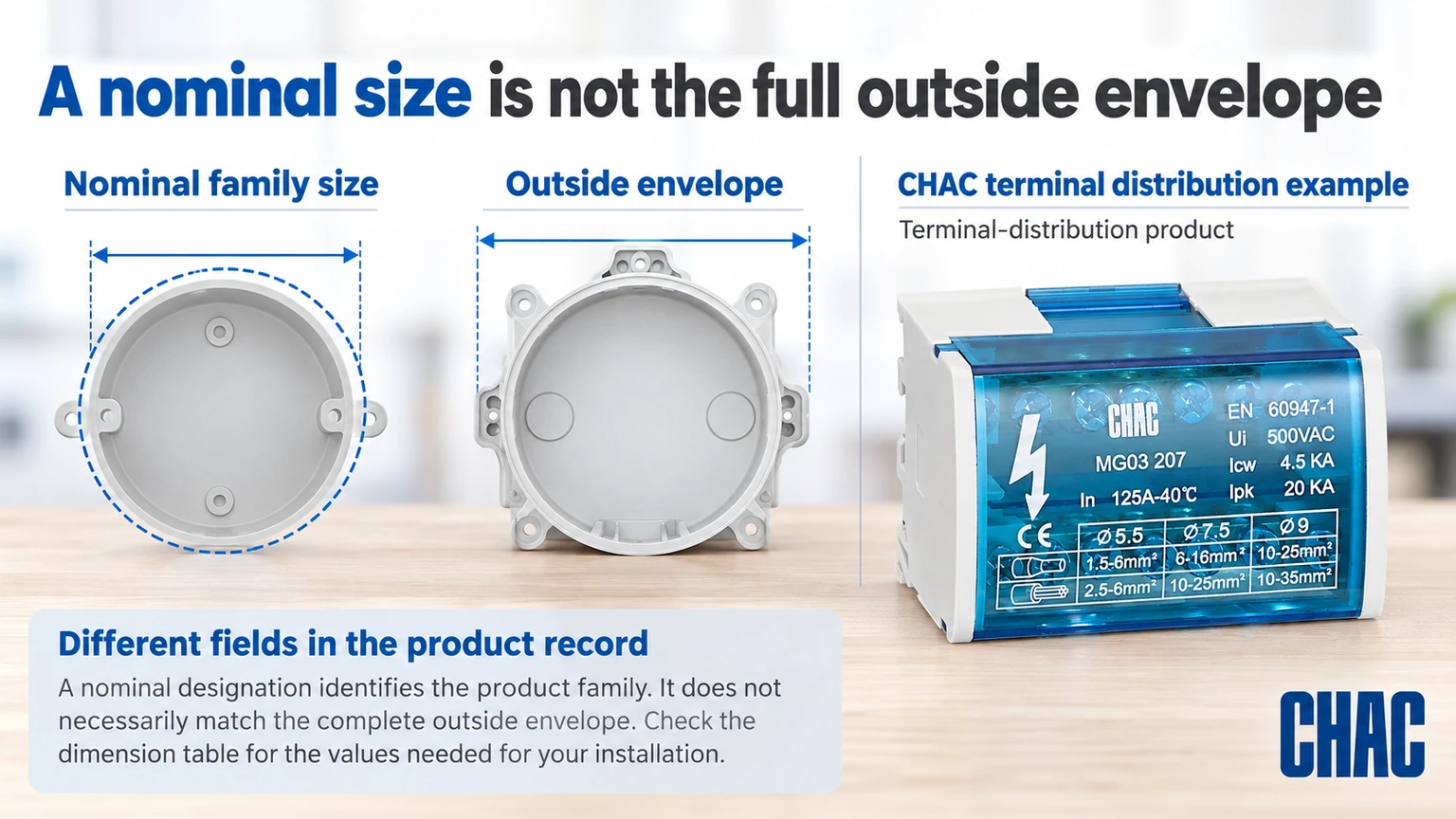
Una denominazione nominale identifica la famiglia di prodotti; non deve necessariamente corrispondere all’intera confezione esterna. Il Record del prodotto RACO 299, controllato il 19 ottobre 2026, elenca “Dimensione: 4 in” insieme alla larghezza e all’altezza di 4.25 in. Questo è un motivo diretto per consultare la tabella delle dimensioni piuttosto che ricavare le misure dal nome del prodotto.
Per il dimensione tipica di una scatola di derivazione rotonda per il soffitto, Iniziate separando la scocca, le sporgenze di fissaggio, il coperchio e l’apertura. Un disegno potrebbe indicare piani di riferimento non visibili in una fotografia di catalogo. Prima di decidere quale dimensione pubblicata determina l’apertura, verificate che il materiale del soffitto e il metodo di supporto siano adeguati all’installazione.
| RACO 299 elemento del record | Valore pubblicato | Implicazioni della selezione |
|---|---|---|
| Dimensione nominale | 4 in | Designazione familiare, non l'intera busta |
| Larghezza e altezza | 4.25 in ciascuno | Verificare rispetto al disegno del prodotto |
| Profondità | 2.125 in | Verificare il gioco tra la cavità e il dispositivo |
| Campo di profondità reale separato | 2.56 in | Conferma i piani di riferimento nel disegno |
| Capacità | 22.4 pollici cubi. | Utilizzare per la valutazione del riempimento pertinente. |
Il record contiene sia il campo relativo alla profondità che quello relativo alla profondità effettiva. Non ipotizzare le ragioni della loro differenza né sostituire silenziosamente uno con l’altro. Determinare l’ingombro completo di montaggio a partire dal disegno corrente e dalle istruzioni, soprattutto quando lo spazio del controsoffitto è limitato.
Una comune scatola rotonda può sostenere un ventilatore da soffitto?
Non solo perché è rotondo o in metallo. Un ventilatore introduce un requisito di supporto che deve essere soddisfatto dal prodotto e dall’installazione scelti. RACO propone linee di prodotti distinte per le cassette a soffitto e per il supporto dei ventilatori, il che ricorda opportunamente che l’aspetto estetico da solo non basta a garantirne l’idoneità.
Il record 299 citato riporta 70 lb per il supporto del ventilatore a soffitto e 150 lb per il supporto dell’apparecchio. Questi sono valori specifici per quel modello, soggetti alle sue condizioni di installazione; non devono essere applicati a un’altra scatola. Verificare le istruzioni del ventilatore o dell’apparecchio, il carico nominale della scatola, la struttura di sostegno e gli elementi di fissaggio prescritti come insieme completo. Una classificazione di carico non garantisce che ogni installazione esistente a soffitto possa sopportare tale carico.
| Attività di installazione | Ciò che necessita di conferma | Assunzione non sicura da evitare |
|---|---|---|
| Solo collegamento elettrico | Alloggiamento, ingressi, riempimento e copertura idonei | Ogni scatola di derivazione è anche una scatola di supporto. |
| Apparecchio di illuminazione | Obbligo di sostegno e fissaggio consentito | A small fixture needs no support check |
| Ceiling fan | Specific fan-support suitability and structure | A fixture rating proves fan suitability |
| Receptacle in the ceiling | Compatible box, cover and device arrangement | A round opening guarantees device compatibility |
What should be verified when a light is replaced by a ceiling fan?
Make the replacement a support review, not just a wiring change. During an authorized inspection, identify the existing box and how it attaches to the supporting structure. Then match that identity to the manufacturer’s stated fan duty and installation instructions. The fan’s mounting hardware and requirements must also agree. A similar-looking round box cannot inherit the RACO 299 example’s rating from this article.
If the model or support arrangement cannot be confirmed, document what is missing instead of assigning a capacity from the visible cover. Ask the responsible installer to establish an appropriate support solution before the fan is hung. Keep the box identity, support details and approved hardware with the installation record so a later replacement does not have to reconstruct the decision. This is a proposed verification workflow, not evidence that an existing concealed installation has been inspected.
How much depth and wiring space are needed?
The answer depends on conductors, connectors, grounding provisions and any device or fixture arrangement occupying the enclosure. Use the marked capacity with the locally adopted fill rules. External diameter and depth do not provide a reliable substitute for the specified internal capacity.
Practical access matters too. An entry fitting may occupy the route needed for a conductor bend, while a fixture bracket can restrict how connections are arranged. Check the actual assembly rather than assuming that unused space in a photograph will remain accessible after installation. Do not force the cover into place to compensate for a crowded box.
When do material and environment change the choice?
Metal and nonmetallic products need to be suitable for the wiring method, environment and intended support duty. A conductive enclosure requires the appropriate bonding arrangement. A nonmetallic enclosure is not automatically suitable for every ceiling structure or temperature exposure.
Where a fire-rated ceiling assembly is involved, confirm the product’s permitted use and the assembly conditions. A generic statement about a box material does not demonstrate that the ceiling system retains its required classification. Access, cover compatibility and entry protection must remain acceptable after the fixture is fitted.
Will the connections remain accessible after the canopy is installed?
Review the canopy, bracket and box together. Confirm that the permitted fastening sequence allows the installer to make and inspect the connections, close the enclosure correctly and remove the fitting for future service. Check where the conductors lie as the canopy moves into position; do not use its fixing screws to force a crowded connector arrangement out of sight.
Keep decorative coverage separate from support and enclosure suitability. A wide canopy may hide the edge of an opening, but that does not repair a damaged mounting surface or establish the box’s support duty. Likewise, a flush-looking finish does not prove that entries, bonding or connection space meet the applicable requirements. Record any change to the bracket or cover because it can change access even when the original box stays in place.
What should an installation checklist include?
Record the model, current drawing, nominal and actual envelope, marked capacity, entry layout, cover, mounting method and intended supported equipment. For ceiling box dimensions, identify the reference plane for every depth measurement. Photograph or document the existing support arrangement during an authorized inspection rather than assuming it from the visible cover.
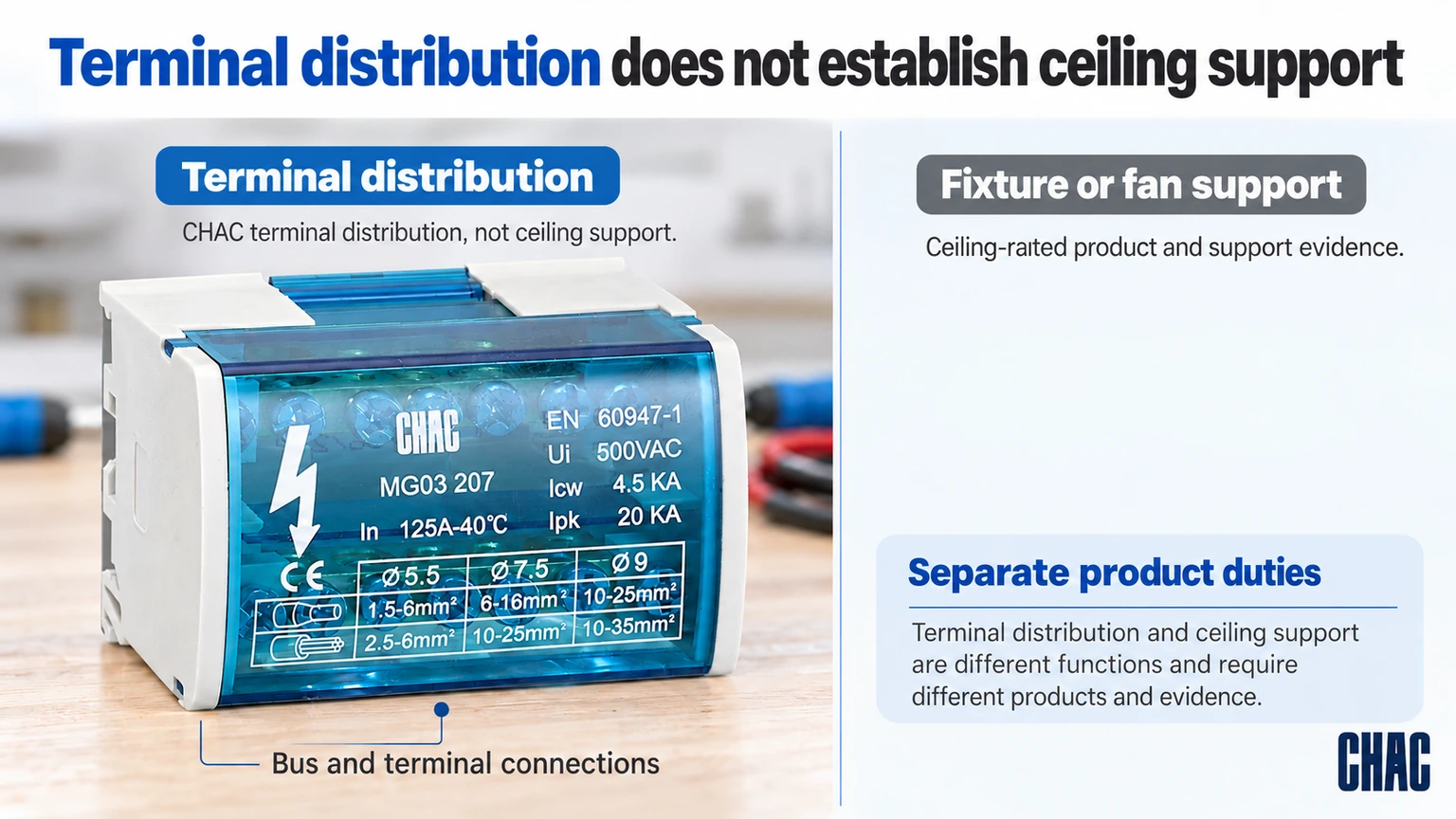
di CHAC distribution junction box connection product performs bus and terminal distribution duties. It is not a fan-support or round ceiling outlet box. For the distribution side of a project, review the electrical protection and distribution components separately and request model-specific information. Clear function names prevent a generic junction-box search from becoming an incorrect product substitution.
What do installers ask about round ceiling box sizes?
What are the standard sizes for ceiling junction boxes?
Manufacturers offer several nominal sizes and depths. Use the exact product drawing and intended duty; the cited four-inch RACO example does not define every ceiling box.
Can you put an outlet in a round ceiling box?
Only with a box, cover and device arrangement suitable for that use and installation. Round shape alone does not establish compatibility or compliance.
What are the typical sizes of round junction boxes?
Nominal family descriptions should be checked against actual dimensions. For example, RACO 299 is designated four inches while its published width and height are 4.25 inches.
What is the diameter of a round electrical box?
Read the exact manufacturer drawing. Nominal diameter, outside envelope, mounting features and required opening can be different measurements.
What are the standard sizes for typical size of a round ceiling outlet junction box?
Choose a specific model and check its nominal size, external envelope, depth and volume. Also verify any required fixture or fan support duty rather than selecting by size alone.
How deep should typical size of a round ceiling outlet junction box be for the wiring inside?
It needs enough calculated volume and practical connection clearance for the actual wiring and fixture arrangement. The complete enclosure must also fit the available cavity and its permitted support system.
Referenze
- Hubbell RACO 299: dimensions, capacity and model-specific support ratings; accessed October 19, 2026
- Hubbell RACO ceiling boxes and covers; accessed October 19, 2026
- Hubbell RACO box families and application categories; accessed October 19, 2026
Conclusione
A round ceiling box is not fully specified by a familiar diameter. Confirm the product’s complete envelope, capacity and mounting method, then check the duty of the equipment it will support. Fixture and fan ratings are model-specific, and the supporting structure and fasteners remain part of the decision. Where a catalog lists different depth fields, obtain the drawing rather than guessing which measurement controls the ceiling clearance. Apply the wiring and assembly requirements to the real installation before the cover goes on. CHAC publishes distribution and connection information for products that serve those separate functions. Keeping terminal distribution, ceiling connections and structural support distinct helps buyers select the right product evidence for each part of the project.
Per i disegni del modello e la documentazione di progetto pertinenti, Contattare CHAC con i requisiti del circuito..