Một lỗ trần có thể lắp vừa một hộp tròn, nhưng việc lắp đặt vẫn có thể không vượt qua được kiểm tra quan trọng nhất: liệu hộp và hệ thống giá đỡ có phù hợp với thiết bị treo bên dưới hay không. Khi thay thế đèn bằng quạt trần, sự khác biệt này càng trở nên đặc biệt quan trọng. Đường kính danh nghĩa, không gian dây dẫn bên trong, độ khít của nắp đậy và chứng nhận khả năng chịu tải của giá đỡ đều trả lời những câu hỏi khác nhau; tuy nhiên, chúng thường bị đơn giản hóa thành cụm từ “hộp trần bốn inch”. Hướng dẫn này giải thích cần đo những kích thước nào, sử dụng một hồ sơ sản xuất có thể truy xuất nguồn gốc từ nhà sản xuất, đồng thời chỉ ra lý do tại sao không bao giờ được mặc định rằng một hộp nối thông thường có thể đảm nhiệm chức năng chịu tải như một sản phẩm chuyên dùng cho trần đã được chứng nhận.
A hộp nối âm trần tròn nên được lựa chọn theo đúng model cụ thể của nó, chứ không chỉ dựa trên đường kính. Ví dụ, RACO 299 được mô tả là một hộp trần tròn đạt chuẩn 4, với chiều rộng và chiều cao lần lượt là 4.25 in, độ sâu 2.125 in và dung tích 22.4 inch khối. Hồ sơ của sản phẩm cũng ghi rõ các mức chịu tải riêng biệt dành cho quạt và đèn theo từng model. Những thông số này không phải là các tiêu chuẩn chung cho hộp trần hay là khuôn cắt. Trước khi lắp đặt, hãy xác nhận bản vẽ hiện hành, hướng dẫn lắp đặt, mức độ lấp đầy dây điện và giấy chứng nhận chịu tải cho chính thiết bị đèn hoặc quạt đó.
Tại sao một hộp có kích thước bốn inch lại có một chiều rộng được công bố khác?
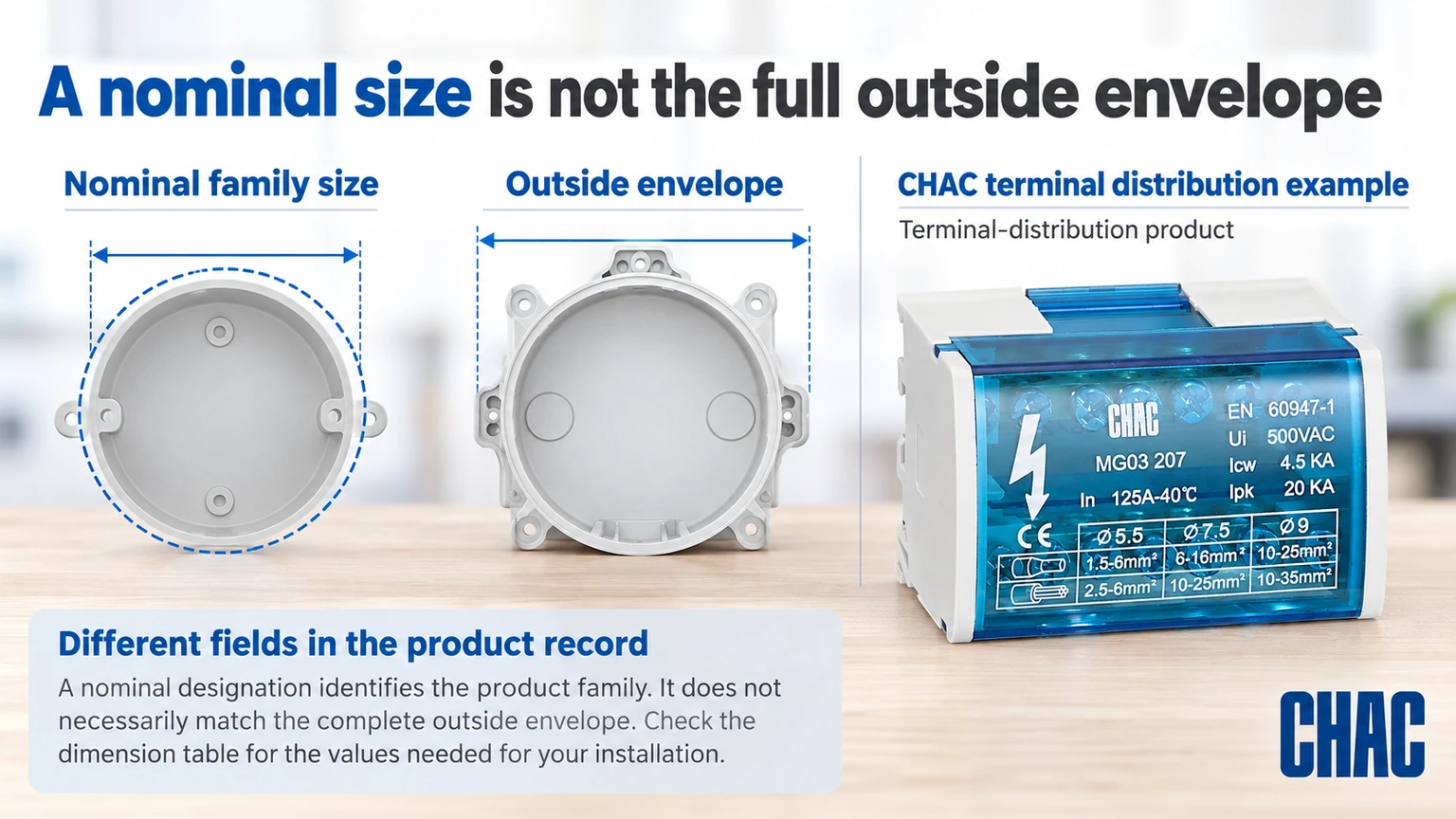
Một ký hiệu danh nghĩa xác định dòng sản phẩm; nó không nhất thiết phải là toàn bộ vỏ bao bên ngoài. Hồ sơ sản phẩm RACO 299, được kiểm tra vào ngày 19, 2026, liệt kê “Kích thước: 4 in” cùng với chiều rộng và chiều cao là 4.25 in. Đây là lý do trực tiếp để đọc bảng kích thước thay vì cắt một lỗ từ tên sản phẩm.
Đối với kích thước thông thường của hộp nối ổ cắm trần hình tròn, hãy bắt đầu bằng việc tách rời vỏ bọc, các phần nhô ra dùng để gắn, nắp đậy và lỗ mở. Bản vẽ có thể hiển thị các mặt phẳng tham chiếu mà không thể nhận thấy trong ảnh chụp trong catalogue. Trước khi quyết định kích thước nào được công bố sẽ xác định kích thước của lỗ mở, hãy kiểm tra xem vật liệu trần và phương pháp đỡ có phù hợp với quá trình lắp đặt hay không.
| RACO 299 mục ghi chép | Giá trị đã công bố | Tác động của việc lựa chọn |
|---|---|---|
| Kích thước danh nghĩa | 4 trong | Ký hiệu gia đình, không phải toàn bộ phong bì |
| Chiều rộng và chiều cao | 4.25 trong mỗi | Kiểm tra đối chiếu với bản vẽ sản phẩm |
| Độ sâu | 2.125 trong | Check cavity and device clearance |
| Separate actual-depth field | 2.56 in | Confirm reference planes in the drawing |
| Capacity | 22.4 cu. in. | Use for the applicable fill evaluation |
The record contains both depth and actual-depth fields. Do not guess why they differ or silently substitute one for the other. Resolve the complete mounting envelope from the current drawing and instructions, especially when the ceiling cavity is limited.
Can an ordinary round box support a ceiling fan?
Not merely because it is round or metal. A fan introduces a support duty that must be covered by the selected product and installation. RACO maintains distinct ceiling-box and fan-support product families, which is a useful reminder that appearance alone does not establish suitability.
The cited 299 record lists 70 lb for ceiling-fan support and 150 lb for fixture support. These are values for that model, subject to its installation conditions; they must not be copied to another box. Confirm the fan or fixture instructions, the box’s stated duty, the supporting structure and the specified fasteners as a complete arrangement. A support rating is not a promise that every existing ceiling installation can carry that load.
| Installation task | Điều gì cần xác nhận | Unsafe assumption to avoid |
|---|---|---|
| Wiring connection only | Suitable enclosure, entries, fill and cover | Every junction box is also a support box |
| Light fixture | Permitted support duty and fastening | A small fixture needs no support check |
| Ceiling fan | Specific fan-support suitability and structure | A fixture rating proves fan suitability |
| Receptacle in the ceiling | Compatible box, cover and device arrangement | A round opening guarantees device compatibility |
What should be verified when a light is replaced by a ceiling fan?
Make the replacement a support review, not just a wiring change. During an authorized inspection, identify the existing box and how it attaches to the supporting structure. Then match that identity to the manufacturer’s stated fan duty and installation instructions. The fan’s mounting hardware and requirements must also agree. A similar-looking round box cannot inherit the RACO 299 example’s rating from this article.
If the model or support arrangement cannot be confirmed, document what is missing instead of assigning a capacity from the visible cover. Ask the responsible installer to establish an appropriate support solution before the fan is hung. Keep the box identity, support details and approved hardware with the installation record so a later replacement does not have to reconstruct the decision. This is a proposed verification workflow, not evidence that an existing concealed installation has been inspected.
How much depth and wiring space are needed?
The answer depends on conductors, connectors, grounding provisions and any device or fixture arrangement occupying the enclosure. Use the marked capacity with the locally adopted fill rules. External diameter and depth do not provide a reliable substitute for the specified internal capacity.
Practical access matters too. An entry fitting may occupy the route needed for a conductor bend, while a fixture bracket can restrict how connections are arranged. Check the actual assembly rather than assuming that unused space in a photograph will remain accessible after installation. Do not force the cover into place to compensate for a crowded box.
When do material and environment change the choice?
Metal and nonmetallic products need to be suitable for the wiring method, environment and intended support duty. A conductive enclosure requires the appropriate bonding arrangement. A nonmetallic enclosure is not automatically suitable for every ceiling structure or temperature exposure.
Where a fire-rated ceiling assembly is involved, confirm the product’s permitted use and the assembly conditions. A generic statement about a box material does not demonstrate that the ceiling system retains its required classification. Access, cover compatibility and entry protection must remain acceptable after the fixture is fitted.
Will the connections remain accessible after the canopy is installed?
Review the canopy, bracket and box together. Confirm that the permitted fastening sequence allows the installer to make and inspect the connections, close the enclosure correctly and remove the fitting for future service. Check where the conductors lie as the canopy moves into position; do not use its fixing screws to force a crowded connector arrangement out of sight.
Keep decorative coverage separate from support and enclosure suitability. A wide canopy may hide the edge of an opening, but that does not repair a damaged mounting surface or establish the box’s support duty. Likewise, a flush-looking finish does not prove that entries, bonding or connection space meet the applicable requirements. Record any change to the bracket or cover because it can change access even when the original box stays in place.
What should an installation checklist include?
Record the model, current drawing, nominal and actual envelope, marked capacity, entry layout, cover, mounting method and intended supported equipment. For ceiling box dimensions, identify the reference plane for every depth measurement. Photograph or document the existing support arrangement during an authorized inspection rather than assuming it from the visible cover.
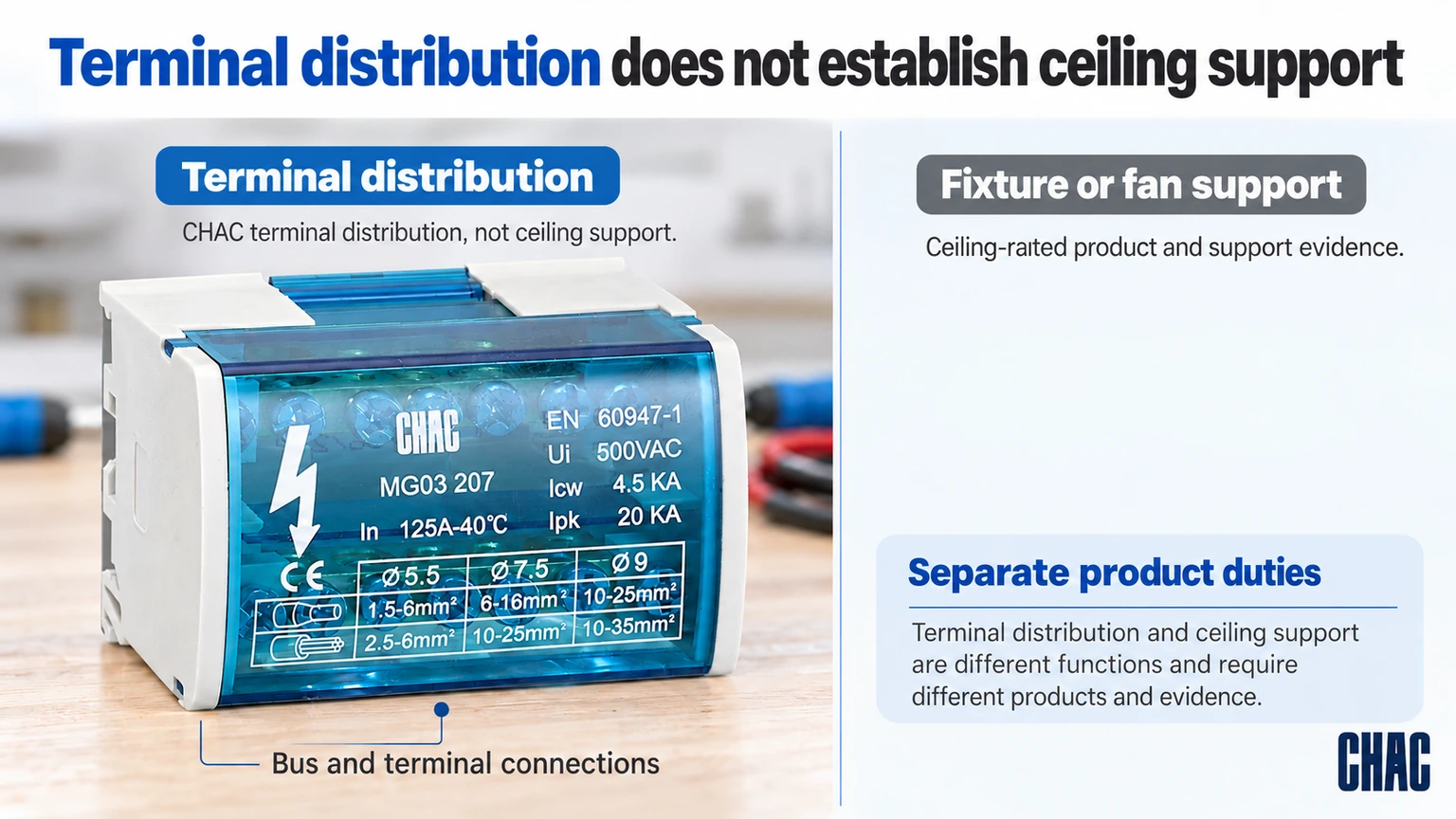
CHAC distribution junction box connection product performs bus and terminal distribution duties. It is not a fan-support or round ceiling outlet box. For the distribution side of a project, review the electrical protection and distribution components separately and request model-specific information. Clear function names prevent a generic junction-box search from becoming an incorrect product substitution.
What do installers ask about round ceiling box sizes?
What are the standard sizes for ceiling junction boxes?
Manufacturers offer several nominal sizes and depths. Use the exact product drawing and intended duty; the cited four-inch RACO example does not define every ceiling box.
Can you put an outlet in a round ceiling box?
Only with a box, cover and device arrangement suitable for that use and installation. Round shape alone does not establish compatibility or compliance.
What are the typical sizes of round junction boxes?
Nominal family descriptions should be checked against actual dimensions. For example, RACO 299 is designated four inches while its published width and height are 4.25 inches.
What is the diameter of a round electrical box?
Read the exact manufacturer drawing. Nominal diameter, outside envelope, mounting features and required opening can be different measurements.
What are the standard sizes for typical size of a round ceiling outlet junction box?
Choose a specific model and check its nominal size, external envelope, depth and volume. Also verify any required fixture or fan support duty rather than selecting by size alone.
How deep should typical size of a round ceiling outlet junction box be for the wiring inside?
It needs enough calculated volume and practical connection clearance for the actual wiring and fixture arrangement. The complete enclosure must also fit the available cavity and its permitted support system.
Tham khảo
- Hubbell RACO 299: dimensions, capacity and model-specific support ratings; accessed October 19, 2026
- Hubbell RACO ceiling boxes and covers; accessed October 19, 2026
- Hubbell RACO box families and application categories; accessed October 19, 2026
Kết luận
A round ceiling box is not fully specified by a familiar diameter. Confirm the product’s complete envelope, capacity and mounting method, then check the duty of the equipment it will support. Fixture and fan ratings are model-specific, and the supporting structure and fasteners remain part of the decision. Where a catalog lists different depth fields, obtain the drawing rather than guessing which measurement controls the ceiling clearance. Apply the wiring and assembly requirements to the real installation before the cover goes on. CHAC publishes distribution and connection information for products that serve those separate functions. Keeping terminal distribution, ceiling connections and structural support distinct helps buyers select the right product evidence for each part of the project.
Đối với các bản vẽ mô hình và tài liệu dự án liên quan, Liên hệ CHAC về các yêu cầu của mạch điện.