

DC MCB AC compatibility is not determined by the breaker handle, frame size, or catalogue photograph. An AC disjuntor miniatura may be unsuitable for a DC circuit because the interruption method, voltage per pole, polarity, and permitted circuit orientation can be different. The safe answer is conditional: use a device whose marking and technical documentation cover the actual DC voltage, current, fault level, pole arrangement, and installation system. This guide gives a procurement and review path for engineers, panel builders, and distributors.
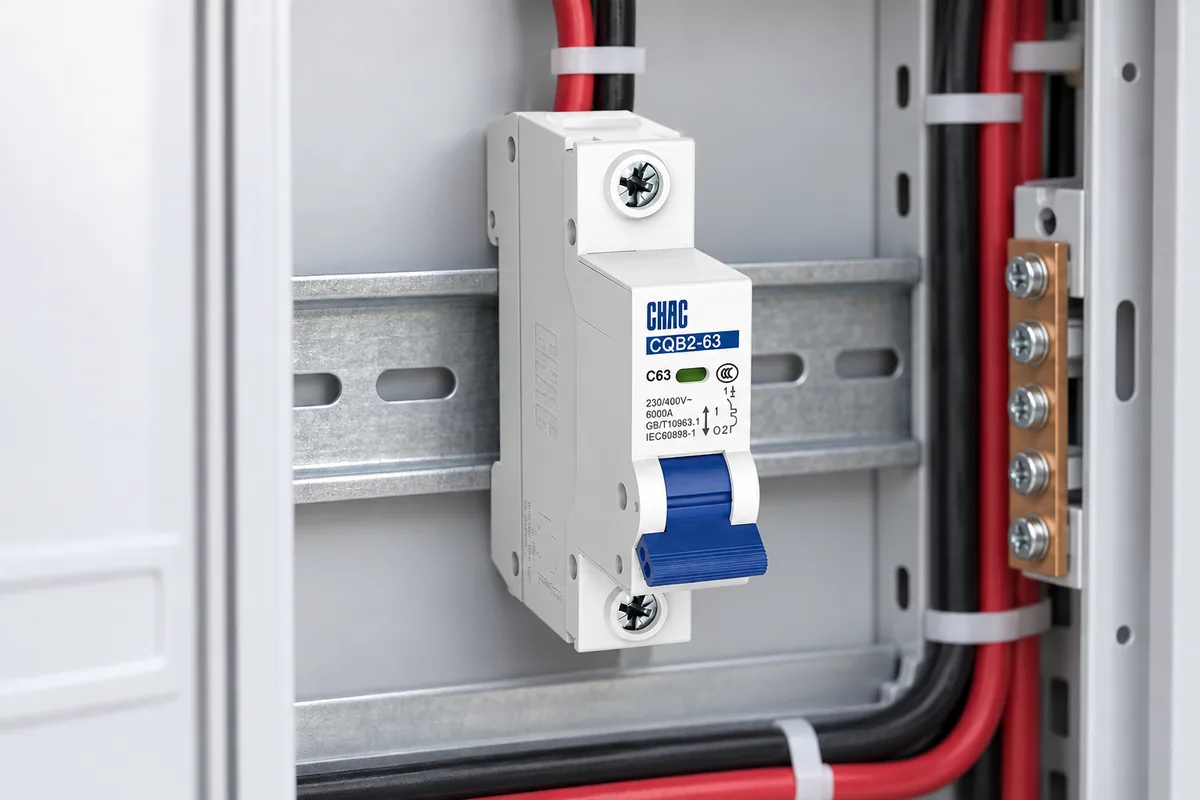
Can an AC MCB be used in a DC circuit?
Not automatically. A DC circuit breaker must be selected from documentation that states its DC application and interruption capability. AC current passes through a natural zero point each cycle, while a DC arc does not have that same repeating zero crossing. The result is that an AC rating cannot be copied to DC simply because the voltage and current numbers look similar.
For a replacement or new design, record the system voltage, maximum continuous current, prospective fault current, number of poles, polarity requirements, conductor arrangement, and enclosure conditions. If the manufacturer does not publish the required DC rating or orientation, treat the device as unverified rather than assuming it is suitable.
What must be compared before choosing a DC circuit breaker?
| Decision field | Por que é importante | Provas a reter |
|---|---|---|
| DC voltage per pole | A multi-pole device may have a defined voltage limit per pole or for a specified series arrangement. | Current datasheet and nameplate marking |
| Continuous and fault current | The operating current and available fault current affect thermal loading and interruption duty. | Load calculation and fault-level study |
| Polarity and orientation | Some DC designs require the line/load direction or polarity shown by the manufacturer. | Wiring diagram and installation instructions |
| Poles and isolation | The circuit may require simultaneous opening of positive, negative, or other conductors. | Single-line diagram and pole configuration |
| Standard and listing | Component testing does not automatically approve the complete panel or installation. | Applicable certification, standard edition, and project approval |
These fields also explain why a larger current rating is not a universal solution. A higher rating can change conductor protection, coordination, and the energy the system must withstand before interruption.
Why does polarity matter on some DC breakers?
Polarity can affect the magnetic field and arc path used to help extinguish a DC arc. The exact requirement depends on the breaker design, pole arrangement, and the manufacturer’s tested application. Do not infer the wiring direction from a generic diagram or from an AC installation. Follow the product marking and the installation manual for the exact model.
The same caution applies to series-pole arrangements. A drawing that shows two poles does not prove that the device is approved to combine them for a particular DC voltage. That relationship must be stated in the product evidence.
How should an AC-to-DC breaker substitution be reviewed?
- Define the circuit: source type, nominal and maximum voltage, load current, fault current, and environment.
- Confirm the required protective function and which conductors must open together.
- Check the candidate device’s DC voltage, current, polarity, interrupting, and mounting data.
- Compare terminals, enclosure, accessories, clearances, and conductor requirements.
- Obtain approval from the responsible engineer or authority having jurisdiction before release.
For a product discussion, compare the project conditions with CHAC’s DC circuit breaker range and the relevant DC miniature circuit breaker option. The product page is a starting point for model matching, not a replacement for the project fault and wiring data.
How should the installation be verified before energizing?
Verify de-energization, conductor identification, terminal condition, torque, enclosure suitability, labels, and required spacing. Then complete the tests required by the device instructions and local installation code. Record the model, revision, test method, readings, date, and responsible person. If a breaker trips, heats, or shows an unexpected arc path, isolate the circuit and investigate the documented conditions before resetting it.
For AC equipment, use an AC MCB product category only when the application and product evidence match the AC system. AC and DC devices should not be treated as interchangeable categories.
FAQs
Can AC MCBs be used in DC circuits?
Only when the manufacturer explicitly rates the device for the required DC voltage, current, polarity, and interruption duty. An AC-only marking is not evidence of DC suitability.
Can a DC circuit breaker be used for AC?
Do not assume so. Check the device marking and instructions for an AC application, including voltage, frequency, interrupting rating, and required accessories.
Are AC and DC circuit breakers different?
They can use different arc-interruption and wiring assumptions. Selection must follow the application rating and tested configuration rather than the external appearance.
Why are some DC breakers polarity-sensitive?
The tested arc path may depend on current direction and magnetic effects. Follow the polarity marks and the exact installation instructions for the model.
What happens if an AC breaker is used on DC?
The device may fail to interrupt the fault as intended, so the circuit can remain exposed to sustained arcing or unacceptable damage. Stop and verify the application before energizing.
Fontes para normas e verificação adicional
- International Electrotechnical Commission standards portal
- UL Solutions standards and certification guidance
- NFPA 70, National Electrical Code information
Decision principle: approve AC breaker on DC ou DC MCB AC compatibility only after the voltage, fault current, polarity, pole arrangement, listing, and installation method are documented. When those inputs are available, CHAC Electric can help match them to the appropriate product evidence through its technical contact channel.


