Розетка, выступающая над поверхностью стены, не всегда является проблемой с точки зрения декоративной крышки. За ней глубокий механизм, соединитель и задний ввод кабеля могут претендовать на одно и то же узкое пространство. Слишком сильное затягивание винтов может скрыть проблему, но при этом создаст нагрузку на токопроводящие жилы или помешает правильной посадке устройства. Кроме того, тонкая стена делает невозможным применение простого решения — установку более глубокой подрозеточной коробки. В данном руководстве объясняется, как определить реальное ограничение по глубине, сравнить технические чертежи изделий и выбрать допустимую компоновку, не путая габаритную посадку с приемлемой проводкой.
A мелкая электрическая коробка является вариантом меньшей глубины в рамках конкретной линейки продукции, а не единой стандартизированной глубиной. Например, RACO предлагает трёхместную сварную коробку 952 глубиной 1-5/8 и трёхместную коробку 942 глубиной 2-1/2. Подходящий вариант зависит от метода монтажа, доступного пространства в стене, выступа устройства и требуемого заполнения. Сначала измерьте готовую полость стены и всю компоновку устройства. Затем сравните конкретные коробку, крышку и соединительные элементы; не сжимайте проводники и не применяйте неодобрённые модификации, чтобы сделать малогабаритный корпус кажущимся достаточным.
Какая часть установки потребляет глубину?
Измерьте расстояние от чистовой поверхности до препятствия, расположенного за предполагаемой коробкой. В стене могут присутствовать кирпичная кладка, выступы стоек, другие инженерные коммуникации или элементы обвязки, которые не позволяют использовать полную номинальную глубину. Замер только каркаса может ввести в заблуждение после монтажа плитки, гипсокартона и установочного кольца.
Далее следует учесть глубину монтажной коробки в сочетании с выступом установленного устройства. Клеммам и разъёмам, как и корпусу самого устройства, требуется свободное пространство. При заднем подводе проводов изгиб проводника может оказаться непосредственно за самой выступающей частью умного выключателя или розетки с защитным отключением (GFCI). Переход на другую допустимую схему подвода проводов может иметь значение, но только в том случае, если это предусмотрено инструкцией по монтажу коробки и электропроводки.
| Наблюдаемая проблема | Размер для проверки | Разделительная граница |
|---|---|---|
| Коробка ударяется о заднюю стену. | Внешняя глубина и вылет фитинга | Выберите подходящий разрешённый вольер. |
| Устройство не устанавливается. | Установленная глубина устройства и положение разъёма | Не прилагайте чрезмерного усилия при затягивании винтов. |
| Проводка загромождена | Объём с отметками и фактическое заполнение | Физическое закрытие не является доказательством соответствия. |
| Крышка установлена неправильно | Положение отделанной стены и соответствующее кольцо | Проверьте утверждённую сборку |
Как сравниваются узкие и более глубокие модели?
The Продукт RACO 952 описывается как сварная коробка на три поста глубиной 1-5/8. Продукт RACO 942 является сварной коробкой на три поста глубиной 2-1/2. Разница между этими двумя опубликованными примерами составляет 7/8. Эти записи, проверенные 19 октября 2026 года, позволяют провести реальное сравнение глубин, не предполагая, что все у浅ые коробки имеют одинаковые размеры.
The глубина распределительной коробки В комплекты также должны включаться выбранные крышка и внешние фитинги, если они влияют на монтаж. Заявленный объём короба следует определять непосредственно по его паспорту или маркировке; не следует вычислять его путем перемножения наружных габаритов, поскольку конструкция и внутреннее устройство влияют на полезный объем.
| Вариант | Потенциальная причина для его рассмотрения | Требуемая проверка |
|---|---|---|
| Более мелкая перечисленная рамка | Ограниченное пространство за стеной | Сертификация устройства и расчётный объём заполнения |
| Совместимая коробка Deeper | Больше места за глубоким устройством | Зазор до стены, монтаж и расположение входов |
| Разрешённое поверхностное расположение | Недостаточная скрытая полость | Утверждённый короб, фитинги и открытый монтаж |
| Различные подходящие устройства | Установленное проецирование устройства является ограничением. | Electrical function and mounting compatibility |
| Redesigned wiring arrangement | Connectors or entries block access | Permitted wiring method and accessible connections |
How do you build a useful depth budget without confusing it with box fill?
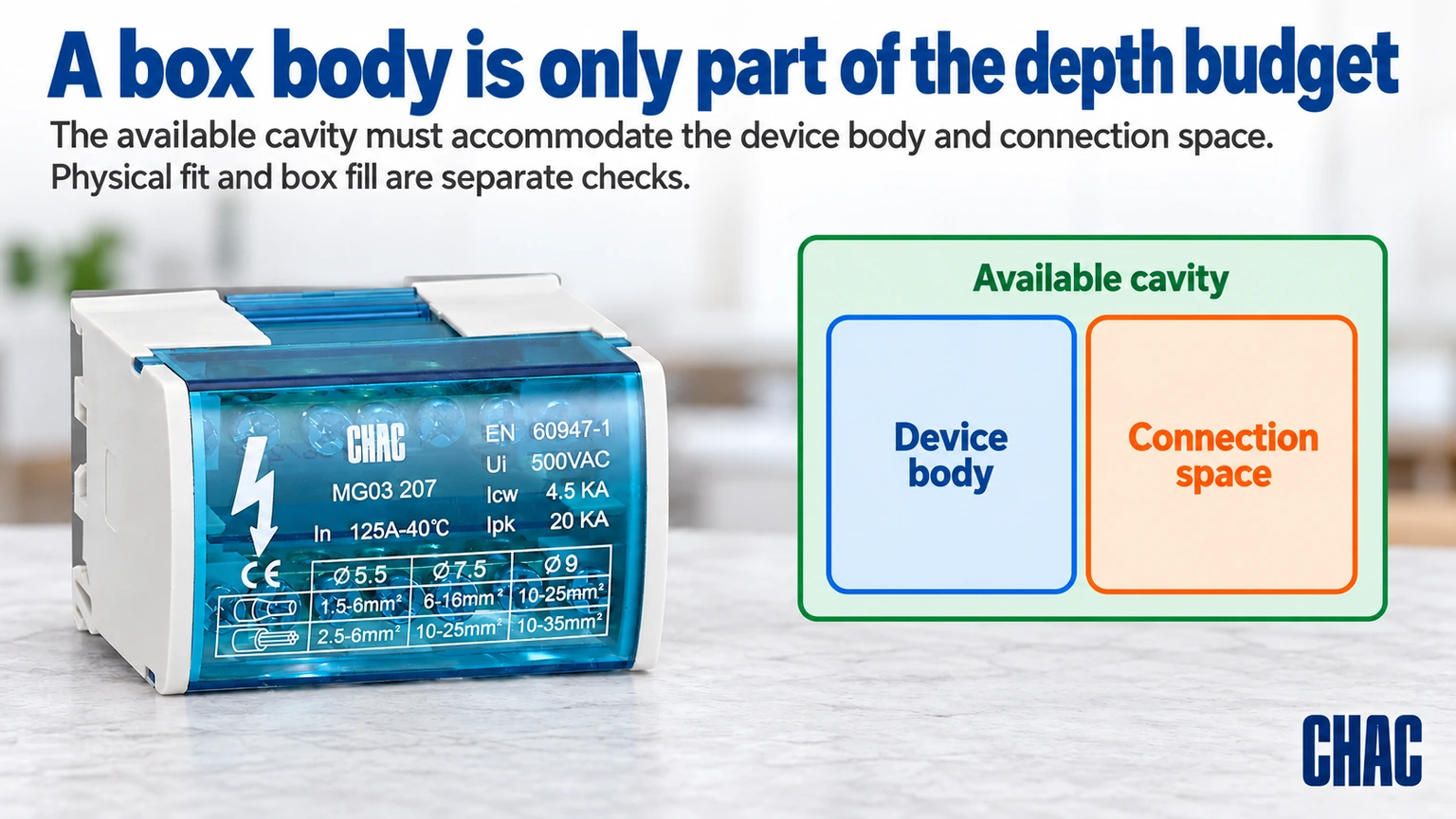
Draw the device and entry fittings from a shared mounting plane, using the actual internal envelope rather than the box’s nominal outside depth. For a simplified hypothetical example, assume 2.0 in of usable depth behind the mounting plane and a device projecting 1.4 in into it. That leaves 0.6 in in the same rearward direction before considering a connector, conductor route or other obstruction. None of those assumed dimensions describes a particular product.
The remaining 0.6 in is not a permitted conductor allowance or a box-fill calculation. Parts can occupy different regions, and their envelopes may overlap differently from a simple stack. Check the proposed routes on the assembly drawing and, where necessary, a de-energized sample. Record the first actual interference. This identifies whether the limiting item is the box shell, the device, an entry fitting or the wiring arrangement, rather than treating every seating problem as insufficient total volume.
Can a shallow box pass fill checks and still be difficult to use?
Yes. Required volume is one acceptance condition; conductor routing and assembly access are another. A device can occupy the central space while connectors sit at the sides, but that arrangement must remain practical without damaging insulation or exceeding product instructions. It should not depend on a precise fold that cannot be reproduced during maintenance.
Apply the adopted box-fill rules to the actual circuit. Different items can have different counting treatment, and grounding-conductor provisions depend on the applicable rules. A generic statement that a box holds a certain number of wires is incomplete when devices, clamps or other components are added. Have the calculation checked for the intended installation rather than treating an online capacity example as a permit-ready design.
When should the installation be redesigned?
If no suitable box can meet both the cavity limit and the wiring requirement, the constraint is real. A permitted surface box, a relocated device or another approved arrangement may be necessary. An extension ring is not automatically suitable for every enclosure or wall system; confirm the manufacturer’s compatibility and how the finished assembly is approved.
Do not remove required box parts, cut away a mounting feature or leave connections behind an inaccessible cover to gain space. Material choice must also remain suitable for the wiring system and environment. Metal requires the applicable bonding arrangement, while nonmetallic construction does not remove the need for correct entries, fastening and any wall-assembly conditions.
What must an extension proposal show before it solves the depth problem?
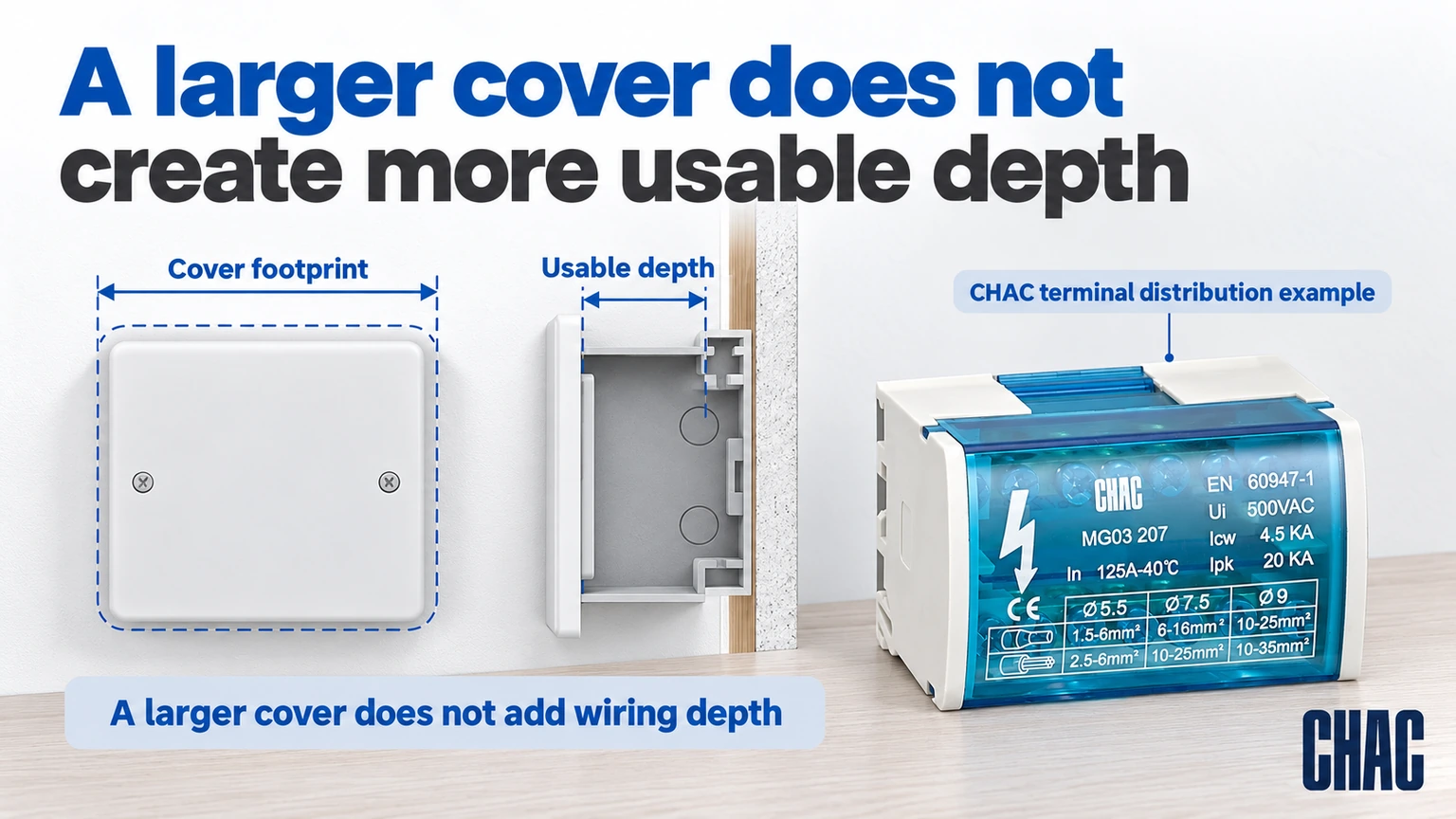
Request the exact box, extension or raised cover, device mounting arrangement and compatible fasteners as one proposal. Ask which documented volume may be included in the applicable fill evaluation and where the finished device plane will sit. Do not assume that a raised decorative face creates approved wiring space, or that every extension can be attached with longer device screws.
Also check any required bonding, cover engagement, wall-assembly conditions and entry access after the change. A proposal may solve the rear clearance while creating an unacceptable front projection or preventing the cover from seating. Mark both positions on the drawing and obtain the relevant manufacturer instructions. If the proposed combination has no supporting compatibility information, retain the unresolved status and evaluate another permitted arrangement rather than describing the extension as a completed repair.
What should be confirmed before ordering a replacement box?
Record the available cavity, finished-wall position, device model, conductor and connector arrangement, mounting method and required approval. Request the replacement’s drawing and installation instructions, then compare the complete assembly. This makes electrical box depth a defined requirement rather than a guess based on the old cover.
CHAC distribution junction box connection assembly is a terminal and bus connection product, not a shallow outlet box. Its documented dimensions are relevant to cabinet layouts that use that function. For related projects, consult the distribution and control product range while keeping the wall enclosure and device specification separate.
What are the common questions about shallow electrical boxes?
What is the shallowest electrical box you can get?
The answer depends on the product family and intended installation. Choose from approved models that meet the wiring and device requirements, rather than selecting the smallest advertised depth alone.
What is the minimum depth of an electrical box?
There is no single minimum suitable for every device and circuit. Check the applicable installation rules, device instructions, capacity and enclosure approval.
What are shallow electrical boxes used for?
They can serve installations where the available cavity is limited, provided the chosen box remains suitable for the devices, wiring method, fill and mounting conditions.
What are the dimensions of a shallow electrical box?
They are model-specific. The cited RACO 952 example is 1-5/8 inches deep, but that does not define every shallow box or its required opening.
What are the standard sizes for shallow electrical box?
Compare the exact height, width, depth and capacity within the chosen manufacturer range. The shallow label alone does not identify these values.
How deep should shallow electrical box be for the wiring inside?
Deep enough for the permitted device and conductor arrangement while meeting fill requirements, and shallow enough to fit the real cavity. If both cannot be met, redesign the installation rather than forcing the wiring.
Ссылки
- Hubbell RACO 952: three-gang 1-5/8-inch-deep box; accessed October 19, 2026
- Hubbell RACO 942: three-gang 2-1/2-inch-deep box; accessed October 19, 2026
- Hubbell RACO enclosure families and accessories; accessed October 19, 2026
Заключение
A shallow-box problem is solved by identifying the space constraint, not by hiding it behind a larger faceplate. Check the finished cavity, the installed device and the conductor arrangement before comparing replacement enclosures. Then verify capacity, mounting, entries and any approved cover or extension as one assembly. If the required wiring cannot fit appropriately, change the installation arrangement rather than crushing conductors or modifying the box without approval. Model-specific depth examples help compare options, but they do not establish a universal minimum or guarantee device compatibility. CHAC provides documented connection and distribution components for relevant cabinet applications. Use the exact model information for those functions and a separately verified wall-box specification where the project needs an outlet enclosure.
Для соответствующих чертежей модели и проектной документации, Свяжитесь с CHAC, чтобы уточнить требования к цепи..