Một hộp âm tường nhô cao so với bề mặt tường không phải lúc nào cũng là vấn đề về nắp che. Phía sau hộp, một thiết bị sâu, một đầu nối và lỗ đi dây phía sau có thể đang tranh giành cùng một khoảng trống hẹp. Siết chặt các vít hơn có thể che giấu được vấn đề, nhưng đồng thời làm căng các dây dẫn hoặc ngăn thiết bị lắp đúng vị trí. Mặt tường mỏng cũng khiến lời khuyên đơn giản là dùng hộp sâu hơn trở nên bất khả thi. Hướng dẫn này giải thích cách xác định chính xác giới hạn về chiều sâu thực tế, so sánh bản vẽ kỹ thuật của sản phẩm và lựa chọn phương án lắp đặt phù hợp theo quy chuẩn, tránh nhầm lẫn giữa việc lắp vừa về mặt vật lý với khả năng đấu nối đạt yêu cầu.
A hộp điện nông là một lựa chọn có độ sâu nhỏ hơn trong cùng một dòng sản phẩm, chứ không phải là một độ sâu tiêu chuẩn duy nhất. Ví dụ, RACO liệt kê một hộp hàn ba lỗ 952 với độ sâu 1-5/8 và một hộp hàn ba lỗ 942 với độ sâu 2-1/2. Việc lựa chọn loại nào phù hợp phụ thuộc vào phương pháp lắp đặt, không gian tường sẵn có, độ nhô ra của thiết bị và mức độ đầy cần thiết. Trước tiên, hãy đo khoang tường hoàn thiện và toàn bộ bố trí thiết bị. Sau đó, so sánh chính xác hộp, nắp đậy và các phụ kiện đầu vào; không được nén dây dẫn hoặc sử dụng biện pháp sửa đổi không được phê duyệt để làm cho một hộp nông trông có vẻ đủ.
Phần nào của hệ thống lắp đặt đang chiếm dụng chiều sâu?
Hãy đo từ bề mặt hoàn thiện đến vật cản phía sau vị trí đặt hộp điện dự kiến. Tường có thể chứa gạch xây, mép của thanh giằng, các đường ống kỹ thuật khác hoặc các phụ kiện ngăn không cho sử dụng hết chiều sâu danh nghĩa. Kích thước đo trên khung xương trần có thể gây hiểu nhầm khi đã lắp gạch ốp, tấm vách và vòng đệm gắn thiết bị.
Tiếp theo, hãy tách chiều sâu của hộp ra khỏi phần nhô ra khi thiết bị đã được lắp đặt. Các đầu nối và giắc cắm cũng cần có không gian, bên cạnh thân thiết bị. Lối vào phía sau có thể khiến đoạn dây dẫn bị uốn cong nằm ngay phía sau phần nhô ra nhiều nhất của công tắc thông minh hoặc ổ cắm GFCI. Việc chuyển sang một cách bố trí lối vào khác được phép có thể mang ý nghĩa quan trọng, nhưng chỉ khi bản vẽ chi tiết của hộp điện và hướng dẫn đi dây cho phép điều đó.
| Vấn đề được quan sát | Kích thước cần kiểm tra | Ranh giới quyết định |
|---|---|---|
| Hộp đập vào tường phía sau | Chiều sâu bên ngoài và độ nhô của phụ kiện | Hãy chọn một chuồng nuôi được phép phù hợp. |
| Thiết bị không thể lắp chặt | Độ sâu lắp đặt của thiết bị và vị trí của đầu nối | Đừng cố ép bằng các vít. |
| Dây điện bị chật chội | Khối lượng đã ghi nhận và mức độ nạp thực tế | Việc đóng cửa vật lý không chứng minh được sự tuân thủ. |
| Lớp bọc không được lắp đúng cách | Vị trí của tường hoàn thiện và vòng nối tương ứng | Kiểm tra bộ lắp ráp đã được phê duyệt |
Các mô hình nông và các mô hình sâu hơn so sánh như thế nào?
Phần Sản phẩm RACO 952 được mô tả là một hộp ba ngăn hàn với chiều sâu 1-5/8. Sản phẩm RACO 942 là một hộp ba gang được hàn, có chiều sâu 2-1/2. Sự khác biệt là 7/8 trong hai ví dụ đã được công bố này. Những hồ sơ này, được kiểm tra vào ngày 19, 2026, thiết lập một so sánh chiều sâu thực tế mà không giả định rằng tất cả các hộp nông đều có cùng kích thước.
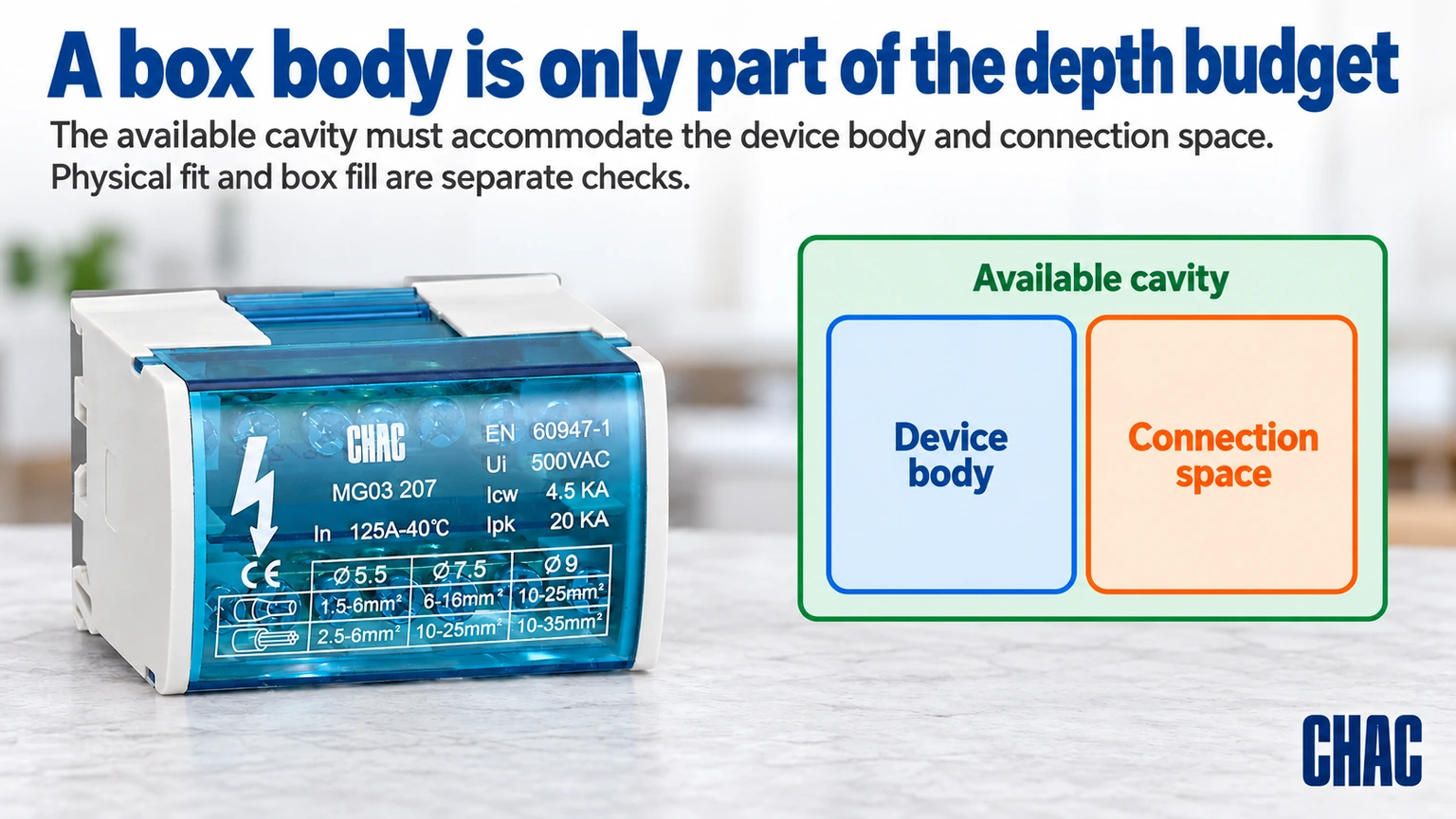
Phần depth of junction box assemblies should also include the selected cover and external fittings where they affect the installation. A box’s published volume should be read directly from its own record or marking; it should not be inferred by multiplying external dimensions, since construction and internal features affect usable space.
| Option | Potential reason to consider it | Xác minh bắt buộc |
|---|---|---|
| Shallower listed box | Limited cavity behind the wall | Device clearance and calculated fill |
| Deeper compatible box | More room behind a deep device | Wall clearance, mounting and entry layout |
| Permitted surface arrangement | Insufficient concealed cavity | Approved box, fittings and exposed installation |
| Different suitable device | Installed device projection is the constraint | Electrical function and mounting compatibility |
| Redesigned wiring arrangement | Connectors or entries block access | Permitted wiring method and accessible connections |
How do you build a useful depth budget without confusing it with box fill?
Draw the device and entry fittings from a shared mounting plane, using the actual internal envelope rather than the box’s nominal outside depth. For a simplified hypothetical example, assume 2.0 in of usable depth behind the mounting plane and a device projecting 1.4 in into it. That leaves 0.6 in in the same rearward direction before considering a connector, conductor route or other obstruction. None of those assumed dimensions describes a particular product.
The remaining 0.6 in is not a permitted conductor allowance or a box-fill calculation. Parts can occupy different regions, and their envelopes may overlap differently from a simple stack. Check the proposed routes on the assembly drawing and, where necessary, a de-energized sample. Record the first actual interference. This identifies whether the limiting item is the box shell, the device, an entry fitting or the wiring arrangement, rather than treating every seating problem as insufficient total volume.
Can a shallow box pass fill checks and still be difficult to use?
Yes. Required volume is one acceptance condition; conductor routing and assembly access are another. A device can occupy the central space while connectors sit at the sides, but that arrangement must remain practical without damaging insulation or exceeding product instructions. It should not depend on a precise fold that cannot be reproduced during maintenance.
Apply the adopted box-fill rules to the actual circuit. Different items can have different counting treatment, and grounding-conductor provisions depend on the applicable rules. A generic statement that a box holds a certain number of wires is incomplete when devices, clamps or other components are added. Have the calculation checked for the intended installation rather than treating an online capacity example as a permit-ready design.
When should the installation be redesigned?
If no suitable box can meet both the cavity limit and the wiring requirement, the constraint is real. A permitted surface box, a relocated device or another approved arrangement may be necessary. An extension ring is not automatically suitable for every enclosure or wall system; confirm the manufacturer’s compatibility and how the finished assembly is approved.
Do not remove required box parts, cut away a mounting feature or leave connections behind an inaccessible cover to gain space. Material choice must also remain suitable for the wiring system and environment. Metal requires the applicable bonding arrangement, while nonmetallic construction does not remove the need for correct entries, fastening and any wall-assembly conditions.
What must an extension proposal show before it solves the depth problem?
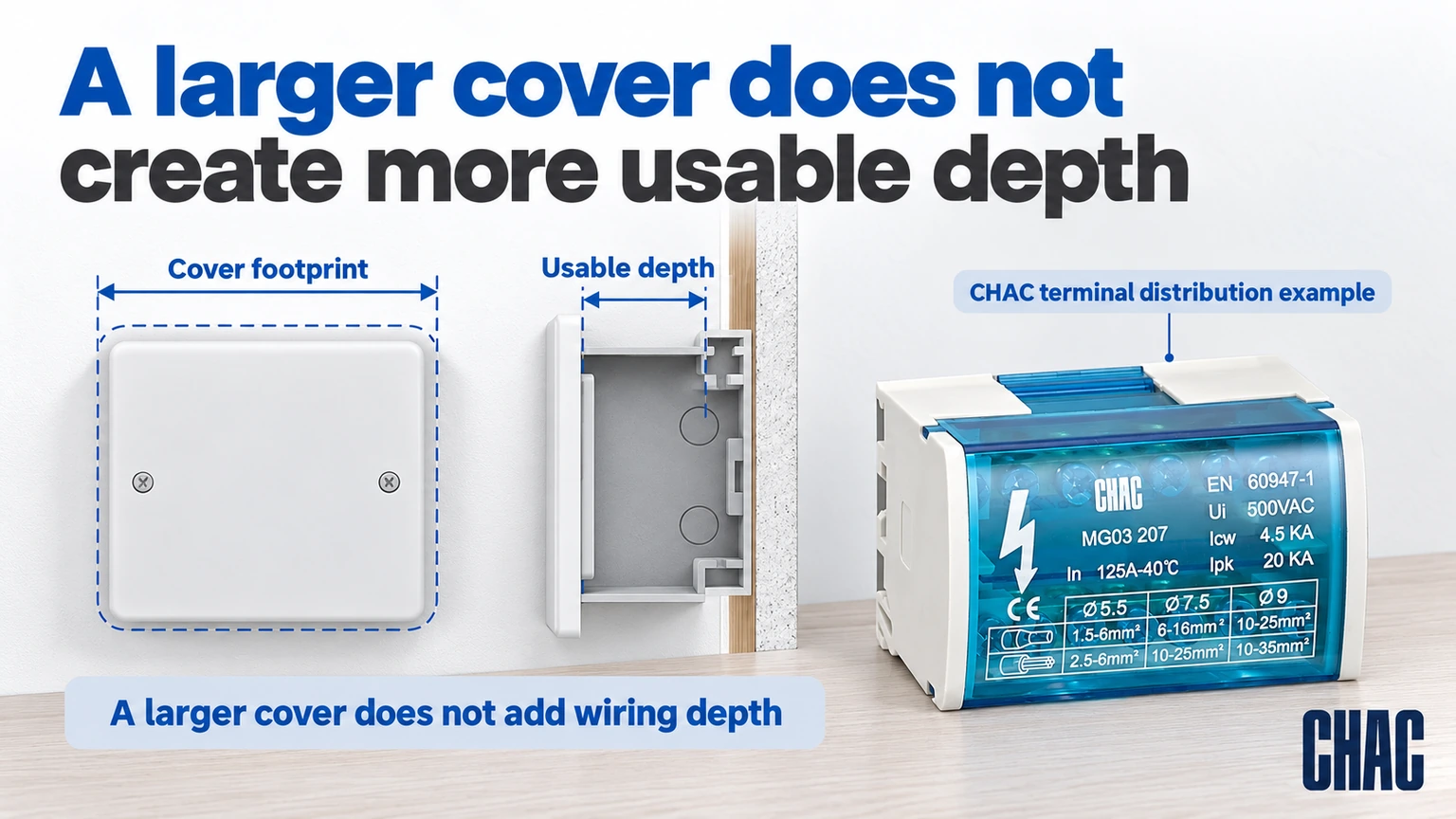
Request the exact box, extension or raised cover, device mounting arrangement and compatible fasteners as one proposal. Ask which documented volume may be included in the applicable fill evaluation and where the finished device plane will sit. Do not assume that a raised decorative face creates approved wiring space, or that every extension can be attached with longer device screws.
Also check any required bonding, cover engagement, wall-assembly conditions and entry access after the change. A proposal may solve the rear clearance while creating an unacceptable front projection or preventing the cover from seating. Mark both positions on the drawing and obtain the relevant manufacturer instructions. If the proposed combination has no supporting compatibility information, retain the unresolved status and evaluate another permitted arrangement rather than describing the extension as a completed repair.
What should be confirmed before ordering a replacement box?
Record the available cavity, finished-wall position, device model, conductor and connector arrangement, mounting method and required approval. Request the replacement’s drawing and installation instructions, then compare the complete assembly. This makes electrical box depth a defined requirement rather than a guess based on the old cover.
CHAC distribution junction box connection assembly is a terminal and bus connection product, not a shallow outlet box. Its documented dimensions are relevant to cabinet layouts that use that function. For related projects, consult the distribution and control product range while keeping the wall enclosure and device specification separate.
What are the common questions about shallow electrical boxes?
What is the shallowest electrical box you can get?
The answer depends on the product family and intended installation. Choose from approved models that meet the wiring and device requirements, rather than selecting the smallest advertised depth alone.
What is the minimum depth of an electrical box?
There is no single minimum suitable for every device and circuit. Check the applicable installation rules, device instructions, capacity and enclosure approval.
What are shallow electrical boxes used for?
They can serve installations where the available cavity is limited, provided the chosen box remains suitable for the devices, wiring method, fill and mounting conditions.
What are the dimensions of a shallow electrical box?
They are model-specific. The cited RACO 952 example is 1-5/8 inches deep, but that does not define every shallow box or its required opening.
What are the standard sizes for shallow electrical box?
Compare the exact height, width, depth and capacity within the chosen manufacturer range. The shallow label alone does not identify these values.
How deep should shallow electrical box be for the wiring inside?
Deep enough for the permitted device and conductor arrangement while meeting fill requirements, and shallow enough to fit the real cavity. If both cannot be met, redesign the installation rather than forcing the wiring.
Tham khảo
- Hubbell RACO 952: three-gang 1-5/8-inch-deep box; accessed October 19, 2026
- Hubbell RACO 942: three-gang 2-1/2-inch-deep box; accessed October 19, 2026
- Hubbell RACO enclosure families and accessories; accessed October 19, 2026
Kết luận
A shallow-box problem is solved by identifying the space constraint, not by hiding it behind a larger faceplate. Check the finished cavity, the installed device and the conductor arrangement before comparing replacement enclosures. Then verify capacity, mounting, entries and any approved cover or extension as one assembly. If the required wiring cannot fit appropriately, change the installation arrangement rather than crushing conductors or modifying the box without approval. Model-specific depth examples help compare options, but they do not establish a universal minimum or guarantee device compatibility. CHAC provides documented connection and distribution components for relevant cabinet applications. Use the exact model information for those functions and a separately verified wall-box specification where the project needs an outlet enclosure.
Đối với các bản vẽ mô hình và tài liệu dự án liên quan, Liên hệ CHAC về các yêu cầu của mạch điện.