Một thiết bị RCCB bị ngắt khi một mạch khác được bật không phải là thiết bị bị lỗi tự động. Một thiết bị có dòng trung tính được cho mượn có thể truyền dòng điện trở lại bên ngoài đường dẫn cảm nhận của thiết bị, trong khi loại dòng dư được chọn không đúng có thể gây ra một vấn đề khác: thiết bị có thể không phù hợp với dạng sóng lỗi do tải gây ra. Đối với nhà thầu điện Và đối với các nhà phân phối, đây là các kiểm tra riêng biệt, không phải là những giải thích tương thích với nhau. Việc sao chép một sơ đồ dây điện chung chung hoặc chọn một mức điện trở lớn hơn sẽ không giải quyết được cả hai vấn đề này. Hướng dẫn này giải thích cách xem xét các đường dẫn dây, phân biệt mức điện trở với các chức năng bảo vệ, đánh giá tải điện tử và xác định các tài liệu cần thiết trước khi chấp nhận bảng mạch. Việc lắp đặt và điều tra sự cố thuộc về một chuyên gia điện có trình độ sau hướng dẫn của thiết bị và các quy định địa phương áp dụng.
Câu trả lời ngắn gọn là: Lắp đặt và đấu nối RCCB Cần đảm bảo rằng tất cả các thiết bị dẫn điện trực tiếp liên quan đến mạch được bảo vệ nằm trong cùng một đường dẫn cảm nhận, với thiết bị bảo vệ đất bên ngoài. Một thiết bị RCCB cung cấp khả năng bảo vệ dòng điện còn lại mà không tích hợp chức năng bảo vệ quá tải hoặc ngắn mạch; một thiết bị RCBO kết hợp cả hai chức năng này. Các tiêu chuẩn IEC 61008 và IEC 61009 đề cập đến các dòng sản phẩm khác nhau này. Chỉ số dòng điện còn lại là 30 mA và chỉ số dòng điện có thể truyền tải là Ampe, cho thấy các đặc tính khác nhau, nhưng không có tính năng nào trong số đó là duy nhất để xác định tính phù hợp. Trước khi lựa chọn thiết bị, cần kiểm tra cấu trúc mạch, dạng sóng tải, khả năng bảo vệ quá dòng, sơ đồ nối dây của nhà sản xuất và các yêu cầu lắp đặt.
RCCB bảo vệ chống lại những gì?
RCCB so sánh tổng dòng điện đi qua hệ thống cảm nhận dòng điện dư của nó. Trong mạch một pha, dòng tải bình thường chảy ra qua dây dẫn và trở lại qua cực trung tính. Việc dòng điện chảy ngược lại theo một đường khác tạo ra sự mất cân bằng. RCCB hoạt động theo đặc tính dòng điện dư và thời gian được chỉ định; nó không xác định nguyên nhân của sự mất cân bằng đó.
Một thiết bị RCCB không phải là giải pháp thay thế cho việc bảo vệ quá tải hoặc ngắn mạch. MCB hoặc cầu chì phù hợp thực hiện nhiệm vụ chống quá dòng trong một thiết bị RCCB, trong khi RCBO bao gồm cả chức năng chống quá dòng và chống dòng dư. Hướng dẫn lắp đặt hệ thống điện: Kích thước của các thiết bị RCD, Được cập nhật vào ngày 5 tháng 8 năm 2026, tài liệu này phân biệt các dòng sản phẩm thiết bị và các tiêu chuẩn áp dụng cho chúng.
| Sắp xếp thiết bị | Chức năng dòng điện còn lại | Chức năng quá dòng | Quyết định về nhà thiết kế bảng điều khiển |
|---|---|---|---|
| Chỉ riêng MCB | Không được cung cấp bởi chính MCB | Chống quá tải và ngắn mạch | Xác định xem có cần thiết thiết lập bộ phận bảo vệ dòng điện còn lại riêng biệt hay không. |
| RCCB với bộ phận MCB hoặc cầu chì phối hợp | Được cung cấp bởi RCCB | Bán riêng | Kiểm tra cả yêu cầu bảo vệ của RCCB và bảo vệ mạch hạ lưu. |
| RCBO | Tích hợp | Tích hợp | Kiểm tra cả hai bộ chỉ số đánh giá và cấu trúc mạch cụ thể. |
Thiết bị dòng điện còn sót lại không đảm bảo an toàn mọi lần tiếp xúc với điện. Ví dụ, dòng điện từ dây điện sang trung tính qua người có thể vẫn được cân bằng qua đường cảm nhận. Các biện pháp bảo vệ cần thiết khác như nối đất, kết dính, cách điện, cách ly vẫn cần được xác nhận độc lập.
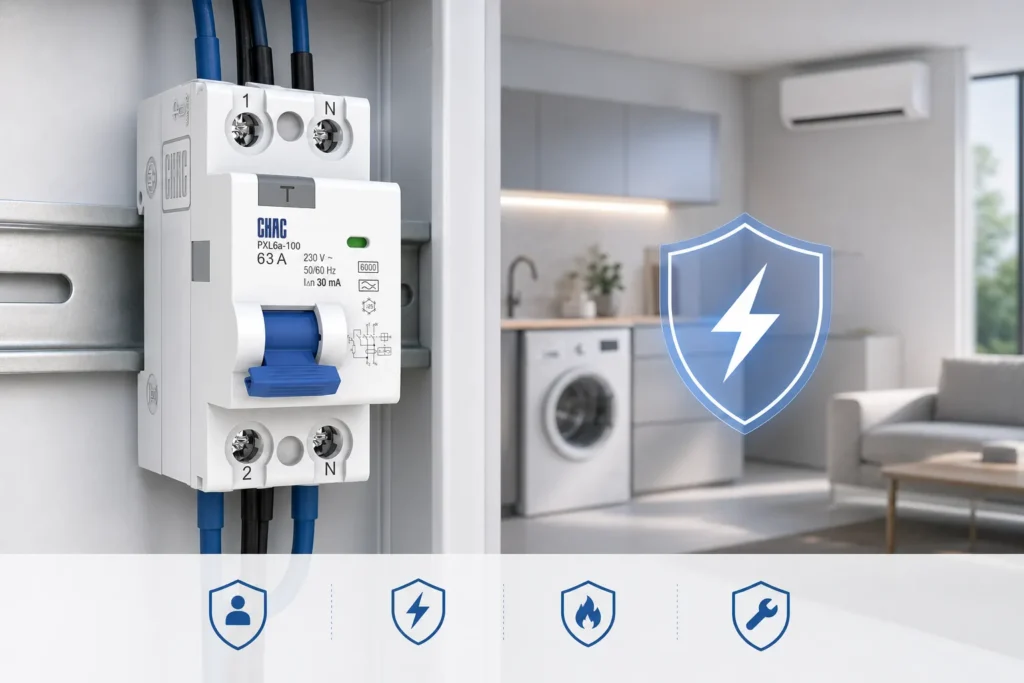
Dây điện nối đất, dây điện trung tính và dây điện bảo vệ nên được định tuyến như thế nào?
Luật dây điện thiết yếu là một đường dẫn dòng điện được giám sát hoàn toàn, không phải là sự sắp xếp đầu cuối từ trên xuống dưới phổ biến. Bản vẽ thiết bị chính xác sẽ xác định hướng cung cấp điện, vị trí đầu cực trung tính, các dây dẫn được phép sử dụng và các yêu cầu về kết nối mạch thử nghiệm. Đừng dựa vào các chi tiết này từ một mô hình khác có vỏ tương tự.
RCCB một pha được kết nối như thế nào?
Trong trường hợp hệ thống có dây điện và dây trung tính, cả hai đều đi qua các cực RCCB được chỉ định và tiếp tục đến tải được bảo vệ. Dây trung tính được bảo vệ sẽ đi qua thiết bị tương tự đó. Dây điện bảo vệ đi theo hệ thống nối đất của hệ thống lắp đặt bên ngoài đường dẫn cảm nhận dòng điện còn lại; nó không được sử dụng làm dây dẫn nối tải thay thế.
Những thay đổi nào xảy ra đối với một mạch ba pha?
Tất cả các pha cung cấp cho mạch được bảo vệ phải được bao gồm trong cùng một hệ thống cảm biến. Trong trường hợp tải sử dụng thiết bị trung tính, thiết bị đó cũng phải được bao gồm. Đối với tải ba pha không có thiết bị trung tính, cần phải có thiết bị và hệ thống kết nối được phép đặc biệt dành cho mục đích đó; không nên cho rằng mọi sản phẩm có bốn cực đều có thể được sử dụng mà không cần thiết bị trung tính, vì mạch thử nghiệm của nó có thể có các yêu cầu bổ sung.
| Sự sắp xếp mạch điện | Các con đường hiện tại để giải thích | Chi tiết của nhà sản xuất để xác nhận |
|---|---|---|
| Đơn pha với pha trung tính | Line và trạng thái trung lập trở lại của nó | Dấu hiệu thiết lập như một đầu cuối trung lập và dấu hiệu cung cấp/bốc xếp |
| Ba pha với pha trung tính | Tất cả ba giai đoạn và các trạng thái trung tính liên quan | Yêu cầu về hệ thống dẫn điện bốn dây và cực trung tính |
| Ba pha không có pha trung hòa | Tất cả ba giai đoạn | Sử dụng kết nối và hoạt động mạch thử nghiệm không cần thiết lập trung tính tải |
Tại sao một vật trung tính được chia sẻ hoặc mượn lại lại gây ra sự kích hoạt?
Một thiết bị trung tính mượn được là một đường dẫn trở lại tải thuộc một mạch được bảo vệ khác hoặc nằm bên ngoài RCCB có liên quan. Nếu dòng điện đi qua RCCB A nhưng một phần dòng điện trở lại đi qua RCCB B, thì cả hai thiết bị này sẽ không nhận thấy sự cân bằng mong muốn. Tương tự, việc kết nối tải được bảo vệ với thanh trung tính không được bảo vệ sẽ bỏ qua đường dẫn trở lại được giám sát. Điều này có thể gây ra sự ngắt mạch ngay cả khi chính tải không có lỗi về cách điện.
Một thanh nối trung tính thông thường phục vụ chức năng dòng điện phía hạ lưu của một thiết bị RCCB không phải là vấn đề tương tự như việc nối các thanh trung tính phía hạ lưu của các thiết bị RCCB riêng biệt lại với nhau. Việc đánh giá phải xác định nhóm bảo vệ nào của từng dây và thanh trung tính. Dây đất bảo vệ lại là một đường dẫn riêng biệt: một kết nối từ thanh trung tính phía hạ lưu đến đất có thể làm chệch dòng điện trở lại ngoài hệ thống cảm biến. Những giải thích này tuân theo nguyên tắc cân bằng dòng điện; chúng không thay thế việc đánh giá hệ thống dây điện cụ thể. Đừng bao giờ ngắt kết nối dây đất bảo vệ hoặc thêm một đường nối từ thanh trung tính đến đất để ngăn ngừa sự ngắt mạch.
Làm thế nào để chọn các cấp độ dòng điện và độ nhạy của RCCB?
Đánh giá amp có phải là giá trị thiết lập dòng điện quá tải không?
Không. Công suất dòng điện định mức của RCCB, In, mô tả khả năng truyền tải dòng điện của nó trong điều kiện quy định, không phải là thiết lập để tự động ngắt dòng điện quá tải. Việc tăng In không làm tăng khả năng bảo vệ chống quá tải. Hệ thống bảo vệ quá dòng riêng biệt phải bảo vệ dây dẫn và RCCB chống lại quá tải theo yêu cầu của hướng dẫn và thiết kế lắp đặt.
Short-circuit coordination is another check. The prospective fault current at the board and the RCCB manufacturer’s stated coordination with a specified short-circuit protective device, or SCPD, must be reviewed together. A conditional short-circuit rating is not evidence that an RCCB can independently interrupt that fault current. Do not substitute an arbitrary upstream MCB or fuse for the device specified in the coordination documentation.
Is 30 mA suitable for every installation?
No single residual-current setting applies to every circuit. The rated residual operating current, IΔn, is expressed in milliamperes and is distinct from In. A 30 mA device is commonly associated with additional protection, but its use and location depend on the applicable installation rules. Higher settings are not equivalent substitutes where additional protection is required; lower settings are not automatically a better choice for every load.
Consider the protective purpose, earthing arrangement, normal leakage from the connected equipment, and coordination with other residual-current devices. Do not increase IΔn merely to stop unexplained trips. The required sensitivity, timing, and selectivity need an installation-specific decision rather than a fixed application table.
What is the difference between Type AC, A, F, and B?
The type designation describes the residual-current waveforms a device is designed to detect. This is separate from its ampere rating, sensitivity, and upstream SCPD coordination. Schneider Electric’s Types of RCDs, updated 5 August 2026, explains the waveform distinctions with reference to IEC 60755 and IEC 62423.
| RCD type | Detection distinction | Selection boundary |
|---|---|---|
| Type AC | Sinusoidal AC residual current | Do not assume it covers rectifier or inverter fault waveforms, or that local rules permit it for the intended circuit. |
| Type A | Sinusoidal AC and pulsating DC residual current | Pulsating DC capability is not the same as smooth DC detection. |
| Type F | Type A characteristics plus specified composite-frequency residual currents associated with single-phase variable-speed drives | Do not treat it as a universal solution for every inverter or three-phase drive. |
| Type B | Sinusoidal AC, pulsating DC, specified composite-frequency currents, and smooth DC residual current | Relevant where the fault waveform requires it; the application name alone does not establish the requirement. |
How does DC detection affect EV charger selection?
Check the complete arrangement, including any residual direct-current detecting device (RDC-DD), rather than the external RCD type alone. Wallbox’s explanation of Sweden’s May 2024 SEK Handbook 444 requirements provides a scoped manufacturer example: it describes Type B or Type A with an IEC 62955 RDC-DD for certain models, and an integrated Type A plus RDC-DD arrangement for another. That example shows why built-in functions and external requirements must be checked model by model. It is not a worldwide installation rule or evidence that a CHAC device includes DC detection.
Does every solar inverter need a Type B RCCB?
No blanket recommendation follows from the label “solar PV.” Inverter architecture affects the possible residual-current waveform. The equipment instructions and applicable installation rules must establish whether an external RCD is required and which type is acceptable. If smooth DC residual current must be detected by the external RCD, Type A’s pulsating DC capability is not equivalent to Type B’s smooth DC capability.
An inverter’s reference to internal monitoring is not, by itself, proof that a particular external RCCB can be omitted or changed. Obtain the model-specific installation requirement and verify the complete protection arrangement. The waveform source above identifies PV among applications where rectifier characteristics can make Type B relevant; it does not prove that all PV installations require the same device.

Why does an RCCB keep tripping after installation?
A trip is evidence of an imbalance or an operating issue to investigate, not proof of a failed RCCB. A qualified person should distinguish the observed pattern, the circuit wiring, the load condition, and the device specification. The following table defines investigation priorities rather than live-testing instructions.
| Observed pattern | Possible explanation | What needs to be established |
|---|---|---|
| Trips when a different circuit operates | Borrowed neutral or interconnected protection-group neutral bars | Whether each load’s line and neutral pass through the same RCCB |
| Trips when one load is connected | Equipment leakage, insulation fault, or an unsuitable residual-current type | Equipment condition and documented waveform requirements |
| Trips as more loads operate | Accumulated leakage across the protected group | The installed loads’ leakage and whether circuit grouping meets the design requirements |
| Cannot reset or hold closed | Persistent downstream fault, connection problem, or device problem | The installation and device condition before returning the circuit to service |
| Test button does not produce the specified response | Incorrect supply/test-circuit connection or a device fault | The manufacturer’s test requirements and a qualified assessment |
Do not repeatedly reset a device without investigating a recurring fault, bypass its protective function, or remove earth connections. A replacement with a higher ampere rating does not correct a borrowed neutral; a change of waveform type does not repair damaged insulation. The RCD wiring and electrical safety guide provides related context, but the exact circuit and equipment documentation govern the decision.
What must be verified before an RCCB installation is accepted?
The test button checks the device’s built-in test function under its stated operating conditions. A successful test is useful, but it does not establish protective-conductor continuity, correct bonding, insulation condition, correct neutral grouping, or satisfactory protection throughout the installation. Handle reset is not an acceptance test either.
- Confirm the approved circuit diagram, supply arrangement, earthing system, and applicable installation requirements.
- Match voltage, frequency, current-carrying rating, residual-current sensitivity, timing, and waveform type to the design and equipment instructions.
- Verify terminal markings, permitted supply direction, conductor suitability, manufacturer tightening requirements, and the separation of protected neutrals.
- Document overload protection and short-circuit coordination, including the specified SCPD and the relevant fault-level assessment.
- Complete and record the required inspection and commissioning tests using the applicable procedure, in addition to the manufacturer’s test-button check.
This is a specification and acceptance checklist, not a procedure for working on energized equipment. Test methods, limits, and repeat-test intervals must come from the manufacturer’s instructions and the rules adopted for the project; a generic blog cannot establish them for every market.
How should the RCCB and upstream protective device be recorded together?
In the handover file, pair the RCCB installation record with the specified upstream short-circuit protective device. Include both complete model codes, the applicable system voltage, the assessed fault level and the manufacturer’s coordination-document reference. A photograph showing two devices in one board is not evidence of their tested combination.
For repeat orders, treat a changed upstream breaker or fuse as a configuration change to review. Keeping the same RCCB current rating does not demonstrate that the original combination evidence still applies. Ask the responsible designer which part of the coordination and commissioning record needs updating before the altered board is accepted.
Link this device pair to the neutral-group and circuit schedule described in the Hướng dẫn đấu dây RCD. Together, those records identify both the protective arrangement and the circuits it actually serves.
Which compliance documents should an RCCB buyer request?
Keep product standards, legal conformity, certification scope, and installation acceptance separate. IEC 61008 concerns the RCCB device family without integral overcurrent protection; IEC 61009 concerns RCBOs with integral overcurrent protection. A reference to either standard is not itself proof that a particular model has been independently certified.
Phần European Commission’s CE marking guidance explains that the manufacturer declares conformity with applicable legal requirements and must carry out conformity assessment, prepare the technical file, and issue the EU declaration of conformity. CE marking does not mean that the EU or another authority has approved a product as safe. For an EEA purchase, check the declaration against the exact supplied model and applicable legislation rather than accepting a logo alone.
For US panelboard applications, IEC or CE documentation does not establish interchangeability with listed equipment. The UL Solutions Panelboard Application Guide distinguishes certification and classification scopes and explains the importance of product markings and installation instructions. Verify the equipment’s permitted use, certification scope, and the locally adopted requirements with the responsible designer or authority. No UL status is inferred for the products linked here.
How should distributors compare RCCB offers?
Compare offers against the same protection requirement, not just price per pole. A shared RCCB arrangement can affect several downstream circuits when it trips, while circuit-level protection changes the board layout and fault-isolation arrangement. Neither design is universally preferable; assess the required continuity of service, available space, installation rules, and documented protection coordination before comparing purchasing costs.
Request a model-specific package containing the wiring diagram, ratings, waveform designation, terminal and mounting requirements, coordination documentation, and applicable conformity or certification evidence. Missing documents can delay board approval or require redesign even when a product fits physically. CHAC’s RCCB breaker category is a starting point for identifying products; the category name does not confirm an individual model’s suitability for EV, PV, or another electronic load.
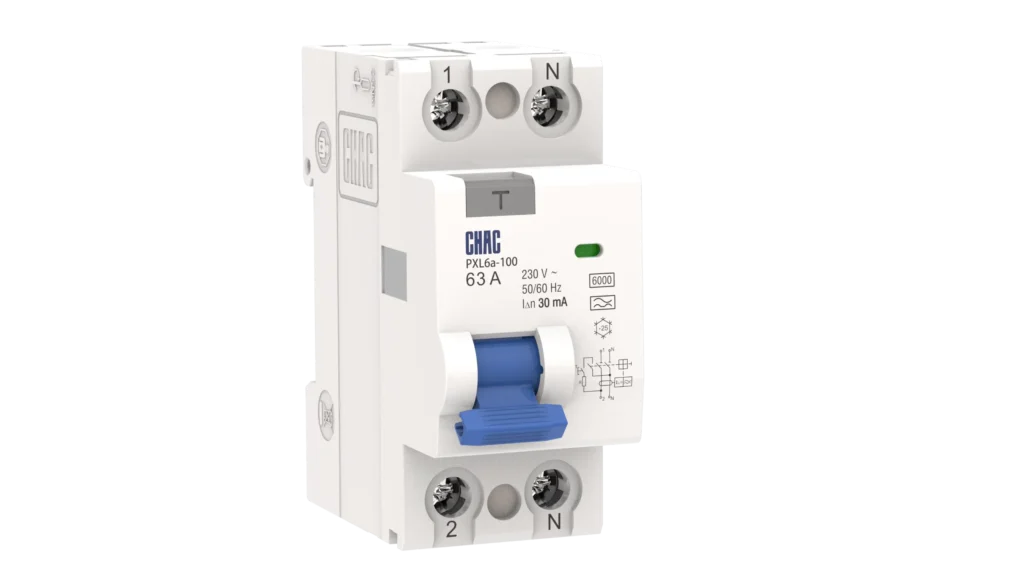
The existing PXL6a-100 product reference is retained below for model identification, not as a universal recommendation. Check the current documentation before specification.
PXL6a-100 Electromagnetic Residual Current Operated Circuit Breaker
Câu hỏi thường gặp
Sự khác biệt giữa RCCB và RCD là gì?
RCD là thuật ngữ rộng hơn để chỉ thiết bị dòng dư. RCCB là RCD không có chức năng bảo vệ quá dòng tích hợp, trong khi RCBO kết hợp chức năng bảo vệ dòng dư và quá dòng. Khi chỉ định bảng mạch, hãy sử dụng tên chính xác của thiết bị.
RCCB có thể hoạt động mà không cần nối đất không?
An RCCB senses current imbalance rather than measuring an earth conductor directly. It can therefore operate in some fault conditions without a direct earth connection to the device. This does not remove the installation’s earthing and bonding requirements or establish complete protection.
Tôi có thể sử dụng thiết bị điều khiển từ xa loại A cho bộ sạc điện xe hơi không?
Only if the charger’s documented residual-current protection arrangement and applicable local rules permit it. Type A detects AC and pulsating DC residual current; it is not equivalent to smooth DC detection. Any claimed built-in DC detection or other protective function must be verified for the exact charger before a Type A RCBO is accepted.
Loại RCCB nào là cần thiết cho bộ sạc điện xe hơi?
Hướng dẫn sử dụng bộ sạc, các dạng sóng lỗi có thể xảy ra và các yêu cầu lắp đặt tại địa phương sẽ xác định loại bộ sạc. Loại B cung cấp khả năng phát hiện dòng điện dư DC ổn định, nhưng điều đó không chứng minh rằng mọi bộ sạc đều cần một thiết bị RCCB loại B bên ngoài. Xác nhận xem các chức năng bảo vệ nào được tích hợp sẵn trong bộ sạc và các chức năng nào phải được cung cấp bên ngoài.
Tôi nên sử dụng bộ điều khiển điện tử công suất lớn cỡ nào cho bộ sạc xe điện của mình?
There is no universal ampere rating for an EV charger. Confirm the manufacturer’s circuit requirements, configured maximum charging current, conductor capacity, installation conditions, and applicable rules. Then verify the RCBO’s overcurrent characteristic, breaking capacity, residual-current sensitivity, and waveform type separately.
RCCB nên được kiểm tra bao nhiêu lần?
Follow the device manufacturer’s stated test-button interval and the inspection or testing requirements applicable to the installation. Do not assume one schedule applies across all products and markets. Test-button operation does not replace the required installation verification.
Tham khảo
- Schneider Electric, Electrical Installation Guide: Form factors of RCDs and Types of RCDs, both updated 5 August 2026. These explain device families and waveform selection, not certification of a CHAC model.
- European Commission: CE marking. This explains manufacturer and supply-chain responsibilities, not installation approval.
- UL Solutions: Panelboard Application Guide. This explains panelboard suitability, markings, and certification scope for the applications covered by the guide.
- Wallbox: EV charging standards, explaining May 2024 Swedish SEK Handbook 444 requirements and named Wallbox charger arrangements. This is a manufacturer example specific to its stated scope.
Linked source pages were reviewed on 7 October 2026. The comparisons concern protection functions and documentation requirements, not independently tested performance or pricing. This article is published by CHAC; no CHAC model-specific certification or EV/PV suitability is inferred from these sources.
What is the final check before choosing an RCCB?
The decisive distinction is between a correct current path and a correct protection specification. A borrowed neutral can defeat the intended balance even with a suitable device, while orderly wiring cannot make an unsuitable waveform type correct. Start with the circuit and equipment requirements, establish the earthing and neutral arrangements, then select the current-carrying rating, residual-current characteristics, and coordinated overcurrent protection. Before acceptance, verify the installation under the applicable procedure rather than relying on a successful test-button operation. These checks cannot be replaced by a familiar product name or conformity logo. For a model-level discussion, review CHAC’s Bộ ngắt dòng điện còn sót lại information and request the wiring and coordination documents needed for the intended project.