When a solar installer in Perth substituted an AC miniature breaker for a DC string, the lever looked normal but the arc did not extinguish when the fault occurred. The replacement had the right current number and the wrong voltage and polarity arrangement. The incident showed why a DC MCB is selected by arc behavior, system voltage, polarity, and interruption rating—not by label shape alone. The practical answer is to document single pole DC MCB như một phần của hệ thống điện hoàn chỉnh.
Tóm tắt: A single-pole DC MCB protects a conductor in a direct-current circuit, but the device must be rated for the system voltage, polarity, short-circuit current, and intended use. Buyers should confirm DC breaking capacity, number of poles, polarised terminals, trip curve, ambient derating, and the manufacturer wiring direction. AC and DC ratings are not interchangeable.
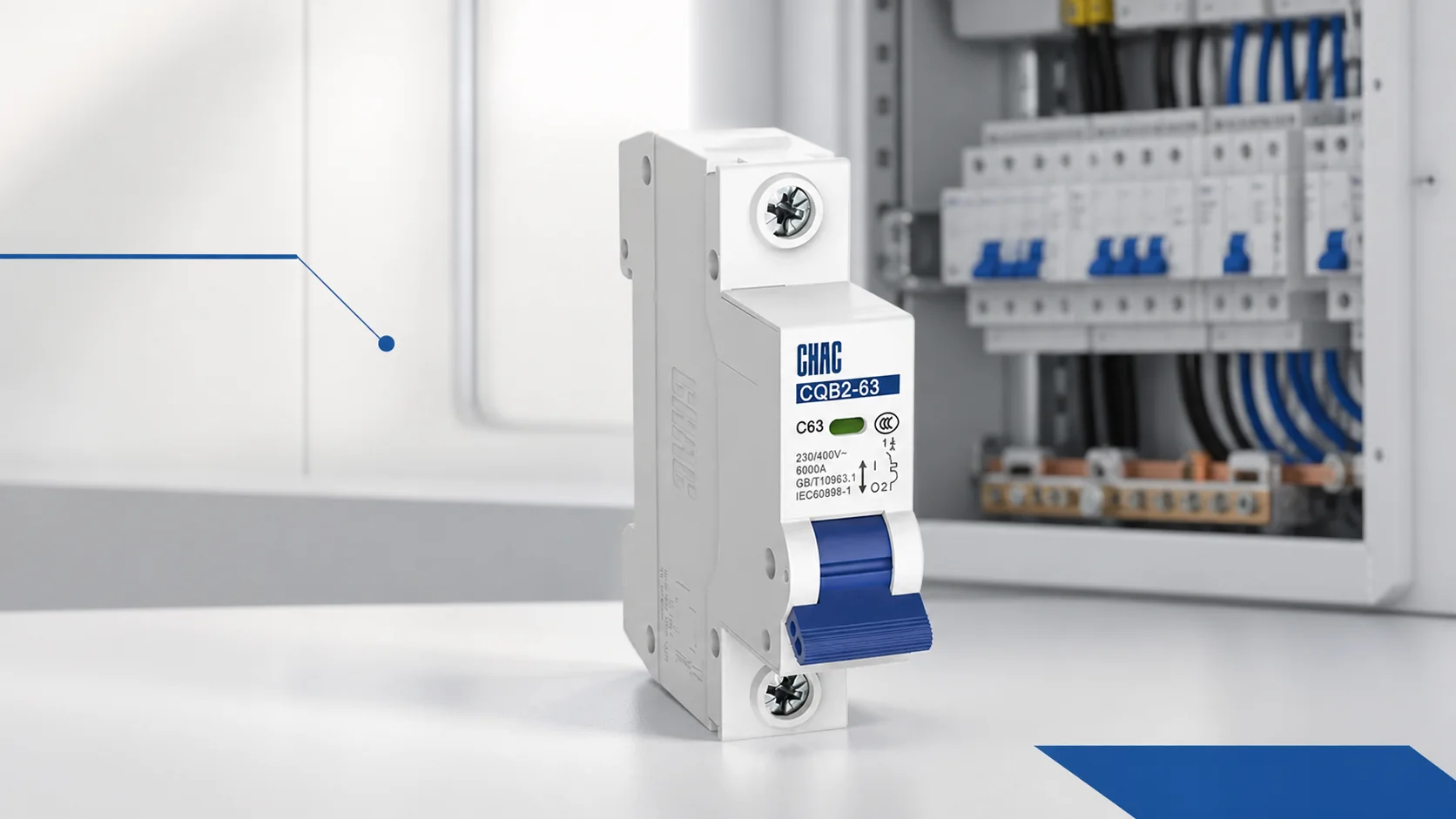
A DC MCB is used in battery, photovoltaic, telecom, control, and other direct-current circuits. Since DC has no natural current zero, arc interruption is more demanding than in many AC applications. The selection brief must include maximum voltage, prospective fault current, cable size, source type, and whether both conductors need isolation. When the brief is clear, circuit breaker for DC voltage Có thể so sánh bằng cách sử dụng bằng chứng thay vì một lời hứa marketing chung chung.
What Is the Function of a Single-Pole DC MCB?
The breaker carries normal current and opens when overload or short-circuit current exceeds its time-current characteristic. A single-pole unit interrupts one conductor; whether that conductor is positive or negative, and whether the other pole also needs isolation, depends on the system design. In a floating or battery system, a two-pole isolating arrangement may be required even when the branch protection is single pole.
Why Is DC Voltage Rating Critical?
The voltage rating defines the distance and magnetic design used to extinguish the arc. A breaker marked for 250 VDC is not automatically suitable for a 500 V string. Check the rating at the actual number of poles in series, the current direction if the device is polarised, and the maximum prospective fault current. Use the manufacturer table rather than estimating from an AC label.
How Do AC and DC Circuit Breakers Differ?
AC breakers benefit from alternating current crossing zero each half cycle. DC devices use magnetic blowout, longer arc paths, or pole series arrangements to interrupt current. This is why an AC MCB may fail to clear a DC fault safely. A DC MCB may be suitable for some AC applications only if the manufacturer explicitly provides that rating.
How Should the Breaker Be Installed?
Follow polarity arrows, line/load markings, torque values, clearance, and the specified cable stripping length. Keep source conductors short and route them to limit loop energy. After installation, test insulation and polarity, verify the open gap, and record the breaker model, voltage, current, and fault-level calculation in the as-built file.
What changes if the DC circuit can be supplied from another source?
For a single-pole DC MCB, show every possible supply on the project diagram before the device is selected. A circuit with storage or conversion equipment needs a review of its permitted operating modes, including any mode in which the assumed supply direction changes. Do not infer reverse-feed capability from the handle position or from an AC product in a similar housing.
Ask the supplier to identify the allowed current direction, voltage and connection arrangement for the exact model. If a multi-pole arrangement is proposed to meet the voltage duty, obtain its documented connection scheme; do not invent a series-pole layout. Keep this permission separate from the system’s isolation requirements, because opening one conductor does not automatically establish isolation from every source.
Phần breaker buying guide’s backfeed checks explain the procurement distinction between physical fit and permitted supply direction. For the DC circuit, the selected model’s own instructions remain decisive.
What Should Be Coordinated Around the MCB?
Coordinate the breaker with fuses, battery protection, PV modules, converters, contactors, cable ampacity, and downstream equipment. Selectivity may be difficult when several protective devices share a high-energy source. The goal is to clear the smallest faulty section while keeping the rest of the DC system available.
How Should a Buyer Choose a DC MCB Supplier?
Ask for IEC test evidence, DC voltage tables, polarity diagrams, terminal data, mechanical endurance, and a clear replacement family. CHAC offers DC MCB and terminal protection options with engineering support for low-voltage distribution. A complete purchase record should state voltage, poles, current, curve, breaking capacity, and installation orientation.
Đề xuất sản phẩm
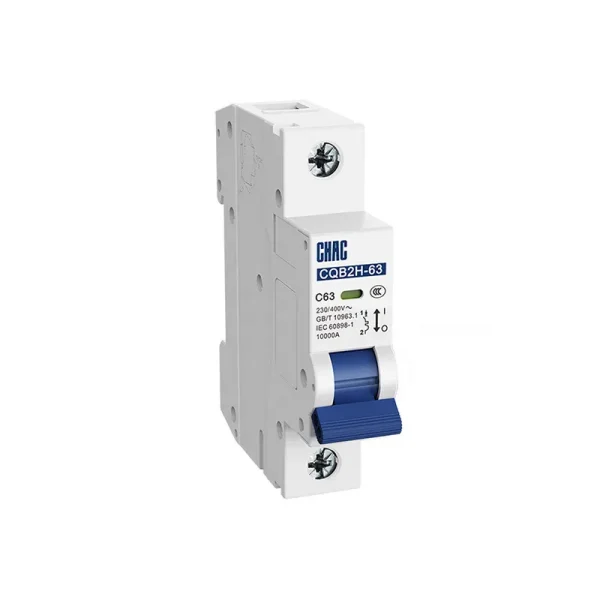
CQB2H-63 Miniature Circuit Breaker – CHAC Electric
Các thông số nào nên được ghi trong RFQ?
| Vùng quyết định | Điều cần xác định | Tại sao điều đó lại quan trọng |
|---|---|---|
| Điện áp | Maximum DC voltage and poles in series | Controls arc interruption |
| Fault level | Prospective short-circuit current | Confirms breaking capacity |
| Điện cực | Positive/negative and line/load direction | Prevents incorrect magnetic operation |
| Cable | Ampacity, temperature, route, terminal size | Coordinates protection and heating |
Chúng tôi khuyên bạn nên đo kết quả lắp đặt cũng như giá trị theo catalog. Hãy chụp ảnh các thiết bị đầu cuối, ghi lại momen xoắn và các giá trị thử nghiệm, đồng thời lưu giữ bản vẽ đã phê duyệt cùng với lô hàng. Bản ghi này sẽ rất hữu ích. DC circuit breaker Có thể kiểm tra được khi cần thay thế hoặc mở rộng.
Người mua nên lựa chọn sản phẩm và nhà cung cấp như thế nào?
- Trước khi yêu cầu báo giá, hãy xác định điện áp, dòng điện, công suất hoạt động, môi trường làm việc, mức độ lỗi và rủi ro của người dùng hoặc máy móc.
- Yêu cầu bảng dữ liệu chính xác, sơ đồ dây điện, giấy chứng nhận, chứng chỉ thử nghiệm, phụ kiện và chính sách thay thế.
- Xác nhận mẫu hoặc kiểm tra lần đầu tiên về sản phẩm và xác nhận việc lắp đặt, không chỉ là việc đóng gói.
- Các kết quả về chuỗi số, đợt sản xuất, cài đặt, mô-men xoắn và vận hành được ghi lại trong tệp bảo trì hoặc dự án.
- So sánh chi phí vận chuyển, thời gian giao hàng, phụ tùng thay thế, thời gian phản hồi dịch vụ và thông báo thay đổi trước khi phát hành sản phẩm.
CHAC là nhà sản xuất thiết bị điện áp thấp OEM/ODM có trụ sở tại Trung Quốc và là nhà cung cấp giải pháp hệ thống điện toàn cầu. Các dòng sản phẩm của hãng bao gồm thiết bị điện tử đầu cuối, MCB, RCCB/RCBO, SPD, thiết bị phân phối, contactor, rơle quá tải nhiệt và thiết bị bảo vệ động cơ. Người mua có thể xem qua Dòng sản phẩm CHAC phù hợp và Hướng dẫn ứng dụng liên quan trước khi yêu cầu lựa chọn theo dự án cụ thể.
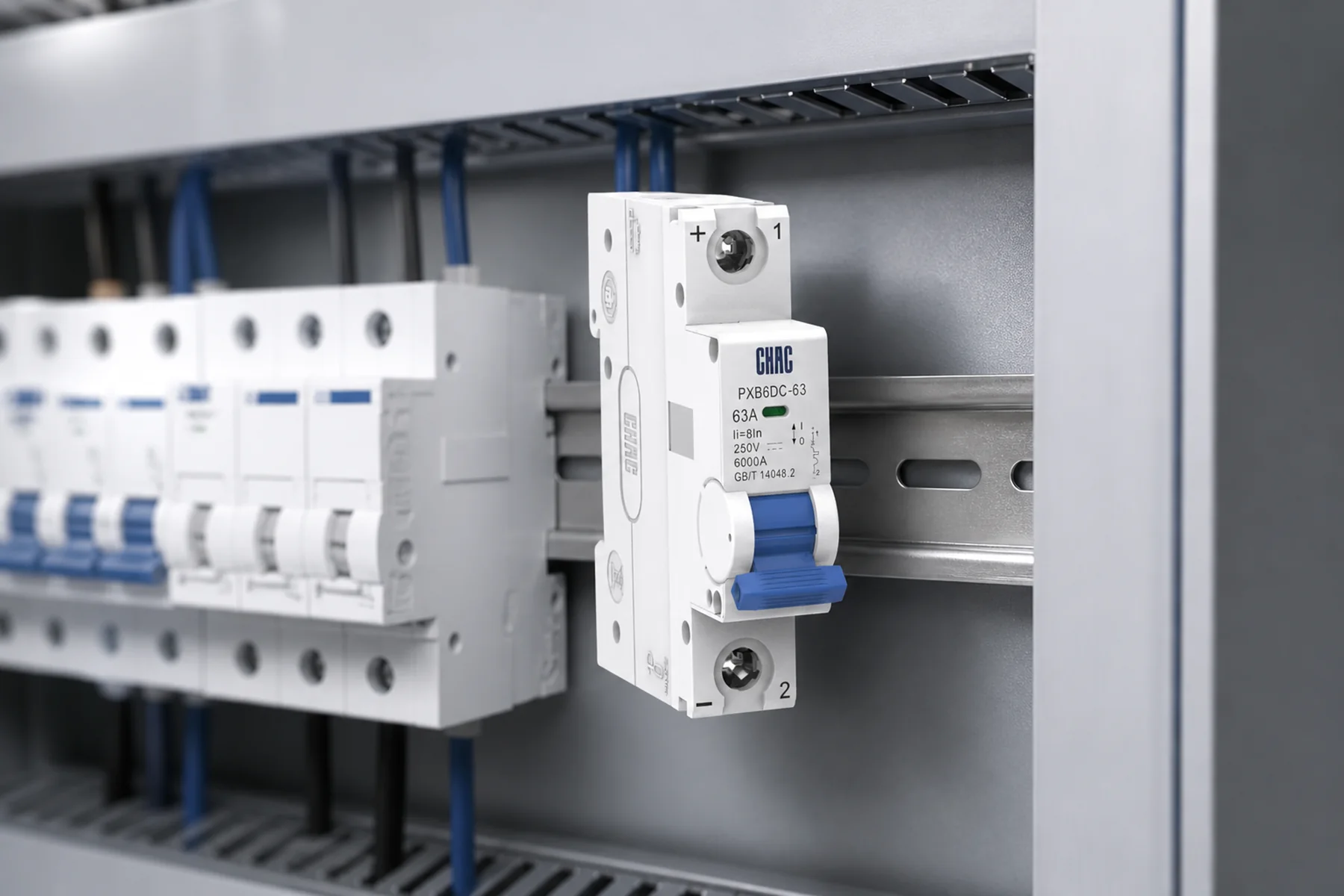
Questions that prevent an AC-to-DC substitution
Before approving a single-pole DC MCB, write down the maximum open-circuit voltage, prospective fault current, source type, polarity and the number of poles that will be placed in series. Solar strings, batteries and converter outputs can have different fault behaviour even when their normal current is similar. An AC-only marking is not evidence that the device can clear a DC arc.
Installation records should retain the manufacturer polarity diagram, line/load direction, terminal torque and the actual cable arrangement. If a project needs isolation of both conductors, a single-pole device may not meet that requirement; confirm the circuit boundary and the locally adopted rule before selecting a DC circuit breaker.
FAQ: Dc Mcb
What is the purpose of a DC MCB?
It protects a DC conductor from overload and short-circuit current and provides a controlled means of isolation when correctly rated.
What is the purpose of a DC circuit breaker?
It interrupts DC faults safely and isolates a circuit; the exact device must match system voltage, current, fault level, and polarity.
What is the difference between a two-pole MCB and a single-pole MCB?
A single-pole unit opens one conductor, while a two-pole unit can open two. The required arrangement depends on grounding, isolation, and the applicable installation rules.
When should I use one pole versus two poles?
Use the circuit design and local code. Battery and floating systems often need simultaneous isolation of both conductors, while some grounded branches protect one ungrounded conductor.
Can a DC MCB be used on AC?
Only when the manufacturer gives an AC rating for the exact model and connection. Never infer interchangeability from the housing.
Cá nhân tham khảo và quyết định cuối cùng
Hãy sử dụng các nguồn này khi kiểm tra thiết kế, kế hoạch thử nghiệm hoặc thông số kỹ thuật mua sắm:
- Bộ phận ngắt mạch theo tiêu chuẩn IEC 60947-2
- IEC 60898-2 circuit-breakers for DC
- IEC 60364-7-712 photovoltaic power supply systems
Sự khác biệt không chỉ nằm ở thành phần trên đường ray – mà còn ở các chỉ số hiệu suất, hệ thống dây điện, các thử nghiệm và các quyết định sau đó. Khi người mua xử lý DC MCB breaker Là một yêu cầu có thể đo lường được, việc triển khai sẽ dễ dàng hơn, dễ bảo trì và dễ mở rộng quy mô. CHAC có thể giúp chuyển đổi các yêu cầu về ứng dụng, tuân thủ và cung cấp thành một giải pháp điện áp thấp có thể lặp lại được.