When a solar installer in Perth substituted an AC miniature breaker for a DC string, the lever looked normal but the arc did not extinguish when the fault occurred. The replacement had the right current number and the wrong voltage and polarity arrangement. The incident showed why a DC MCB is selected by arc behavior, system voltage, polarity, and interruption rating—not by label shape alone. The practical answer is to document Unige polar MCB de DC Dans le cadre du système électrique complet.
Résumé : A single-pole DC MCB protects a conductor in a direct-current circuit, but the device must be rated for the system voltage, polarity, short-circuit current, and intended use. Buyers should confirm DC breaking capacity, number of poles, polarised terminals, trip curve, ambient derating, and the manufacturer wiring direction. AC and DC ratings are not interchangeable.
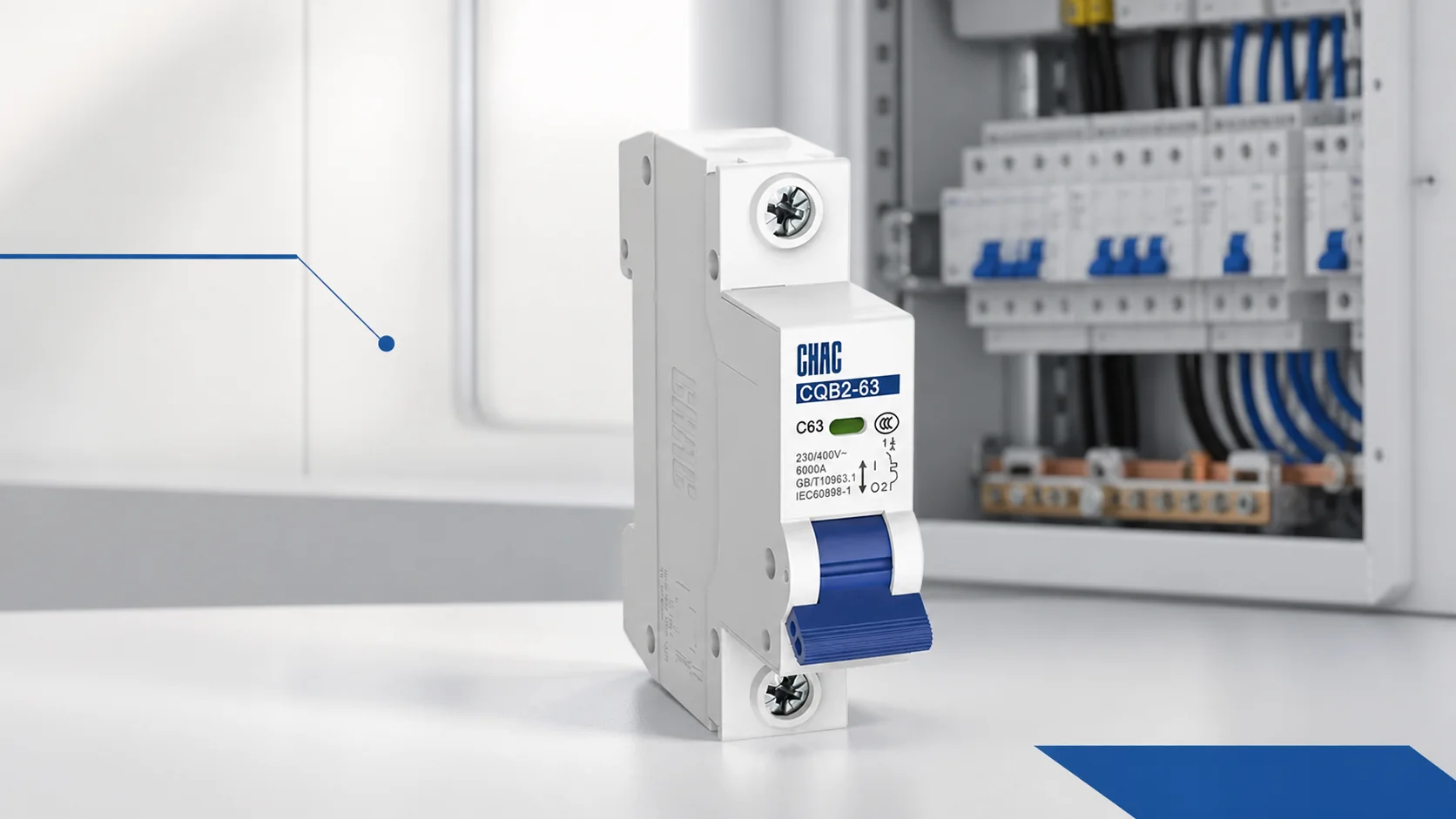
A DC MCB is used in battery, photovoltaic, telecom, control, and other direct-current circuits. Since DC has no natural current zero, arc interruption is more demanding than in many AC applications. The selection brief must include maximum voltage, prospective fault current, cable size, source type, and whether both conductors need isolation. When the brief is clear, circuit breaker for DC voltage Il peut être comparé en utilisant des preuves plutôt que des promesses marketing génériques.
What Is the Function of a Single-Pole DC MCB?
The breaker carries normal current and opens when overload or short-circuit current exceeds its time-current characteristic. A single-pole unit interrupts one conductor; whether that conductor is positive or negative, and whether the other pole also needs isolation, depends on the system design. In a floating or battery system, a two-pole isolating arrangement may be required even when the branch protection is Unige polar.
Why Is DC Voltage Rating Critical?
The voltage rating defines the distance and magnetic design used to extinguish the arc. A breaker marked for 250 VDC is not automatically suitable for a 500 V string. Check the rating at the actual number of poles in series, the current direction if the device is polarised, and the maximum prospective fault current. Use the manufacturer table rather than estimating from an AC label.
How Do AC and DC Circuit Breakers Differ?
AC breakers benefit from alternating current crossing zero each half cycle. DC devices use magnetic blowout, longer arc paths, or pole series arrangements to interrupt current. This is why an AC MCB may fail to clear a DC fault safely. A DC MCB may be suitable for some AC applications only if the manufacturer explicitly provides that rating.
How Should the Breaker Be Installed?
Follow polarity arrows, line/load markings, torque values, clearance, and the specified cable stripping length. Keep source conductors short and route them to limit loop energy. After installation, test insulation and polarity, verify the open gap, and record the breaker model, voltage, current, and fault-level calculation in the as-built file.
What changes if the DC circuit can be supplied from another source?
For a single-pole DC MCB, show every possible supply on the project diagram before the device is selected. A circuit with storage or conversion equipment needs a review of its permitted operating modes, including any mode in which the assumed supply direction changes. Do not infer reverse-feed capability from the handle position or from an AC product in a similar housing.
Ask the supplier to identify the allowed current direction, voltage and connection arrangement for the exact model. If a multi-pole arrangement is proposed to meet the voltage duty, obtain its documented connection scheme; do not invent a series-pole layout. Keep this permission separate from the system’s isolation requirements, because opening one conductor does not automatically establish isolation from every source.
Le breaker buying guide’s backfeed checks explain the procurement distinction between physical fit and permitted supply direction. For the DC circuit, the selected model’s own instructions remain decisive.
What Should Be Coordinated Around the MCB?
Coordinate the breaker with fuses, battery protection, PV modules, converters, contactors, cable ampacity, and downstream equipment. Selectivity may be difficult when several protective devices share a high-energy source. The goal is to clear the smallest faulty section while keeping the rest of the DC system available.
How Should a Buyer Choose a DC MCB Supplier?
Ask for IEC test evidence, DC voltage tables, polarity diagrams, terminal data, mechanical endurance, and a clear replacement family. CHAC offers DC MCB and terminal protection options with engineering support for low-voltage distribution. A complete purchase record should state voltage, poles, current, curve, breaking capacity, and installation orientation.
Recommandation de produit
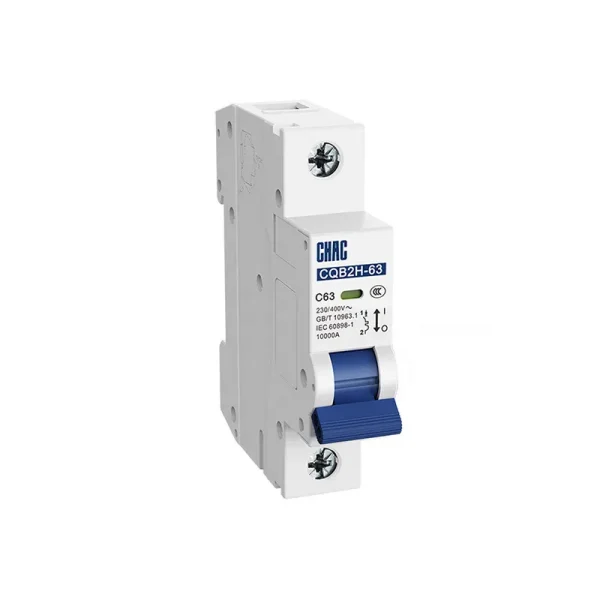
Disjoncteur miniature CQB2H-63 – CHAC Electric
Quels paramètres doivent-ils figurer dans le cahier des charges ?
| Zone de décision | Qu'est-ce qu'il faut préciser ? | Pourquoi c'est important |
|---|---|---|
| Tension | Maximum DC voltage and poles in series | Controls arc interruption |
| Fault level | Prospective short-circuit current | Confirms breaking capacity |
| Polarité | Positive/negative and line/load direction | Prevents incorrect magnetic operation |
| Cable | Ampacity, temperature, route, terminal size | Coordinates protection and heating |
Nous recommandons de mesurer le résultat installé ainsi que la valeur du catalogue. Photographiez les bornes, enregistrez le couple et les mesures de test, et conservez le dessin approuvé avec le lot de livraison. Cette documentation constitue DC circuit breaker Il est possible de vérifier l’état des choses lorsque des remplacements ou des agrandissements sont nécessaires.
Comment les acheteurs doivent-ils sélectionner le produit et le fournisseur ?
- Définissez la tension, la puissance, le mode de fonctionnement, l'environnement, le niveau de défaillance et le risque pour l'utilisateur ou la machine avant de demander un devis.
- Demandez les données techniques exactes, le schéma électrique, le certificat, les preuves d'essai, les accessoires et la politique de remplacement.
- Approuver un échantillon ou une première inspection du produit et vérifier l’installation, et non seulement l’emballage.
- Les résultats enregistrés concernant les séries, les lots, les paramètres, le couple et la mise en service sont sauvegardés dans le fichier de maintenance ou de projet.
- Comparez les coûts d'immobilisation, les délais de livraison, les pièces de rechange, la rapidité des interventions et les notifications de changement avant la mise sur le marché.
CHAC est un fabricant de produits électriques basse tension OEM/ODM basé en Chine et un fournisseur de solutions globales pour les systèmes électriques. Ses gammes de produits comprennent les appareils électriques de borne, les MCB, les RCCB/RCBO, les SPD, les équipements de distribution, les contacteurs, les relais de surcharge thermique et les dispositifs de protection des moteurs. Les acheteurs peuvent consulter le gamme de produits CHAC pertinente et le guide d'application connexe avant de demander une sélection spécifique au projet.
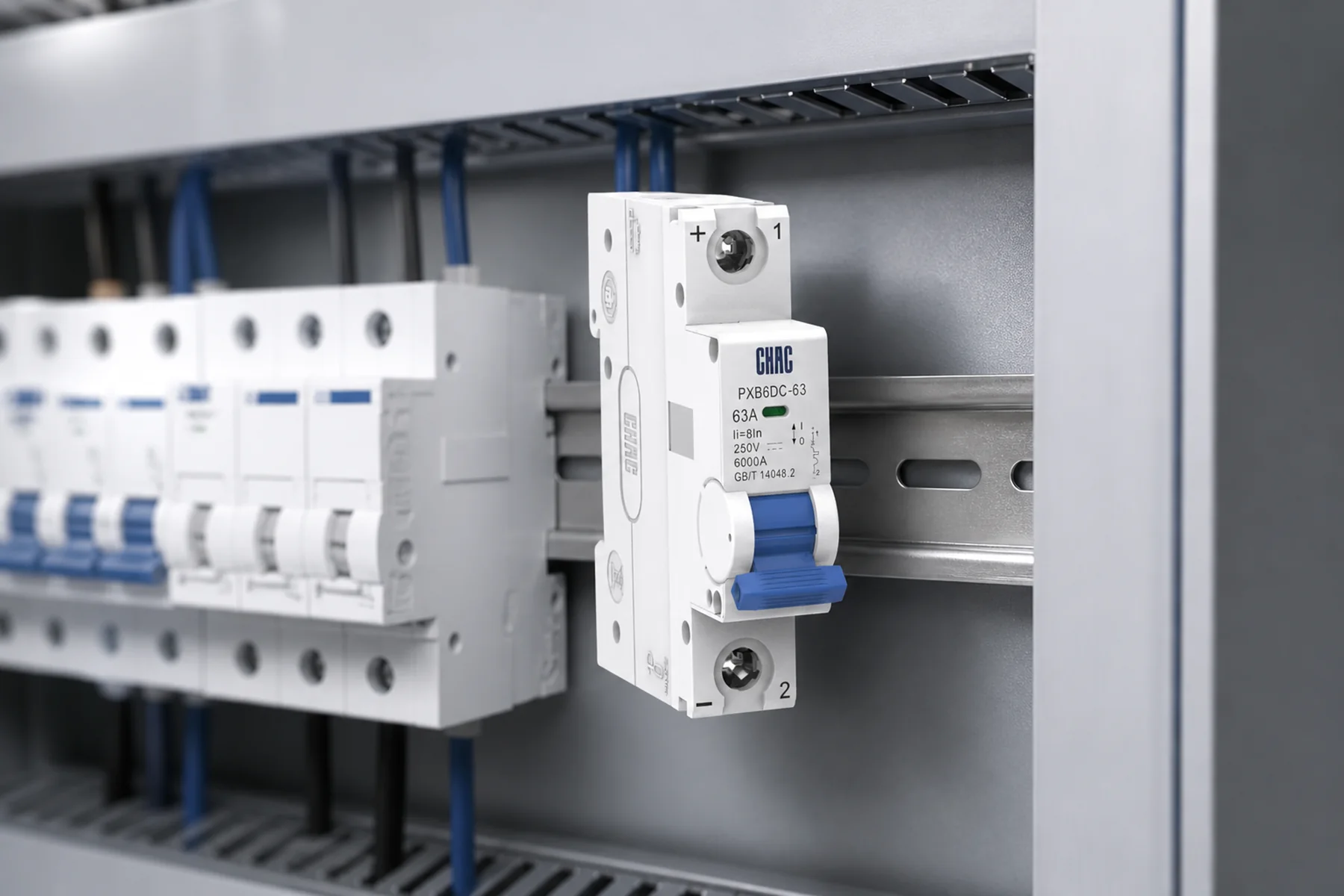
Questions that prevent an AC-to-DC substitution
Before approving a single-pole DC MCB, write down the maximum open-circuit voltage, prospective fault current, source type, polarity and the number of poles that will be placed in series. Solar strings, batteries and converter outputs can have different fault behaviour even when their normal current is similar. An AC-only marking is not evidence that the device can clear a DC arc.
Installation records should retain the manufacturer polarity diagram, line/load direction, terminal torque and the actual cable arrangement. If a project needs isolation of both conductors, a single-pole device may not meet that requirement; confirm the circuit boundary and the locally adopted rule before selecting a DC circuit breaker.
FAQ: Dc Mcb
What is the purpose of a DC MCB?
It protects a DC conductor from overload and short-circuit current and provides a controlled means of isolation when correctly rated.
What is the purpose of a DC circuit breaker?
It interrupts DC faults safely and isolates a circuit; the exact device must match system voltage, current, fault level, and polarity.
What is the difference between a two-pole MCB and a single-pole MCB?
A single-pole unit opens one conductor, while a two-pole unit can open two. The required arrangement depends on grounding, isolation, and the applicable installation rules.
When should I use one pole versus two poles?
Use the circuit design and local code. Battery and floating systems often need simultaneous isolation of both conductors, while some grounded branches protect one ungrounded conductor.
Can a DC MCB be used on AC?
Only when the manufacturer gives an AC rating for the exact model and connection. Never infer interchangeability from the housing.
Références et décision finale
Utilisez ces sources lors de la vérification d’un projet, d’un plan de test ou d’une spécification d’achat :
- Disjoncteurs IEC 60947-2
- IEC 60898-2 circuit-breakers for DC
- IEC 60364-7-712 photovoltaic power supply systems
La différence ne se situe pas uniquement dans le composant sur le rail — elle se situe dans les performances, le câblage, les tests et les décisions qui en résultent. Lorsqu’un acheteur traite DC MCB breaker En tant que critère mesurable, l'installation est plus facile à mettre en service, à maintenir et à étendre. CHAC peut aider à transformer les exigences applicatives, de conformité et de livraison en une solution à faible tension reproductible.