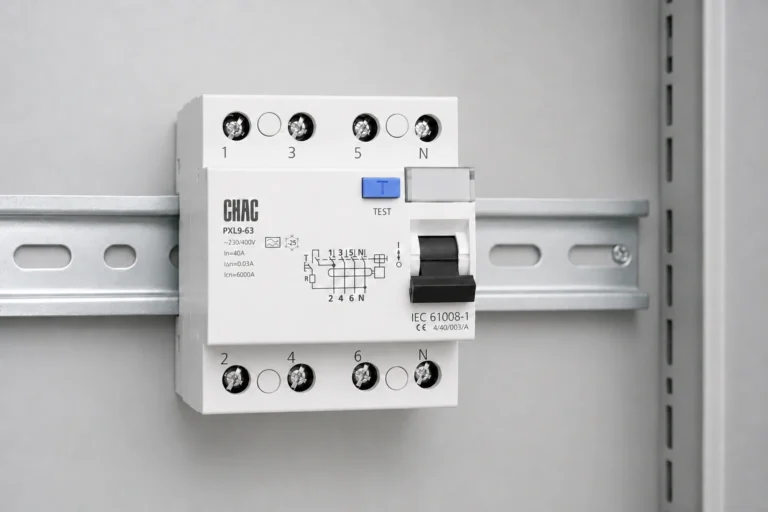
When a solar installer in Perth substituted an AC miniature breaker for a DC string, the lever looked normal but the arc did not extinguish when the fault occurred. The replacement had the right current number and the wrong voltage and polarity arrangement. The incident showed why a DC MCB is selected by arc behavior, system voltage, polarity, and interruption rating—not by label shape alone. The practical answer is to document single pole DC MCB as part of the complete electrical system.
Summary: A single-pole DC MCB protects a conductor in a direct-current circuit, but the device must be rated for the system voltage, polarity, short-circuit current, and intended use. Buyers should confirm DC breaking capacity, number of poles, polarised terminals, trip curve, ambient derating, and the manufacturer wiring direction. AC and DC ratings are not interchangeable.
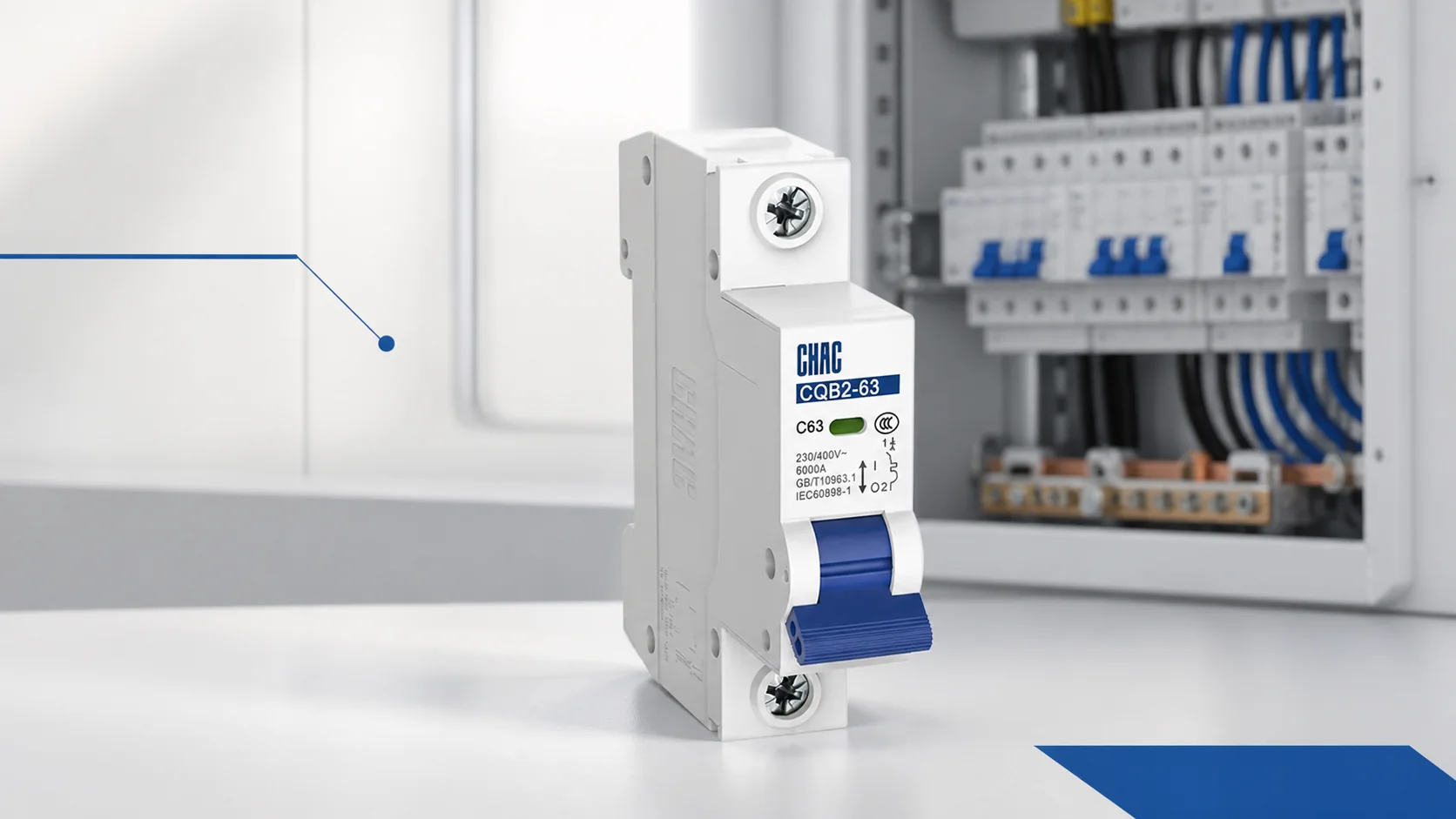
A DC MCB is used in battery, photovoltaic, telecom, control, and other direct-current circuits. Since DC has no natural current zero, arc interruption is more demanding than in many AC applications. The selection brief must include maximum voltage, prospective fault current, cable size, source type, and whether both conductors need isolation. When the brief is clear, circuit breaker for DC voltage can be compared using evidence instead of a generic marketing promise.
What Is the Function of a Single-Pole DC MCB?
The breaker carries normal current and opens when overload or short-circuit current exceeds its time-current characteristic. A single-pole unit interrupts one conductor; whether that conductor is positive or negative, and whether the other pole also needs isolation, depends on the system design. In a floating or battery system, a two-pole isolating arrangement may be required even when the branch protection is single pole.
Why Is DC Voltage Rating Critical?
The voltage rating defines the distance and magnetic design used to extinguish the arc. A breaker marked for 250 VDC is not automatically suitable for a 500 V string. Check the rating at the actual number of poles in series, the current direction if the device is polarised, and the maximum prospective fault current. Use the manufacturer table rather than estimating from an AC label.
How Do AC and DC Circuit Breakers Differ?
AC breakers benefit from alternating current crossing zero each half cycle. DC devices use magnetic blowout, longer arc paths, or pole series arrangements to interrupt current. This is why an AC MCB may fail to clear a DC fault safely. A DC MCB may be suitable for some AC applications only if the manufacturer explicitly provides that rating.
How Should the Breaker Be Installed?
Follow polarity arrows, line/load markings, torque values, clearance, and the specified cable stripping length. Keep source conductors short and route them to limit loop energy. After installation, test insulation and polarity, verify the open gap, and record the breaker model, voltage, current, and fault-level calculation in the as-built file.
What Should Be Coordinated Around the MCB?
Coordinate the breaker with fuses, battery protection, PV modules, converters, contactors, cable ampacity, and downstream equipment. Selectivity may be difficult when several protective devices share a high-energy source. The goal is to clear the smallest faulty section while keeping the rest of the DC system available.
How Should a Buyer Choose a DC MCB Supplier?
Ask for IEC test evidence, DC voltage tables, polarity diagrams, terminal data, mechanical endurance, and a clear replacement family. CHAC offers DC MCB and terminal protection options with engineering support for low-voltage distribution. A complete purchase record should state voltage, poles, current, curve, breaking capacity, and installation orientation.
Product recommendation
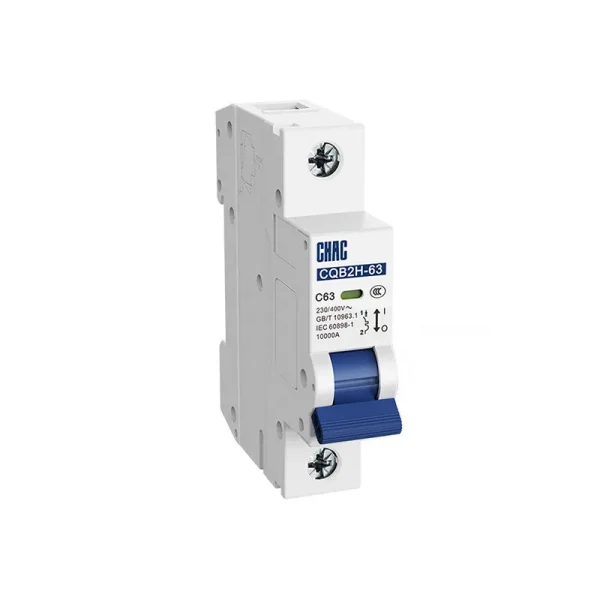
CQB2H-63 Miniature Circuit Breaker – CHAC Electric
Which Parameters Should Be Written Into the RFQ?
| Decision area | What to specify | Why it matters |
|---|---|---|
| Voltage | Maximum DC voltage and poles in series | Controls arc interruption |
| Fault level | Prospective short-circuit current | Confirms breaking capacity |
| Polarity | Positive/negative and line/load direction | Prevents incorrect magnetic operation |
| Cable | Ampacity, temperature, route, terminal size | Coordinates protection and heating |
We recommend measuring the installed result as well as the catalog value. Photograph terminals, record torque and test readings, and keep the approved drawing with the delivery lot. That record makes DC circuit breaker auditable when a replacement or expansion is needed.
How Should Buyers Select the Product and Supplier?
- Define voltage, current, duty, environment, fault level, and the user or machine risk before asking for a quote.
- Request the exact datasheet, wiring diagram, certificate, test evidence, accessories, and replacement policy.
- Approve a sample or first-article inspection and verify the installation, not only the packaging.
- Record serial, batch, settings, torque, and commissioning results in the maintenance or project file.
- Compare landed cost, lead time, spares, service response, and change notification before release.
CHAC is a China-based OEM/ODM low-voltage electrical appliance manufacturer and global electrical system solutions provider. Its product lines include terminal electrical appliances, MCB, RCCB/RCBO, SPD, distribution equipment, contactors, thermal overload relays, and motor protection devices. Buyers can review the relevant CHAC product range and the related application guide before requesting a project-specific selection.
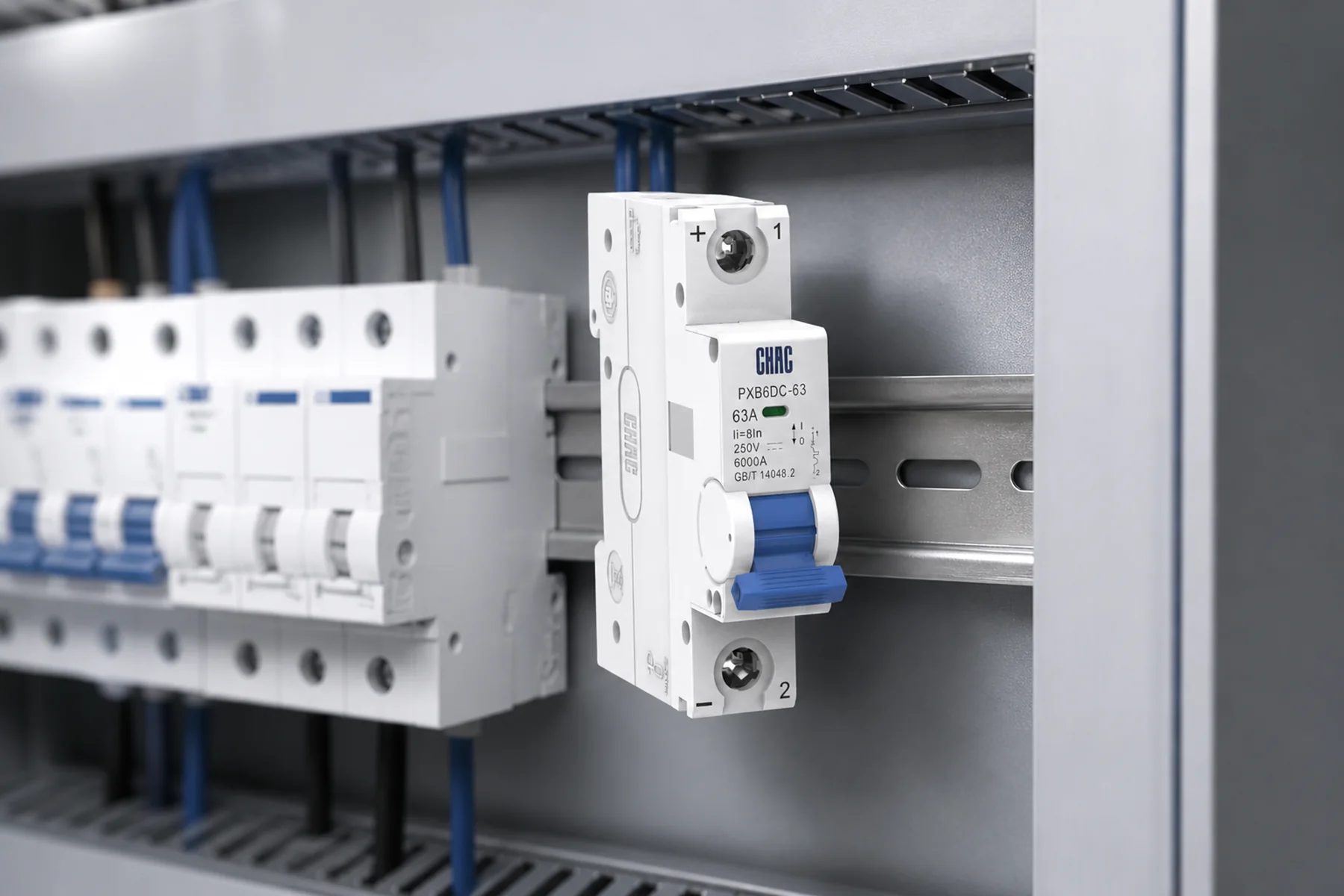
FAQ: Dc Mcb
What is the purpose of a DC MCB?
It protects a DC conductor from overload and short-circuit current and provides a controlled means of isolation when correctly rated.
What is the purpose of a DC circuit breaker?
It interrupts DC faults safely and isolates a circuit; the exact device must match system voltage, current, fault level, and polarity.
What is the difference between a two-pole MCB and a single-pole MCB?
A single-pole unit opens one conductor, while a two-pole unit can open two. The required arrangement depends on grounding, isolation, and the applicable installation rules.
When should I use one pole versus two poles?
Use the circuit design and local code. Battery and floating systems often need simultaneous isolation of both conductors, while some grounded branches protect one ungrounded conductor.
Can a DC MCB be used on AC?
Only when the manufacturer gives an AC rating for the exact model and connection. Never infer interchangeability from the housing.
References and Final Decision
Use these sources when checking a design, test plan, or procurement specification:
- IEC 60947-2 circuit-breakers
- IEC 60898-2 circuit-breakers for DC
- IEC 60364-7-712 photovoltaic power supply systems
The difference is not just in the component on the rail—it is in the ratings, wiring, tests, and decisions that follow. When a buyer treats DC MCB breaker as a measurable requirement, the installation is easier to commission, maintain, and scale. CHAC can help convert the application, compliance, and delivery requirements into a repeatable low-voltage solution.