
Rechner zur Auswahl des Motorstarters – Direktanschluss
Schätzen Sie den Drehstrom-Motorstrom und den Anlaufstrom, und vergleichen Sie anschließend die Schaltgeräte CHAC CQC6 sowie die angegebenen Überlastrelaisbereiche CQR2.
Bauen Sie eine Dreiphasen-Direktanlaufschütz-Referenz mithilfe der CQC6- und AC-3-Daten sowie der veröffentlichten CQR2-Steckrelais-Baureihen.
Ergebnis
DOL-Starter-Referenz
CQC6-25Eingegebene numerische Prüfungen wurden bestanden; vollständige Installation überprüfen.CQC6-25 mit CQR2-25 (17–25 A) ist das erste aufgeführte Paar, das die aktuelle, die Motorleistung und die vorgeschlagene Relaiseinstellung abdeckt.
I = Pwelle × 1,000 / (√3 × V × PF × η); IAnlauf = I × Anlaufmultiplikator; der Relaisbereich muss die vorgeschlagene Einstellung umfassen.Die Übereinstimmung von Strom- und kW-Tabelle sowie ein aufgeführtes Sortiment an Steckrelais stellen keine Koordination des Typs 1/Type 2 sicher. Überprüfen Sie die Anlaufdauer, die Auslösekategorie, die Schutzkurve des Leistungsschalters, die Spulenspannung, den Steuerkreis und die exakt getestete Kombination.
Warum dieses Ergebnis?
Bei 400 V: Kontaktor Ie ≥ 20.75 A (der höhere Wert zwischen Motorstrom und vorgeschlagener Einstellung); Motornennleistung ≥ 11 kW; der Relaisbereich muss 20.75 A umfassen.
Ausgewählte Referenz- und benachbarte aufgeführte Optionen. Die angezeigten Werte sind gerundet; bei Prüfungen werden die nicht gerundeten Werte verwendet.
| Kontaktor | AC-3 aktuell / Motorleistung | Aufgeführtes Überlastrelais | Grund |
|---|---|---|---|
| CQC6-18 | 18.00 A / 7.5 kW | CQR2-25 · 17–25 A | AC-3 Strom unter Anforderung; Motorleistungsnennwert unter Anforderung |
| CQC6-25Ausgewählte Referenz | 25.00 A / 11 kW | CQR2-25 · 17–25 A | Erstes verzeichnetes Spiel für diese Kontrollen |
| CQC6-32 | 32.00 A / 15 kW | CQR2-38 · Keine Range enthält 20.75 A | Kein aufgeführter Relaisbereich enthält die Einstellung. |
Alle 12 geprüften Optionen anzeigen
| Kontaktor | AC-3 aktuell / Motorleistung | Aufgeführtes Überlastrelais | Grund |
|---|---|---|---|
| CQC6-6 | 6.00 A / 2.2 kW | Keine aufgeführte Plug-in-Kopplung | AC-3 Strom unter Anforderung; Motorleistung unter Anforderung; Steckkompatibilität nicht aufgeführt |
| CQC6-9 | 9.00 A / 4 kW | CQR2-25 · 17–25 A | AC-3 Strom unter Anforderung; Motorleistungsnennwert unter Anforderung |
| CQC6-12 | 12.00 A / 5.5 kW | CQR2-25 · 17–25 A | AC-3 Strom unter Anforderung; Motorleistungsnennwert unter Anforderung |
| CQC6-18 | 18.00 A / 7.5 kW | CQR2-25 · 17–25 A | AC-3 Strom unter Anforderung; Motorleistungsnennwert unter Anforderung |
| CQC6-25Ausgewählte Referenz | 25.00 A / 11 kW | CQR2-25 · 17–25 A | Erstes verzeichnetes Spiel für diese Kontrollen |
| CQC6-32 | 32.00 A / 15 kW | CQR2-38 · Keine Range enthält 20.75 A | Kein aufgeführter Relaisbereich enthält die Einstellung. |
| CQC6-38 | 38.00 A / 18.5 kW | Keine aufgeführte Plug-in-Kopplung | Plug-in-Kompatibilität nicht aufgeführt |
| CQC6-40 | 40.00 A / 18.5 kW | CQR2-95 · 17–25 A | Schecks eingehalten; später aufgeführte Option |
| CQC6-50 | 50.00 A / 22 kW | CQR2-95 · 17–25 A | Schecks eingehalten; später aufgeführte Option |
| CQC6-65 | 65.00 A / 30 kW | CQR2-95 · 17–25 A | Schecks eingehalten; später aufgeführte Option |
| CQC6-80 | 80.00 A / 37 kW | CQR2-95 · 17–25 A | Schecks eingehalten; später aufgeführte Option |
| CQC6-95 | 95.00 A / 45 kW | CQR2-95 · 17–25 A | Schecks eingehalten; später aufgeführte Option |
Eingegangene Zustandsprüfungen
| Überprüfen | Anforderung | Eingegebener Wert | Status |
|---|---|---|---|
| Motorstrom und Schutzeinrichtung | Leistungsschalter ein ≥ 20.75 A | 32.00 A | Eingetragener Scheck erfüllt |
| Kapazität des Kabels | Corrected Iz ≥ 32.00 A | 40.00 A | Eingetragener Scheck erfüllt |
| Short-circuit capability | Declared capability ≥ 6.00 kA | 10.00 kA | Eingetragener Scheck erfüllt |
Noch zu bestätigen
- The pairing is based on listed plug-in compatibility and adjustment range; Type 1/Type 2 coordination is not verified.
- Confirm starting duration, trip class, breaker curve, coil supply and the actual control circuit.
Datenquelle: CHAC CQC6 AC-3 rating table (öffnet sich in einer neuen Registerkarte) · CHAC CQR2 listed plug-in ranges (öffnet sich in einer neuen Registerkarte)
Formel und Methode
Schätzen Sie den Drehstrom-Motorstrom und den Anlaufstrom, und vergleichen Sie anschließend die Schaltgeräte CHAC CQC6 sowie die angegebenen Überlastrelaisbereiche CQR2.
So verwenden Sie diese Rechner
- Enter motor shaft output, line voltage, efficiency and power factor; actual nameplate current overrides the estimate.
- Enter a justified start-current multiple and proposed overload setting factor.
- Review the CQC6 and CQR2 references with the exact wiring, trip class and manufacturer coordination data.
Berechnungsgrenzen
Direct-on-line three-phase motors only. Does not design star-delta, reversing, soft-starter or VFD arrangements. Plug-in compatibility is not proof of a tested short-circuit coordination combination.
DOL motor starter sizing and thermal overload relay selection
A DOL starter combines switching, overload protection and short-circuit protection. This tool uses CQC6 AC-3 columns for the contactor reference and the CQR2 table for a listed plug-in relay range that contains the proposed overload setting.
Hinweise zum Einlesen
| Input | Was zu überprüfen ist |
|---|---|
| Motorstrom | Use actual motor nameplate current when available. Otherwise the tool estimates current from shaft kW, efficiency, power factor and line voltage. |
| Starting duty and setting | Starting-current multiple and overload setting factor are project inputs. They do not replace start-duration and trip-class checks. |
| Protection and relay range | The tool checks entered breaker/cable/fault bounds and a listed plug-in relay range. This does not prove a tested coordinated combination. |
Beispielarbeit · Anfangsformate
11 kW, 400 V direct-on-line starter reference
PF 0.85 · efficiency 90% · start multiple 6 · overload factor 1.00
Motor current = 20.75 A; assumed starting current = 20.7549 × 6 = 124.53 A.
CQC6-25 meets the loaded 400 V AC-3 columns. CQR2-25 has a listed 17–25 A range containing 20.75 A.
CQC6-25
This is a contactor and relay-range reference. The proposed setting, start duration, trip class and tested short-circuit protection combination still require verification.
DOL starter sizing starts with motor full-load current
A direct-on-line starter applies the line supply to the motor through a contactor. Use motor nameplate current for component checks whenever it is available. The power-based estimate is useful for preliminary work when shaft kW, efficiency, power factor and line voltage are known.
Starting current is a separate quantity. Here it is estimated as running current multiplied by your entered starting-current multiple. For the default 11 kW example, 20.75 A running current and a multiple of six give about 124.53 A during starting; the actual motor and driven load determine the starting profile.
Motor starter components: contactor, overload relay and fault protection
The contactor switches the motor. The thermal overload relay responds to sustained overload according to its setting and trip characteristic. A suitable short-circuit protective device handles the fault-protection duty. These functions need to work together in an electric motor starter.
The tool compares CQC6 AC-3 current and motor-kW ratings, then looks for an explicitly listed CQR2 plug-in relay range containing the proposed setting. Plug-in compatibility establishes a component pairing; it does not establish a tested Type 1 or Type 2 coordinated starter.
Thermal overload relay setting and starting time
Choose a relay range that contains the required setting, then confirm the setting against motor data and the relay instructions. In the default example, the proposed 20.75 A setting falls within the listed CQR2-25 range of 17–25 A paired with CQC6-25.
A relay can have a suitable adjustment range yet be unsuitable for a long acceleration time. Check trip class, hot and cold starting conditions, starts per hour and the driven load. A motor protection circuit breaker is another protection option, but its use still requires the applicable contactor and coordination data.
Compatibility and coordination are different checks
- The CQR2 source identifies plug-in contactor families. Mechanical plug-in compatibility is not evidence of Type 1 or Type 2 short-circuit coordination.
- An overload relay does not replace the necessary short-circuit protective device. A breaker that carries running current can still be unsuitable for starting duty or fault protection.
Häufig gestellte Fragen
Can this select a star-delta starter?
No. The topology and relay location change the component-current relationships. This version is limited to a three-phase DOL arrangement.
Is the calculated overload setting mandatory?
No. The setting factor is an entered proposal. Final settings must follow motor data, relay instructions, start conditions and applicable rules.
Why might there be no complete match?
The motor/current combination can exceed the loaded CQC6 columns, or the proposed setting may not fit a listed CQR2 range for that contactor.
Does the result prove Type 2 coordination?
No. It does not check a tested manufacturer combination or its stated prospective-fault limit. Obtain the applicable coordination data.
What is the difference between a motor starter and a contactor?
A contactor provides switching. A motor starter combines switching with the required motor-protection functions. For this DOL reference, the tool examines a contactor and overload relay, with separate checks still needed for short-circuit protection and coordination.
Can I choose a thermal overload relay only by its maximum ampere rating?
No. Its adjustment range must contain the required setting, and its trip class must suit the starting conditions. Confirm compatibility with the contactor and the manufacturer’s instructions as well.
Hilfen bei der Auswahl eines CHAC-Produkts?
Senden Sie bei Ihrer Anfrage die Systemspannung, den Laststrom und die Installationsbedingungen mit.
CQC6 contactor and CQR2 overload relay reference
Current adjustment ranges and plug-in contactors from the CHAC CQR2 product table. Each listed range is shown separately; the model names and range notation retain the source wording.
Referenzdaten. Berechnen, um die übereinstimmende Zeile hervorzuheben.
CQR2-25
Plug-in contactors listed by CHAC:
Scrollen Sie auf kleinen Bildschirmen horizontal, um alle Spalten anzuzeigen.
| Aktueller Einstellbereich RC(A) | Calculator reference |
|---|---|
| 0.1~0.16 | Listed adjustment rangeCurrent calculated range |
| 0.16~0.25 | Listed adjustment rangeCurrent calculated range |
| 0.25~0.40 | Listed adjustment rangeCurrent calculated range |
| 0.40~0.63 | Listed adjustment rangeCurrent calculated range |
| 0.63~1 | Listed adjustment rangeCurrent calculated range |
| 1~1.6 | Listed adjustment rangeCurrent calculated range |
| 1.6~2.5 | Listed adjustment rangeCurrent calculated range |
| 2.5~4 | Listed adjustment rangeCurrent calculated range |
| 4~6 | Listed adjustment rangeCurrent calculated range |
| 5.5-8 | Listed adjustment rangeCurrent calculated range |
| 7~10 | Listed adjustment rangeCurrent calculated range |
| 9~13 | Listed adjustment rangeCurrent calculated range |
| 12~18 | Listed adjustment rangeCurrent calculated range |
| 17-25 | Listed adjustment rangeCurrent calculated range |
CQR2-38
Plug-in contactors listed by CHAC:
Scrollen Sie auf kleinen Bildschirmen horizontal, um alle Spalten anzuzeigen.
| Aktueller Einstellbereich RC(A) | Calculator reference |
|---|---|
| 23-32 | Listed adjustment rangeCurrent calculated range |
| 30~38 | Listed adjustment rangeCurrent calculated range |
CQR2-95
Plug-in contactors listed by CHAC:
Scrollen Sie auf kleinen Bildschirmen horizontal, um alle Spalten anzuzeigen.
| Aktueller Einstellbereich RC(A) | Calculator reference |
|---|---|
| 17~25 | Listed adjustment rangeCurrent calculated range |
| 23~32 | Listed adjustment rangeCurrent calculated range |
| 30~40 | Listed adjustment rangeCurrent calculated range |
| 37~50 | Listed adjustment rangeCurrent calculated range |
| 48~65 | Listed adjustment rangeCurrent calculated range |
| 55~70 | Listed adjustment rangeCurrent calculated range |
| 63~85 | Listed adjustment rangeCurrent calculated range |
| 80~95 | Listed adjustment rangeCurrent calculated range |
Das Lesen dieser Referenz
- Plug-in compatibility and adjustment-range coverage do not establish a tested Type 1 or Type 2 short-circuit coordinated starter.
- The source lists CQR2-38 with CQC6(SM/KMNC1)-32. This reference does not add CQC6-38 to that pairing.
- Use the original product page for the separately listed protection data, relay characteristics and installation requirements.
Quelle: CHAC CQR2 adjustment-range and plug-in table (öffnet sich in einer neuen Registerkarte) · CHAC CQC6 AC-3 ratings
Quelle geprüft: . Dies ist das Abrufdatum, nicht das Datum einer Standardausgabe oder Produktrevision.
Beispiel einer Anwendung · Beispielsätze
Pairing a pump contactor with a listed overload-relay range
For a 15 kW, 400 V DOL pump example with a 28 A motor-current input, the calculator shortlists CQC6-32 and a CQR2-38 relay range of 23–32 A. These come from CHAC’s published current, motor-power and plug-in pairing tables. An assumed six-times starting multiple gives 168 A, but does not establish starting duration or a breaker trip response. The proposed 28 A overload setting must be reviewed against the actual motor and relay instructions. Complete the selection with the exact protection and coordination data rather than presenting the table pairing as a tested starter combination.
Produktinformationen: CQC6-Serie Industrielle AC-Schütze - OEM-Hersteller · Thermostatischer Überlastrelais der CQR2-Serie
Verwandte CHAC-Produkte
Review the contactor, overload relay and motor-protection options. These cards do not establish a coordinated starter combination.
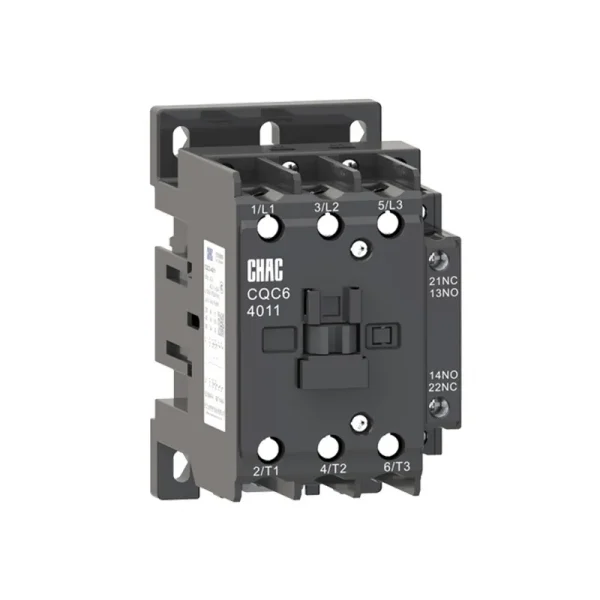
CQC6
AC-Kontaktor
Vergleichen Sie die AC-3-Bewertungen, die Motorleistung und die Spulenspannung.
Produkt ansehen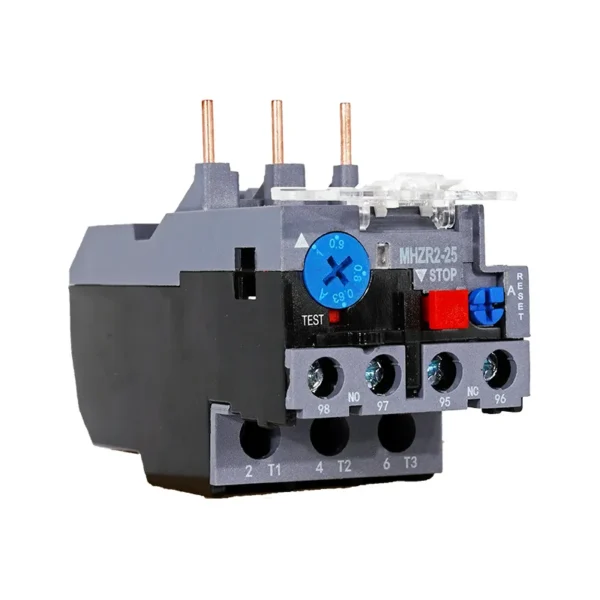
CQR2
Thermisches Überlastrelais
Überprüfen Sie den Einstellbereich und die aufgeführte Schützpaarung.
Produkt ansehen
CQV2
Motorschutzschalter
Überprüfen Sie den Einstellbereich des Motorstroms sowie die Schutzdaten.
Produkt ansehen