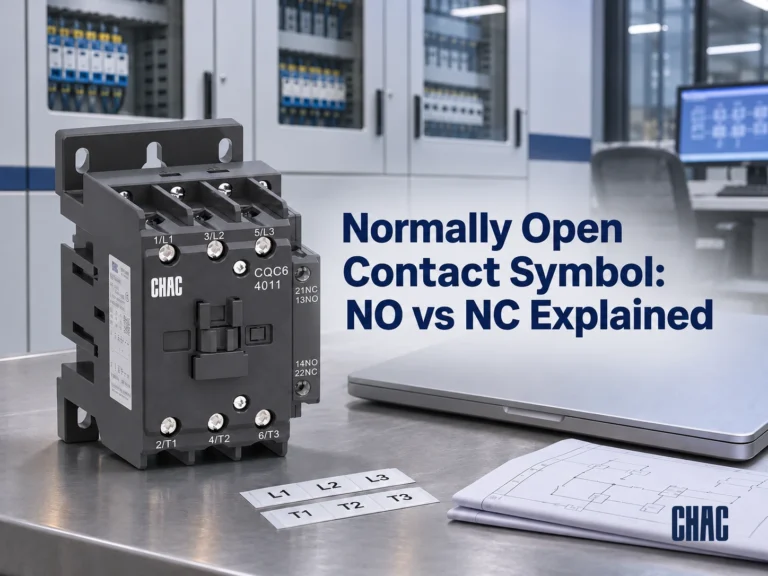
Contrôleur de courant alternatifLes interrupteurs sont souvent sélectionnés sur la seule base du courant, bien que la catégorie de charge, le circuit de la bobine et le régime de commutation déterminent si ce choix est justifié. Un dispositif qui fonctionne avec une petite charge résistive peut se comporter différemment lorsqu’il met en marche un compresseur, un moteur ou un groupe d’éclairage. Cette révision sépare la fonction de commutation de la protection contre les surcharges et les courts-circuits, puis fournit aux acheteurs une documentation pratique permettant d’approuver le modèle.
Le marché de l’électricité évolue aujourd’hui vers l’efficacité énergétique, la supervision numérique, des conceptions compactes et la maintenance prédictive. Les clients ont besoin de contacteurs AC capables de supporter des commutations fréquentes, de résister à l’usure des contacts, de s’adapter à différents types de charges et de fonctionner de manière fiable dans des environnements exigeants. Toutefois, les acheteurs s’inquiètent souvent de la combustion de la bobine, du soudage des contacts, d’une sélection de tension inappropriée, d’une durée de vie électrique réduite, de la conformité aux normes et de la capacité des produits à faible coût à répondre véritablement aux exigences opérationnelles à long terme. C’est pourquoi il est essentiel de bien comprendre la structure des contacteurs, les méthodes d’essai, les recommandations de remplacement et la qualité des fournisseurs avant de prendre une décision d’achat.
Que sont les contacteurs CA et pourquoi sont-ils importants dans les opérations électriques ?
Un Contacteur CA est un dispositif de commutation électromagnétique utilisé pour contrôler les charges électriques alternatives. Lorsque la bobine est alimentée, elle crée un champ magnétique qui attire le noyau mobile et ferme les contacts principaux, permettant au courant de circuler vers la charge. Lorsque la bobine n’est plus alimentée, le mécanisme à ressort libère les contacts et ouvre le circuit.
Les contacteurs CA sont largement utilisés dans :
- Industrial motor control systems
- HVAC and air conditioning units
- Compressors and pumps
- Lighting control panels
- Automation equipment
- Power distribution cabinets
In electrical operations, contactors matter because they allow high-current loads to be controlled by low-current control signals. This improves safety, enables automation, and protects operators from directly switching high-power circuits.
Key Components Inside an AC Contactor
A high-quality AC Contactor is more than a simple electrical switch. Its performance depends on the quality of each internal component, especially the coil, contacts, magnetic system, and arc suppression structure.
| Composant | Fonction | Why It Matters |
|---|---|---|
| Coil | Generates magnetic force when energized | Determines stable pulling force and voltage compatibility |
| Main Contacts | Switch the load current on and off | Directly affects electrical lifespan and load capacity |
| Contes auxiliaires | Provide signal feedback or control logic | Used for interlocking, self-holding circuits, and PLC signals |
| Magnetic Core | Transfers electromagnetic force | Influences response speed and operating noise |
| Arc Chute | Extinguishes arc during switching | Reduces contact erosion and improves safety |
| Spring Mechanism | Releases contacts when coil power is removed | Ensures fast and reliable disconnection |
| Insulated Housing | Protects internal components | Requires flame-retardant and heat-resistant material |
Auxiliary Contacts: Additional contacts used for signal feedback, electrical interlocking, self-holding circuits, or PLC control logic.
For demanding industrial applications, the contactor should have strong dielectric strength, reliable insulation resistance, stable coil performance, and excellent arc extinguishing capability. Manufacturers with in-house testing capabilities can better control these performance factors throughout production.
How to Test AC Contactor
Testing an AC Contactor is important during maintenance, troubleshooting, or before replacing a suspected faulty unit. A failed contactor can cause motor failure, compressor malfunction, overheating, or system shutdown.
Before testing, always disconnect power and follow Sécurité électrique procedures.
Common testing steps include:
-
Visual Inspection
Check for burned marks, melted housing, loose terminals, damaged wires, or carbonized contacts. -
Coil Resistance Test
Use a multimeter to measure the resistance between coil terminals, usually marked as A1 and A2. If the coil is open or shorted, the contactor may need replacement. -
Voltage Test
Confirm whether the control voltage matches the coil rating, such as 24V, 110V, 220V, or 380V AC. -
Contact Continuity Test
Check whether the main contacts open and close properly when the coil is energized and de-energized. -
Mechanical Movement Check
Press the movable core manually when safe and powered off. The movement should be smooth without sticking. -
Load Operation Test
After reinstalling safely, verify whether the connected motor, compressor, or ac unit contactor system starts and stops normally.
If the contactor chatters, overheats, fails to pull in, or has welded contacts, it may require ac contactor repair or replacement.
How to Replace AC Contactor
Replacing an AC Contactor should be done carefully because incorrect wiring or wrong specifications can damage equipment or create safety hazards.
Basic replacement process:
-
Turn Off Power Completely
Disconnect the main power supply and verify with a voltage tester. -
Record Existing Wiring
Take clear photos of all terminals, including line side, load side, coil terminals, and auxiliary contacts. -
Check the Contactor Specification
Match the new contactor with the old one based on:- Courant nominal
- Tension nominale
- Coil voltage
- Nombre de poteaux
- Load category such as AC-1, AC-3, or AC-4
- Auxiliary contact configuration
-
Remove the Old Contactor
Loosen terminal screws, disconnect wires, and remove it from the DIN rail or mounting plate. -
Install the New Contactor
Mount it securely and reconnect wires according to the original wiring diagram. -
Tighten Terminals Properly
Loose terminals can cause overheating, arcing, and premature failure. -
Test Operation
Restore power and test start/stop operation under controlled conditions.
For HVAC systems, replacing an ac unit contactor often solves issues such as the outdoor unit not starting, compressor not running, or fan failure. However, if the root cause is voltage instability, capacitor failure, or control board damage, simply replacing the contactor may not solve the problem.
Electrical Lifespan vs Mechanical Lifespan: What Buyers Often Overlook
Many buyers focus only on mechanical lifespan, but for real electrical operations, electrical lifespan is often more important.
Mechanical lifespan refers to how many times the contactor can operate without load. Electrical lifespan refers to how many times it can switch actual current under load conditions. Since real switching creates arcs, heat, and contact erosion, electrical lifespan is usually much shorter than mechanical lifespan.
For motor control applications, especially under AC-3 working conditions, buyers should pay close attention to electrical lifespan rather than only comparing mechanical operation cycles. According to the application categories defined in IEC 60947-4-1 low-voltage switchgear and controlgear standards, utilization categories such as AC-1, AC-3, and AC-4 are critical for selecting the right contactor based on load type and switching duty.
AC-3 Duty: A common utilization category for switching squirrel-cage motors during normal starting and stopping operations.
In practical applications, AC-3 Duty is commonly used for standard motor starting and stopping, such as pumps, fans, compressors, and conveyor motors. Choosing a contactor with the correct utilization category helps prevent overheating, contact wear, and premature failure.
| Lifespan Type | Signification | Main Influencing Factors |
|---|---|---|
| Mechanical Lifespan | Number of no-load operations | Spring system, magnetic core, mechanical wear |
| Electrical Lifespan | Number of load-switching operations | Load current, arc energy, contact material, switching frequency |
| Practical Service Life | Actual usable life in field conditions | Temperature, dust, voltage stability, maintenance quality |
At the manufacturing level, electrical endurance testing is essential for validating long-term contactor reliability. CHAC’s independent laboratories conduct electrical endurance, material, magnetic, salt spray, and dimensional testing to help ensure consistent quality throughout the production process.
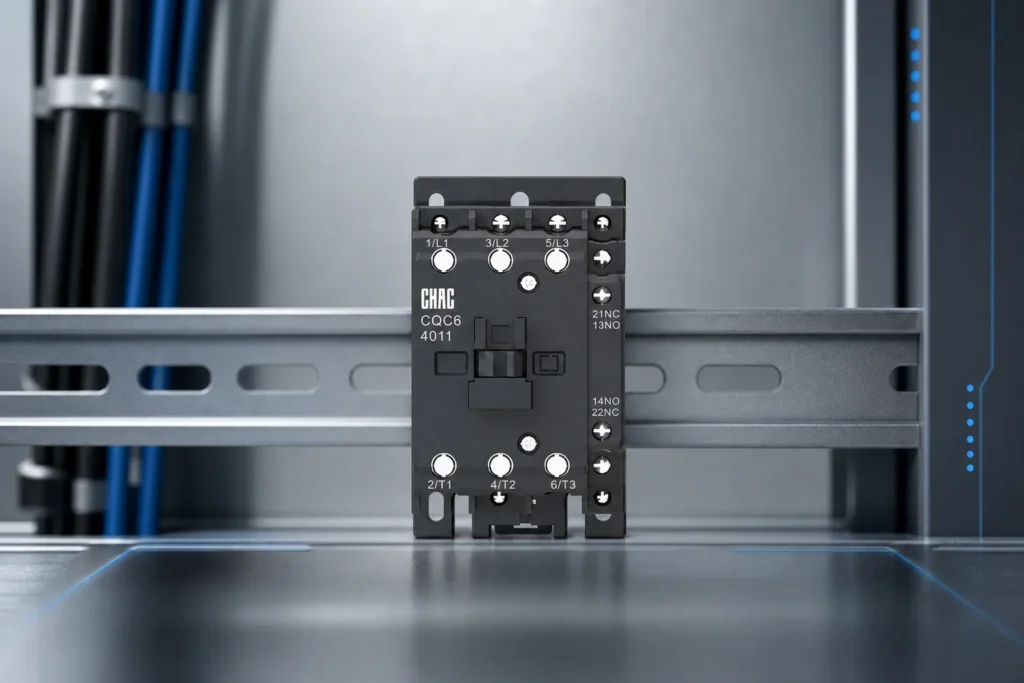
Contact Material and Arc Suppression: Hidden Factors Behind Contactor Performance
The main contacts are the most critical parts of an AC Contactor. During switching, especially under inductive loads such as motors and compressors, an electric arc forms between the contacts. If the arc is not controlled properly, it can cause contact burning, welding, and reduced lifespan.
High-quality contactors usually use silver alloy contact materials, such as silver tin oxide or other environmentally compliant contact materials. These materials provide better conductivity, lower contact resistance, and improved resistance to arc erosion.
Arc Suppression: A design method used to control and extinguish electrical arcs generated when contacts open under load.
Arc suppression is essential for safe and durable contactor operation. A well-designed arc chute helps divide, cool, and extinguish the arc quickly. This reduces thermal stress and protects the contact surface. For heavy-duty applications, poor arc suppression often leads to frequent ac contactor repair, unexpected downtime, and unsafe operation.
AI Predictive Maintenance: The Future of AC Contactor Reliability
As industrial automation becomes more digitalized, contactors are no longer viewed only as passive switching devices. In smart electrical panels, data from contactor operation can be monitored to predict failures before they happen.
AI-based predictive maintenance can analyze:
- Switching frequency
- Coil temperature
- Résistance de contact
- Load current fluctuation
- Pull-in and drop-out time
- Abnormal vibration or noise
- Historical fault patterns
For example, if a contactor starts taking longer to close or its contact resistance increases gradually, the system can generate an early warning. This allows maintenance teams to replace or repair the contactor before a production line stops unexpectedly.
This trend is especially valuable in smart factories, HVAC monitoring systems, and large-scale motor control centers. In production environments, digital workshops and automated production lines also play an important role in improving consistency. CHAC has developed smart manufacturing systems supported by SCADA, MES, and intelligent management platforms to enhance process control and production traceability.
AC Contactor vs Relay vs DC Contactor: Key Differences Buyers Should Know
Although contactors, relays, and DC contactors all perform switching functions, they are designed for different electrical requirements.
An AC Contactor is mainly used for switching AC loads such as motors, compressors, and heaters. A relay is usually used for lower-current control circuits. A DC contactor is designed to interrupt direct current, which is more difficult to extinguish because DC current has no natural zero-crossing point.
| Appareil | Main Use | Typical Load | Key Feature |
|---|---|---|---|
| Contacteur CA | High-power AC switching | Motors, HVAC, pumps, compressors | Strong arc control for AC loads |
| Relais | Low-power signal control | Control circuits, alarms, small devices | Compact and sensitive |
| DC Contactor | High-power DC switching | EV, battery systems, solar storage | Stronger arc suppression for DC circuits |
For buyers, the most important rule is simple: do not use an AC contactor for DC loads unless the manufacturer specifically approves it. Incorrect selection can cause severe arcing, contact welding, or fire risk.
Safety Standards, Certifications, and Supplier Evaluation for AC Contactors
A reliable AC Contactor should comply with international safety and performance standards. For industrial and export markets, certifications are not only quality indicators but also entry requirements. Buyers can refer to UL 60947-4-1 standards for contactors and motor starters when evaluating products for North American industrial control applications.
Common standards and certifications include:
- IEC 60947-4-1 for contactors and motor starters
- CE for European market compliance
- UL for North American applications
- CCC for China market access
- RoHS for restricted hazardous substances
- Flame-retardant material standards for housing safety
When evaluating an AC contactor supplier, buyers should consider:
- Complete product testing process
- Stable coil and contact material quality
- Rated current and utilization category accuracy
- Production capacity and delivery stability
- OEM/ODM support
- Technical documentation and wiring diagrams
- Warranty and after-sales support
For global buyers, supplier capability is as important as product specification. With over 30 years of experience in low-voltage electrical product R&D and manufacturing, CHAC produces 2 million AC contactors annually and serves customers across global markets. Its large-scale production capacity and quality control system help support stable supply and consistent product performance.
A low-cost product may seem attractive at first, but if it causes frequent downtime, overheating, or repeated ac contactor repair, the total cost will be much higher.
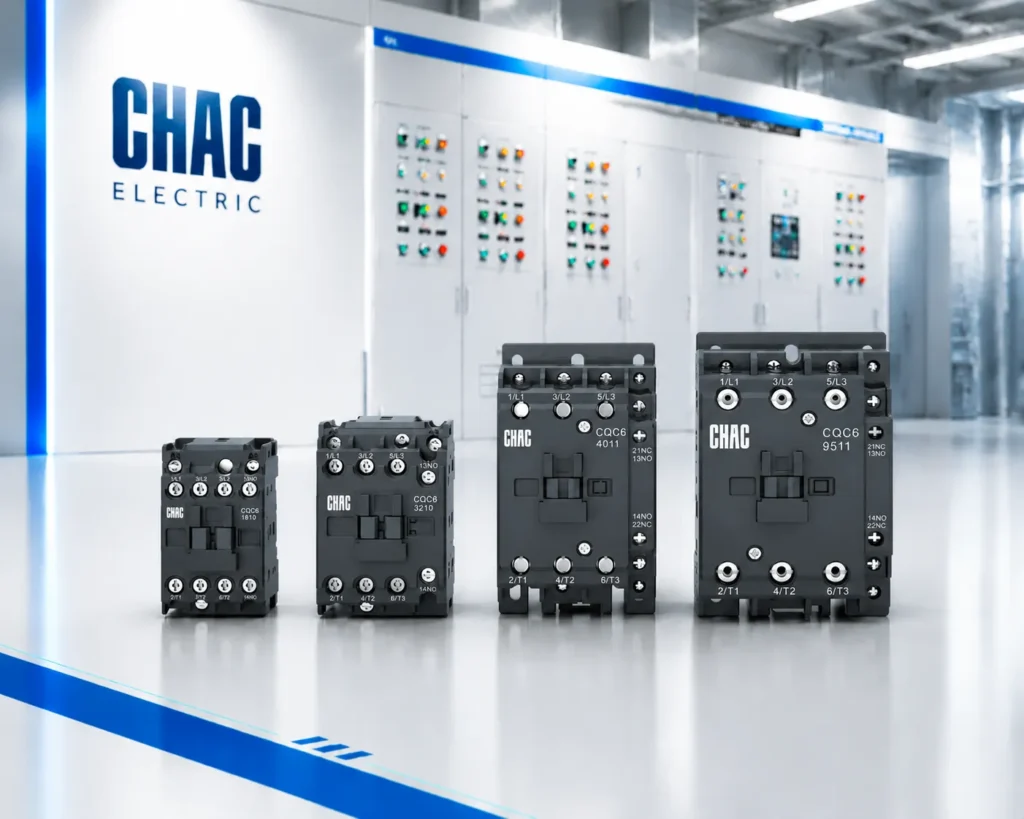
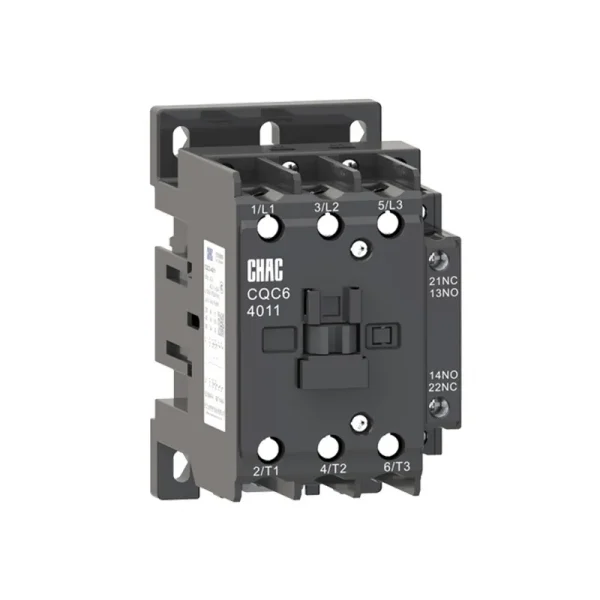
CHAC AC contactor Recommended:
Fabricant d'interrupteurs AC industriels de la série CQC6 | CHAC Electric
Future Trends: Digitalized, Compact, and Sustainable AC Contactors
The future of AC contactors is moving toward smarter, smaller, and more energy-efficient designs. Traditional contactors will continue to be widely used, but modern electrical systems increasingly require digital monitoring, lower energy consumption, and easier integration with automation platforms.
As highlighted by the International Energy Agency report on energy efficiency, improving electrical efficiency across industrial and building systems remains an important direction for reducing energy consumption and operating costs.
Key trends include:
- Compact design for space-saving control panels
- Low-power coils to reduce heat and energy loss
- Modular auxiliary contact blocks
- Smart monitoring for predictive maintenance
- Environmentally friendly contact materials
- Higher switching durability for frequent-start applications
- Better compatibility with PLC and IoT-based control systems
Sustainable manufacturing is also becoming a key factor in supplier evaluation. CHAC is recognized as a National Green Factory and operates under the ISO 14001 environmental management system, supporting cleaner and more responsible production of low-voltage electrical products.
As industries focus on automation, energy efficiency, and operational reliability, the AC Contactor will remain a core component in electrical operations. Whether used in motor control, industrial machinery, or an ac unit contactor system, choosing the right contactor is essential for safe, efficient, and long-lasting performance.
Which AC contactor checks prevent a repeat failure?
Start with the load rather than the enclosure. Record the utilization category, operating current, starting or inrush current, starts per hour, duty cycle, coil voltage and auxiliary-contact requirement. An AC contactor model can be a useful candidate, but the product page does not replace the exact variant datasheet or the project coordination study.
| Point de révision | Pourquoi cela change-t-il la décision |
|---|---|
| Load category | Motor, resistive, lighting and capacitive loads impose different switching duties. |
| Control circuit | Coil voltage, hold-in behavior and auxiliary contacts must match the schematic. |
| Protection coordination | The contactor switches; the upstream and motor-protection devices address fault and overload duties. |
Google results for contactor selection repeatedly surface utilization categories and overload-relay coordination. Treat those as research prompts, not as proof that one current rating works for every load. The final approval should reference the applicable edition of the standard and the exact manufacturer combination.
FAQ
À quoi sert un contacteur CA ?
Un contacteur CA permet d’allumer et d’éteindre des charges électriques alimentées en courant alternatif, telles que les moteurs, les compresseurs, les pompes, les unités de CVC et les systèmes d’éclairage. Il permet à un signal de commande basse tension de contrôler en toute sécurité un circuit de plus forte puissance.
Comment savoir si mon contacteur de climatisation est défectueux ?
Les signes courants d’un contacteur de climatisation défectueux comprennent un bruit de bourdonnement ou de cliquetis, des contacts brûlés ou piqués, l’incapacité du moteur à démarrer, une surchauffe, des contacts soudés, ou encore l’absence de continuité lorsque la bobine est alimentée.
Qu’est-ce que le contacteur de l’unité de climatisation ?
Le contacteur d’une unité de climatisation est un interrupteur électrique qui commande l’alimentation du compresseur et du moteur du ventilateur extérieur. Lorsque le thermostat envoie un signal, le contacteur se ferme et permet à l’unité de climatisation de fonctionner.
Qu'est-ce qu'un contacteur CA 2 ?
Un contacteur AC-2 est utilisé pour la commutation des moteurs à bagues. Il est conçu pour les applications de démarrage, d’arrêt et de mouvement par à-coups des moteurs, lorsque des courants de démarrage plus élevés et des conditions de service spécifiques sont nécessaires.
Quelle est la différence entre le contacteur AC 3 et le contacteur AC 4 ?
Les contacteurs AC-3 sont principalement utilisés pour le démarrage et l’arrêt normaux des moteurs à cage d’écureuil. Les contacteurs AC-4 sont employés pour des opérations plus exigeantes, telles que le déplacement par pas, le freinage par inversion de phase et les inversions de sens fréquentes ; ils doivent donc offrir une durabilité de commutation supérieure.
Que se passe-t-il lorsque vous placez 240V entre A1 et A2 du contacteur ?
A1 et A2 sont les bornes de la bobine. Si la bobine du contacteur est conçue pour 240V, l’application de 240V va alimenter la bobine et fermer les contacts. Si la bobine n’est pas conçue pour 240V, elle risque de surchauffer, de brûler ou de tomber en panne.
Que signifie le « T » sur un contacteur ?
Sur un contacteur, les bornes T désignent généralement les bornes côté charge, comme T1, T2 et T3. Elles sont reliées au moteur ou à la charge électrique, tandis que L1, L2 et L3 sont habituellement les bornes d’entrée d’alimentation côté ligne.
Un contacteur AC remplace-t-il un disjoncteur de protection moteur ?
Non. Un contacteur assure la commutation contrôlée ; les protections contre les surcharges et les courts-circuits doivent être sélectionnées et coordonnées séparément pour le circuit du moteur.
Quel document doit confirmer le service d’un contacteur CA ?
Utilisez la fiche technique exacte du modèle, la norme de produit applicable, les données de charge ainsi que la combinaison de protection testée ou documentée. Une page de catégorie seule ne suffit pas.
Références
- IEC 60947-4-1 Low-Voltage Switchgear and Controlgear Standards
- UL 60947-4-1 Standards for Contactors and Motor Starters
- International Energy Agency Report on Energy Efficiency
- Publication de produit IEC 60947-4-1:2023 Use the applicable edition and scope for low-voltage contactors and motor starters.
- Guide d’installation électrique Schneider : fonctions de protection des moteurs Use as an explanatory source; confirm project-specific settings separately.
Looking for reliable AC contactors for industrial control, HVAC systems, or global electrical projects? Contact CHAC today to discuss your application requirements and find the right low-voltage electrical solution for your business.