Kontaktor ACSering kali, pemilihannya hanya didasarkan pada arus nominal, meskipun kategori beban, rangkaian koil, dan tugas saklar menentukan apakah pilihan tersebut dapat dipertanggungjawabkan. Suatu perangkat yang berfungsi pada beban resistif kecil mungkin akan berperilaku berbeda ketika menghidupkan kompresor, motor, atau bank penerangan. Revisi ini memisahkan fungsi saklar dari proteksi terhadap beban lebih dan hubungan singkat, kemudian memberikan kepada pembeli dokumentasi yang praktis sebagai dasar persetujuan model.
Pasar kelistrikan saat ini bergerak menuju efisiensi energi, pemantauan digital, desain yang ringkas, serta pemeliharaan prediktif. Pelanggan membutuhkan kontaktor AC yang mampu menangani pergantian frekuensi tinggi, tahan terhadap keausan kontak, mendukung berbagai jenis beban, dan beroperasi secara andal di lingkungan yang menantang. Namun, pembeli sering kali khawatir tentang terbakarnya koil, pengelasan kontak, kesalahan pemilihan tegangan, umur pakai listrik yang singkat, kepatuhan terhadap sertifikasi, serta apakah produk berbiaya rendah benar-benar dapat memenuhi persyaratan operasional jangka panjang. Oleh karena itu, memahami struktur kontaktor, metode pengujian, panduan penggantian, serta kualitas pemasok sangatlah penting sebelum mengambil keputusan pembelian.
Apa Itu Kontaktor AC dan Mengapa Hal Ini Penting dalam Operasi Kelistrikan?
Sebuah Kontaktor AC adalah perangkat sakelar elektromagnetik yang digunakan untuk mengendalikan beban listrik AC. Ketika kumparan dialiri arus, kumparan tersebut akan menghasilkan medan magnet yang menarik inti bergerak dan menutup kontak utama, sehingga arus dapat mengalir ke beban. Ketika kumparan tidak dialiri arus, mekanisme pegas akan melepaskan kontak dan memutuskan rangkaian.
Kontaktor AC banyak digunakan dalam:
- Sistem kontrol motor industri
- Unit HVAC dan pendingin udara
- Kompresor dan pompa
- Panel kontrol pencahayaan
- Peralatan otomasi
- Kabinet distribusi tenaga listrik
Dalam operasi kelistrikan, kontaktor sangat penting karena memungkinkan beban arus tinggi dikendalikan oleh sinyal kendali berarus rendah. Hal ini meningkatkan keselamatan, memungkinkan otomatisasi, serta melindungi operator dari pengalihan langsung rangkaian berdaya tinggi.
Komponen-Komponen Utama di Dalam Kontaktor AC
Kontaktor AC berkualitas tinggi bukan sekadar sakelar listrik biasa. Kinerjanya bergantung pada kualitas setiap komponen di dalamnya, terutama kumparan, kontak, sistem magnetik, dan struktur penangkal busur.
| Komponen | Fungsi | Mengapa Ini Penting |
|---|---|---|
| Coil | Menghasilkan gaya magnet saat dialiri arus listrik | Menentukan gaya tarik yang stabil dan kompatibilitas tegangan |
| Kontak Utama | Hidupkan dan matikan arus beban | Secara langsung memengaruhi umur pakai listrik dan kapasitas beban |
| Kontak Tambahan | Sediakan umpan balik sinyal atau logika kontrol | Digunakan untuk sirkuit interlocking, self-holding, dan sinyal PLC. |
| Inti Magnetik | Mentransfer gaya elektromagnetik | Mempengaruhi kecepatan respons dan tingkat kebisingan operasional |
| Terowongan Lengkung | Memadamkan busur listrik saat pemutusan/alih beban | Mengurangi erosi kontak dan meningkatkan keselamatan |
| Mekanisme Pegas | Membuka kontak ketika daya koil dilepas. | Memastikan pemutusan sambungan yang cepat dan andal |
| Perumahan Terisolasi | Melindungi komponen internal | Membutuhkan bahan tahan api dan tahan panas |
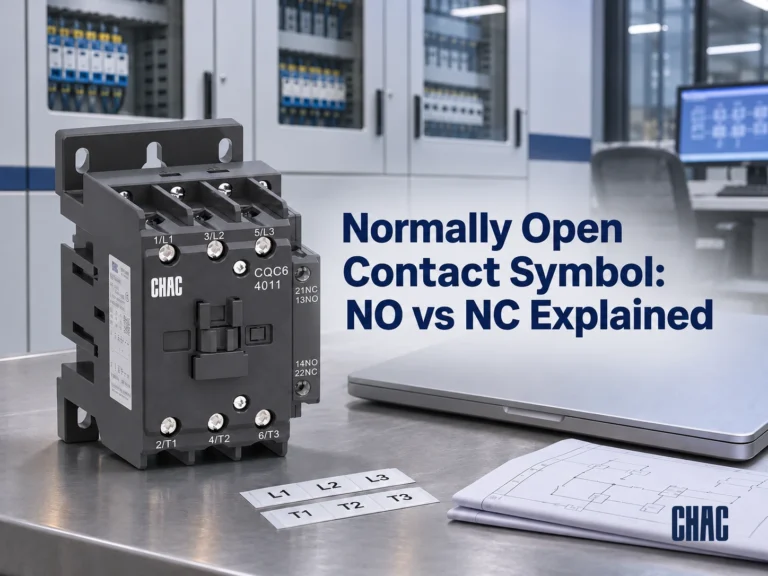
Kontak Bantu: Kontak tambahan yang digunakan untuk umpan balik sinyal, interlocking listrik, rangkaian self-holding, atau logika kontrol PLC.
Untuk aplikasi industri yang menuntut, kontaktor harus memiliki kekuatan dielektrik yang tinggi, ketahanan isolasi yang andal, kinerja koil yang stabil, serta kemampuan pemadaman busur yang sangat baik. Produsen yang memiliki kemampuan pengujian internal dapat lebih baik mengendalikan faktor-faktor kinerja tersebut sepanjang proses produksi.
Cara Menguji Kontaktor AC
Pengujian kontaktor AC sangat penting dilakukan saat pemeliharaan, pemecahan masalah, atau sebelum mengganti unit yang diduga rusak. Kerusakan pada kontaktor dapat menyebabkan motor tidak berfungsi, kompresor bermasalah, panas berlebih, atau sistem mati.
Sebelum melakukan pengujian, selalu lepaskan sumber daya dan ikuti Keamanan listrik prosedur.
Langkah-langkah pengujian yang umum meliputi:
-
Inspeksi Visual
Periksa apakah terdapat bekas terbakar, rumah komponen yang meleleh, terminal yang longgar, kabel yang rusak, atau kontak yang menghitam. -
Uji Resistansi Kumparan
Gunakan multimeter untuk mengukur resistansi antara terminal kumparan, yang biasanya ditandai sebagai A1 dan A2. Jika kumparan terputus atau terhubung singkat, kontaktor mungkin perlu diganti. -
Uji Tegangan
Konfirmasikan apakah tegangan kontrol sesuai dengan rating kumparan, seperti 24V, 110V, 220V, atau 380V AC. -
Uji Kelangsungan Kontak
Periksa apakah kontak utama membuka dan menutup dengan benar saat koil diberi energi dan tidak diberi energi. -
Mechanical Movement Check
Press the movable core manually when safe and powered off. The movement should be smooth without sticking. -
Load Operation Test
After reinstalling safely, verify whether the connected motor, compressor, or ac unit contactor system starts and stops normally.
If the contactor chatters, overheats, fails to pull in, or has welded contacts, it may require ac contactor repair or replacement.
How to Replace AC Contactor
Replacing an AC Contactor should be done carefully because incorrect wiring or wrong specifications can damage equipment or create safety hazards.
Basic replacement process:
-
Turn Off Power Completely
Disconnect the main power supply and verify with a voltage tester. -
Record Existing Wiring
Take clear photos of all terminals, including line side, load side, coil terminals, and auxiliary contacts. -
Check the Contactor Specification
Match the new contactor with the old one based on:- Arus pengenal
- Voltan yang diukur
- Coil voltage
- Jumlah tiang
- Load category such as AC-1, AC-3, or AC-4
- Auxiliary contact configuration
-
Remove the Old Contactor
Loosen terminal screws, disconnect wires, and remove it from the DIN rail or mounting plate. -
Install the New Contactor
Mount it securely and reconnect wires according to the original wiring diagram. -
Tighten Terminals Properly
Loose terminals can cause overheating, arcing, and premature failure. -
Test Operation
Restore power and test start/stop operation under controlled conditions.
For HVAC systems, replacing an ac unit contactor often solves issues such as the outdoor unit not starting, compressor not running, or fan failure. However, if the root cause is voltage instability, capacitor failure, or control board damage, simply replacing the contactor may not solve the problem.
Electrical Lifespan vs Mechanical Lifespan: What Buyers Often Overlook
Many buyers focus only on mechanical lifespan, but for real electrical operations, electrical lifespan is often more important.
Mechanical lifespan refers to how many times the contactor can operate without load. Electrical lifespan refers to how many times it can switch actual current under load conditions. Since real switching creates arcs, heat, and contact erosion, electrical lifespan is usually much shorter than mechanical lifespan.
For motor control applications, especially under AC-3 working conditions, buyers should pay close attention to electrical lifespan rather than only comparing mechanical operation cycles. According to the application categories defined in IEC 60947-4-1 low-voltage switchgear and controlgear standards, utilization categories such as AC-1, AC-3, and AC-4 are critical for selecting the right contactor based on load type and switching duty.
AC-3 Duty: A common utilization category for switching squirrel-cage motors during normal starting and stopping operations.
In practical applications, AC-3 Duty is commonly used for standard motor starting and stopping, such as pumps, fans, compressors, and conveyor motors. Choosing a contactor with the correct utilization category helps prevent overheating, contact wear, and premature failure.
| Lifespan Type | Meaning | Main Influencing Factors |
|---|---|---|
| Mechanical Lifespan | Number of no-load operations | Spring system, magnetic core, mechanical wear |
| Electrical Lifespan | Number of load-switching operations | Load current, arc energy, contact material, switching frequency |
| Practical Service Life | Actual usable life in field conditions | Temperature, dust, voltage stability, maintenance quality |
At the manufacturing level, electrical endurance testing is essential for validating long-term contactor reliability. CHAC’s independent laboratories conduct electrical endurance, material, magnetic, salt spray, and dimensional testing to help ensure consistent quality throughout the production process.
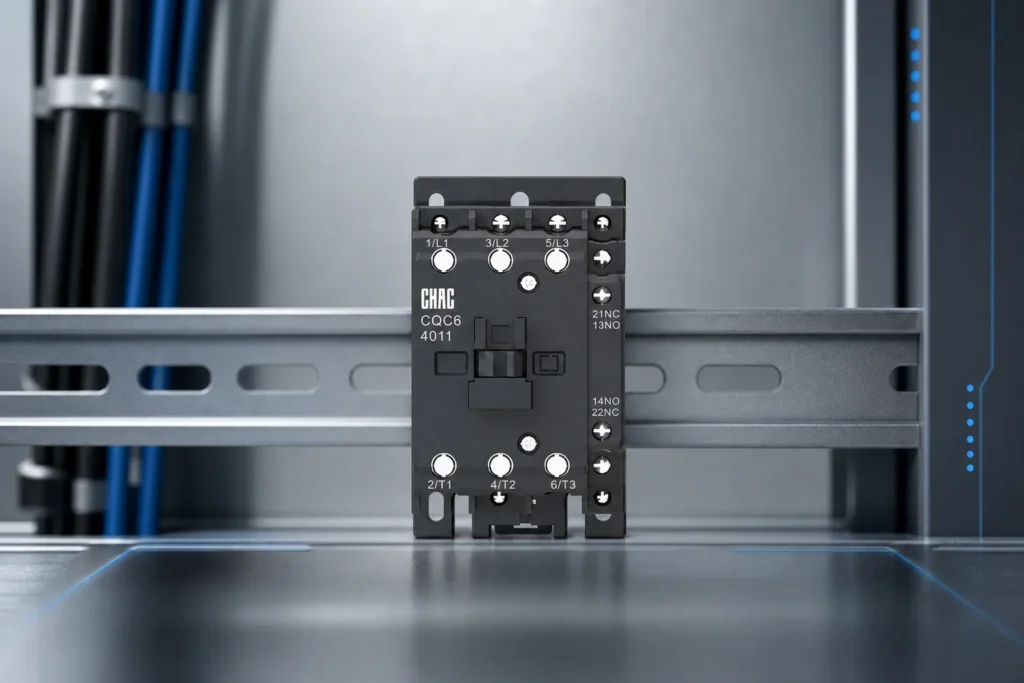
Contact Material and Arc Suppression: Hidden Factors Behind Contactor Performance
The main contacts are the most critical parts of an AC Contactor. During switching, especially under inductive loads such as motors and compressors, an electric arc forms between the contacts. If the arc is not controlled properly, it can cause contact burning, welding, and reduced lifespan.
High-quality contactors usually use silver alloy contact materials, such as silver tin oxide or other environmentally compliant contact materials. These materials provide better conductivity, lower contact resistance, and improved resistance to arc erosion.
Arc Suppression: A design method used to control and extinguish electrical arcs generated when contacts open under load.
Arc suppression is essential for safe and durable contactor operation. A well-designed arc chute helps divide, cool, and extinguish the arc quickly. This reduces thermal stress and protects the contact surface. For heavy-duty applications, poor arc suppression often leads to frequent ac contactor repair, unexpected downtime, and unsafe operation.
AI Predictive Maintenance: The Future of AC Contactor Reliability
As industrial automation becomes more digitalized, contactors are no longer viewed only as passive switching devices. In smart electrical panels, data from contactor operation can be monitored to predict failures before they happen.
AI-based predictive maintenance can analyze:
- Switching frequency
- Coil temperature
- Resistansi kontak
- Load current fluctuation
- Pull-in and drop-out time
- Abnormal vibration or noise
- Historical fault patterns
For example, if a contactor starts taking longer to close or its contact resistance increases gradually, the system can generate an early warning. This allows maintenance teams to replace or repair the contactor before a production line stops unexpectedly.
This trend is especially valuable in smart factories, HVAC monitoring systems, and large-scale motor control centers. In production environments, digital workshops and automated production lines also play an important role in improving consistency. CHAC has developed smart manufacturing systems supported by SCADA, MES, and intelligent management platforms to enhance process control and production traceability.
AC Contactor vs Relay vs DC Contactor: Key Differences Buyers Should Know
Although contactors, relays, and DC contactors all perform switching functions, they are designed for different electrical requirements.
An AC Contactor is mainly used for switching AC loads such as motors, compressors, and heaters. A relay is usually used for lower-current control circuits. A DC contactor is designed to interrupt direct current, which is more difficult to extinguish because DC current has no natural zero-crossing point.
| Perangkat | Main Use | Typical Load | Key Feature |
|---|---|---|---|
| Kontaktor AC | High-power AC switching | Motors, HVAC, pumps, compressors | Strong arc control for AC loads |
| Relay | Low-power signal control | Control circuits, alarms, small devices | Compact and sensitive |
| DC Contactor | High-power DC switching | EV, battery systems, solar storage | Stronger arc suppression for DC circuits |
For buyers, the most important rule is simple: do not use an AC contactor for DC loads unless the manufacturer specifically approves it. Incorrect selection can cause severe arcing, contact welding, or fire risk.
Safety Standards, Certifications, and Supplier Evaluation for AC Contactors
A reliable AC Contactor should comply with international safety and performance standards. For industrial and export markets, certifications are not only quality indicators but also entry requirements. Buyers can refer to UL 60947-4-1 standards for contactors and motor starters when evaluating products for North American industrial control applications.
Common standards and certifications include:
- IEC 60947-4-1 for contactors and motor starters
- CE for European market compliance
- UL for North American applications
- CCC for China market access
- RoHS for restricted hazardous substances
- Flame-retardant material standards for housing safety
When evaluating an AC contactor supplier, buyers should consider:
- Complete product testing process
- Stable coil and contact material quality
- Rated current and utilization category accuracy
- Production capacity and delivery stability
- OEM/ODM support
- Technical documentation and wiring diagrams
- Warranty and after-sales support
For global buyers, supplier capability is as important as product specification. With over 30 years of experience in low-voltage electrical product R&D and manufacturing, CHAC produces 2 million AC contactors annually and serves customers across global markets. Its large-scale production capacity and quality control system help support stable supply and consistent product performance.
A low-cost product may seem attractive at first, but if it causes frequent downtime, overheating, or repeated ac contactor repair, the total cost will be much higher.
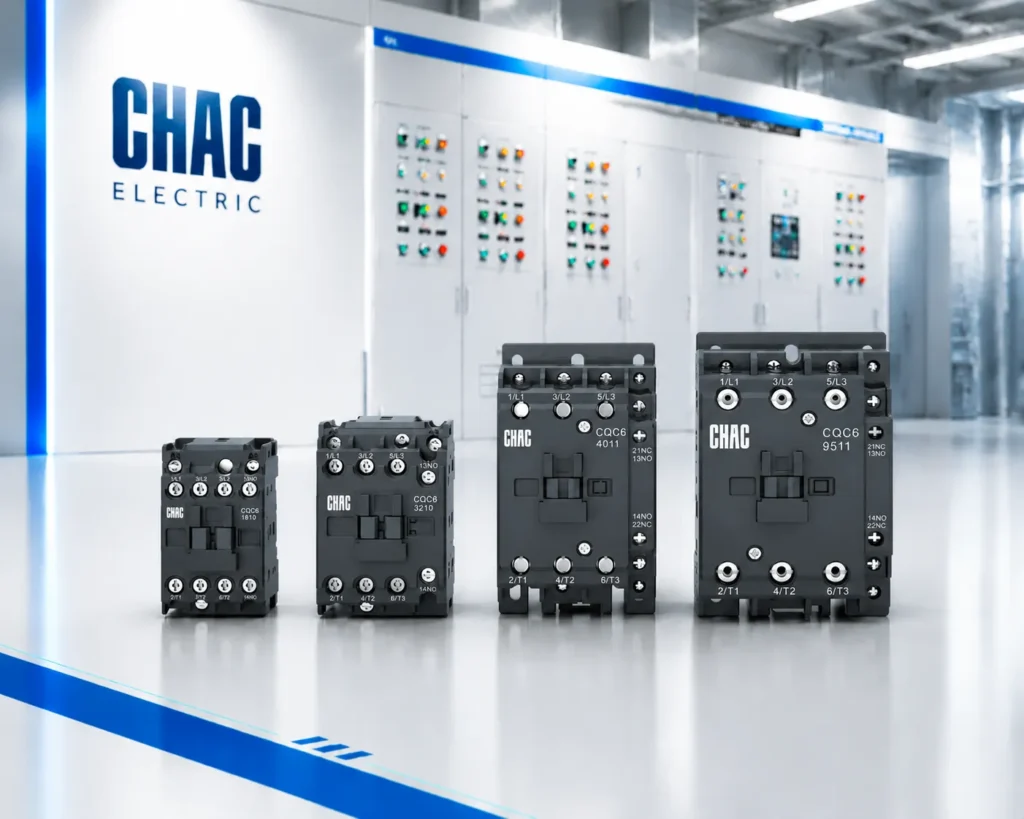
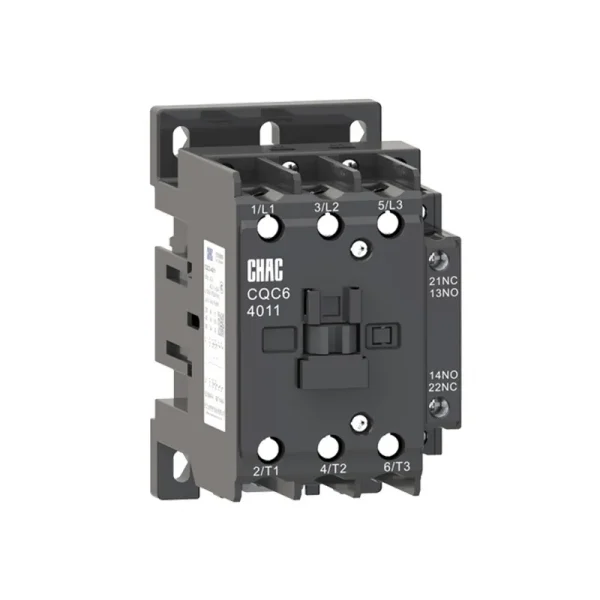
CHAC AC contactor Recommended:
Produsen Kontaktor AC Industri Seri CQC6 | CHAC Electric
Future Trends: Digitalized, Compact, and Sustainable AC Contactors
The future of AC contactors is moving toward smarter, smaller, and more energy-efficient designs. Traditional contactors will continue to be widely used, but modern electrical systems increasingly require digital monitoring, lower energy consumption, and easier integration with automation platforms.
As highlighted by the International Energy Agency report on energy efficiency, improving electrical efficiency across industrial and building systems remains an important direction for reducing energy consumption and operating costs.
Key trends include:
- Compact design for space-saving control panels
- Low-power coils to reduce heat and energy loss
- Modular auxiliary contact blocks
- Smart monitoring for predictive maintenance
- Environmentally friendly contact materials
- Higher switching durability for frequent-start applications
- Better compatibility with PLC and IoT-based control systems
Sustainable manufacturing is also becoming a key factor in supplier evaluation. CHAC is recognized as a National Green Factory and operates under the ISO 14001 environmental management system, supporting cleaner and more responsible production of low-voltage electrical products.
As industries focus on automation, energy efficiency, and operational reliability, the AC Contactor will remain a core component in electrical operations. Whether used in motor control, industrial machinery, or an ac unit contactor system, choosing the right contactor is essential for safe, efficient, and long-lasting performance.
Which AC contactor checks prevent a repeat failure?
Start with the load rather than the enclosure. Record the utilization category, operating current, starting or inrush current, starts per hour, duty cycle, coil voltage and auxiliary-contact requirement. An AC contactor model can be a useful candidate, but the product page does not replace the exact variant datasheet or the project coordination study.
| Poin ulasan | Mengapa hal itu mengubah keputusan |
|---|---|
| Load category | Motor, resistive, lighting and capacitive loads impose different switching duties. |
| Control circuit | Coil voltage, hold-in behavior and auxiliary contacts must match the schematic. |
| Koordinasi proteksi | The contactor switches; the upstream and motor-protection devices address fault and overload duties. |
Google results for contactor selection repeatedly surface utilization categories and overload-relay coordination. Treat those as research prompts, not as proof that one current rating works for every load. The final approval should reference the applicable edition of the standard and the exact manufacturer combination.
Pertanyaan yang sering diajukan
Apa fungsi dari kontaktor AC?
Kontaktor AC berfungsi untuk menghidupkan dan mematikan beban listrik AC, seperti motor, kompresor, pompa, unit HVAC, dan sistem pencahayaan. Kontaktor ini memungkinkan sinyal kontrol bertegangan rendah untuk mengendalikan rangkaian dengan daya yang lebih tinggi secara aman.
Bagaimana cara mengetahui apakah kontaktor AC saya rusak?
Tanda-tanda umum kontaktor AC yang rusak meliputi suara berdengung atau bergetar, kontak yang terbakar atau berlubang, beban tidak menyala, panas berlebih, kontak yang saling menempel, atau tidak adanya kontinuitas saat kumparan dialiri arus.
Apa itu kontaktor pada unit AC?
Kontaktor pada unit AC adalah sakelar listrik yang mengendalikan aliran daya ke kompresor dan motor kipas luar ruangan. Ketika termostat mengirimkan sinyal, kontaktor akan menutup dan memungkinkan unit pendingin udara untuk beroperasi.
Apa itu kontaktor AC 2?
Sebuah kontaktor AC-2 digunakan untuk mengalihkan motor cincin selip. Alat ini dirancang untuk aplikasi yang melibatkan starting, stopping, dan inching motor, di mana diperlukan arus starting yang lebih tinggi serta kondisi tugas khusus.
Apa perbedaan antara kontaktor AC 3 dan AC 4?
Kontaktor AC-3 terutama digunakan untuk menghidupkan dan mematikan motor sangkar tupai secara normal. Kontaktor AC-4 digunakan untuk operasi yang lebih menuntut seperti gerakan maju-mundur sejauh satu langkah, pengereman dengan membalik polaritas, dan pembalikan arah yang sering, sehingga memerlukan ketahanan saklar yang lebih tinggi.
Apa yang terjadi ketika Anda menempatkan 240V di antara A1 dan A2 pada kontaktor?
A1 dan A2 adalah terminal kumparan. Jika kumparan kontaktor dirating untuk 240V, penerapan 240V akan mengaktifkan kumparan dan menutup kontak. Jika kumparan tidak dirating untuk 240V, kumparan tersebut dapat menjadi terlalu panas, terbakar, atau mengalami kegagalan.
Apa yang dimaksud dengan huruf T pada kontaktor?
Pada sebuah kontaktor, terminal T biasanya merujuk pada terminal sisi beban, seperti T1, T2, dan T3. Terminal-terminal tersebut terhubung ke motor atau beban listrik, sedangkan L1, L2, dan L3 umumnya merupakan terminal input daya sisi saluran.
Apakah kontaktor AC dapat menggantikan pemutus arus pelindung motor?
Tidak. Kontaktor menyediakan pemutusan yang terkendali; perlindungan terhadap beban lebih dan arus pendek harus dipilih serta dikordinasikan secara terpisah untuk rangkaian motor.
Dokumen mana yang harus mengonfirmasi tugas kontaktor AC?
Gunakan lembar data model yang tepat, standar produk yang berlaku, data beban, serta kombinasi proteksi yang telah diuji atau didokumentasikan. Halaman kategori saja tidak cukup.
Referensi
- IEC 60947-4-1 Low-Voltage Switchgear and Controlgear Standards
- UL 60947-4-1 Standards for Contactors and Motor Starters
- International Energy Agency Report on Energy Efficiency
- Publikasi produk IEC 60947-4-1:2023 Use the applicable edition and scope for low-voltage contactors and motor starters.
- Panduan Instalasi Listrik Schneider: fungsi proteksi motor Use as an explanatory source; confirm project-specific settings separately.
Looking for reliable AC contactors for industrial control, HVAC systems, or global electrical projects? Contact CHAC today to discuss your application requirements and find the right low-voltage electrical solution for your business.