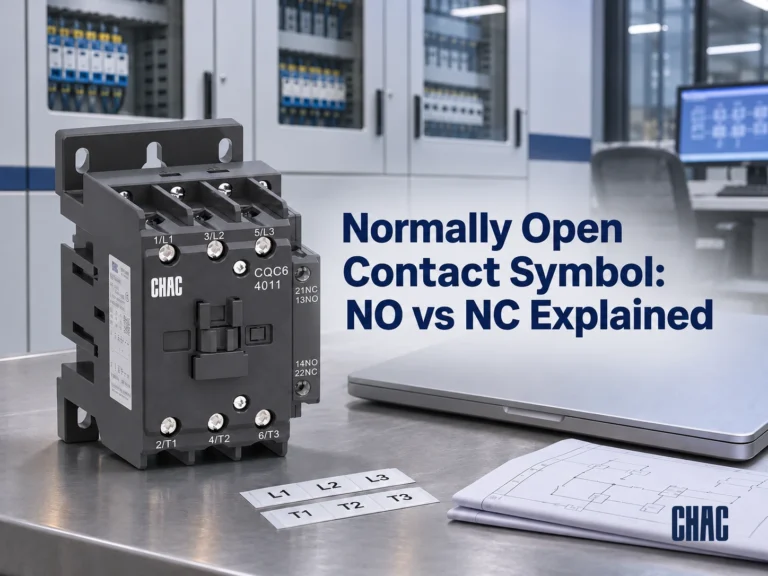
Контактный клапан переменного токаКонтакторы часто выбирают только по номинальному току, хотя категория нагрузки, цепь катушки и режим коммутации определяют, является ли такой выбор обоснованным. Устройство, работающее на малой резистивной нагрузке, может вести себя иначе при пуске компрессора, двигателя или группы осветительных приборов. Настоящая редакция разделяет функцию коммутации с защитой от перегрузки и короткого замыкания, а также предоставляет покупателям практический документальный материал для одобрения модели.
Современный рынок электротехники стремится к повышению энергоэффективности, внедрению цифрового мониторинга, компактным конструкциям и предиктивному обслуживанию. Заказчики нуждаются в контакторах переменного тока, способных выдерживать частые коммутации, противостоять износу контактов, работать с различными типами нагрузок и надежно функционировать в жёстких эксплуатационных условиях. Однако покупатели часто беспокоятся о перегорании обмотки, прилипании контактов, неправильном выборе напряжения, недостаточном электрическом ресурсе, соответствии требованиям сертификации, а также о том, смогут ли недорогие изделия действительно удовлетворять долгосрочные эксплуатационные потребности. Поэтому перед принятием решения о закупке крайне важно разобраться в конструкции контакторов, методах их испытаний, рекомендациях по замене и оценить качество поставщика.
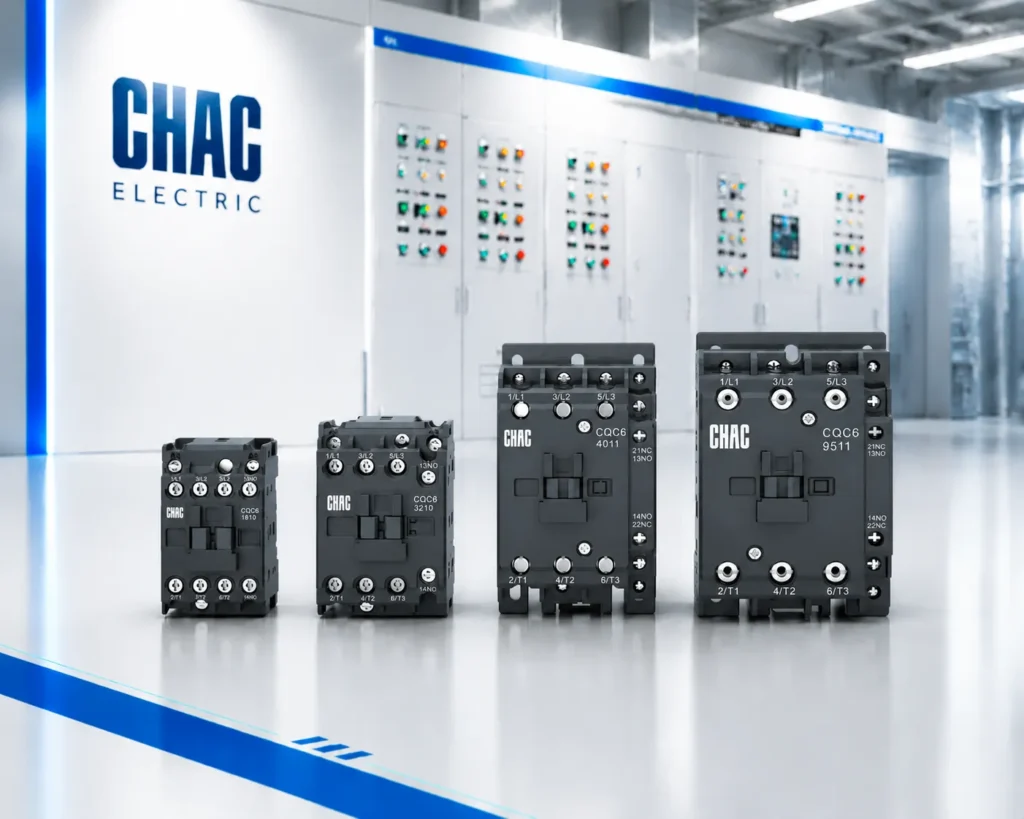
Что такое контакторы переменного тока и почему они важны в электротехнических системах?
Ан Контактор переменного тока это электромагнитное коммутационное устройство, предназначенное для управления электрическими нагрузками переменного тока. При подаче напряжения на катушку создается магнитное поле, которое притягивает подвижный сердечник и замыкает главные контакты, обеспечивая прохождение тока к нагрузке. При снятии напряжения с катушки пружинный механизм размыкает контакты, разрывая цепь.
Контакторы переменного тока широко применяются в:
- Промышленные системы управления двигателями
- Системы отопления, вентиляции и кондиционирования воздуха
- Компрессоры и насосы
- Панели управления освещением
- Оборудование для автоматизации
- Шкафы распределения электроэнергии
В электрических системах контакторы играют важную роль, поскольку они позволяют управлять нагрузками с высоким током с помощью управляющих сигналов малой мощности. Это повышает уровень безопасности, делает возможной автоматизацию и защищает операторов от непосредственного коммутирования цепей большой мощности.
Ключевые компоненты внутри контактора переменного тока
Высококачественный контактор переменного тока — это нечто большее, чем обычный электрический выключатель. Его работоспособность зависит от качества каждого внутреннего компонента, в первую очередь катушки, контактов, магнитной системы и устройства гашения дуги.
| Компонент | Функция | Почему это важно |
|---|---|---|
| Кольцо | Вырабатывает магнитную силу при подаче электропитания. | Определяет стабильное тяговое усилие и совместимость по напряжению |
| Основные контакты | Включайте и выключайте ток нагрузки. | Прямо влияет на электрический ресурс и нагрузочную способность. |
| Дополнительные контакты | Обеспечить обратную связь по сигналу или управляющую логику | Используется для цепей блокировки, самоподдерживающих цепей и сигналов ПЛК. |
| Magnetic Core | Transfers electromagnetic force | Influences response speed and operating noise |
| Arc Chute | Extinguishes arc during switching | Reduces contact erosion and improves safety |
| Spring Mechanism | Releases contacts when coil power is removed | Ensures fast and reliable disconnection |
| Insulated Housing | Protects internal components | Requires flame-retardant and heat-resistant material |
Auxiliary Contacts: Additional contacts used for signal feedback, electrical interlocking, self-holding circuits, or PLC control logic.
For demanding industrial applications, the contactor should have strong dielectric strength, reliable insulation resistance, stable coil performance, and excellent arc extinguishing capability. Manufacturers with in-house testing capabilities can better control these performance factors throughout production.
How to Test AC Contactor
Testing an AC Contactor is important during maintenance, troubleshooting, or before replacing a suspected faulty unit. A failed contactor can cause motor failure, compressor malfunction, overheating, or system shutdown.
Before testing, always disconnect power and follow электрическая безопасность procedures.
Common testing steps include:
-
Visual Inspection
Check for burned marks, melted housing, loose terminals, damaged wires, or carbonized contacts. -
Coil Resistance Test
Use a multimeter to measure the resistance between coil terminals, usually marked as A1 and A2. If the coil is open or shorted, the contactor may need replacement. -
Voltage Test
Confirm whether the control voltage matches the coil rating, such as 24V, 110V, 220V, or 380V AC. -
Contact Continuity Test
Check whether the main contacts open and close properly when the coil is energized and de-energized. -
Mechanical Movement Check
Press the movable core manually when safe and powered off. The movement should be smooth without sticking. -
Load Operation Test
After reinstalling safely, verify whether the connected motor, compressor, or ac unit contactor system starts and stops normally.
If the contactor chatters, overheats, fails to pull in, or has welded contacts, it may require ac contactor repair or replacement.
How to Replace AC Contactor
Replacing an AC Contactor should be done carefully because incorrect wiring or wrong specifications can damage equipment or create safety hazards.
Basic replacement process:
-
Turn Off Power Completely
Disconnect the main power supply and verify with a voltage tester. -
Record Existing Wiring
Take clear photos of all terminals, including line side, load side, coil terminals, and auxiliary contacts. -
Check the Contactor Specification
Match the new contactor with the old one based on:- Максимальный ток
- Номинальное напряжение
- Coil voltage
- Количество полюсов
- Load category such as AC-1, AC-3, or AC-4
- Auxiliary contact configuration
-
Remove the Old Contactor
Loosen terminal screws, disconnect wires, and remove it from the DIN rail or mounting plate. -
Install the New Contactor
Mount it securely and reconnect wires according to the original wiring diagram. -
Tighten Terminals Properly
Loose terminals can cause overheating, arcing, and premature failure. -
Test Operation
Restore power and test start/stop operation under controlled conditions.
For HVAC systems, replacing an ac unit contactor often solves issues such as the outdoor unit not starting, compressor not running, or fan failure. However, if the root cause is voltage instability, capacitor failure, or control board damage, simply replacing the contactor may not solve the problem.
Electrical Lifespan vs Mechanical Lifespan: What Buyers Often Overlook
Many buyers focus only on mechanical lifespan, but for real electrical operations, electrical lifespan is often more important.
Mechanical lifespan refers to how many times the contactor can operate without load. Electrical lifespan refers to how many times it can switch actual current under load conditions. Since real switching creates arcs, heat, and contact erosion, electrical lifespan is usually much shorter than mechanical lifespan.
For motor control applications, especially under AC-3 working conditions, buyers should pay close attention to electrical lifespan rather than only comparing mechanical operation cycles. According to the application categories defined in IEC 60947-4-1 low-voltage switchgear and controlgear standards, utilization categories such as AC-1, AC-3, and AC-4 are critical for selecting the right contactor based on load type and switching duty.
AC-3 Duty: A common utilization category for switching squirrel-cage motors during normal starting and stopping operations.
In practical applications, AC-3 Duty is commonly used for standard motor starting and stopping, such as pumps, fans, compressors, and conveyor motors. Choosing a contactor with the correct utilization category helps prevent overheating, contact wear, and premature failure.
| Lifespan Type | Значение | Main Influencing Factors |
|---|---|---|
| Mechanical Lifespan | Number of no-load operations | Spring system, magnetic core, mechanical wear |
| Electrical Lifespan | Number of load-switching operations | Load current, arc energy, contact material, switching frequency |
| Practical Service Life | Actual usable life in field conditions | Temperature, dust, voltage stability, maintenance quality |
At the manufacturing level, electrical endurance testing is essential for validating long-term contactor reliability. CHAC’s independent laboratories conduct electrical endurance, material, magnetic, salt spray, and dimensional testing to help ensure consistent quality throughout the production process.
Contact Material and Arc Suppression: Hidden Factors Behind Contactor Performance
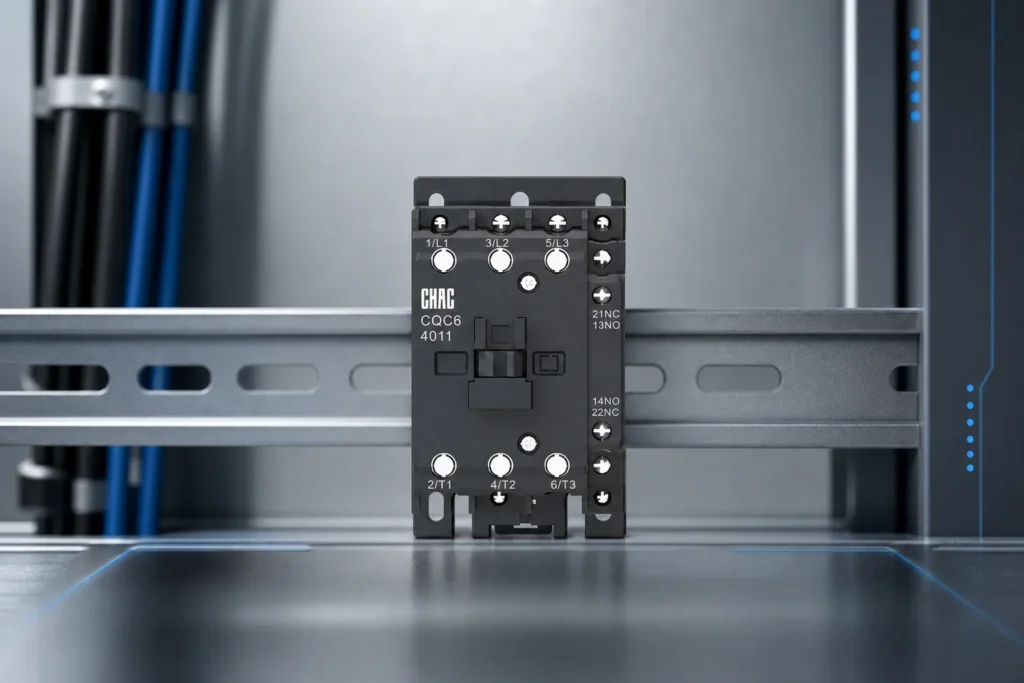
The main contacts are the most critical parts of an AC Contactor. During switching, especially under inductive loads such as motors and compressors, an electric arc forms between the contacts. If the arc is not controlled properly, it can cause contact burning, welding, and reduced lifespan.
High-quality contactors usually use silver alloy contact materials, such as silver tin oxide or other environmentally compliant contact materials. These materials provide better conductivity, lower contact resistance, and improved resistance to arc erosion.
Arc Suppression: A design method used to control and extinguish electrical arcs generated when contacts open under load.
Arc suppression is essential for safe and durable contactor operation. A well-designed arc chute helps divide, cool, and extinguish the arc quickly. This reduces thermal stress and protects the contact surface. For heavy-duty applications, poor arc suppression often leads to frequent ac contactor repair, unexpected downtime, and unsafe operation.
AI Predictive Maintenance: The Future of AC Contactor Reliability
As industrial automation becomes more digitalized, contactors are no longer viewed only as passive switching devices. In smart electrical panels, data from contactor operation can be monitored to predict failures before they happen.
AI-based predictive maintenance can analyze:
- Switching frequency
- Coil temperature
- Contact resistance
- Load current fluctuation
- Pull-in and drop-out time
- Abnormal vibration or noise
- Historical fault patterns
For example, if a contactor starts taking longer to close or its contact resistance increases gradually, the system can generate an early warning. This allows maintenance teams to replace or repair the contactor before a production line stops unexpectedly.
This trend is especially valuable in smart factories, HVAC monitoring systems, and large-scale motor control centers. In production environments, digital workshops and automated production lines also play an important role in improving consistency. CHAC has developed smart manufacturing systems supported by SCADA, MES, and intelligent management platforms to enhance process control and production traceability.
AC Contactor vs Relay vs DC Contactor: Key Differences Buyers Should Know
Although contactors, relays, and DC contactors all perform switching functions, they are designed for different electrical requirements.
An AC Contactor is mainly used for switching AC loads such as motors, compressors, and heaters. A relay is usually used for lower-current control circuits. A DC contactor is designed to interrupt direct current, which is more difficult to extinguish because DC current has no natural zero-crossing point.
| Устройство | Main Use | Typical Load | Key Feature |
|---|---|---|---|
| Контактор переменного тока | High-power AC switching | Motors, HVAC, pumps, compressors | Strong arc control for AC loads |
| Реле | Low-power signal control | Control circuits, alarms, small devices | Compact and sensitive |
| DC Contactor | High-power DC switching | EV, battery systems, solar storage | Stronger arc suppression for DC circuits |
For buyers, the most important rule is simple: do not use an AC contactor for DC loads unless the manufacturer specifically approves it. Incorrect selection can cause severe arcing, contact welding, or fire risk.
Safety Standards, Certifications, and Supplier Evaluation for AC Contactors
A reliable AC Contactor should comply with international safety and performance standards. For industrial and export markets, certifications are not only quality indicators but also entry requirements. Buyers can refer to UL 60947-4-1 standards for contactors and motor starters when evaluating products for North American industrial control applications.
Common standards and certifications include:
- IEC 60947-4-1 for contactors and motor starters
- CE for European market compliance
- UL for North American applications
- CCC for China market access
- RoHS for restricted hazardous substances
- Flame-retardant material standards for housing safety
When evaluating an AC contactor supplier, buyers should consider:
- Complete product testing process
- Stable coil and contact material quality
- Rated current and utilization category accuracy
- Production capacity and delivery stability
- OEM/ODM support
- Technical documentation and wiring diagrams
- Warranty and after-sales support
For global buyers, supplier capability is as important as product specification. With over 30 years of experience in low-voltage electrical product R&D and manufacturing, CHAC produces 2 million AC contactors annually and serves customers across global markets. Its large-scale production capacity and quality control system help support stable supply and consistent product performance.
A low-cost product may seem attractive at first, but if it causes frequent downtime, overheating, or repeated ac contactor repair, the total cost will be much higher.
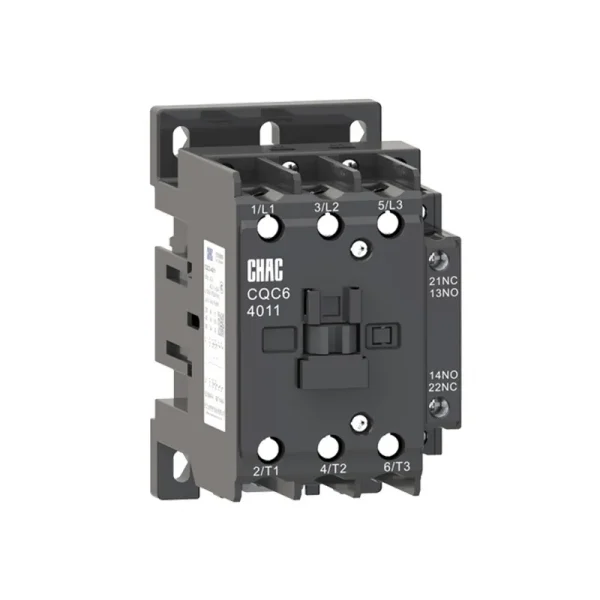
CHAC AC contactor Recommended:
Производитель промышленного контактора с переменным током серии CQC6 — OEM | CHAC Electric
Future Trends: Digitalized, Compact, and Sustainable AC Contactors
The future of AC contactors is moving toward smarter, smaller, and more energy-efficient designs. Traditional contactors will continue to be widely used, but modern electrical systems increasingly require digital monitoring, lower energy consumption, and easier integration with automation platforms.
As highlighted by the International Energy Agency report on energy efficiency, improving electrical efficiency across industrial and building systems remains an important direction for reducing energy consumption and operating costs.
Key trends include:
- Compact design for space-saving control panels
- Low-power coils to reduce heat and energy loss
- Modular auxiliary contact blocks
- Smart monitoring for predictive maintenance
- Environmentally friendly contact materials
- Higher switching durability for frequent-start applications
- Better compatibility with PLC and IoT-based control systems
Sustainable manufacturing is also becoming a key factor in supplier evaluation. CHAC is recognized as a National Green Factory and operates under the ISO 14001 environmental management system, supporting cleaner and more responsible production of low-voltage electrical products.
As industries focus on automation, energy efficiency, and operational reliability, the AC Contactor will remain a core component in electrical operations. Whether used in motor control, industrial machinery, or an ac unit contactor system, choosing the right contactor is essential for safe, efficient, and long-lasting performance.
Which AC contactor checks prevent a repeat failure?
Start with the load rather than the enclosure. Record the utilization category, operating current, starting or inrush current, starts per hour, duty cycle, coil voltage and auxiliary-contact requirement. An AC contactor model can be a useful candidate, but the product page does not replace the exact variant datasheet or the project coordination study.
| Точка обзора | Почему это меняет решение? |
|---|---|
| Load category | Motor, resistive, lighting and capacitive loads impose different switching duties. |
| Control circuit | Coil voltage, hold-in behavior and auxiliary contacts must match the schematic. |
| Protection coordination | The contactor switches; the upstream and motor-protection devices address fault and overload duties. |
Google results for contactor selection repeatedly surface utilization categories and overload-relay coordination. Treat those as research prompts, not as proof that one current rating works for every load. The final approval should reference the applicable edition of the standard and the exact manufacturer combination.
Часто задаваемые вопросы
Что делает контактор переменного тока?
Контактор переменного тока включает и выключает электрические нагрузки, питаемые от сети переменного тока, такие как двигатели, компрессоры, насосы, системы отопления, вентиляции и кондиционирования воздуха, а также осветительные установки. Он позволяет управлять цепью более высокой мощности с помощью низковольтного управляющего сигнала, обеспечивая при этом безопасность.
Как определить, что мой контактор кондиционера вышел из строя?
К распространённым признакам неисправности контактора системы кондиционирования относятся жужжащий или дребезжащий шум, обгоревшие или выщербленные контакты, отсутствие запуска нагрузки, перегрев, залипание контактов или отсутствие электрической проводимости при подаче напряжения на катушку.
Что такое контактор блока кондиционера?
Контактор системы кондиционирования — это электрический выключатель, который управляет подачей питания на компрессор и наружный вентилятор. Когда термостат посылает сигнал, контактор замыкается и включает работу кондиционера.
Что такое контактор переменного тока 2?
Контактор AC-2 используется для коммутации асинхронных двигателей с фазным ротором. Он предназначен для применения при пуске, остановке и точном перемещении двигателей, когда требуются повышенные пусковые токи и специфические условия эксплуатации.
В чём разница между контактором AC 3 и контактором AC 4?
Контакторы AC-3 в основном используются для обычного пуска и остановки асинхронных двигателей с короткозамкнутым ротором. Контакторы AC-4 применяются для более сложных операций, таких как точное перемещение, торможение противовключением и частые реверсы, поэтому они требуют более высокой коммутационной износостойкости.
Что произойдёт, если поместить 240V между A1 и A2 контактора?
A1 и A2 — это клеммы катушки. Если катушка контактора рассчитана на 240V, подача напряжения 240V приведёт к её возбуждению и замыканию контактов. Если катушка не рассчитана на 240V, она может перегреться, сгореть или выйти из строя.
Что обозначает буква «T» на контакторе?
На контакторе клеммы T обычно обозначают стороны нагрузки, такие как T1, T2 и T3. Они подключаются к двигателю или электрической нагрузке, тогда как L1, L2 и L3, как правило, являются клеммами ввода питания со стороны сети.
Заменяет ли контактор переменного тока автоматический выключатель защиты двигателя?
Нет. Контактор обеспечивает управляемое коммутационное переключение; защиту от перегрузки и короткого замыкания для цепи двигателя необходимо выбирать и согласовывать отдельно.
Какой документ должен подтверждать режим работы контактора переменного тока?
Используйте точный технический паспорт модели, соответствующий стандарт на продукцию, данные о нагрузке и проверённую или документально подтверждённую комбинацию средств защиты. Одной лишь страницы категории недостаточно.
Ссылки
- IEC 60947-4-1 Low-Voltage Switchgear and Controlgear Standards
- UL 60947-4-1 Standards for Contactors and Motor Starters
- International Energy Agency Report on Energy Efficiency
- Публикация по продукту IEC 60947-4-1:2023 Use the applicable edition and scope for low-voltage contactors and motor starters.
- Руководство по электромонтажу Schneider: функции защиты двигателей Use as an explanatory source; confirm project-specific settings separately.
Looking for reliable AC contactors for industrial control, HVAC systems, or global electrical projects? Contact CHAC today to discuss your application requirements and find the right low-voltage electrical solution for your business.