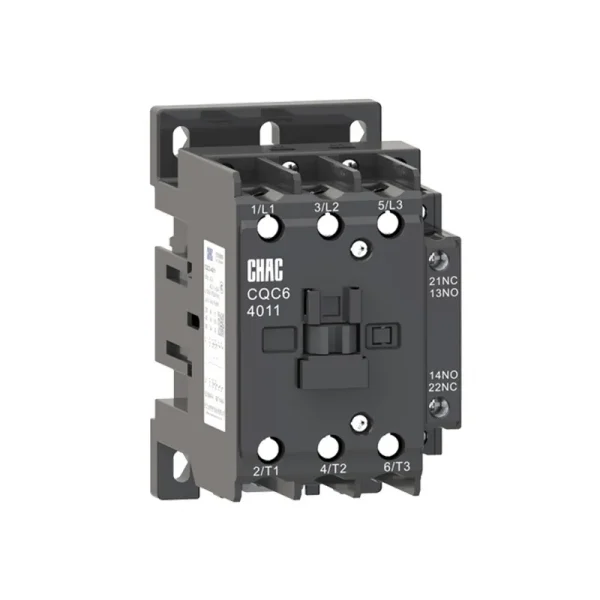
Calcolatore di selezione dei contatori — AC-1 / AC-3
Calcolare la corrente del contattore AC e confrontare i carichi trifase AC-3 con i valori di corrente e potenza motore di CHAC CQC6 a 230, 400 o 690 V.
Confronta un carico trifase AC-3 con le colonne pubblicate relative alla corrente e alla potenza del motore di CQC6. AC-1 fornisce un riferimento di corrente per una verifica su una scheda tecnica separata.
Risultato
AC-3 tabella lista ristretta
CQC6-25Solo corrispondenza in tabella; nessuna coordinazione dei partenti verificataCQC6-25 è il primo modello elencato che soddisfa sia i requisiti di corrente AC-3 sia quelli di potenza del motore a 400 V.
I = Palbero × 1,000 / (√3 × V × PF × η); confrontare AC-3 Ie e kW del motoreIl riferimento di corrispondenza CQC6 utilizza sia la colonna della corrente pubblicata che quella dei kW alla tensione selezionata. Confermare la corrente nominale effettiva, la tensione della bobina, il servizio di avviamento, la frequenza di commutazione e il coordinamento prima dell'ordine.
Perché questo risultato?
Obbligatorio AC-3 Ie ≥ 20.75 A; potenza nominale del motore ≥ 11 kW. La corrente è stimata a partire dalla potenza all'albero, dal fattore di potenza e dall'efficienza.
Opzioni di riferimento selezionate e opzioni elencate adiacenti. I valori vengono arrotondati per la visualizzazione; i controlli utilizzano valori non arrotondati.
| Contattore | AC-3 corrente | Potenza motore a 400 V | Motivo |
|---|---|---|---|
| CQC6-18 | 18.00 A · Requisito sottostante | 7.5 kW · Requisito inferiore | AC-3 corrente inferiore al requisito; Potenza nominale del motore inferiore al requisito |
| CQC6-25Riferimento selezionato | 25.00 A · Soddisfa il requisito | 11 kW · Soddisfa il requisito | Prima partita elencata per questi controlli |
| CQC6-32 | 32.00 A · Soddisfa il requisito | 15 kW · Soddisfa il requisito | Assegni soddisfatti; opzione elencata in seguito |
Visualizza tutte le opzioni verificate di 12
| Contattore | AC-3 corrente | Potenza motore a 400 V | Motivo |
|---|---|---|---|
| CQC6-6 | 6.00 A · Requisito sottostante | 2.2 kW · Requisito inferiore | AC-3 corrente inferiore al requisito; Potenza nominale del motore inferiore al requisito |
| CQC6-9 | 9.00 A · Requisito sottostante | 4 kW · Requisito inferiore | AC-3 corrente inferiore al requisito; Potenza nominale del motore inferiore al requisito |
| CQC6-12 | 12.00 A · Requisito sottostante | 5.5 kW · Sotto il requisito | AC-3 corrente inferiore al requisito; Potenza nominale del motore inferiore al requisito |
| CQC6-18 | 18.00 A · Requisito sottostante | 7.5 kW · Requisito inferiore | AC-3 corrente inferiore al requisito; Potenza nominale del motore inferiore al requisito |
| CQC6-25Riferimento selezionato | 25.00 A · Soddisfa il requisito | 11 kW · Soddisfa il requisito | Prima partita elencata per questi controlli |
| CQC6-32 | 32.00 A · Soddisfa il requisito | 15 kW · Soddisfa il requisito | Assegni soddisfatti; opzione elencata in seguito |
| CQC6-38 | 38.00 A · Soddisfa il requisito | 18.5 kW · Meets requirement | Assegni soddisfatti; opzione elencata in seguito |
| CQC6-40 | 40.00 A · Meets requirement | 18.5 kW · Meets requirement | Assegni soddisfatti; opzione elencata in seguito |
| CQC6-50 | 50.00 A · Meets requirement | 22 kW · Meets requirement | Assegni soddisfatti; opzione elencata in seguito |
| CQC6-65 | 65.00 A · Meets requirement | 30 kW · Meets requirement | Assegni soddisfatti; opzione elencata in seguito |
| CQC6-80 | 80.00 A · Meets requirement | 37 kW · Meets requirement | Assegni soddisfatti; opzione elencata in seguito |
| CQC6-95 | 95.00 A · Meets requirement | 45 kW · Meets requirement | Assegni soddisfatti; opzione elencata in seguito |
Still to confirm
- Confirm coil supply, actual nameplate data and switching duty.
- Ambient derating, endurance and short-circuit coordination have not been verified.
Data source: CHAC CQC6 AC-3 rating table (aprirà in una nuova scheda)
Forma e metodo
Calcolare la corrente del contattore AC e confrontare i carichi trifase AC-3 con i valori di corrente e potenza motore di CHAC CQC6 a 230, 400 o 690 V.
Come utilizzare questo calcolatore
- Choose AC-3 for normal squirrel-cage motor starting/stopping, or AC-1 for a suitable non-inductive load.
- Use the stated line voltage and shaft power for AC-3. Enter actual nameplate current when available.
- Compare the table shortlist with the exact variant, control-coil voltage and required switching duty.
Limiti di calcolo
Three-phase reference only. AC-4, reversing, plugging, frequent inching, capacitor switching, derating and tested starter coordination are not assessed. AC-1 gives a numeric Ie comparison without model selection.
Contactor sizing for AC-1 and AC-3 loads
A contactor’s AC-3 operating current depends on voltage and utilization duty. This tool reads the published CQC6 current and three-phase motor-kW columns at 230, 400 or 690 V. It checks both columns; a matching ampere value alone is insufficient.
Note di input
| Input | Cosa controllare |
|---|---|
| AC-3 or AC-1 | AC-3 uses shaft output and efficiency. AC-1 uses electrical input and gives an operational-current reference without selecting a model. |
| Nameplate current | A positive entry overrides the calculated current. The entered shaft kW still remains part of the AC-3 table check. |
| Voltage and allowance | Select the table’s line-voltage column. A user allowance changes the current reference; it is not a universal required margin. |
Esemplo pratico · valori delle forme iniziali
11 kW three-phase motor at 400 V
AC-3 · PF 0.85 · efficiency 90% · no current override · allowance 1.00
I = 11,000 / (√3 × 400 × 0.85 × 0.90) = 20.75 A
At 400 V, CQC6-25 lists AC-3 Ie 25 A and motor output 11 kW.
CQC6-25
This is the first loaded table row meeting both entered conditions. Confirm the actual motor nameplate, coil supply, switching rate and installation duty.
Contactor sizing: motor current, voltage and duty
Start with the motor nameplate current at the intended supply voltage. When only shaft output is known, estimate three-phase current as I = P × 1,000 / (√3 × V × PF × η), using efficiency η as a decimal. A lower power factor or efficiency increases the estimated current for the same shaft kW.
For an AC-3 shortlist, compare that current and the motor output with the same voltage column in the contactor table. At 400 V, an 11 kW motor in this example draws 20.75 A; CQC6-25 meets both the 25 A operational-current rating and the 11 kW motor rating. A current-only comparison would miss the second requirement.
AC-1 vs AC-3: choose the utilization category first
AC-1 covers non-inductive or slightly inductive loads, such as resistance heating. AC-3 applies to starting squirrel-cage motors and switching them off while running. These duties impose different making and breaking demands, so one contactor can have different ratings for each category.
For AC-1, compare the load with an operational Ie rating explicitly declared for the application. Conventional thermal current Ith describes a different test condition. This calculator does not turn an Ith value into an AC-1 model recommendation.
An AC contactor’s coil voltage is a separate choice
The main contacts carry the load; the coil belongs to the control circuit. A 400 V motor supply does not by itself specify the coil voltage. Check the available control supply, AC or DC coil type, frequency where applicable, auxiliary contacts and mounting arrangement.
Use the model result to open the CQC6 technical data and complete those checks. Frequent jogging, plugging, reversing or capacitor switching needs its own duty assessment rather than the normal AC-3 selection used here.
What the table match does not decide
- Conventional thermal current Ith is not interchangeable with operational current Ie. The published AC-1-labelled thermal row is deliberately not used to choose AC-1 models.
- Starting/stopping duty, AC-4 operation, electrical endurance, ambient derating and short-circuit coordination still require the exact product instructions.
Domande frequenti
Why can the same contactor have a lower current at 690 V?
Operational current is voltage- and duty-specific. The CQC6 table lists separate AC-3 columns; the calculator does not carry a 400 V current value into the 690 V column.
Does AC-3 cover reversing or frequent inching?
Do not assume so. Plugging, inching and some reversing duties require a different utilization assessment. This tool is limited to normal AC-3 motor starting and stopping.
Can I enter the actual motor current?
Yes. Enter a positive nameplate current to replace the power-based estimate. Keep the correct shaft kW so the motor-power column is also checked.
Why is there no AC-1 model result?
The available source row is conventional free-air thermal current. The tool instead compares your current with an entered, independently verified AC-1 operational Ie.
What is a contactor used for in a motor circuit?
A contactor switches the motor supply through electrically operated main contacts. Its coil is controlled by the control circuit. It does not replace the overload relay or the short-circuit protective device.
Does the motor voltage determine the contactor coil voltage?
No. Main-circuit voltage and coil supply are separate specifications. Check the actual control voltage, coil type and frequency where applicable when ordering the selected contactor.
Hai bisogno di aiuto per scegliere un prodotto CHAC?
Inviate al sistema la tensione di alimentazione, la corrente di carico e le condizioni di installazione insieme alla vostra richiesta.
CQC6 AC contactor ratings
Published AC-3 operational current and controlled three-phase squirrel-cage motor power. The voltage groups below retain the labels used in the CHAC product table.
Reference data. Calculate to highlight the matching row.
Scroll horizontally on small screens to read all columns.
| Numero di modello | 220V/230V | 380V/400V | 660V/690V | |||
|---|---|---|---|---|---|---|
| AC-3 Ie (A) | Motor power (kW) | AC-3 Ie (A) | Motor power (kW) | AC-3 Ie (A) | Motor power (kW) | |
| CQC6 -6Current reference | 6 | 1.5 | 6 | 2.2 | 4.8 | 3 |
| CQC6 -9Current reference | 9 | 2 | 9 | 4 | 6.6 | 5.5 |
| CQC6 -12Current reference | 12 | 3.5 | 12 | 5.5 | 8.9 | 7.5 |
| CQC6 -18Current reference | 18 | 4 | 18 | 7.5 | 12 | 10 |
| CQC6 -25Current reference | 25 | 6 | 25 | 11 | 18 | 15 |
| CQC6 -32Current reference | 32 | 7.5 | 32 | 15 | 20.2 | 18.5 |
| CQC6 -38Current reference | 38 | 9 | 38 | 18.5 | 20.2 | 18.5 |
| CQC6 -40Current reference | 40 | 11 | 40 | 18.5 | 34 | 30 |
| CQC6 -50Current reference | 50 | 15 | 50 | 22 | 39 | 33 |
| CQC6 -65Current reference | 65 | 18.5 | 65 | 30 | 42 | 37 |
| CQC6 -80Current reference | 80 | 22 | 80 | 37 | 49 | 45 |
| CQC6 -95Current reference | 95 | 25 | 95 | 45 | 49 | 45 |
Reading this reference
- The calculator uses the 230, 400 or 690 V selection within the corresponding published voltage group.
- This table covers AC-3 only. The separate conventional free-air thermal current row is not an AC-1 operational Ie selection table.
- Confirm the exact coil supply, switching duty and installation conditions in the product documentation.
Source: CHAC CQC6 product technical table (aprirà in una nuova scheda)
Source checked: . This is the retrieval date, not a standard edition or product revision date.
Esempio di applicazione · Contributi illustrativi
Matching a 15 kW motor to both CQC6 AC-3 columns
For a pump-control example, enter 15 kW shaft output, 400 V, AC-3 duty and an illustrative 28 A nameplate current, with no added current allowance. The calculator shortlists CQC6-32: the CHAC table lists 32 A and 15 kW in the 380V/400V group. CQC6-25 is below both requirements at 25 A and 11 kW. This is why checking only the model’s ampere value can be misleading. Use the table match to continue the selection, then confirm the coil supply, switching duty, installation conditions and required protection for the actual motor circuit.
Dati del prodotto: CQC6 Serie Contatto Industriale AC, Prodotto per l'OEM
Prodotti CHAC correlati
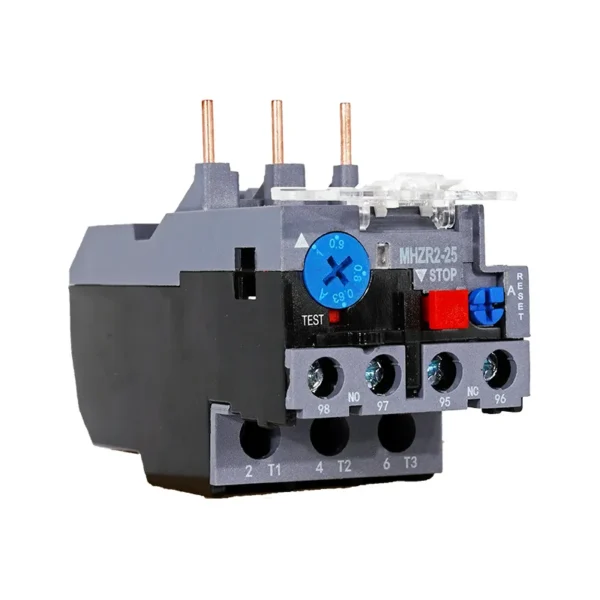
Open the CQC6 ratings and CQR2 pairing tables to continue the motor-circuit selection.