When a solar installer in Perth substituted an AC miniature breaker for a DC string, the lever looked normal but the arc did not extinguish when the fault occurred. The replacement had the right current number and the wrong voltage and polarity arrangement. The incident showed why a DC MCB is selected by arc behavior, system voltage, polarity, and interruption rating—not by label shape alone. The practical answer is to document single pole DC MCB jako część pełnego systemu elektrycznego.
Podsumowanie: A single-pole DC MCB protects a conductor in a direct-current circuit, but the device must be rated for the system voltage, polarity, short-circuit current, and intended use. Buyers should confirm DC breaking capacity, number of poles, polarised terminals, trip curve, ambient derating, and the manufacturer wiring direction. AC and DC ratings are not interchangeable.
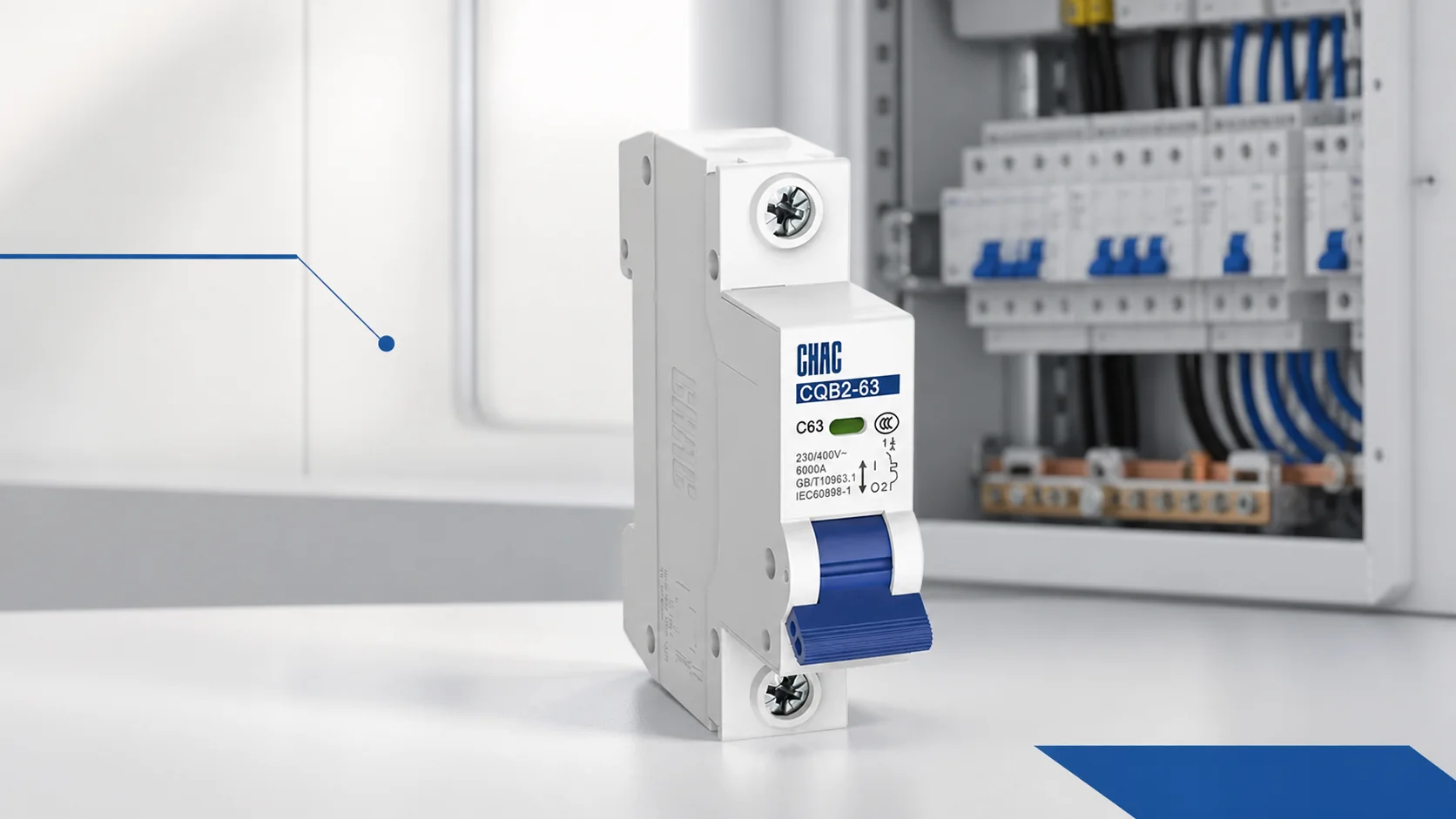
A DC MCB is used in battery, photovoltaic, telecom, control, and other direct-current circuits. Since DC has no natural current zero, arc interruption is more demanding than in many AC applications. The selection brief must include maximum voltage, prospective fault current, cable size, source type, and whether both conductors need isolation. When the brief is clear, circuit breaker for DC voltage można je porównywać na podstawie faktów, zamiast generalnego obiegu marketingowego.
What Is the Function of a Single-Pole DC MCB?
The breaker carries normal current and opens when overload or short-circuit current exceeds its time-current characteristic. A single-pole unit interrupts one conductor; whether that conductor is positive or negative, and whether the other pole also needs isolation, depends on the system design. In a floating or battery system, a two-pole isolating arrangement may be required even when the branch protection is single pole.
Why Is DC Voltage Rating Critical?
The voltage rating defines the distance and magnetic design used to extinguish the arc. A breaker marked for 250 VDC is not automatically suitable for a 500 V string. Check the rating at the actual number of poles in series, the current direction if the device is polarised, and the maximum prospective fault current. Use the manufacturer table rather than estimating from an AC label.
How Do AC and DC Circuit Breakers Differ?
AC breakers benefit from alternating current crossing zero each half cycle. DC devices use magnetic blowout, longer arc paths, or pole series arrangements to interrupt current. This is why an AC MCB may fail to clear a DC fault safely. A DC MCB may be suitable for some AC applications only if the manufacturer explicitly provides that rating.
How Should the Breaker Be Installed?
Follow polarity arrows, line/load markings, torque values, clearance, and the specified cable stripping length. Keep source conductors short and route them to limit loop energy. After installation, test insulation and polarity, verify the open gap, and record the breaker model, voltage, current, and fault-level calculation in the as-built file.
What changes if the DC circuit can be supplied from another source?
For a single-pole DC MCB, show every possible supply on the project diagram before the device is selected. A circuit with storage or conversion equipment needs a review of its permitted operating modes, including any mode in which the assumed supply direction changes. Do not infer reverse-feed capability from the handle position or from an AC product in a similar housing.
Ask the supplier to identify the allowed current direction, voltage and connection arrangement for the exact model. If a multi-pole arrangement is proposed to meet the voltage duty, obtain its documented connection scheme; do not invent a series-pole layout. Keep this permission separate from the system’s isolation requirements, because opening one conductor does not automatically establish isolation from every source.
The breaker buying guide’s backfeed checks explain the procurement distinction between physical fit and permitted supply direction. For the DC circuit, the selected model’s own instructions remain decisive.
What Should Be Coordinated Around the MCB?
Coordinate the breaker with fuses, battery protection, PV modules, converters, contactors, cable ampacity, and downstream equipment. Selectivity may be difficult when several protective devices share a high-energy source. The goal is to clear the smallest faulty section while keeping the rest of the DC system available.
How Should a Buyer Choose a DC MCB Supplier?
Ask for IEC test evidence, DC voltage tables, polarity diagrams, terminal data, mechanical endurance, and a clear replacement family. CHAC offers DC MCB and terminal protection options with engineering support for low-voltage distribution. A complete purchase record should state voltage, poles, current, curve, breaking capacity, and installation orientation.
Zalecenie produktu
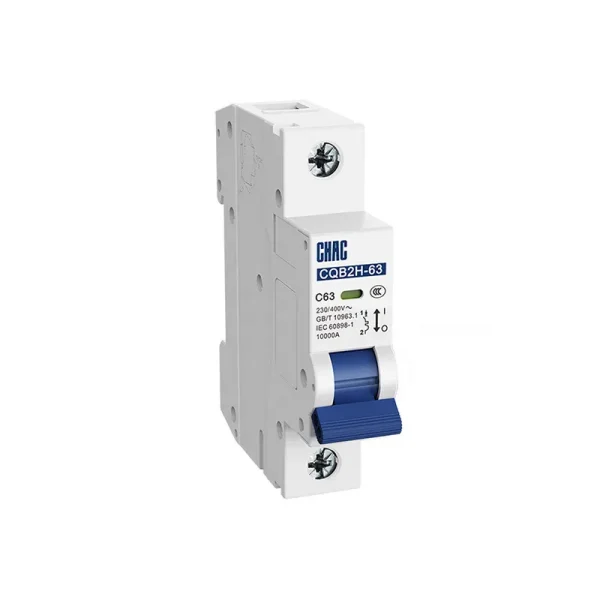
CQB2H-63 Miniature Circuit Breaker – CHAC Electric
Jakie parametry należy zawrzeć w zapytaniu ofertowym?
| Obszar decyzji | Co należy określić | Dlaczego to ma znaczenie |
|---|---|---|
| Napięcie | Maximum DC voltage and poles in series | Controls arc interruption |
| Fault level | Prospective short-circuit current | Confirms breaking capacity |
| Polaryzacja | Positive/negative and line/load direction | Prevents incorrect magnetic operation |
| Cable | Ampacity, temperature, route, terminal size | Coordinates protection and heating |
Zalecamy mierzenie zainstalowanego wyniku oraz wartości katalogowej. Zrób zdjęcie terminali, zapisz moment obrotowy i wyniki testów oraz zachowaj zatwierdzoną rysunek wraz z partią dostarczoną. Ten zapis jest niezbędny do: DC circuit breaker można to sprawdzić w przypadku potrzeby wymiany lub rozbudowy.
Jak powinni kupujący wybierać produkt i dostawcę?
- Przed złożeniem zapytania o cenę należy określić napięcie, prąd, współczynnik obciążenia, środowisko pracy, poziom awarii oraz ryzyko dla użytkownika lub maszyny.
- Wniosek o dostarczenie dokładnego zestawu danych technicznych, schematu połączeń elektrycznych, certyfikatu, dokumentów potwierdzających badania, akcesoriów oraz polityki wymiany.
- Odozwól na kontrolę próbek lub pierwszego egzemplarza oraz sprawdź instalację, a nie tylko opakowanie.
- Rekordy dotyczące serii, zestawów, ustawień, momentu obrotowego oraz uruchomienia pracy są przechowywane w pliku serwisowym lub projektowym.
- Porównaj koszty wysyłki, czas realizacji, zapasy, szybkość reagowania na problemy oraz powiadomienia o zmianach przed wysyłką.
CHAC to producent urządzeń elektrycznych niskonapięciowych z siedzibą w Chinach oraz dostawca globalnych rozwiązań systemowych elektrycznych. Jego linie produktów obejmują urządzenia elektryczne do zacisków, przekaźniki MCB, RCCB/RCBO, SPD, urządzenia rozdzielcze, kontaktory, przekaźniki termiczne przeciwprzepięciowe oraz urządzenia zabezpieczające silniki. Kupujący mogą zapoznać się z nimi Dotycząca produktu gama produktów CHAC a także Przewodnik dotyczący aplikacji przed złożeniem wniosku o selekcję dotyczącą konkretnego projektu.
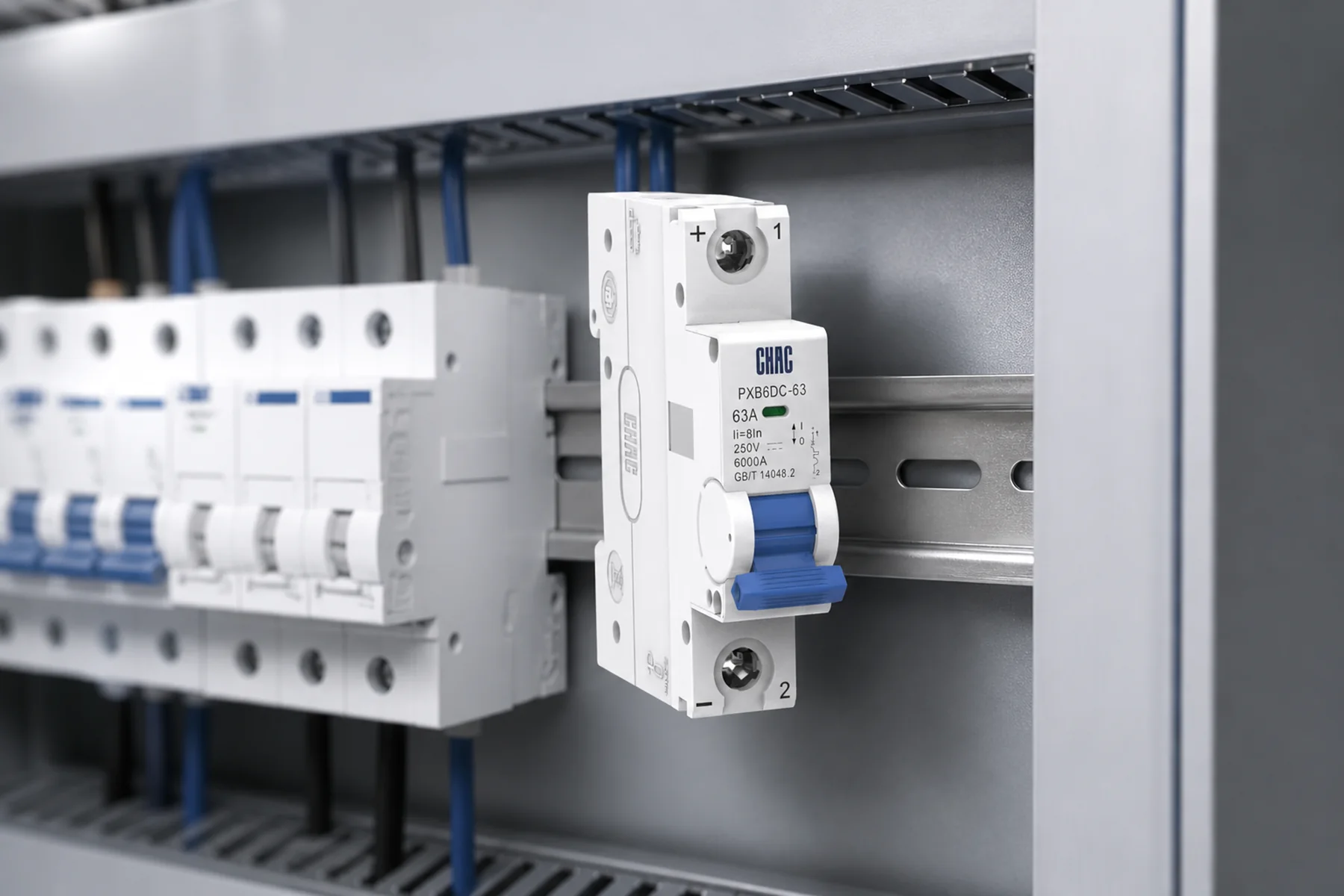
Questions that prevent an AC-to-DC substitution
Before approving a single-pole DC MCB, write down the maximum open-circuit voltage, prospective fault current, source type, polarity and the number of poles that will be placed in series. Solar strings, batteries and converter outputs can have different fault behaviour even when their normal current is similar. An AC-only marking is not evidence that the device can clear a DC arc.
Installation records should retain the manufacturer polarity diagram, line/load direction, terminal torque and the actual cable arrangement. If a project needs isolation of both conductors, a single-pole device may not meet that requirement; confirm the circuit boundary and the locally adopted rule before selecting a DC circuit breaker.
FAQ: Dc Mcb
What is the purpose of a DC MCB?
It protects a DC conductor from overload and short-circuit current and provides a controlled means of isolation when correctly rated.
What is the purpose of a DC circuit breaker?
It interrupts DC faults safely and isolates a circuit; the exact device must match system voltage, current, fault level, and polarity.
What is the difference between a two-pole MCB and a single-pole MCB?
A single-pole unit opens one conductor, while a two-pole unit can open two. The required arrangement depends on grounding, isolation, and the applicable installation rules.
When should I use one pole versus two poles?
Use the circuit design and local code. Battery and floating systems often need simultaneous isolation of both conductors, while some grounded branches protect one ungrounded conductor.
Can a DC MCB be used on AC?
Only when the manufacturer gives an AC rating for the exact model and connection. Never infer interchangeability from the housing.
Przypisy i Ostateczna decyzja
Korzystaj z tych źródeł podczas sprawdzania projektu, planu testów lub specyfikacji zamówienia:
- Przekładnie IEC 60947-2
- IEC 60898-2 circuit-breakers for DC
- IEC 60364-7-712 photovoltaic power supply systems
Rozdział nie tkwi jedynie w komponentie zamontowanym na szynie – tkwi on w parametrach, układzie elektrycznym, testach i decyzjach, które następnie podjęto. Kiedy kupujący traktuje DC MCB breaker Jako wymóg mierzalny, instalacja jest łatwiejsza w uruchomieniu, konserwacji i skalowaniu. CHAC może pomóc przekształcić wymagania dotyczące aplikacji, zgodności i dostarczania w rozwiązanie o niskim napięciu o powtarzalnych parametrach.