A panel specification may call for trip-free operation, yet a purchasing review can still confuse handle position with contact status. That distinction matters when comparing breakers, operating mechanisms and reset requirements: an ON command must not be treated as proof that the main contacts remain closed.
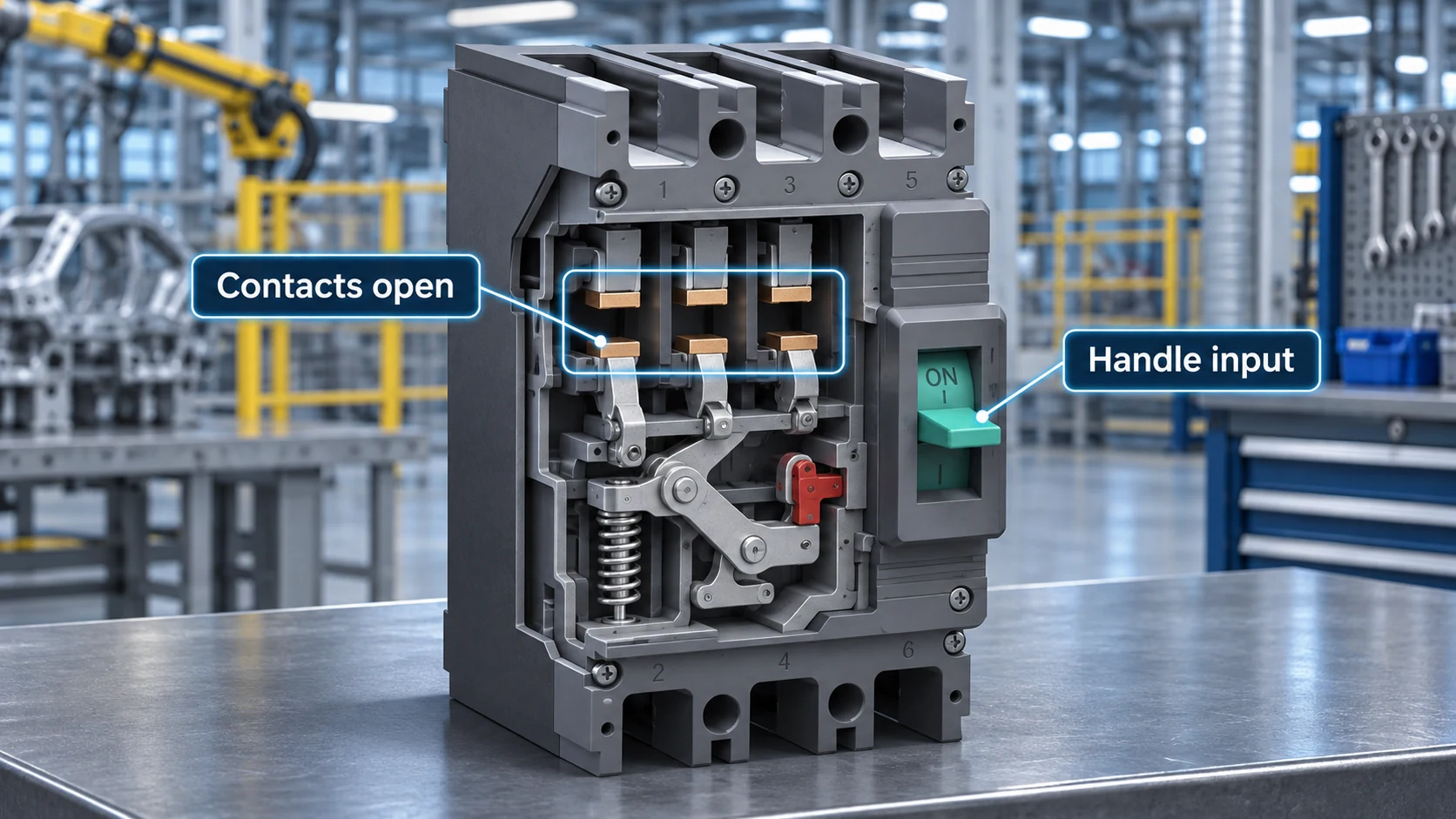
A trip free circuit breaker is designed so that its main contacts can open when the trip mechanism operates, even if the operating handle is held in the ON position. Holding ON cannot override that designed behavior. This describes a mechanism function—not immunity from failure or confirmation that a particular product variant provides it. What makes a circuit breaker trip-free is the release mechanism, not the position of the external handle.
What separates the operating handle from the trip-free mechanism?
The handle provides a manual operating input; the internal mechanism controls contact movement. In a trip-free design, operation of the trip release allows the contacts to open independently of a continued ON input. The handle is therefore not a rigid restraint that can legitimately defeat protective opening.
| Element | Function | Buyer implication |
|---|---|---|
| Operating handle | Provides manual opening or closing input | Do not infer contact condition from handle position alone |
| Trip release | Initiates tripping according to its protection function | Confirm the selected release and its characteristics |
| Trip-free mechanism | Permits opening despite a maintained ON input | Request an explicit statement for the ordered configuration |
| Position or trip indication | Communicates a defined device state | Check what each marking or indicator actually represents |
Trip-free operation does not specify the trip threshold, time-current response or interrupting capacity. Those are separate selection questions. The CHAC MCB range identifies current, poles, trip curve and breaking capacity as comparison inputs; its category description is not variant-level confirmation of trip-free behavior.
Do not demonstrate this distinction by restraining a handle or creating a fault. Use the manufacturer’s documentation and applicable test evidence rather than an improvised energized test.
Does trip-free operation establish protection performance or automatic reclosing?
No. Trip-free describes the relationship between the operating input and protective opening. Automatic reclosing is a separate control function that commands closing after an opening event, subject to the system’s design and permissives. A trip-free mechanism alone neither initiates reclosing nor establishes that re-energization is appropriate.
It also does not make a breaker failure-proof. Mechanical damage, unsuitable application or conditions outside the device’s ratings can compromise performance. Procurement must still address circuit type, voltage, protection functions and prospective fault current.
For example, the CHAC MCCB selection overview distinguishes overload and short-circuit protection from magnetic-only configurations that need separate overload protection. Trip-free behavior cannot supply a protection function absent from the selected release.
The official IEC 60947-2:2024 scope covers circuit-breakers intended for installation and operation by instructed or skilled persons within its stated voltage limits. That scope helps identify a relevant standards framework; it is not certification of a CHAC product, nor proof of a particular unit’s mechanism behavior. Require documentation connecting any compliance claim to the actual model and configuration.
What should buyers document before accepting a trip-free breaker?
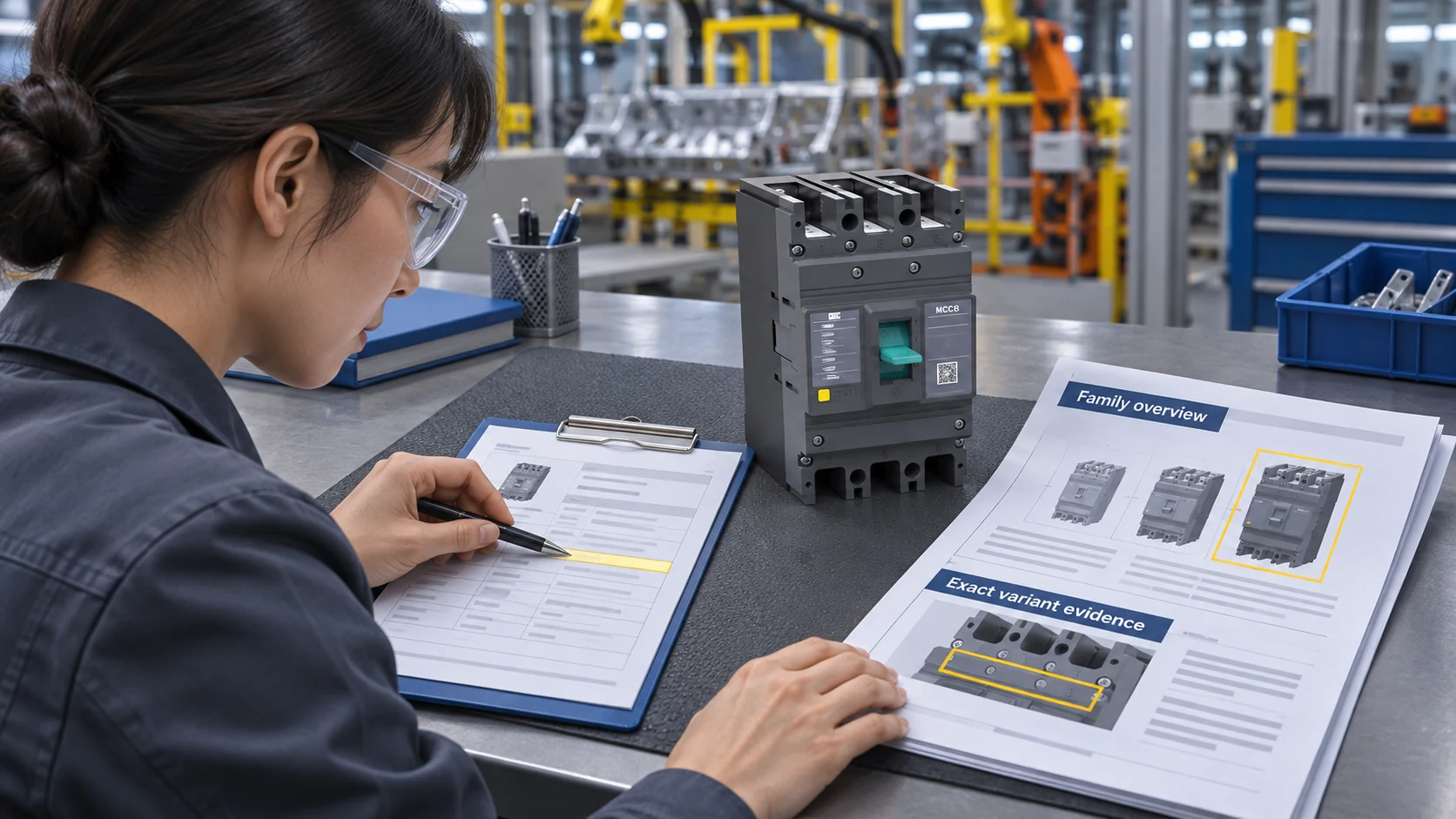
Put the required behavior in the technical enquiry, then reconcile the quotation, ordering code and supporting documents. A family name or general product description is insufficient where releases and operating arrangements differ.
| Decision input | Evidence to request | Acceptance question |
|---|---|---|
| Exact configuration | Ordering code, poles, frame and release identification | Does the evidence cover the quoted variant? |
| Trip-free requirement | Manufacturer declaration and applicable test documentation | Is opening independent of maintained ON input explicitly confirmed? |
| Operating arrangement | Instructions for the specified handle or operator | Is the complete arrangement covered? |
| Post-trip handling | Model-specific reset and inspection instructions | Are reset prerequisites and indications defined? |
| Electrical duty | Ratings and protection characteristics | Do they match the circuit requirements independently of trip-free behavior? |
The CHAC CQM7 product information distinguishes frames, breaking-capacity options and release configurations. Use those distinctions to frame an enquiry, not to infer trip-free performance or accessory compatibility. Request confirmation for the exact proposed combination.
Frequently asked questions
What does trip-free operation mean in a circuit breaker?
It means the mechanism permits the main contacts to open when tripping operates, independently of a continued manual ON input. It describes mechanical operating behavior, not the breaker’s complete protection specification.
Can holding the handle ON prevent a trip-free breaker from opening under a trip condition?
No, not in its intended operation: maintained handle force must not defeat protective opening. Do not restrain the handle or create a fault to check this; seek documented verification.
How does the operating handle differ from the internal contact mechanism?
The handle supplies an operating command, while the internal mechanism moves and releases the contacts. Handle markings, trip indication and contact-position indication may communicate different information; consult the model instructions.
Does trip-free operation mean that a breaker can never fail?
No. It does not eliminate wear, damage or application limits. Correct ratings, installation conditions, inspection and maintenance remain necessary, and a suspected malfunction requires qualified assessment.
How does trip-free operation differ from automatic reclosing?
Trip-free concerns opening despite an ON input. Automatic reclosing concerns a subsequent closing command from a separate control function. Neither function establishes the presence or suitability of the other.
What reset sequence should be checked after a breaker trips?
Check the exact manufacturer's prescribed sequence, including any required reset position, inspection prerequisites and release-specific conditions. Do not assume a universal procedure or repeatedly attempt closure before the trip cause has been assessed by qualified personnel.
Which model documentation should confirm the required trip-free behavior?
Obtain the exact variant’s operating instructions, technical declaration and applicable test or conformity documentation. They should identify the release and operating arrangement and explicitly support the required behavior; a catalogue family heading or standards reference alone is insufficient.
Treat trip-free operation as a specific requirement alongside—not instead of—electrical duty and protection selection. Send the ordering configuration, operating arrangement and required documentary evidence through CHAC’s technical enquiry channel for review before treating any proposed model as confirmed.