When Omar, a facilities manager in Dubai, watched a rooftop unit pull in late and then drop out during an afternoon cooling call, his team first suspected the compressor. A voltage check at the energized coil and an inspection of the contactor reversed that diagnosis: rooftop heat, unstable control voltage, and worn poles were causing the switching failure.
ملخص: The most important AC contactor failure symptoms are buzzing, chattering, delayed pull-in, welded or badly pitted contacts, overheating, and equipment that runs intermittently. These signs often reveal a circuit or application problem rather than one defective part. IEC 60947-4-1 distinguishes utilization categories such as AC-1 and AC-3 because load behavior changes contact stress. Diagnose the root cause before replacement, then verify coil rating, voltage under load, switching frequency, terminal condition, and actual duty.
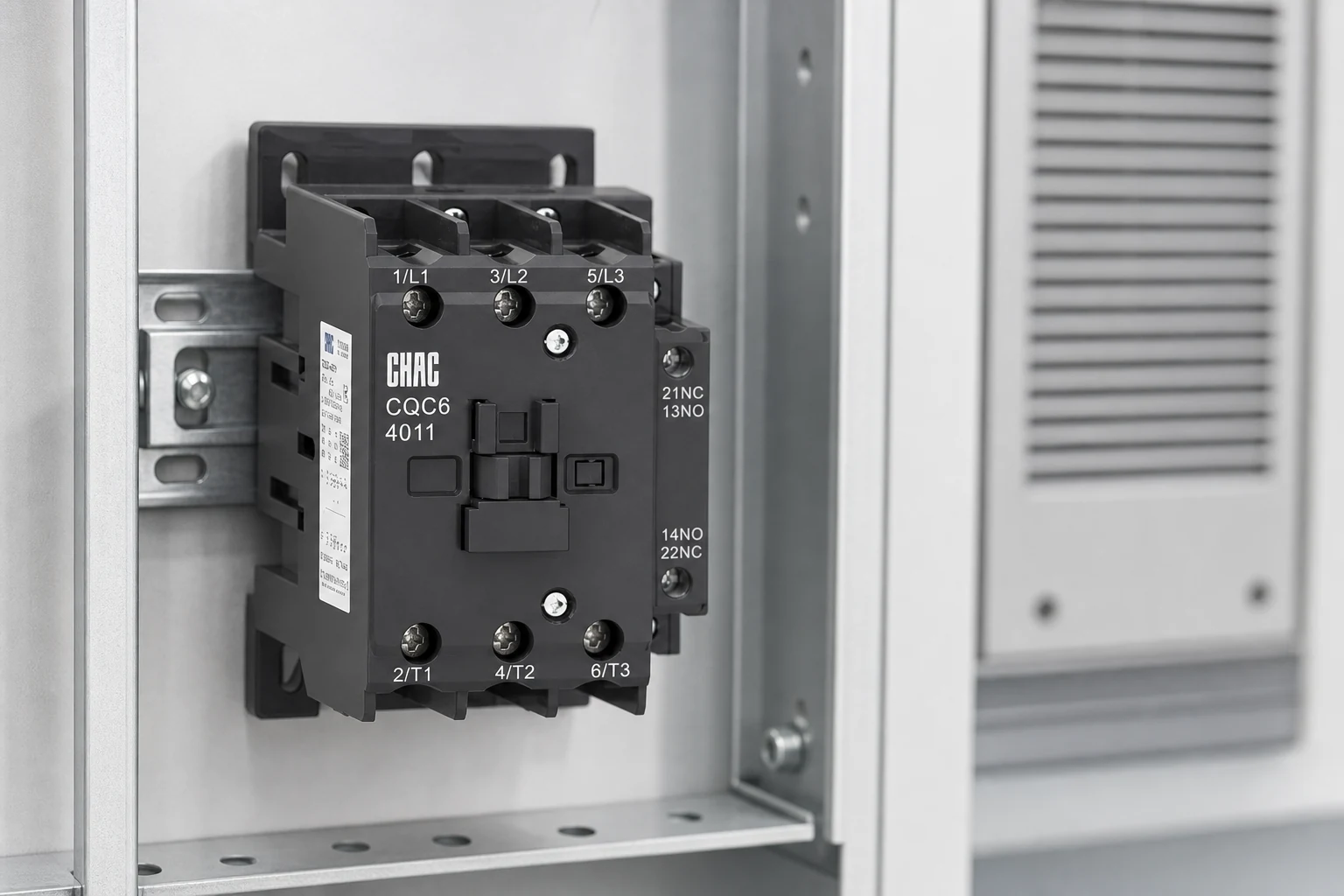
An AC contactor switches motors, compressors, fans, heaters, and other recurring loads. This guide to how a contactor works in HVAC is a useful refresher. The practical goal is to recognize a symptom early enough to prevent repeat calls and equipment downtime.
What the first symptoms usually look like
In HVAC contactor troubleshooting, audible instability is often the first clue. A healthy contactor normally makes one decisive pull-in sound. If the coil buzzes or chatters, the cause may be low control voltage, contamination on the magnetic faces, loose hardware, or reduced coil pull force. In an AC magnet, a cracked or broken shading ring can also prevent the armature from holding smoothly as the current passes through zero. A noisy assembly therefore does not automatically prove contactor coil failure.
Another symptom is delayed pull-in or dropout under load. A rooftop unit may start normally in the morning and fail later as solar gain and condenser heat raise the compartment temperature. Higher coil resistance and lower available control voltage reduce pull-in margin, exposing a weak transformer, long control wiring, loose connections, or marginal controller output. Repeating the check under the hot operating condition is more useful than relying on a cold reading.
Visible damage needs interpretation. Severe erosion, welded faces, or one pole carrying more damage can indicate load imbalance, excessive inrush, short cycling, or the wrong utilization category. Confirm with voltage and phase-current measurements, then isolate the equipment for coil-resistance and contact checks. Appearance alone cannot identify the root cause.
Why the symptom often points beyond the contactor
Many failures begin upstream. A correctly marked coil can still behave badly if the voltage at its terminals collapses during pull-in. Measure control voltage across the coil while the circuit is commanded on, because an open-circuit transformer reading can look normal while a high-resistance connection or overloaded transformer fails under load. Contactor coil failure is often the end result, not the starting cause.
A contactor may pass a bench check but fail in service because of vibration, loose control connections, a worn return mechanism, or contact bounce. Auxiliary-contact bounce is easy to overlook: the main poles may close while unstable feedback creates false status signals, PLC alarms, or repeated restart commands. Monitor feedback through an operating cycle to separate power-pole and control-logic faults.
If overheating or insulation damage appears in a mixed control panel, check overcurrent and control-circuit protection as well as the contactor. CHAC’s article on RCD wiring and electrical safety standards explains why residual-current protection differs from overload and short-circuit protection.
| Observed symptom | Likely technical cause | Business risk | Useful field check |
|---|---|---|---|
| Buzzing or chattering coil | Undervoltage, dirty magnetic faces, coil wear, loose wiring, or damaged shading ring | Stoppage, heat, and faster contact wear | Measure loaded coil voltage; inspect the magnet after isolation |
| Contactor pulls in late | Weak transformer, long wiring, high-resistance connection, or enclosure heat | Late starts and process instability | Compare cold and hot loaded voltage |
| One pole badly pitted | Load imbalance, motor inrush, wrong duty category | Load damage from poor switching | Inspect all poles and verify the IEC 60947 utilization category |
| Contacts welded closed | Short-circuit stress, arcing, underspecified making capacity | Load may not de-energize | Isolate and find the cause before replacement |
| Overheated terminals or housing | Loose termination, conductor mismatch, overload | Shutdown and enclosure damage | Thermal scan and termination check |
| No pull-in | Open coil, missing signal, failed interlock, blown control fuse | Equipment outage | Check the command path, fuse, and coil resistance |
What buyers should verify before replacement
Replacement should start with the application, not frame size. IEC 60947-4-1 distinguishes categories such as AC-1 for non-inductive or slightly inductive loads and AC-3 for squirrel-cage motor starting and switching off while running. These duties impose different making and breaking conditions, so a look-alike contactor may be unsuitable.
Switching frequency is another missed specification. Frequent starts, short cycling, or jogging consume electrical life faster, while mechanical-life figures do not describe wear under load. Record starts per hour and the operating sequence. Also document voltage fluctuation, dust, vibration, and rooftop heat.
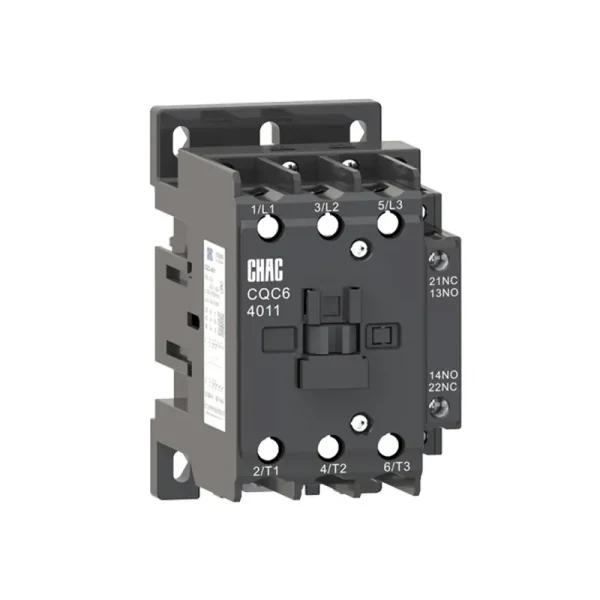
This is where a correctly specified HVAC contactor أو high-duty AC contactor becomes relevant. CHAC is one sourcing option, not a substitute for application review. Compare coil voltage, rated current, utilization category, switching frequency, auxiliary contacts, terminals, and technical documentation before standardizing a part number.
| Replacement dimension | What to verify | Why it is often missed | Commercial consequence if ignored |
|---|---|---|---|
| Control voltage | Coil rating and voltage at pull-in | Loaded voltage is often missed | Chatter, dropout, or coil burnout |
| Load category | AC-1, AC-3, or the relevant actual duty | Frame size gets priority | Short life and repeat failure |
| Switching frequency | Starts per hour and sequence | Daily averages hide intensive periods | Unexpected maintenance and downtime |
| بيئة | Heat, dust, moisture, vibration | Rooftop severity is underestimated | Derating and unstable operation |
| Auxiliary logic | Status, interlock, and feedback needs | Main poles get the attention | False alarms or sequence faults |
| Termination and documentation | Conductors, torque, drawings, evidence | Price and delivery lead | Errors, disputes, slower approval |
How standards and maintenance checks reduce service risk
For international buyers, IEC 60947-4-1 covers contactors and motor-starters, while IEC 60947-1 supplies general rules for low-voltage switchgear and controlgear. In North America, UL 508 covers industrial control equipment, and NFPA 70 addresses electrical installation requirements. Their scopes are not interchangeable: a product standard defines device requirements and tests, while an installation code governs how equipment is applied in the field.
Maintenance teams should also separate symptom confirmation from compliance claims. Infrared thermography, under-load voltage checks, insulation assessment where appropriate, and contact inspection are maintenance methods; they do not create product certification. Any conformity claim should be supported by documentation that matches the destination market, exact model, and intended application.
The commercial risk is straightforward: replacing a failed contactor without correcting undervoltage, excessive heat, a loose termination, or duty mismatch invites the same outage to return. Record the symptom and operating condition, confirm the root cause, then specify the replacement against the load profile, environment, switching frequency, and documentation requirements.
Questions buyers ask about AC contactor failure symptoms
What are the most common AC contactor failure symptoms?
The usual signs are buzzing, chattering, delayed pull-in, overheating, visible contact pitting, welded contacts, and loads that start or stop unpredictably. Treat the symptom as a starting point, then confirm whether the cause is the contactor itself or the surrounding voltage, load, wiring, or operating environment.
Can a contactor fail intermittently?
Yes. Intermittent failure can occur when control voltage sags under load, rooftop panel temperature rises, or vibration affects terminals or auxiliary contacts. Test during the condition that triggers the fault; a cold static inspection may not reproduce it.
Does buzzing always mean the coil is bad?
No. Buzzing may come from undervoltage, contamination, magnetic-face wear, mechanical looseness, or a cracked shading ring rather than a failed coil. Check voltage across the energized coil, then isolate the circuit before resistance and mechanical inspection.
Is welded contact damage a safety issue?
Yes. A welded contactor may keep a motor, heater, or compressor energized after the control signal has been removed. Isolate the equipment and investigate the cause before installing a new unit.
Should buyers replace a contactor with the same model every time?
Only if the original specification was correct and the root cause was normal end-of-life. If the application has frequent cycling, high ambient temperature, a changed load, or a mismatch between coil rating and measured control voltage, review the specification before choosing the replacement.
Official references
- IEC, IEC 60947-4-1, Low-voltage switchgear and controlgear – Contactors and motor-starters.
- IEC, IEC 60947-1, Low-voltage switchgear and controlgear – General rules.
- UL, UL 508, Standard for Industrial Control Equipment.
- NFPA, NFPA 70, National Electrical Code, and NFPA 70B, Standard for Electrical Equipment Maintenance.
The lasting takeaway is simple: AC contactor failure symptoms are valuable only when they lead to a root-cause decision, not a reflex part swap.
If your team is comparing replacement options for HVAC or industrial control assemblies, review CHAC’s contactor range against the load category, measured control voltage, switching frequency, environment, and documentation needs, then contact CHAC before standardizing the next order.