Choosing a DIN-rail indicator light is a panel-documentation decision before it is a purchasing decision. The lamp must match the control circuit, the status that it is meant to report, and the space available in the enclosure. A light across a supply proves voltage at its sensing point; it does not automatically prove that a contactor has closed or that a machine is running.
What should the indicator prove to the operator?
Start with the approved schematic or I/O list. Write down whether the indication means control power present, motor command active, contactor feedback, a trip state, or another defined condition. This distinction prevents a bright lamp from creating false confidence when the sensing point is upstream of a failed device.
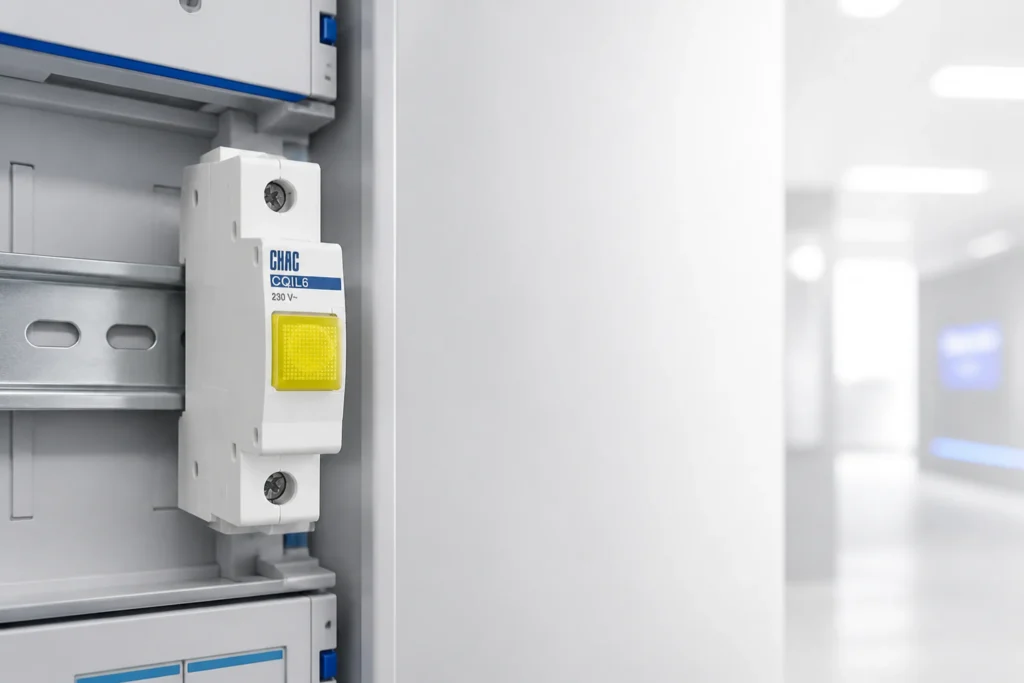
For a product discussion, CHAC’s DIN-rail indicator light page is a starting point for model-specific mounting and electrical information. The exact voltage, AC/DC type and terminal arrangement still belong to the selected datasheet.

Which electrical and mounting details must be checked first?
Record the control-circuit voltage, frequency where relevant, AC or DC supply, polarity requirements, expected ambient conditions, rail or cut-out arrangement, enclosure depth and the clearance needed for wiring and replacement. Do not infer any of these from a catalogue photograph.
LED technology can reduce power demand, but electronic outputs may have leakage current or polarity limits. Confirm that the indicator is compatible with the output device and that its visibility remains adequate under the panel’s normal lighting conditions.
How should colour and legend map to the control drawing?
Use one project legend for power, running, fault and service states, then repeat the same wording in the schematic, panel labels and maintenance documents. For machinery, consult the applicable edition of IEC 60204-1 information and the project’s local requirements; colour conventions are not a substitute for a named signal.
Where do labelling and service access affect the choice?
Check whether the lamp can be read from the normal operator position, whether its legend remains visible after the door is closed, and whether a failed unit can be replaced without disturbing adjacent conductors. Include the replacement method in the panel layout rather than leaving it to site work.
What should a buyer send with a quotation request?
Include the circuit schedule, signal meaning, supply voltage and type, mounting format, colour legend, quantity, ambient constraints and the documents required for approval. That compact brief is more useful than asking for a generic lamp catalogue.
Which CHAC product route should a panel builder review?
Use the low-voltage product range to compare related panel accessories, then confirm the exact indicator model and drawing against the application. If the panel also needs signalling contacts or modular accessories, keep those functions as separate line items in the schedule.
Where does indicator selection stop and machine safety begin?
An indicator is a reporting interface, not proof of a safe state. Critical interlocks, feedback circuits and fault detection need their own design evidence. Freeze the lamp schedule only after the status map and enclosure layout have been reviewed by the responsible designer.
A final panel status indication review should confirm that every lamp has one named source signal, one legend and one documented failure response.
For a related selection reference, see DIN Rail Indicator Light Selection.
Continue with this related guide: Voltage Protector Keeps Tripping How.
FAQs
Is a DIN-rail indicator light a protection device?
No. It is a status indication device unless the project design documents a different verified function.
Can color selection ignore the control drawing?
No. Color and legend must map to named statuses on the approved drawing or IO list.
What mounting details should buyers confirm?
Confirm rail or panel cut-out preference, enclosure depth, front access, and replacement constraints from the assembly drawing.
Which voltage information belongs in the RFQ?
State the control-circuit voltage and any interface constraints required by the selected indicator documentation.
Why request model documentation for a lamp?
Lens, voltage, terminals, and environmental limits are model-specific and should not be inferred from a category photo.
When should the final indicator schedule be frozen?
Freeze it after the status map and enclosure layout are approved, and before the panel bill of materials is released.