Kalkulator Ukuran Pemutus Sirkuit DC
Hitung arus desain DC dan lakukan pemeriksaan terhadap pemutus arus yang dimasukkan berdasarkan kapasitas kabel, tegangan sumber maksimum, kemampuan menahan gangguan DC, serta konfirmasi pengkabelan tiang.
Hitung arus desain DC dan bandingkan pemutus arus yang dimasukkan dengan kapasitas kabel, tegangan sumber maksimum, dan arus gangguan potensial.
Hasilnya
Nilai arus DC referensi
50.00APemeriksaan numerik telah terpenuhi; kabel DC masih belum diverifikasi.I = P × 1,000 / V; Idesign = I × faktor; In ≥ Idesign dan In ≤ IzNilai rating yang dibulatkan merupakan referensi umum, bukan pemilihan model CHAC. Gunakan data pemutusan arus searah untuk tegangan dan susunan tiang yang sebenarnya. Jangan mengalikan tegangan per tiang dengan jumlah tiang tanpa adanya diagram yang telah disetujui.
Mengapa hasil ini?
Formula dan metode
Hitung arus desain DC dan lakukan pemeriksaan terhadap pemutus arus yang dimasukkan berdasarkan kapasitas kabel, tegangan sumber maksimum, kemampuan menahan gangguan DC, serta konfirmasi pengkabelan tiang.
Cara menggunakan kalkulator ini
- Masukkan daya listrik DC input yang sebenarnya dan tegangan operasi. Gunakan tegangan sumber maksimum untuk pemeriksaan tegangan perangkat.
- Masukkan nilai-nilai dari pemutus arus yang sesuai dan kapasitas kabel yang telah dikoreksi.
- Konfirmasikan polaritas, sambungan kutub, dan beban gangguan arus searah dengan menggunakan diagram pabrikan serta data pemutusan.
Batas perhitungan
Tidak menghitung arus gangguan baterai/panel surya, tegangan rangkaian terbuka panel surya pada kondisi dingin, konstanta waktu, arus susulan, atau arus yang dapat dilewati dengan pembatasan arus. Seri arus generik bukan merupakan pernyataan ketersediaan produk.
Perencanaan ukuran pemutus sirkuit DC: arus, tegangan, dan daya patah arus
Pemilihan pemutus sirkuit DC memerlukan lebih dari sekadar nilai arus beban. Tegangan maksimum sumber baterai atau PV dapat melebihi tegangan nominal, dan kemampuan pemutusan yang dinyatakan berlaku untuk tegangan DC tertentu, susunan kutub, serta jenis beban sirkuit yang spesifik.
Catatan masukan
| Masukan | Apa yang harus diperiksa |
|---|---|
| Daya dan tegangan operasi | Masukkan daya listrik arus searah (DC). Kalkulator membagi daya masukan dalam watt dengan tegangan operasi; kalkulator tidak memperkirakan efisiensi konverter atau motor. |
| Tegangan sumber maksimum | Gunakan tegangan sirkuit maksimum untuk perbandingan tegangan perangkat. Tegangan rangkaian terbuka (Voc) pada panel surya dan batas pengisian baterai harus ditetapkan secara terpisah. |
| Data arus, gangguan, dan kabel | Gunakan kapasitas kabel yang telah dikoreksi dan rating perangkat DC yang sebenarnya. Tandai diagram kutub/polaritas hanya setelah meninjau instruksi produsen secara tepat. |
Contoh kerja · nilai awal formulir
Beban DC 2 kW pada rangkaian 48 V
Faktor 1.00 · sumber maksimum 60 V · kandidat 50 A / 125 V DC / 10 kA · kabel Iz 63 A · gangguan 6 kA
I = 2,000 / 48 = 41.67 A; peringkat generik berikutnya yang terdaftar adalah 50 A.
41.67 A ≤ 50 A ≤ 63 A; 60 V ≤ 125 V; 6 kA ≤ 10 kA.
50.00 A
Pemeriksaan numerik pada contoh telah terpenuhi. Polaritas dan pengkabelan tiang seri masih belum diverifikasi pada pengaturan awal, sehingga alat tersebut tidak memberikan persetujuan yang lengkap.
DC breaker sizing from watts and operating voltage
For a DC load specified by electrical input power, current is I = P / V. A 2,000 W load at 48 V draws approximately 41.67 A. Apply the sizing factor required by the actual design, then compare the resulting design current with the protective device and corrected cable capacity.
The default factor of 1.00 is an example, not a universal installation allowance. If the load specification gives output power, account for conversion losses before entering electrical input power. Inrush, continuous duty and temperature can also affect the final device choice.
Solar DC circuit breakers: nominal voltage is not enough
A solar DC circuit breaker must be assessed against the array’s maximum circuit voltage, not just its nominal operating voltage. Establish cold-condition string open-circuit voltage separately. PV circuit protection also needs array and module data, including the relevant current and reverse-current conditions.
Battery circuits need the same distinction between normal operating voltage and maximum source voltage, together with a prospective fault-current assessment. This tool accepts those established values; it does not calculate PV string voltage or battery short-circuit current.
Check the DC rating and the permitted pole connection together
DC interruption capability belongs to a stated voltage and test duty. An AC breaking rating cannot establish DC suitability, and two poles do not automatically double the allowable voltage. Use the manufacturer’s exact series-pole and polarity diagram.
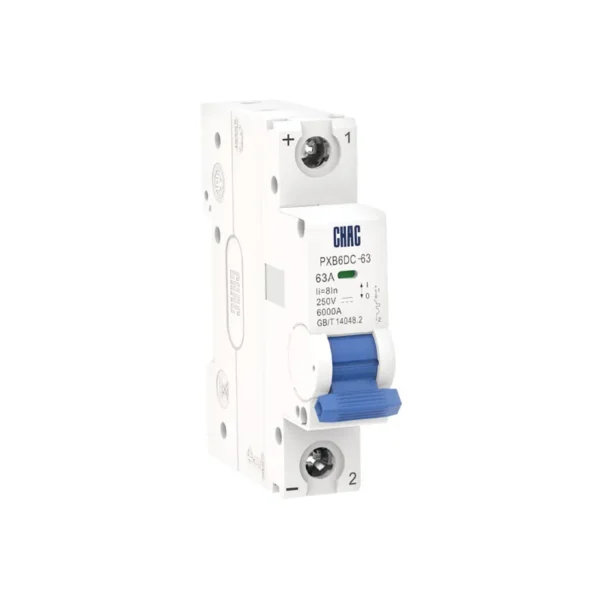
For PXB6DC-63, review the published DC voltage limits and connection requirements for the intended arrangement. The calculator’s generic ampere result is a rating reference, not a selected PXB6DC-63 model. Confirm the declared breaking capability at that voltage before accepting the numeric comparison.
Use the exact DC connection data
- Do not infer DC suitability from an AC breaking rating. Do not multiply a per-pole voltage by pole count unless the exact manufacturer diagram permits that arrangement.
- Starting current, circuit time constant, current-limiting energy, upstream/downstream coordination and maximum source voltage require the relevant circuit study and product data.
Pertanyaan yang sering diajukan
Why enter both operating and maximum source voltage?
Operating voltage is used for the load-current estimate. Maximum source voltage is used to check the device’s DC voltage duty.
Does the 50 A result select PXB6DC-63?
No. It is a generic rounded current reference. A product choice also needs the exact DC voltage, pole diagram, fault duty and installation data.
Can this calculate battery short-circuit current?
No. Prospective fault current is an input from a suitable study or source data. Battery impedance, state of charge and connections are not modeled here.
Does the sizing factor always need to be 1.25?
No universal multiplier is applied. Use a factor justified by the relevant circuit duty and installation rules.
Can this size a solar DC circuit breaker from panel watts alone?
No. A PV design also needs string voltage under the relevant temperature conditions, array currents, module limits and connection details. Enter verified circuit values; a watts-to-amps calculation does not establish the complete PV protection requirement.
Is a 48 V battery circuit always below 48 V?
No. Operating and charging conditions can produce a higher voltage. Use the established maximum battery-system voltage when checking the DC breaker’s voltage rating, and operating voltage for the current estimate.
Perlu bantuan memilih produk CHAC?
Sertakan tegangan sistem, arus beban, dan kondisi pemasangan dalam pertanyaan Anda.
Contoh aplikasi · Masukan ilustratif
Reviewing a 48 V DC feeder against PXB6DC-63 data
A 3 kW DC load at 48 V draws 62.50 A, giving a 63 A reference with the factor set to 1.00. The CHAC PXB6DC-63 table includes 63 A, lists DC125V among its 1P voltage options, and declares 10 kA Icu and 7.5 kA Ics. For this example, a 60 V maximum system voltage and 5 kA fault level can be compared with those entered ratings. The result still leaves the exact voltage variant, pole diagram and source fault behavior to verify. A constant-power load operating below 48 V also needs a higher-current check.
Data produk: PXB6DC-63 Pemutus Sirkuit Miniatur DC
Produk CHAC terkait
Compare DC breaker ratings with the circuit voltage, current, fault level and pole arrangement.