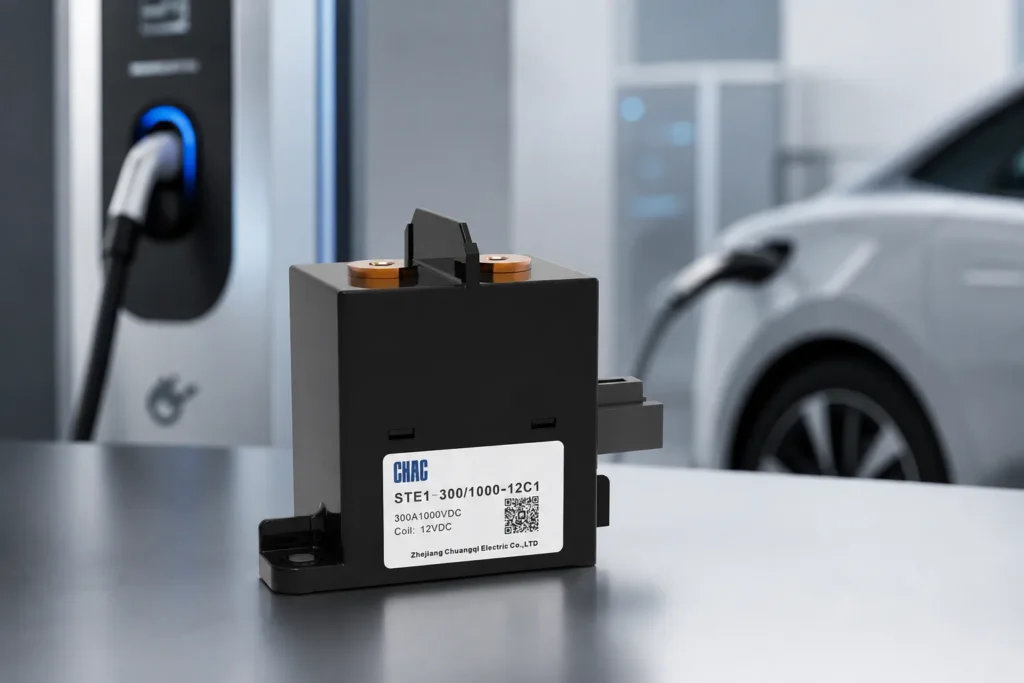
Uma corrente contínua de alta tensão contator A solicitação de cotação para carregamento de veículos elétricos inicia-se com o sistema de corrente contínua e com os dados técnicos do modelo selecionado, e não com o nome da família. O registro do painel ou do carregador deve descrever a aplicação, o tratamento da polaridade da carga, a alimentação do enrolamento, os requisitos auxiliares, o contexto de montagem e os documentos que o fornecedor deve devolver.
Conteúdos
Parte 1. Comece pelo sistema DC em vez de uma família de contatoras
A seleção de contator CC de alta tensão para carregamento de veículos elétricos começa com o levantamento das especificações do sistema: contexto do barramento CC, função do circuito, regime de serviço exigido e o ponto em que o contator será instalado. Esses dados tornam a cotação passível de análise e evitam que uma designação genérica se transforme em um substituto não testado do projeto real.
O desenho também deve identificar a interface de controle e quaisquer requisitos de monitoramento. Em conjunto, essas informações constituem a base para uma análise do modelo selecionado, em vez de uma suposição sobre a adequação do carregador.
Parte 2. Separe a tarefa contínua da revisão de interrupções
Os requisitos de operação contínua e as questões relacionadas a interrupções devem ser mantidos como campos de análise distintos. O sistema, o modelo selecionado e os requisitos aplicáveis do projeto determinam quais evidências são necessárias para cada um; uma descrição genérica de marketing não pode suprir essa lacuna.
Documente a função do circuito, as condições de operação solicitadas e os registros do dispositivo selecionado que devem acompanhar a resposta do fornecedor. O sistema de normas IEC fornece o contexto documental, enquanto as informações do projeto e do modelo selecionado permanecem como referência definitiva.
Importante: Um campo de tensão ou corrente contínua listado, por si só, não aprova um contatores para um sistema de carregamento de veículos elétricos. Mantenha a documentação relativa à classificação de serviço do sistema e ao modelo selecionado reunida durante a análise.Catálogo de documentos de comutação CC da IEC — contexto de evidência do modelo selecionado)
Parte 3. Coloque os requisitos de polaridade, bobina e sinal em uma única folha de revisão.
A solicitação de orçamento torna-se mais robusta quando cada requisito do lado do controle e do lado da carga possui uma especificação clara. Evite colocar polaridade da carga in one drawing note, coil supply in an email, and auxiliary signal needs in a later change order.
| Campo de avaliação | What the buyer should state | O que o fornecedor deve devolver |
|---|---|---|
| DC system and circuit role | Drawing reference and equipment boundary | Proposed model tied to the stated review scope |
| Required duty | Conditions that require selected-model review | Documentation addressing the requested conditions |
| Load-polarity treatment | What the drawing requires for the load connection | Selected-model polarity information |
| Coil supply | Available control supply and interface context | Coil-related information for the proposed model |
| Auxiliary requirement | Needed status or control signal | Published auxiliary-contact information where applicable |
| Mounting and thermal context | Enclosure and environment information to review | Informações e limites de instalação declarados |
Treat this sheet as an evidence index. It does not create an EV charging architecture or select a model without the exact project conditions.
Parte 4. Leia a tabela do modelo selecionado sem considerá-la como aprovação.
The public STE3 product route presents model rows with working-voltage, working-current, load-polarity, coil-polarity, and auxiliary-contact fields. These fields are useful for narrowing a supplier conversation, but the chosen row and project conditions must still be checked before a BOM is released.
The practical rule is to compare each proposed row against the RFQ sheet, then request the documents required by the project. Do not derive a charger approval, interruption result, or local acceptance from a single published field.
For adjacent DC-selection context, see the battery and DC distribution MCB guide e o DC MCB compatibility evidence guide.
Parte 5. Envie uma RFQ de contator EV que mantenha evidências comparáveis
Send the current system drawing, circuit role, requested duty description, polarity treatment, coil supply, auxiliary requirement, mounting context, required documents, and any branding request. Ask each supplier response to identify the selected model and the evidence used for the comparison.
O high-voltage DC contactor category is the upward product-family route. The broader gama de aparelhos eléctricos de controlo industrial can help when the equipment review includes related control components.
Parte 6. Utilize o trajeto do contator CC de alta tensão CHAC para a revisão do modelo.
After the RFQ evidence is complete, use the STE3 high-voltage DC contactor product route to begin a selected-model discussion. Its published table is a useful starting point for comparing stated model fields to the project record, not a blanket EV charger recommendation.
Recomendação de produto
STE1 Series High-voltage DC contactor (Square Ceramic Sealing)STE1 Series High-voltage DC contactor (Square Ceramic Sealing) – CHAC Electric
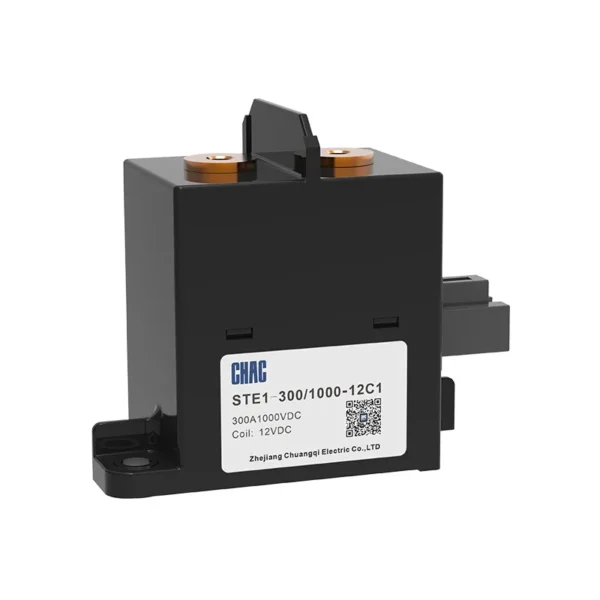
Use the STE3 route when the buyer can supply the DC system and evidence sheet. Do not choose another model merely by family name: working voltage, current, load polarity, auxiliary requirement, and project duty need confirmation for the selected row. OEM and documentation needs can be raised through the industrial-control customization page.
Parte 7. Defina o limite de ajuste antes de liberar um BOM
This guide supports early EV-charging equipment sourcing and document comparison. It does not provide charger architecture, live-work direction, protection coordination, local approval, or a final release decision for a contactor model.
Fit Boundary: retain final choice with the approved system drawing, selected-model documents, applicable project requirements, and qualified engineering review. Share the RFQ evidence with CHAC Elétrico when requesting a documented product route.
Which DC contactor inputs affect an EV charging design?
A Contator de alta tensão DC request needs more than nominal voltage and current. The RFQ should identify continuous and transient duty, load polarity, switching frequency, pre-charge sequence, auxiliary feedback, environmental conditions and the fault-management strategy. The vehicle, battery and charger documentation must agree before a model is approved.
| Entrada de RFQ | Por que é importante | Evidência a solicitar |
|---|---|---|
| DC voltage and current | Defines the electrical duty and thermal review | System limits and model ratings |
| Pre-charge sequence | Controls inrush before the main path closes | Timing, voltage criterion and failure response |
| Feedback and interlock | Prevents the controller from assuming a contact is closed | Auxiliary-contact logic and wiring diagram |
O EV charging contactor decision is part of the complete control sequence, not a timer copied from another system. The useful check is DC contactor pre-charge: define the voltage or diagnostic condition that permits main-contact closure. CHAC’s STE2 high-voltage DC contactor page can support a model discussion; exact switching duty remains product-specific.
Can a high-voltage DC contactor be selected from continuous current alone?
No. Interrupting and making duty, inrush, polarity, pre-charge, ambient conditions and fault response also need review.
Does a pre-charge timer prove that the DC link is ready?
No. A timer is only one control input. The system should define the voltage or diagnostic condition that permits main-contact closure and the action taken on timeout.
FAQs
What does a high-voltage DC contactor do in an EV charging system?
It is reviewed as part of a defined DC circuit role. The project drawing and selected-model documents establish the actual function and suitability.
Which voltage and current fields must be reviewed?
State the DC system requirements and requested duty, then compare them with the exact selected-model information rather than a product-family summary.
Why does load polarity need to be checked?
Load-polarity treatment is a model and system review input. Put the drawing requirement in the RFQ so the supplier can respond against the correct context.
What coil supply information should be sent to a supplier?
Provide the available control supply and interface context shown on the current design. Ask for selected-model coil information in the supplier response.
When is an auxiliary contact required?
List it whenever the charger or panel design needs a defined status or control signal. The selected model must document the requested arrangement.
What documents should accompany an EV contactor RFQ?
Include the system drawing, circuit role, duty description, polarity requirement, coil supply, auxiliary need, installation context, and the evidence expected for the proposed model.