A análise comparativa entre disjuntores diferenciais tipo AC e tipo A inicia‑se pelas características de corrente residual esperadas do circuito, e não por uma imagem do produto ou por um rótulo familiar. Um registro de cargas, o desenho aprovado do quadro elétrico, a sensibilidade requerida e a documentação do modelo selecionado fornecem à equipe responsável pelo quadro de distribuição as informações necessárias para comparar os dois tipos, sem que nenhum deles seja considerado automaticamente como a escolha padrão do projeto.
Parte 1. Comece com as características de corrente residual do circuito
A primeira questão não é qual rótulo soa mais abrangente. Trata-se de quais características de corrente residual a documentação do circuito espera que o dispositivo atenda. A lista de cargas, o quadro de circuitos, a configuração de alimentação e o registro do equipamento selecionado transformam essa questão em uma solicitação técnica passível de revisão.
Para um comprador de painéis elétricos, isso significa manter o escopo elétrico claramente definido antes do início da comparação de preços. Uma solicitação que menciona apenas “Tipo A” ou “Tipo AC” deixa ao fornecedor a tarefa de inferir a carga, a sensibilidade e os limites do circuito. Em vez disso, o desenho e a descrição da carga devem indicar claramente por que aquele tipo está sendo considerado.
Parte 2. O que os rótulos Tipo AC e Tipo A fazem em uma revisão
O Tipo AC e o Tipo A identificam diferentes características de detecção de corrente residual. O Tipo A está associado a circuitos que apresentam corrente contínua pulsante. corrente residual Deve ser levado em consideração; o modelo selecionado, as evidências do circuito e os requisitos aplicáveis do projeto ainda determinam o que fará parte do projeto final.
Assim, a etiqueta constitui apenas um elemento de um conjunto mais amplo de evidências, e não uma abreviatura da aprovação da instalação. A documentação do fabricante e o sistema de normas IEC são fontes úteis para localizar o registro do dispositivo selecionado, enquanto o projeto aprovado continua a ser a referência para o próprio circuito.
Importante: Uma etiqueta do Tipo AC/Tipo A nunca deve substituir o requisito documentado do circuito. Revise o registro de carga e a documentação técnica específica do produto antes de finalizar a seleção do tipo.Publicações da Loja Virtual da IEC — contexto do documento de normas)
Parte 3. Compare as evidências antes de selecionar um tipo
Colocar ambas as rotas ao lado das mesmas questões de revisão evita que uma descrição abrangente da família de produtos se torne uma suposição do projeto. A tabela serve como auxílio à comparação, e não como um diagrama de fiação ou uma regra definitiva para a seleção do tipo.
| Rever entrada | Tipo de rota de revisão AC | Tipo A de rota de revisão |
|---|---|---|
| Descrição do circuito e da carga | Identifique as características de corrente residual especificadas no desenho e no registro de carga. | Identifique as características de corrente residual especificadas no desenho e no registro de carga. |
| Solicitação de tipo de dispositivo | Registre a marcação do Tipo AC solicitada e as evidências do modelo selecionado. | Registre a marcação do Tipo A solicitada e as evidências do modelo selecionado. |
| Sensibilidade | Indique a sensibilidade de corrente residual exigida para revisão. | Indique a sensibilidade de corrente residual exigida para revisão. |
| Fornecimento e postes | Correlacione o arranjo de fornecimento e os requisitos do poste com o registro do modelo. | Correlacione o arranjo de fornecimento e os requisitos do poste com o registro do modelo. |
| Supplier documents | Ask for the exact product identification and documentation | Ask for the exact product identification and documentation |
An evidence-led comparison also keeps product fields in their proper place. The residual-current type request needs to stay beside sensitivity, supply arrangement, and pole requirement, because a type label does not answer those other questions on its own.
Parte 4. Conecte o registro de carga à solicitação do fornecedor
Give the supplier the circuit record that made the type comparison necessary. A current drawing revision, load description, requested residual-current type, requested sensitivity, supply arrangement, and current requirement let the response be checked against the same information used by the panel team.
| Evidências a fornecer | Por que isso é relevante para a cotação | Resposta para comparar |
|---|---|---|
| Panel drawing and revision | Shows the circuit boundary and supply arrangement | Proposed model matched to the identified circuit |
| Load description | Makes the residual-current-type question explicit | Type marking and selected-model documentation |
| Requested sensitivity | States the protection field to be reviewed | Product record matching the request |
| Pole and current requirement | Connects the device route to the panel record | Campos do modelo selecionado publicados |
| Contexto de instalação | Identifies conditions that need confirmation | Stated limits and documentation requested |
For sensitivity-specific context, use the related Guia de seleção do RCCB 30mA versus 10mA. Disposição de polos is a separate drawing review, covered in the two-pole versus four-pole RCCB panel review.
Parte 5. Torne uma cotação de RCCB revisável
A supplier request should name the information to return, not only the product family to search. Ask for the proposed model, its residual-current type marking, the documents used for comparison, and a response tied to the current drawing revision.
| Incluir com o pedido de cotação | O que é que resolve | Resposta do fornecedor a solicitar |
|---|---|---|
| Current panel drawing | Circuit boundary and supply arrangement | Proposed model identified against the drawing |
| Load record and requested type | Reason for the Type AC or Type A comparison | Selected-model type documentation |
| Sensitivity and current requirement | Electrical fields that must be reviewed | Published fields for the proposed product |
| Pole requirement | Device arrangement to compare | Model-specific pole information |
| Required documentation | A traceable technical response | Identificação do produto e registos solicitados |
O RCCB category is the appropriate upward product-family context, while the gama de aparelhos elétricos terminais helps when the panel includes related components. The choice between an RCCB and an RCBO remains a different function question, discussed in the RCBO versus RCCB selection boundary article.
Parte 6. Use a rota CHAC RCCB após a conclusão das entradas.
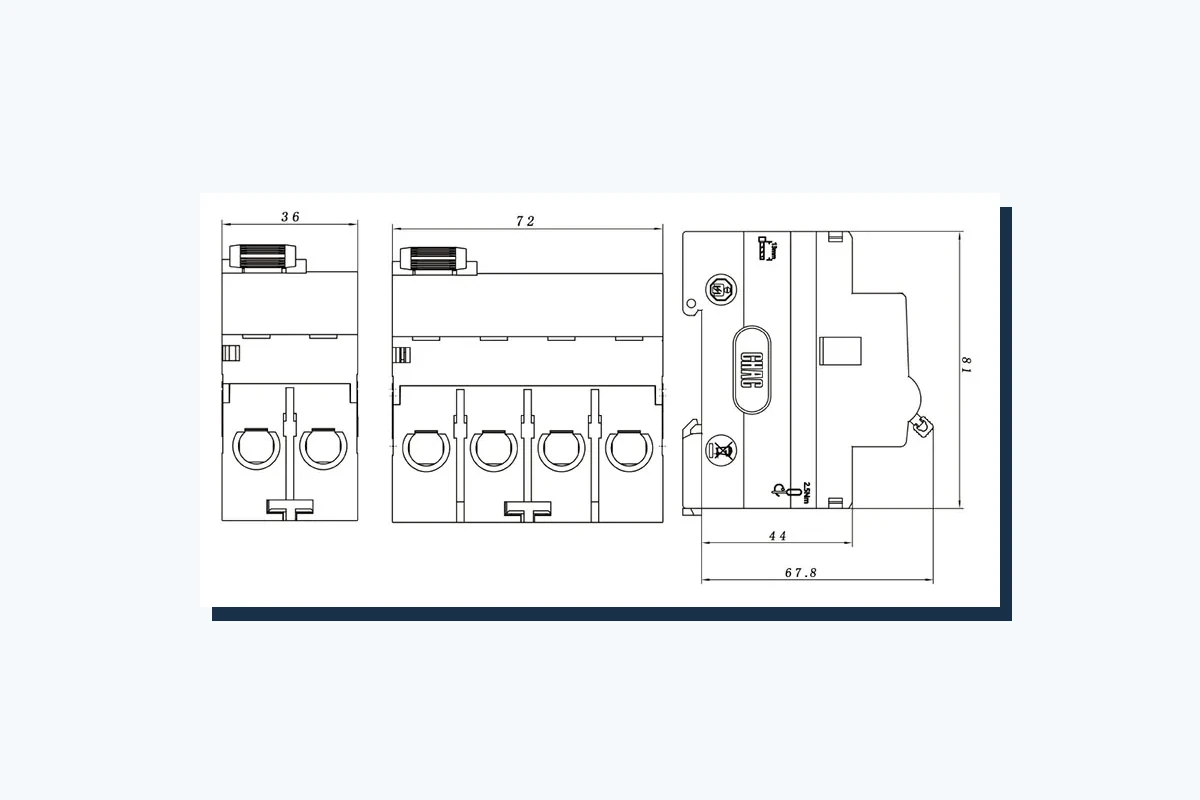
O PXL6a-100 RCCB product route publicly lists AC Type and A Type, 2P/4P, 230/400V AC, 25A–100A, 30/100/300mA, and IEC 61008-1. Use those published fields to start a selected-model discussion after the RFQ has organised the circuit evidence, rather than using them to decide a panel by themselves.
Recomendação de produto
Disjuntor Diferencial Residual com Proteção de Sobrecorrente RCBO da Série PXL9-63 | CHAC Electric

Use this PXL6a-100 RCCB product route when the request already identifies the residual-current type, sensitivity, supply arrangement, pole requirement, and required documents. Do not exchange it for an RCBO or an image-only match: the functional boundary, selected-model fields, and project fit still need their own confirmation. A request that needs branded product presentation or tailored documentation can use the página de personalização de terminais elétricos.
Parte 7. Mantenha a seleção de tipo dentro do seu limite de ajuste
This article supports early panel review and a clearer supplier conversation. It does not provide live-work guidance, local installation interpretation, final protection coordination, or approval of a device type for a named installation.
Fit Boundary: retain final type selection with the approved drawing, load record, selected-model documentation, applicable project requirements, and qualified engineering review. Send the circuit evidence and documentation request to CHAC Elétrico when asking for a product route.
What does the connected load tell you about RCCB type?
A Type AC RCCB e um Type A RCCB are selected by the residual-current waveform expected from the installation, not by preference for a familiar label. Type AC is associated with sinusoidal AC residual current within its scope; Type A is intended for the additional pulsating-DC conditions defined by the applicable standard and product documentation.
| Pergunta de revisão | Por que é importante | O que verificar |
|---|---|---|
| What load is connected? | Power electronics can change the residual-current waveform | Equipment manufacturer and installation requirements |
| What protection function is needed? | Sensitivity and waveform type are separate decisions | Rated residual operating current and type marking |
| What local rule applies? | National adoption can change the permitted arrangement | Current installation requirements |
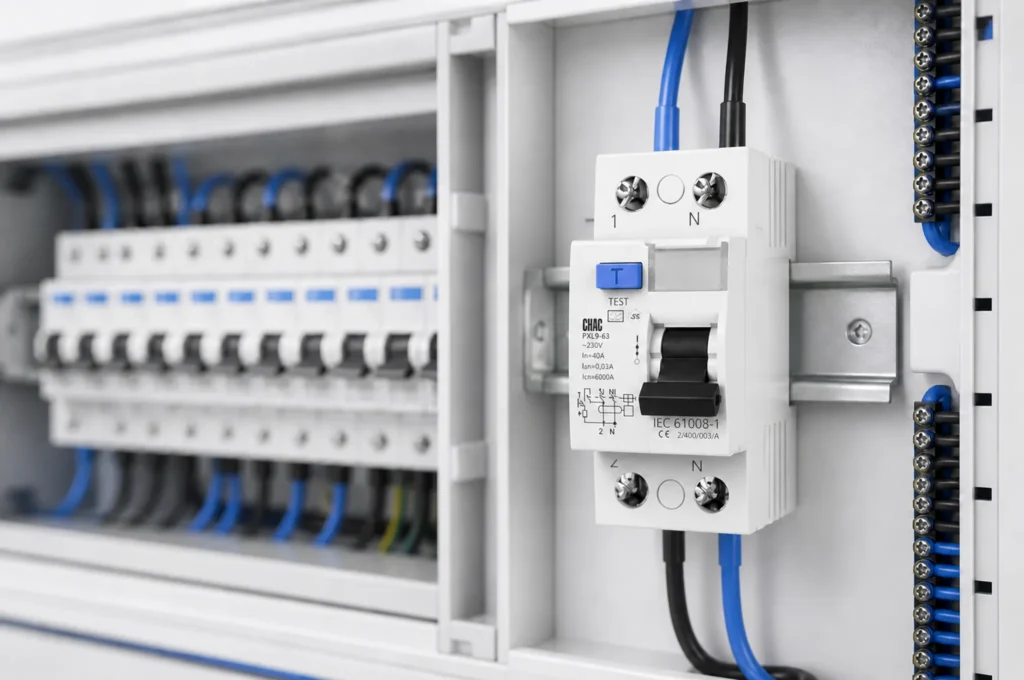
The key selection field is the residual current waveform, alongside sensitivity, pole arrangement and rated current. Review CHAC’s Disjuntor de fuga PXL9-63 documentation for the exact model rather than generalizing from the family name.
Is Type A always better than Type AC?
No. Choose the type that matches the residual-current waveform and the applicable installation requirements. A higher category is not a substitute for checking the actual load.
Are RCCB sensitivity and type the same decision?
No. Sensitivity describes the residual-current operating level; type describes the waveform conditions the device is designed to detect within its scope.
FAQs
What is the difference between Type AC and Type A RCCB?
They represent different residual-current detection characteristics. The circuit evidence and selected-model documentation establish which type should be reviewed for the panel.
Does Type A RCCB detect pulsating DC residual current?
Type A is associated with review of pulsating DC residual current characteristics. Confirm the exact selected-model documentation and the project circuit requirements before making a final choice.
Can Type AC be replaced by Type A without a drawing review?
No automatic replacement should be assumed. Keep the load record, residual-current type request, sensitivity, and current drawing revision together for review.
Which RCCB type should be specified for electronic loads?
Describe the loads and their residual-current characteristics in the project record, then request the selected-model evidence that addresses the stated type requirement. A generic label does not replace that review.
What information should be included in an RCCB RFQ?
Include the panel drawing, load description, requested type, sensitivity, pole and current requirements, supply arrangement, installation context, and the documentation required for the proposed model.
Is an RCCB the same as an RCBO?
No. Their protection-function boundary needs a separate review with the project requirements and selected-model documentation.