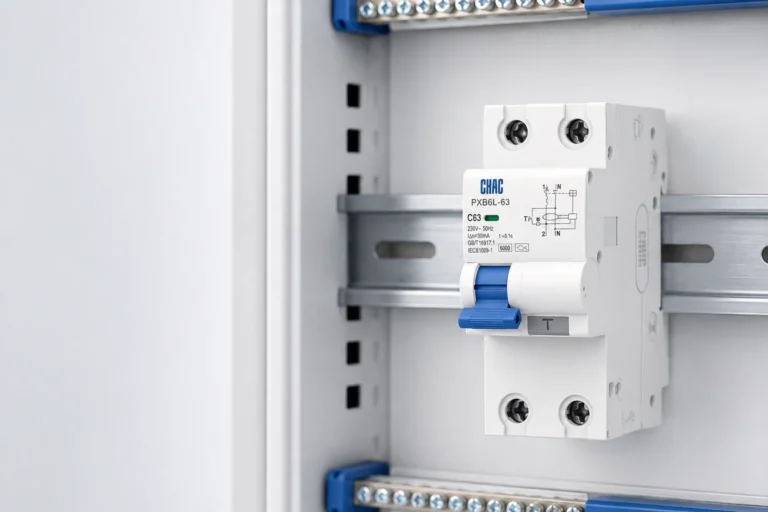
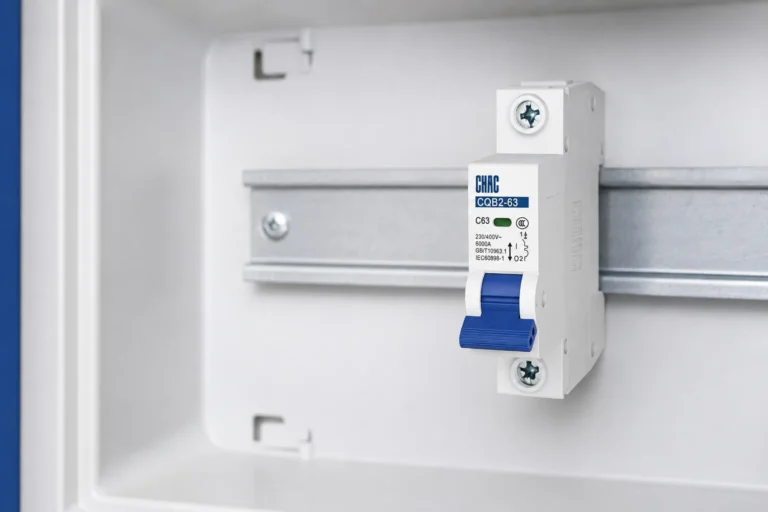
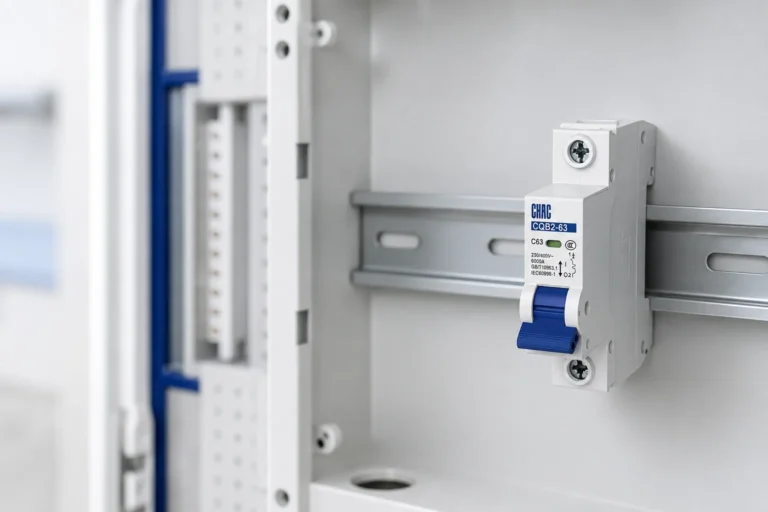
When facilities engineer Elena Ruiz in Monterrey encountered repeated trips on a new packaging line, she replaced the affected MCB with another unit of the same current rating. The conveyor stopped again within seconds of a cold start. Inspection showed no defective breaker: the purchasing schedule had copied an unsuitable trip curve from a general-load panel, without checking motor inrush or fault-loop coordination.
Summary: The practical difference in B Curve vs C Curve vs D Curve MCB selection is the instantaneous operating band: broadly 3–5 times rated current for B, 5–10 times for C, and 10–20 times for D under IEC 60898-1 conditions. Select from the load’s measured or manufacturer-declared inrush, then verify conductor protection, prospective fault current, disconnection time, breaking capacity, upstream/downstream coordination, and local project rules. A higher curve is not a universal cure for nuisance tripping.
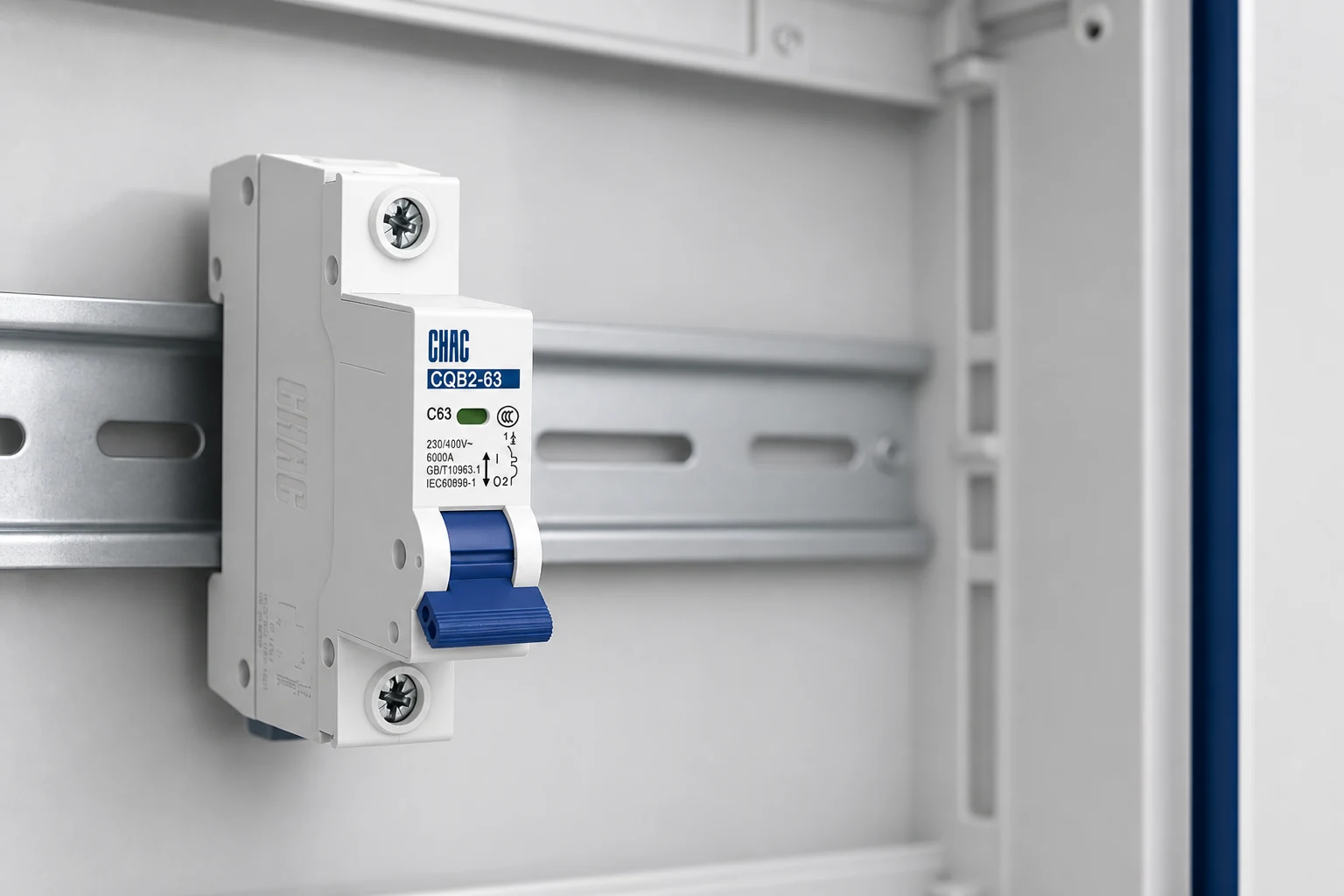
A miniature circuit breaker combines thermal overload protection with fast magnetic short-circuit operation. The curve letter mainly describes the magnetic response; it does not state current rating, breaking capacity, voltage, poles, or approval status. Buyers needing a broader comparison can review these MCB and MCCB differences.
What do B, C, and D curves actually change?
For common IEC 60898-1 curve designations, B devices operate instantaneously within the 3–5 × In band, C within 5–10 × In, and D within 10–20 × In, where In is rated current. Thus, for an illustrative 16 A device, the magnetic region is 48–80 A for B, 80–160 A for C, and 160–320 A for D. These are standardized bands, not a promise that every unit will trip at one exact current.
The thermal element responds to sustained overcurrent. Changing from B16 to C16 does not create a higher-capacity conductor circuit; it changes tolerance of a short surge before magnetic operation. Clearing time also depends on current, initial temperature, tolerances, and the manufacturer’s published curve. See this product-level explanation of B, C and D trip curves.
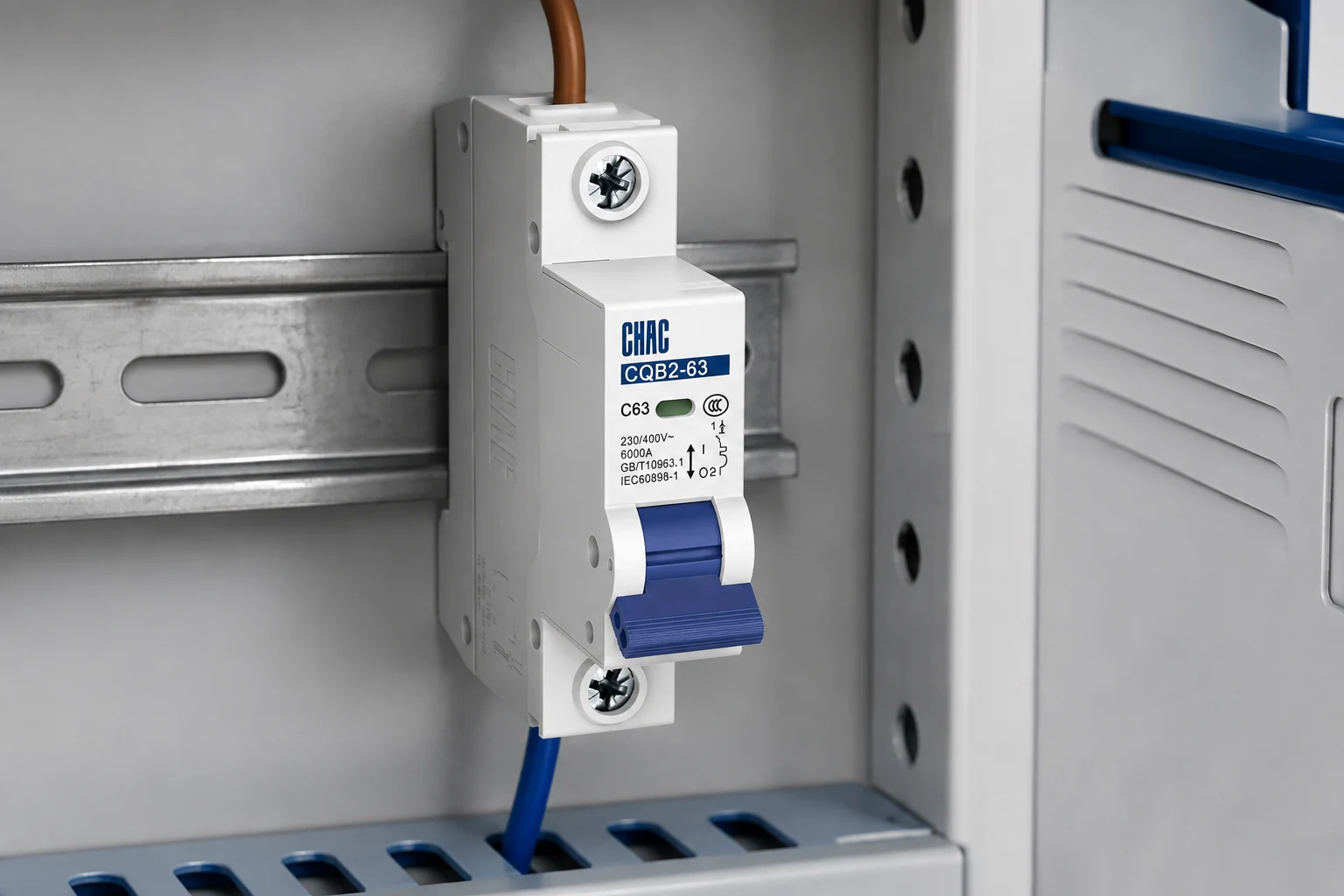
B Curve vs C Curve vs D Curve MCB comparison
This is a screening table, not a specification. IEC 60898-1 provides the curve framework, but suitability depends on circuit calculations and manufacturer data. The examples are conditional because products within each category can have very different inrush.
| Characteristic | B curve | C curve | D curve |
|---|---|---|---|
| IEC instantaneous band | 3–5 × In | 5–10 × In | 10–20 × In |
| Inrush tolerance | Lowest of the three | Moderate | Highest of the three |
| Conditional starting point | Resistive or low-inrush final circuits | Mixed general loads or moderate-inrush equipment | High-inrush equipment supported by calculations |
| Fault-current requirement for fast magnetic operation | Lower | Higher | Highest |
| Procurement risk if chosen by label alone | Nuisance trips on high inrush | May still be too sensitive or too slow for the actual circuit | Fault may not reach the magnetic band; coordination can be impaired |
| Unit-cost tendency | Curve alone is rarely the useful cost comparator; documentation, ratings, approvals, downtime, and redesign exposure drive total cost. | ||
A curve that is too sensitive can interrupt normal operation. One that is too tolerant may miss the required automatic-disconnection time or disrupt selectivity. Unit-price savings rarely offset commissioning delay, repeated callouts, or a coordination gap.
How should load type and cold-start inrush guide selection?
Start with the current waveform, not the equipment category. Record steady current, inrush peak and duration, starts per hour, simultaneous energization, ambient temperature, and worst cold start. Under IEC 60364-4-43 principles, load current, protective-device rating, and conductor capacity must remain coordinated; changing curve never permits an undersized cable.
| Load or project condition | Evidence to collect | Conditional curve direction | Check before approval |
|---|---|---|---|
| Heating or simple resistive load | Nameplate current and switching duty | B may be suitable where inrush is low | Conductor capacity, ambient derating, disconnection time |
| Lighting | Driver/ballast inrush and number switched together | B or C may fit; high LED-driver inrush can change the answer | Manufacturer limits, switching method, fault-loop result |
| Sockets and mixed general loads | Likely connected equipment and diversity | B or C depending on local practice and load behavior | Adopted code, cable, earth-fault path, residual-current requirements |
| Small motor or compressor | Locked-rotor/start current, acceleration time, starting method | C may work; D is considered only when higher inrush is proven | Motor overload protection, short-circuit coordination, start frequency |
| Transformer or bank of power supplies | Manufacturer inrush envelope at energization | C or D may be appropriate; phase angle and cold start matter | Primary conductors, upstream device, fault current, energization sequence |
If a breaker trips, distinguish normal inrush from overload, short circuit, earth leakage, overheating, loose connections, or a defective load. Moving from B to C or D without diagnosis can conceal the cause. This guide to a circuit breaker that keeps tripping explains the risk.
What standards and coordination checks govern the decision?
IEC 60898-1 covers circuit-breakers for overcurrent protection in household and similar installations for AC operation; its requirements and test methods underpin the familiar B, C, and D bands. IEC 60947-2 covers industrial circuit-breakers and uses a different application framework. A catalogue statement that a device was designed to a standard is not, by itself, third-party certification.
IEC 60364-4-43 addresses conductor overcurrent protection. The project also needs fault-loop or prospective-fault-current calculations and the applicable disconnection time. Because D needs more current than B to enter its magnetic band, a long run or higher loop impedance may make D unsuitable even if it stops start-up trips. Breaking capacity must independently meet the prospective short-circuit current.
Verify selectivity and backup protection with manufacturer tables or a time-current study. The market may apply IEC-based national rules, BS 7671, or another code; temperature, grouping, altitude, enclosure approval, residual-current protection, and equipment instructions can alter the answer. Unsupported claims can cause rejected submittals, rework, or shipment delays.
A practical MCB procurement workflow
- Define voltage, frequency, poles, load current, cable, installation method, ambient conditions, and prospective fault current.
- Obtain the maker’s inrush curve or measure peak and duration under credible cold and simultaneous starts.
- Compare inrush with the full time-current envelope; calculate earth-fault clearing and short-circuit performance.
- Check conductor protection, breaking capacity, motor overload protection where relevant, selectivity, and enclosure compatibility.
- Confirm local code, exact-model documents, markings, certification requirements, and project approval before purchase.
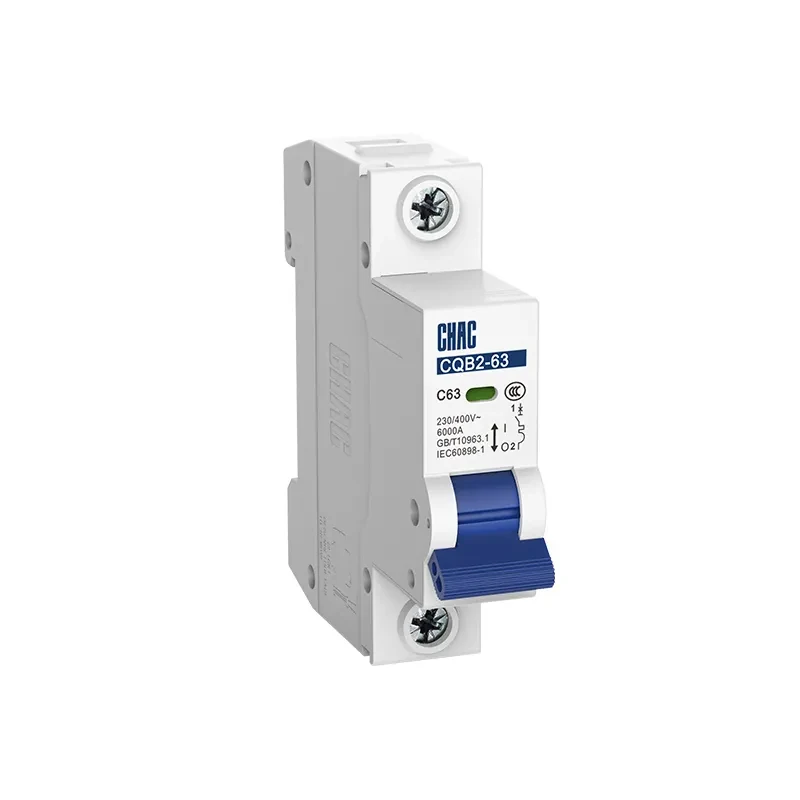
For CHAC Electric, the miniature circuit breaker selection review can use the CQB2-63 as a documented product-family reference. The only certification confirmed for this product in this article is CCC. IEC 60898-1 is a standard and test framework, not a certification; buyers should request evidence for the exact model, rating, curve, and destination-market requirement rather than infer approval from a standard number.
Frequently asked questions
Which is better, a B curve or C curve MCB?
Neither is universally better. B reaches its magnetic operating region at a lower multiple of rated current, while C tolerates more inrush; the correct choice is the one that passes load-starting, cable-protection, fault-clearing, and local-code checks.
Can I replace a B curve MCB with a C curve of the same amp rating?
Not from the amp rating alone. Confirm the load inrush, earth-fault loop or prospective fault current, disconnection time, breaking capacity, conductor protection, panel compatibility, and approval requirements before substituting.
Is a D curve MCB always required for motors?
No. Motor start current and duration vary with motor design, load torque, starter, voltage, and temperature; some circuits coordinate with C, while a documented high-inrush case may justify D. Motor overload protection and short-circuit coordination must also be checked.
Why does an MCB trip when equipment starts in cold weather?
Cold conditions can change lubricant drag, compressor pressure behavior, motor acceleration, transformer magnetizing inrush, or power-supply charging. Measure or obtain the worst-case inrush envelope and inspect for actual faults before changing curve or rating.
Does a higher trip curve increase breaking capacity?
No. B, C, and D describe instantaneous trip-current bands; breaking capacity is a separate rated short-circuit performance. Both must be suitable for the circuit, and neither replaces a coordination study.
References
- IEC 60898-1, Circuit-breakers for overcurrent protection for household and similar installations, International Electrotechnical Commission.
- Choice of a circuit-breaker, Schneider Electric Electrical Installation Guide.
- BS 7671 Requirements for Electrical Installations, Institution of Engineering and Technology.
- Electrical safety at work, UK Health and Safety Executive.
The durable rule is simple: select the curve from verified load behavior, then prove that the whole protective system still clears faults safely.
Review the CQB2-63 documentation against your single-line diagram and project requirements, then contact CHAC Electric with the load profile, conductor details, fault-current calculation, destination market, and required compliance evidence for a focused selection discussion.