When a project role faced a selection problem, the visible failure often appeared before the real cause was understood. Luis, a maintenance lead in Monterrey, found a low-voltage draw-out breaker with pitted contacts after a fault event. A rushed repaint would have hidden the damage; a documented inspection, parts review and injection test showed the breaker could be reconditioned within its original design limits.
Summary: Low-voltage power circuit breakers—especially serviceable draw-out designs—are the devices most commonly considered for reconditioning. Reconditioning is not cosmetic repair: it requires condition assessment, approved replacement parts, calibrated testing and a recorded decision on remaining life. Follow the original manufacturer instructions and applicable maintenance guidance. This article keeps the decision evidence-led and separates product capability from installation responsibility.
Assess condition and parts availability
The right answer starts with the application boundary. Define the source, load, conductors, fault level and operating environment before comparing catalogues. A device that looks suitable by ampere rating can still fail on arc duty, selectivity, temperature or installation method. Use the manufacturer time-current curve and the adopted wiring standard as the common language between design, procurement and commissioning.
Document assumptions and test them at the panel. For example, a protection study should state prospective short-circuit current, expected inrush, conductor ampacity and the required disconnection time. Named methods such as primary-injection testing, insulation-resistance testing or a coordination study are more useful than a generic statement that a product is “industrial grade.”
Stage
Use this checkpoint to keep the specification testable. If the answer changes with destination market, voltage system or utilization category, say so in the specification and obtain written confirmation before release.
Use a controlled reconditioning process
The right answer starts with the application boundary. Define the source, load, conductors, fault level and operating environment before comparing catalogues. A device that looks suitable by ampere rating can still fail on arc duty, selectivity, temperature or installation method. Use the manufacturer time-current curve and the adopted wiring standard as the common language between design, procurement and commissioning.
Document assumptions and test them at the panel. For example, a protection study should state prospective short-circuit current, expected inrush, conductor ampacity and the required disconnection time. Named methods such as primary-injection testing, insulation-resistance testing or a coordination study are more useful than a generic statement that a product is “industrial grade.”
Typical evidence
Use this checkpoint to keep the specification testable. If the answer changes with destination market, voltage system or utilization category, say so in the specification and obtain written confirmation before release.
Prove performance before return to service
The right answer starts with the application boundary. Define the source, load, conductors, fault level and operating environment before comparing catalogues. A device that looks suitable by ampere rating can still fail on arc duty, selectivity, temperature or installation method. Use the manufacturer time-current curve and the adopted wiring standard as the common language between design, procurement and commissioning.
Document assumptions and test them at the panel. For example, a protection study should state prospective short-circuit current, expected inrush, conductor ampacity and the required disconnection time. Named methods such as primary-injection testing, insulation-resistance testing or a coordination study are more useful than a generic statement that a product is “industrial grade.”
Stop condition
Use this checkpoint to keep the specification testable. If the answer changes with destination market, voltage system or utilization category, say so in the specification and obtain written confirmation before release.
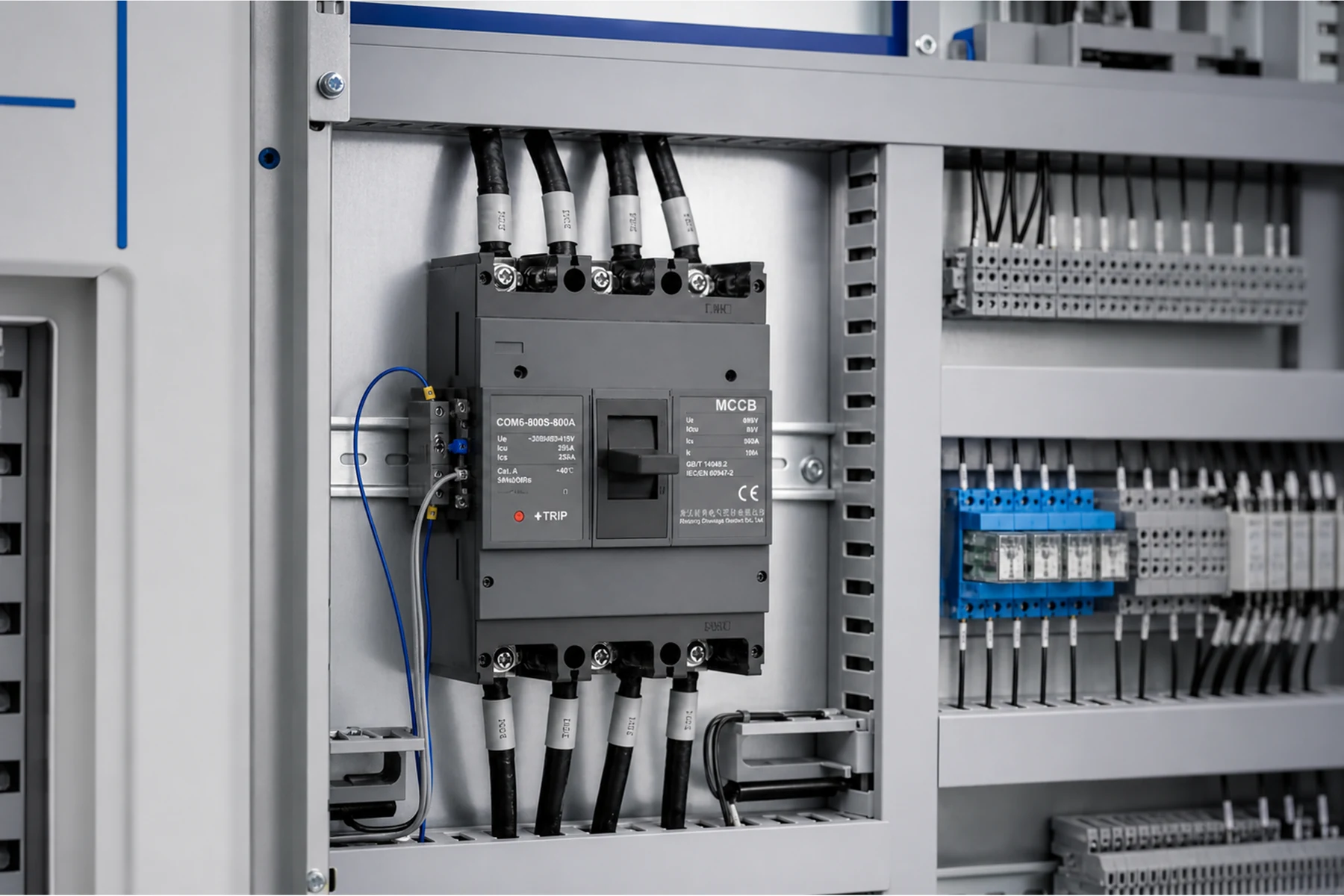
Comparison for a defensible specification
| Dimension | Option A | Option B |
|---|---|---|
| Inspection | Contact wear, insulation, mechanism | Cracks, carbonization or distortion |
| Repair | Approved parts and torque records | Unverified substitute parts |
| Testing | Insulation, timing and primary injection | Trip values outside tolerance |
Selection and procurement actions
- Freeze the electrical assumptions: system voltage, poles, load current, conductor method, fault current and ambient limits.
- Request model-specific data: standard edition, trip curve, breaking capacity, terminal limits, dimensions and test evidence.
- Review coordination with upstream and downstream devices; do not infer selectivity from brand or frame size.
- Approve a sample or first article, record torque and inspection points, and define who performs commissioning tests.
- Plan spares and change control so a later substitution cannot silently alter safety performance.
For buyers comparing configurable protection families, CHAC Electric provides public information on MCB products and electrical distribution equipment. Treat these pages as a starting point and confirm the exact model data for your project.
Separate reconditioning evidence from replacement economics
A reconditioned circuit breaker should be accepted only when its frame, mechanism and insulation system can be identified and tested. The right circuit breaker testing plan records visual inspection, insulation resistance, contact resistance, mechanical operation and trip performance against the applicable manufacturer data. Make the replacement decision explicit when parts are obsolete, the interrupting duty is uncertain or the enclosure has suffered heat damage.
Reconditioning is therefore a condition-based engineering decision, not a cosmetic cleaning exercise. Keep serial numbers, test instruments, calibration status and acceptance limits with the service record.
Related reading: Molded case circuit breaker vs miniature circuit breaker helps define when a larger frame is justified.
Frequently asked questions
Can every circuit breaker be reconditioned?
No. Serviceability depends on design, age, damage and parts support. A breaker with cracked insulation, severe arc damage or an unknown modification may be unsafe to return to service.
What tests are expected after reconditioning?
Typical checks include visual inspection, insulation resistance, contact resistance, mechanical operations, trip timing and primary or secondary injection as appropriate. Use the maker’s limits and calibrated instruments.
Is reconditioning the same as refurbishing?
Terms vary by market. Treat any process as safety-critical unless it defines inspection depth, replacement criteria, testing and documentation. Ask for a clear scope and acceptance record.
When should a breaker be replaced instead?
Replace when critical parts are unavailable, damage exceeds repair limits, fault duty has changed, or test results cannot be brought within the specified tolerance.
Authoritative references
- IEC 60947-2 (consult the current edition and national adoption).
- NFPA 70B (consult the current edition and national adoption).
- IEEE C37.59 (consult the current edition and national adoption).
The durable principle is simple: specify the circuit and the evidence together, then test the assembled result. For a model review, application question or documented quotation, contact CHAC Electric and share the duty, voltage and destination-market requirements.