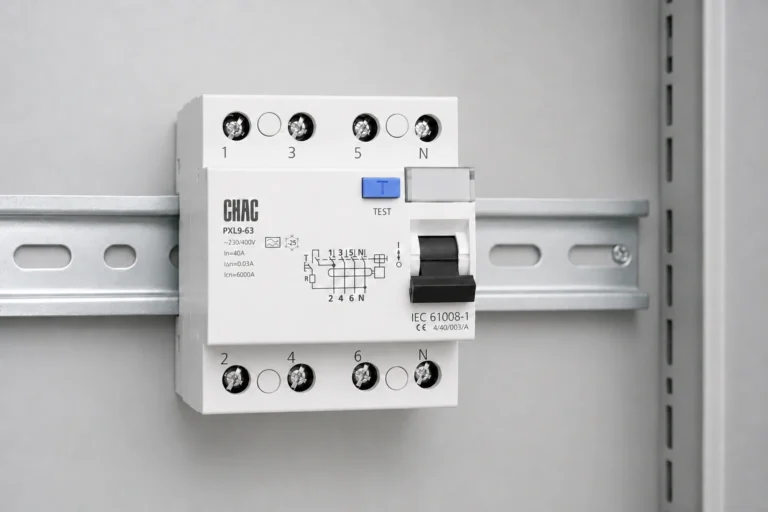
When a panel builder in Manchester replaced an old earth-leakage device, the new unit tripped immediately after energization. The installer had copied the old neutral routing without checking the device topology. The problem was a wiring and terminology mismatch, not evidence that residual-current protection was unreliable.
Summary: An RCCB is generally a residual-current circuit breaker that detects imbalance between live and return conductors; “ELCB” is an older or broader earth-leakage term that can describe voltage-operated or current-operated devices. Modern purchasing should focus on the device standard, residual-current type, rated current, poles, sensitivity, and coordination with overcurrent protection. A residual-current device normally does not replace an MCB unless it is an RCBO designed for both functions.

What is an RCCB used for?
An RCCB opens a circuit when residual current exceeds its rated trip sensitivity. A toroidal sensor compares the current in the monitored conductors; current that leaves through a person, equipment frame, or unintended path creates an imbalance. The device is intended to reduce shock and fire risk, but it does not make damaged wiring safe and it does not normally provide overload protection.
RCCBs are specified by rated current, number of poles, residual operating current, residual-current waveform type, short-circuit coordination, and installation category. The “type” designation matters for loads containing electronics, rectifiers, variable-speed drives, or other components that may produce pulsating or smooth residual current. The device data sheet and local rules determine the correct choice.
Why ELCB terminology causes confusion
ELCB originally referred to earth-leakage circuit breakers that could operate from voltage on the equipment earth. Many markets now use the term loosely for current-operated residual devices. An RCCB is current-operated and monitors imbalance in the circuit conductors; it does not depend on a voltage appearing on the protective earth. When replacing an ELCB, identify the existing wiring, bonding arrangement, and product markings before selecting a modern device.
RCD is the umbrella term used in many standards and installation rules. An RCCB is an RCD without integral overcurrent protection. An RCBO combines residual-current and overcurrent functions. A plain RCCB paired with a correctly rated MCB can be a sound arrangement, but the pair must be coordinated for prospective fault current and selectivity.
| Device term | Primary function | Overcurrent included? | Buyer check |
|---|---|---|---|
| RCCB | Residual-current protection | Normally no | Pair with an MCB and confirm coordination. |
| RCBO | Residual-current and overcurrent protection | Yes | Verify pole, curve, interrupting rating, and neutral path. |
| Legacy ELCB | May be voltage- or current-operated | Varies | Identify operating principle before replacement. |
| RCD | General residual-current category | Varies | Read the exact product standard and marking. |
Wiring and installation applications
All live conductors that belong to the protected circuit normally pass through the sensing core; a neutral bypass or shared neutral can create immediate trips. The protective earth does not pass through the sensing core. Follow the manufacturer’s line/load markings, torque requirements, and test-button instructions. Never bond neutral and earth downstream of the permitted bonding point.

For a residential distribution board, a listed RCCB solution can be evaluated with a separate overcurrent breaker. Where combined protection is desired, review the PXB6L-63 RCBO specifications. A CQB2-63 MCB may be part of a coordinated arrangement when voltage, curve, and interrupting rating match the installation.
How should buyers compare RCCB and RCBO options?
| Decision dimension | RCCB plus MCB | RCBO | Selection implication |
|---|---|---|---|
| Panel space | Usually separate module positions | Combined function can simplify circuits | Check width and neutral arrangement. |
| Fault isolation | One RCCB may trip several circuits | Can isolate a single branch when correctly applied | Compare continuity and nuisance-trip impact. |
| Maintenance | Two devices and coordination records | One device with combined markings | Keep spare and test-button procedures clear. |
| Cost drivers | Device pair, busbar, labor, selectivity | Unit specification and quantity | Compare total installed cost, not unit price only. |
Which standards and testing checks prevent RCCB selection mistakes?
IEC 61008-1 applies to RCCBs without integral overcurrent protection, while IEC 61009-1 applies to RCBOs. IEC 60364 installation rules and the locally adopted wiring code define where residual-current protection is required. These standards specify device behavior and tests; they do not certify an entire panel built without following instructions.
Common mistakes include selecting AC-type protection for a load that requires another residual waveform type, routing a shared neutral outside the sensor, omitting the overcurrent device, and assuming a test button proves every fault condition. Test at the intervals required by the manufacturer or local code, and investigate every unexplained trip instead of repeatedly resetting.
Procurement teams should request the product standard, rated residual current, test conditions, terminal range, wiring diagram, short-circuit coordination information, and environmental limits. The honest comparison is between verified application data and the installation schedule, not between marketing labels.
Frequently asked questions
What is an RCCB used for?
An RCCB detects residual current and disconnects a circuit when the imbalance reaches its rated threshold. It is used for shock and leakage protection where required, but it normally does not protect against overload or short circuit. Pair it with suitable overcurrent protection.
Which is better and RCCB or ELCB?
For a new installation, choose the device defined by the applicable code and product standard rather than the label alone. Modern current-operated RCCB technology is generally easier to specify than legacy voltage-operated ELCB arrangements, but the exact application and wiring decide suitability.
What is the difference between RCD and RCCB?
RCD is a broad category for residual-current devices. RCCB is a specific type of RCD without integral overcurrent protection. An RCBO is an RCD with overcurrent protection.
What is RCCB vs MCB?
An RCCB responds to current imbalance, while an MCB responds to overload and short circuit. They address different hazards and can be used together. A device marked RCBO combines both functions when its ratings are correct.
What is rccb used for?
It is used to disconnect a circuit when leakage or residual current exceeds its setting, reducing shock and fire risk. Confirm the sensitivity, residual-current type, poles, and local installation requirement before choosing one.
How does rccb work?
The device compares current in the monitored live conductors. A difference indicates that some current is returning by an unintended path, so the trip mechanism opens the circuit. Correct neutral routing and periodic testing are essential.
Which official sources should buyers verify?
Good RCCB selection starts with the current path and ends with a tested, documented panel. Review CHAC Electric’s residual-current protection range against your wiring diagram and contact the technical team for the data needed to compare suppliers responsibly.