A panel buyer can identify a breaker’s current rating and still order the wrong lockout. The mismatch often concerns the toggle, engagement holes or surrounding enclosure—not the electrical rating. For a PXB6 purchase, a clear front photograph and a dimensioned interface drawing are more useful for accessory selection than a family name alone.
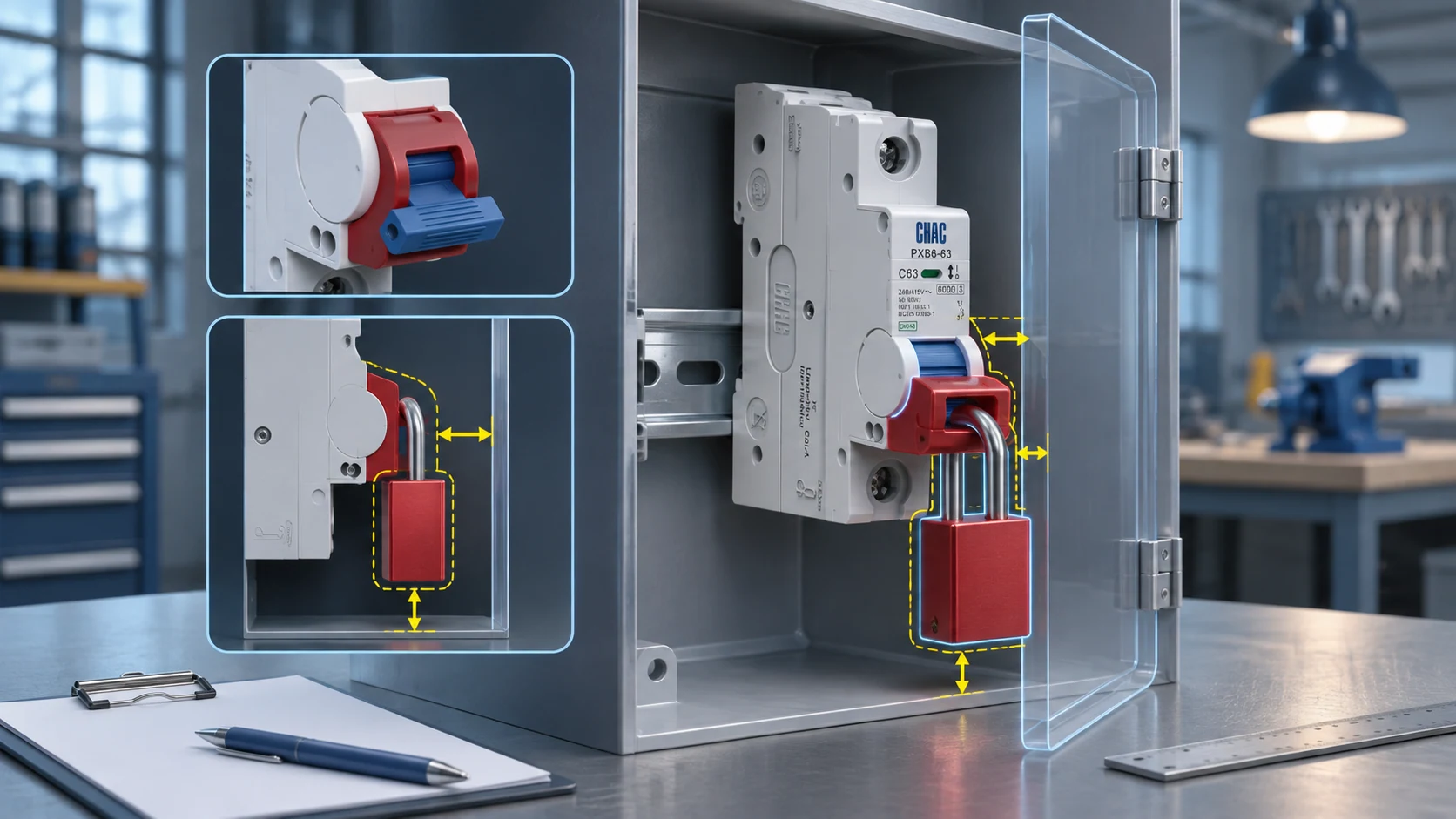
A miniature circuit breaker lockout cannot be confirmed to fit PXB6 from the series name or a “universal” label. Compatibility requires evidence for the exact breaker variant and lockout device, including its engagement method, OFF-position restraint and installed clearance. CHAC’s published PXB6-63 information establishes electrical options, but does not establish compatibility with a particular lockout. Lockout fit is separate from the breaker’s isolation function. The MCB isolation RFQ guide explains what to ask the supplier to document.
Which lockout interface must match the PXB6 variant?
Start with the complete breaker identification, not simply “PXB6.” The CHAC PXB6-63 product page lists 1P, 2P, 3P and 4P options. Those pole options do not prove that every toggle or accessory interface is identical.
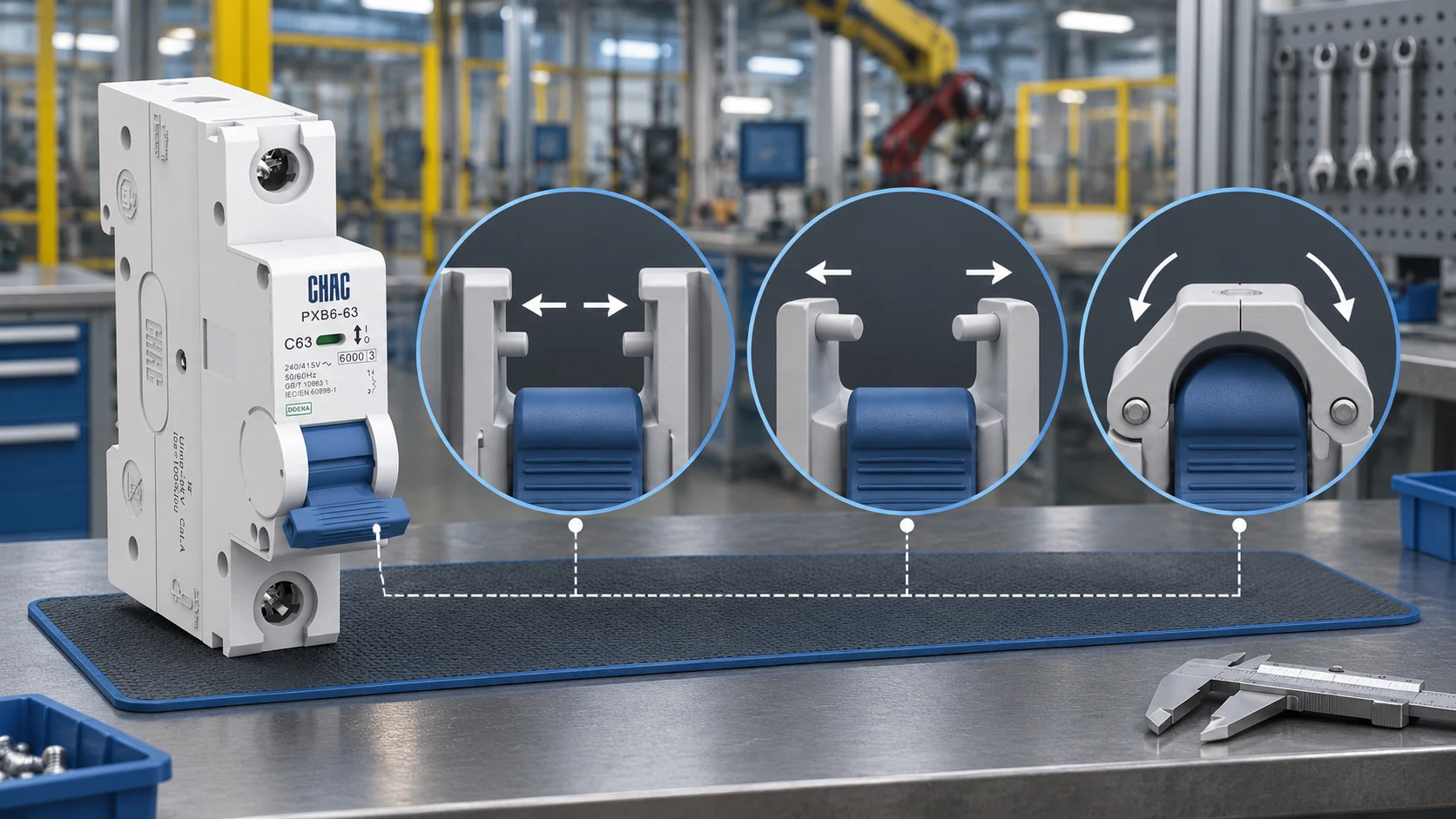
Pin-in and pin-out describe different engagement arrangements; terminology alone is insufficient. Obtain the lockout supplier’s drawing showing where its pins engage and whether their spacing increases or decreases during engagement. Clamp-style products instead depend on the toggle profile and their specified gripping range.
| Interface | What must match | What is not proof |
|---|---|---|
| Pin-in | Specified inward-facing pin engagement, hole spacing and access | A similar-looking toggle |
| Pin-out | Specified outward-facing pin engagement and receiving geometry | The presence of any toggle hole |
| Clamp-style | Toggle thickness, profile and permitted gripping surfaces | A “universal MCB” description |
| Tie-bar arrangement | Combined operating-member geometry and adjacent clearance | Matching one pole’s width |
These are interface categories, not confirmed PXB6 accessory options. Request a written compatibility statement identifying both exact products, supported by drawings or documented evaluation. Do not modify a toggle or improvise an engagement point to resolve a mismatch.
What do PXB6 ratings establish—and what remains unproven?
Electrical selection and mechanical lockout selection answer different questions. The published PXB6-63 current range, trip options and breaking data concern circuit protection. They do not establish whether a circuit breaker lockout device grips securely, accommodates a padlock or clears a panel door.
Likewise, the product page’s 45mm terminal-centre reference is not a toggle width, pin-hole spacing or accessory-clearance dimension. Using it as a lockout selection measurement would substitute an unrelated installation reference for the required geometry.
The listed IEC 60898-1 reference concerns circuit-breaker requirements within that standard’s scope; it is not evidence that an unrelated lockout fits. Any certification claim also needs confirmation for the ordered configuration and destination market. A standards reference should never become an accessory compatibility claim.
For procurement, separate the breaker specification from the lockout specification. The CHAC MCB range overview supports comparison by series, current, poles, curve and breaking capacity. Lockout selection needs a separate interface review. A request described only as “lock out tag out circuit breaker accessory” leaves the engagement geometry and intended restraint undefined.
What evidence should buyers collect before approving an order?
Build a small approval package covering the breaker, lockout, padlock and enclosure together. Use drawings, supplier documentation and an appropriately controlled assessment by competent personnel—not experimentation on energized equipment.
| Decision | Required input | Approval check |
|---|---|---|
| Identify the breaker | Complete designation, pole arrangement and front/side photographs | Evidence covers the ordered variant |
| Match engagement | Toggle width, thickness, projection and profile; hole diameter, spacing and access where relevant | Dimensions fall within the lockout’s documented limits |
| Assess combined handles | Tie-bar shape, span and surrounding obstructions | Restraint addresses the complete operating member |
| Check installed envelope | Lockout body, padlock shackle, lock body and door geometry | No interference or pressure that compromises retention |
| Confirm function | Documented OFF-locking purpose and applicable site procedure | Not confused with an ON-retaining accessory |
Keep unresolved items visible in the purchase specification. If a supplier cannot substantiate fit for the exact combination, record compatibility as unconfirmed rather than treating a sample photograph or generic catalogue claim as approval.
Frequently asked questions
How do pin-in and pin-out miniature circuit breaker lockouts differ?
Pin-in arrangements generally engage with inward-facing pins, while pin-out arrangements use outward-facing pins. The receiving geometry and engagement action differ. Confirm the actual supplier drawing, hole locations and spacing rather than relying only on those names.
Does a universal MCB lockout fit every PXB6 toggle design?
No. “Universal” describes an intended compatibility range, not guaranteed fit across every PXB6 toggle design. Require the lockout supplier to identify the exact supported breaker variant and any limitations involving poles, handles or surrounding accessories.
Which toggle and pin-hole dimensions should be checked before ordering a lockout?
Check toggle width, thickness, projection and profile. For a pin-engaging design, also check hole diameter, centre-to-centre spacing, orientation and unobstructed access. Compare dimension tolerances with the lockout drawing; nominal measurements alone may conceal an interference.
Can a multi-pole tie-bar breaker require a different lockout device?
Yes. A multi-pole operating member or tie bar can change the gripping surface, engagement span and available space. A device suitable for a single toggle is not automatically suitable for the combined arrangement; obtain evidence covering that configuration.
Should panel-door clearance be checked with the lockout and padlock fitted?
Yes. Assess the complete installed envelope, including the padlock body and shackle, against the door, trim and adjacent equipment. Door contact must not displace the lockout or load the operating member. Resolve clearance through documented review under safe, controlled conditions.
How does locking a breaker OFF differ from fitting a lock-on clip?
An OFF lockout is intended to restrain operation from the OFF position within an isolation procedure. A lock-on clip retains an ON condition and serves a different purpose. It is not a substitute for an OFF-locking device, regardless of superficial resemblance.
Why must isolation and absence of voltage still be verified after applying a breaker lockout?
A lockout restrains an operating mechanism; it does not measure voltage or establish that every energy source has been isolated. Misidentification, another supply or stored energy can remain relevant. Competent personnel must verify isolation and absence of voltage under the applicable safe-work procedure.
For a PXB6 lockout enquiry, send the complete breaker designation, interface dimensions, enclosure constraints and proposed accessory details to CHAC for product consultation. Consultation can help clarify the breaker configuration; established lockout compatibility still requires variant-level evidence for the complete arrangement.