An AC contactor auxiliary-contact request is reviewable only when it says what signal the contact must carry and how that signal relates to the selected control circuit. Name the required NO or NC state, coil and timing context, mounting arrangement, drawing revision, and requested product records before comparing a supplier response.
Part 1. What job should the auxiliary interface perform?
An auxiliary interface should be named by its intended signal job before a panel team asks for a part number. A latching path, a status indication, and a control permissive are different functions even when they appear close together on a drawing.
Start with the current control drawing and describe the event that changes the contact state. The request should also identify who consumes that signal, such as another control element, an indicator, or a documented monitoring input. This keeps the purchasing discussion attached to a defined function rather than a familiar-looking accessory.
The industrial control electrical appliances range provides the product-family context. For the wider drawing interface, see the related AC contactor control-wiring article.
Part 2. Why must NO and NC be written into the request?
Unlike a main-pole duty description, an auxiliary-contact requirement needs the intended normal state stated plainly. Schneider Electric’s contactor specification framing separates main poles, auxiliary contacts, and the coil; the separation is useful because one field cannot safely stand in for the others.
Write the required state as NO or NC beside the signal purpose and drawing reference. If the design needs more than one auxiliary signal, identify each function separately instead of assuming a standard contact arrangement. The selected product record then becomes something a supplier can compare with the request.
Important: An auxiliary contact is not, by itself, proof of a complete control or safety function. The control logic, selected device, and project requirements need their own review. (Schneider Electric contactor specification FAQ)
Part 3. Which records make accessory responses comparable?
The comparison is strongest when each supplier receives the same functional and documentary inputs. Rockwell’s contactor technical data and Chint’s auxiliary-contact explanation both distinguish the selection context from the final model choice; the table below turns that distinction into quote-review fields.
| Review input | What the buyer should identify | What the supplier should return |
|---|---|---|
| Signal purpose | Latching, indication, permissive, or another stated drawing function | Proposed accessory or contactor identification against that function |
| Required normal state | NO or NC for each named signal | Published contact arrangement for the proposed item |
| Base contactor | Series or selected-device reference | Compatibility evidence for the stated base device |
| Control record | Current drawing revision and terminal reference | Confirmation of the record reviewed |
| Documents | Required technical records and commercial quantity | Identified product documentation and quote response |
These fields do not prescribe a control circuit. They make missing information visible early, so the buyer can obtain an answer that is traceable to the stated function and base contactor.
Part 4. How should timing, coil, and mounting fields stay separate?
If a request includes a timer, state the intended timing action and required range as project fields, not as an assumed property of an auxiliary contact. Coil data should likewise stay tied to the selected control circuit; it should not be inferred from a main-pole rating or an image.
| Field to keep distinct | Why it changes the review | Evidence to request |
|---|---|---|
| Main-pole duty | Identifies the contactor’s load-side selection context | Selected contactor record for the stated duty |
| Auxiliary-contact state | Defines the signal behavior requested by the drawing | Proposed NO/NC arrangement |
| Coil interface | Relates to the actual control circuit | Published coil data for the proposed model |
| Timing need | Defines whether a separate timing function is being requested | Function and range documentation for the proposed item |
| Mounting arrangement | Affects panel integration and access | Stated mounting information and outline record |
For a coil-specific discussion, use the AC contactor coil-voltage selection article. A motor-starter decision may also require the separate MPCB and contactor coordination article; it should not be collapsed into an accessory-only request.
Part 5. When can the CQC6 contactor page enter the review?
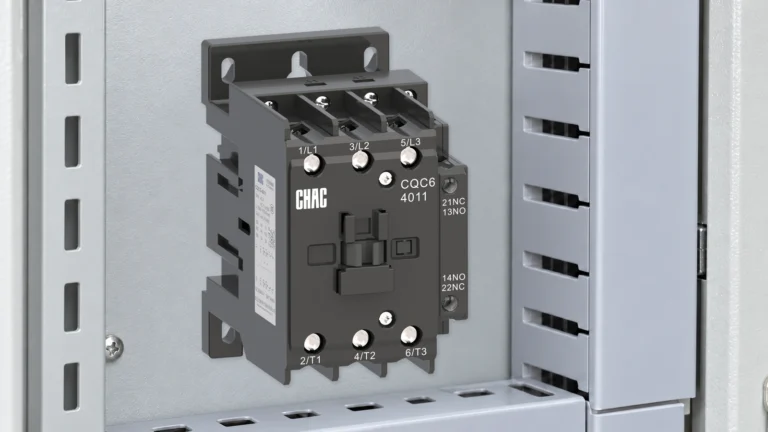
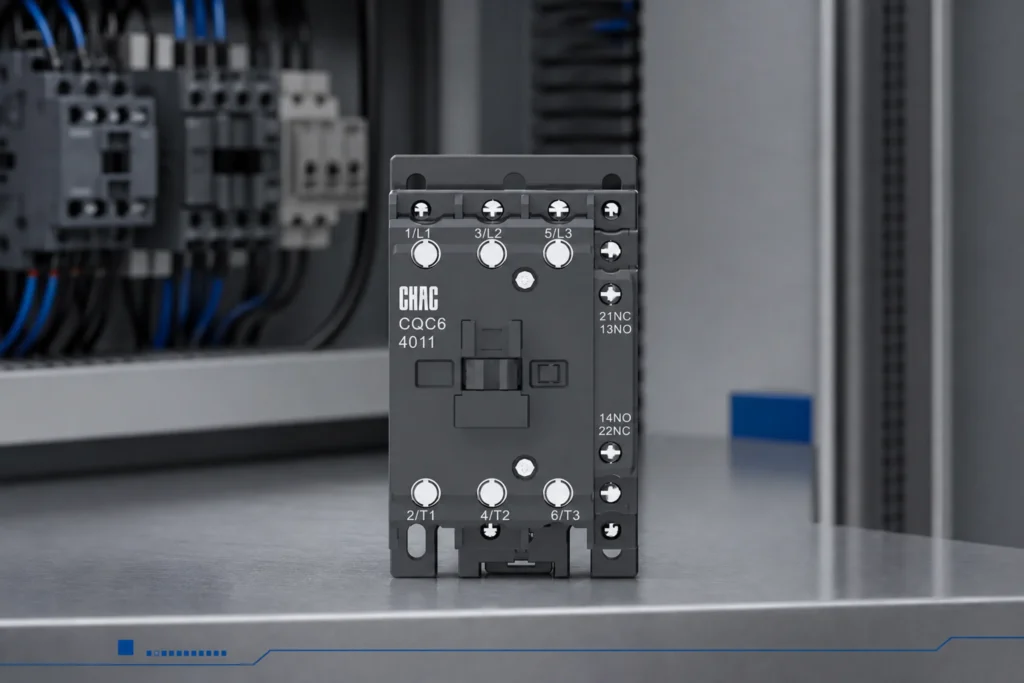
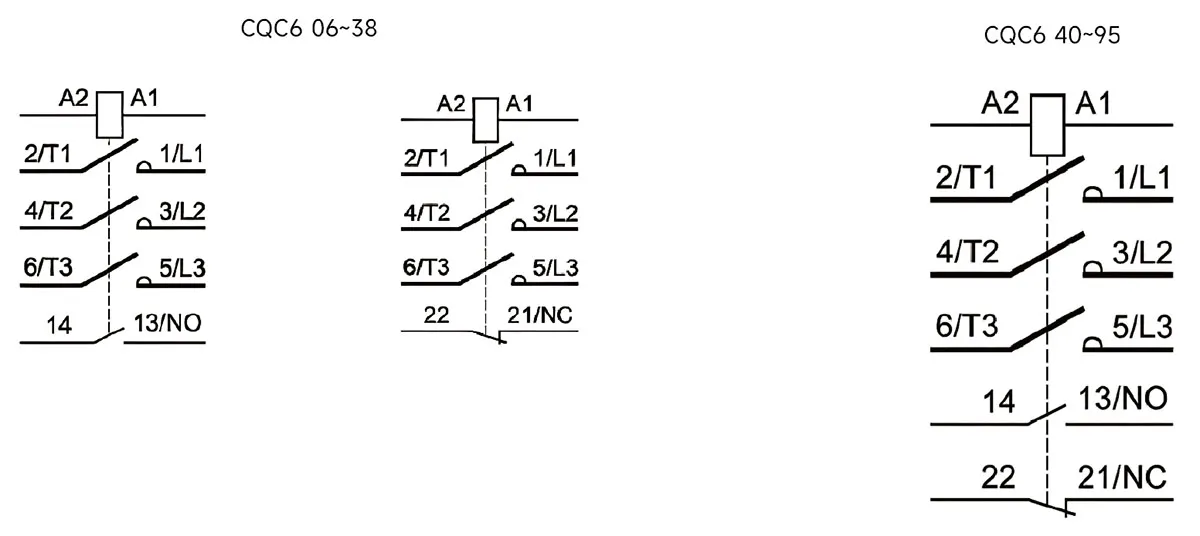
The CQC6 industrial AC contactor page publicly describes 50 Hz systems up to 690 V, a 95 A rated-current field at AC-3/380 V, and expansion with auxiliary contacts, timers, or thermal relays. It also lists screw and DIN-rail mounting information for the stated series range.
Product recommendation
CQC6 Series Industrial AC Contactor OEM Manufacturer | CHAC Electric
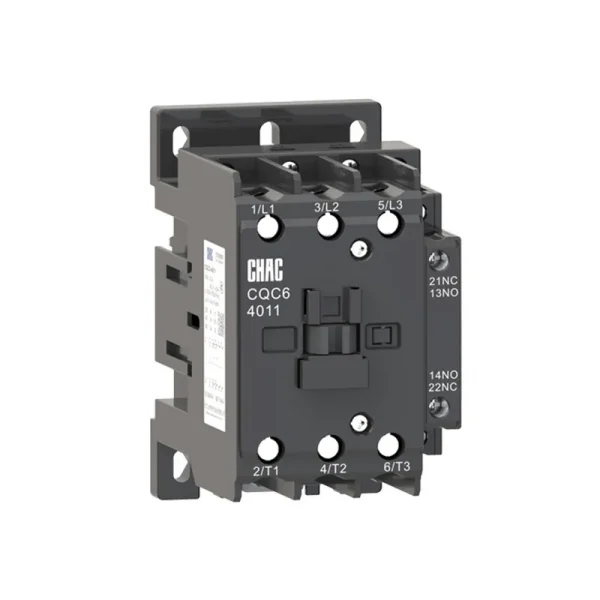
Use that CQC6 page after the RFQ states the base series, signal role, required state, coil context, timing need, and mounting record. The public fields can support a selected-product discussion, but they do not establish the needed contact count, a particular timer behavior, or compatibility with another contactor family. For branded or documentation-led programs, use the industrial-control customization path.
Part 6. What remains outside an auxiliary-interface RFQ?
This article supports a more comparable early-panel enquiry. It is not a wiring instruction, a safety-function design, a timing-program test, a fault investigation, or an approval statement for an accessory whose base contactor has not been identified.
Fit Boundary: keep the final decision with the approved drawing, selected-device documentation, applicable project requirements, and qualified engineering review. Send the stated signal and product-record requirements to CHAC Electric when asking for a product discussion.
FAQs
What is an auxiliary contact on an AC contactor?
It is a contact used for a separately defined control or signal function associated with the contactor. The required role and normal state should be identified on the control record.
Should an RFQ state NO or NC for an auxiliary contact?
Yes. State the required NO or NC condition for each named function so that a supplier can compare the proposed arrangement with the drawing requirement.
Does a timer replace an auxiliary contact?
No. A timing function and an auxiliary signal function should be documented separately. If timing is required, state the intended action and requested range for selected-model review.
What coil information belongs in a contactor request?
Include the control-circuit context and the selected coil field to be reviewed. Do not infer coil information from the main-pole rating or a product photograph.
Can an accessory be selected from a contactor photo?
No. The base contactor, required signal function, NO/NC state, drawing reference, and product records are needed before an accessory response can be compared.
Does an auxiliary contact confirm a complete control design?
No. It is one defined interface in a control arrangement. The circuit logic, selected device, and project requirements require separate engineering review.