As industrial automation, HVAC systems, and smart electrical panels continue to expand, the demand for reliable AC Contactor solutions is growing rapidly. Whether used as an AC unit contactor in air conditioning systems or in motor control cabinets, a high-quality contactor helps ensure stable switching, safer load control, and reduced equipment downtime. For many users, choosing the right product also means fewer failures, lower maintenance costs, and less need for frequent AC contactor repair.
Today’s electrical market is moving toward energy efficiency, digital monitoring, compact design, and predictive maintenance. Customers need AC contactors that can handle frequent switching, resist contact wear, support different load types, and perform reliably in demanding environments. However, buyers often worry about coil burnout, contact welding, incorrect voltage selection, short electrical lifespan, certification compliance, and whether low-cost products can truly meet long-term operational requirements. That is why understanding contactor structure, testing methods, replacement guidance, and supplier quality is essential before making a purchasing decision.
What Are AC Contactors and Why Do They Matter in Electrical Operations?
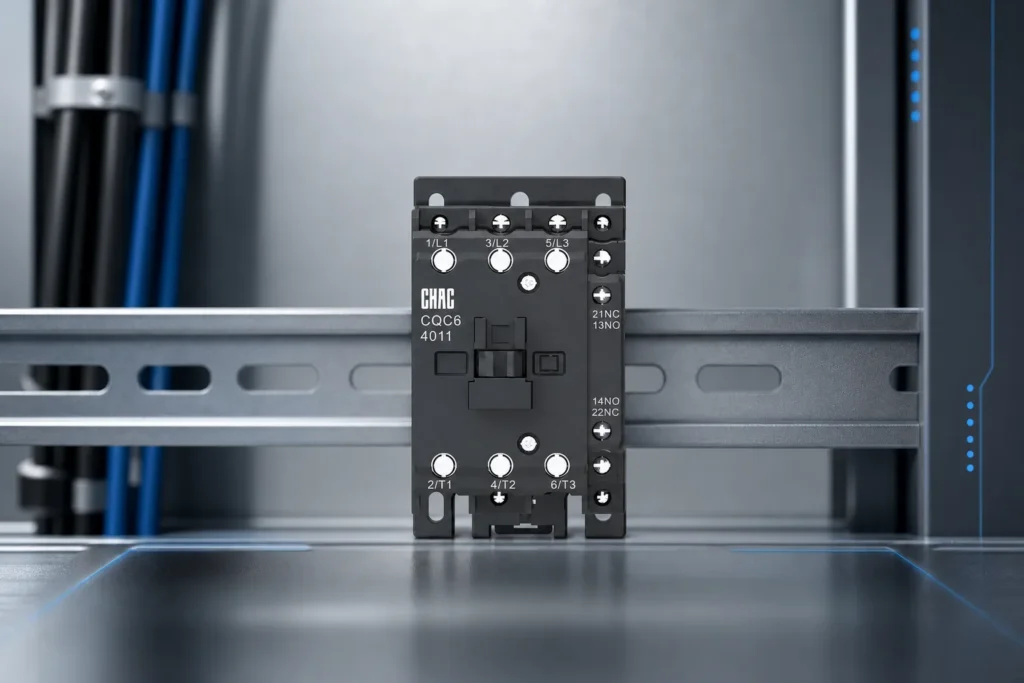
An AC Contactor is an electromagnetic switching device used to control AC electrical loads. When the coil is energized, it creates a magnetic field that pulls the moving core and closes the main contacts, allowing current to flow to the load. When the coil is de-energized, the spring mechanism releases the contacts and disconnects the circuit.
AC contactors are widely used in:
- Industrial motor control systems
- HVAC and air conditioning units
- Compressors and pumps
- Lighting control panels
- Automation equipment
- Power distribution cabinets
In electrical operations, contactors matter because they allow high-current loads to be controlled by low-current control signals. This improves safety, enables automation, and protects operators from directly switching high-power circuits.
Key Components Inside an AC Contactor
A high-quality AC Contactor is more than a simple electrical switch. Its performance depends on the quality of each internal component, especially the coil, contacts, magnetic system, and arc suppression structure.
| Component | Function | Why It Matters |
|---|---|---|
| Coil | Generates magnetic force when energized | Determines stable pulling force and voltage compatibility |
| Main Contacts | Switch the load current on and off | Directly affects electrical lifespan and load capacity |
| Auxiliary Contacts | Provide signal feedback or control logic | Used for interlocking, self-holding circuits, and PLC signals |
| Magnetic Core | Transfers electromagnetic force | Influences response speed and operating noise |
| Arc Chute | Extinguishes arc during switching | Reduces contact erosion and improves safety |
| Spring Mechanism | Releases contacts when coil power is removed | Ensures fast and reliable disconnection |
| Insulated Housing | Protects internal components | Requires flame-retardant and heat-resistant material |
Auxiliary Contacts: Additional contacts used for signal feedback, electrical interlocking, self-holding circuits, or PLC control logic.
For demanding industrial applications, the contactor should have strong dielectric strength, reliable insulation resistance, stable coil performance, and excellent arc extinguishing capability. Manufacturers with in-house testing capabilities can better control these performance factors throughout production.
How to Test AC Contactor
Testing an AC Contactor is important during maintenance, troubleshooting, or before replacing a suspected faulty unit. A failed contactor can cause motor failure, compressor malfunction, overheating, or system shutdown.
Before testing, always disconnect power and follow electrical safety procedures.
Common testing steps include:
-
Visual Inspection
Check for burned marks, melted housing, loose terminals, damaged wires, or carbonized contacts. -
Coil Resistance Test
Use a multimeter to measure the resistance between coil terminals, usually marked as A1 and A2. If the coil is open or shorted, the contactor may need replacement. -
Voltage Test
Confirm whether the control voltage matches the coil rating, such as 24V, 110V, 220V, or 380V AC. -
Contact Continuity Test
Check whether the main contacts open and close properly when the coil is energized and de-energized. -
Mechanical Movement Check
Press the movable core manually when safe and powered off. The movement should be smooth without sticking. -
Load Operation Test
After reinstalling safely, verify whether the connected motor, compressor, or ac unit contactor system starts and stops normally.
If the contactor chatters, overheats, fails to pull in, or has welded contacts, it may require ac contactor repair or replacement.
How to Replace AC Contactor
Replacing an AC Contactor should be done carefully because incorrect wiring or wrong specifications can damage equipment or create safety hazards.
Basic replacement process:
-
Turn Off Power Completely
Disconnect the main power supply and verify with a voltage tester. -
Record Existing Wiring
Take clear photos of all terminals, including line side, load side, coil terminals, and auxiliary contacts. -
Check the Contactor Specification
Match the new contactor with the old one based on:- Rated current
- Rated voltage
- Coil voltage
- Number of poles
- Load category such as AC-1, AC-3, or AC-4
- Auxiliary contact configuration
-
Remove the Old Contactor
Loosen terminal screws, disconnect wires, and remove it from the DIN rail or mounting plate. -
Install the New Contactor
Mount it securely and reconnect wires according to the original wiring diagram. -
Tighten Terminals Properly
Loose terminals can cause overheating, arcing, and premature failure. -
Test Operation
Restore power and test start/stop operation under controlled conditions.
For HVAC systems, replacing an ac unit contactor often solves issues such as the outdoor unit not starting, compressor not running, or fan failure. However, if the root cause is voltage instability, capacitor failure, or control board damage, simply replacing the contactor may not solve the problem.
Electrical Lifespan vs Mechanical Lifespan: What Buyers Often Overlook
Many buyers focus only on mechanical lifespan, but for real electrical operations, electrical lifespan is often more important.
Mechanical lifespan refers to how many times the contactor can operate without load. Electrical lifespan refers to how many times it can switch actual current under load conditions. Since real switching creates arcs, heat, and contact erosion, electrical lifespan is usually much shorter than mechanical lifespan.
For motor control applications, especially under AC-3 working conditions, buyers should pay close attention to electrical lifespan rather than only comparing mechanical operation cycles. According to the application categories defined in IEC 60947-4-1 low-voltage switchgear and controlgear standards, utilization categories such as AC-1, AC-3, and AC-4 are critical for selecting the right contactor based on load type and switching duty.
AC-3 Duty: A common utilization category for switching squirrel-cage motors during normal starting and stopping operations.
In practical applications, AC-3 Duty is commonly used for standard motor starting and stopping, such as pumps, fans, compressors, and conveyor motors. Choosing a contactor with the correct utilization category helps prevent overheating, contact wear, and premature failure.
| Lifespan Type | Meaning | Main Influencing Factors |
|---|---|---|
| Mechanical Lifespan | Number of no-load operations | Spring system, magnetic core, mechanical wear |
| Electrical Lifespan | Number of load-switching operations | Load current, arc energy, contact material, switching frequency |
| Practical Service Life | Actual usable life in field conditions | Temperature, dust, voltage stability, maintenance quality |
At the manufacturing level, electrical endurance testing is essential for validating long-term contactor reliability. CHAC’s independent laboratories conduct electrical endurance, material, magnetic, salt spray, and dimensional testing to help ensure consistent quality throughout the production process.
Contact Material and Arc Suppression: Hidden Factors Behind Contactor Performance
The main contacts are the most critical parts of an AC Contactor. During switching, especially under inductive loads such as motors and compressors, an electric arc forms between the contacts. If the arc is not controlled properly, it can cause contact burning, welding, and reduced lifespan.
High-quality contactors usually use silver alloy contact materials, such as silver tin oxide or other environmentally compliant contact materials. These materials provide better conductivity, lower contact resistance, and improved resistance to arc erosion.
Arc Suppression: A design method used to control and extinguish electrical arcs generated when contacts open under load.
Arc suppression is essential for safe and durable contactor operation. A well-designed arc chute helps divide, cool, and extinguish the arc quickly. This reduces thermal stress and protects the contact surface. For heavy-duty applications, poor arc suppression often leads to frequent ac contactor repair, unexpected downtime, and unsafe operation.
AI Predictive Maintenance: The Future of AC Contactor Reliability
As industrial automation becomes more digitalized, contactors are no longer viewed only as passive switching devices. In smart electrical panels, data from contactor operation can be monitored to predict failures before they happen.
AI-based predictive maintenance can analyze:
- Switching frequency
- Coil temperature
- Contact resistance
- Load current fluctuation
- Pull-in and drop-out time
- Abnormal vibration or noise
- Historical fault patterns
For example, if a contactor starts taking longer to close or its contact resistance increases gradually, the system can generate an early warning. This allows maintenance teams to replace or repair the contactor before a production line stops unexpectedly.
This trend is especially valuable in smart factories, HVAC monitoring systems, and large-scale motor control centers. In production environments, digital workshops and automated production lines also play an important role in improving consistency. CHAC has developed smart manufacturing systems supported by SCADA, MES, and intelligent management platforms to enhance process control and production traceability.
AC Contactor vs Relay vs DC Contactor: Key Differences Buyers Should Know
Although contactors, relays, and DC contactors all perform switching functions, they are designed for different electrical requirements.
An AC Contactor is mainly used for switching AC loads such as motors, compressors, and heaters. A relay is usually used for lower-current control circuits. A DC contactor is designed to interrupt direct current, which is more difficult to extinguish because DC current has no natural zero-crossing point.
| Device | Main Use | Typical Load | Key Feature |
|---|---|---|---|
| AC Contactor | High-power AC switching | Motors, HVAC, pumps, compressors | Strong arc control for AC loads |
| Relay | Low-power signal control | Control circuits, alarms, small devices | Compact and sensitive |
| DC Contactor | High-power DC switching | EV, battery systems, solar storage | Stronger arc suppression for DC circuits |
For buyers, the most important rule is simple: do not use an AC contactor for DC loads unless the manufacturer specifically approves it. Incorrect selection can cause severe arcing, contact welding, or fire risk.
Safety Standards, Certifications, and Supplier Evaluation for AC Contactors
A reliable AC Contactor should comply with international safety and performance standards. For industrial and export markets, certifications are not only quality indicators but also entry requirements. Buyers can refer to UL 60947-4-1 standards for contactors and motor starters when evaluating products for North American industrial control applications.
Common standards and certifications include:
- IEC 60947-4-1 for contactors and motor starters
- CE for European market compliance
- UL for North American applications
- CCC for China market access
- RoHS for restricted hazardous substances
- Flame-retardant material standards for housing safety
When evaluating an AC contactor supplier, buyers should consider:
- Complete product testing process
- Stable coil and contact material quality
- Rated current and utilization category accuracy
- Production capacity and delivery stability
- OEM/ODM support
- Technical documentation and wiring diagrams
- Warranty and after-sales support
For global buyers, supplier capability is as important as product specification. With over 30 years of experience in low-voltage electrical product R&D and manufacturing, CHAC produces 2 million AC contactors annually and serves customers across global markets. Its large-scale production capacity and quality control system help support stable supply and consistent product performance.
A low-cost product may seem attractive at first, but if it causes frequent downtime, overheating, or repeated ac contactor repair, the total cost will be much higher.
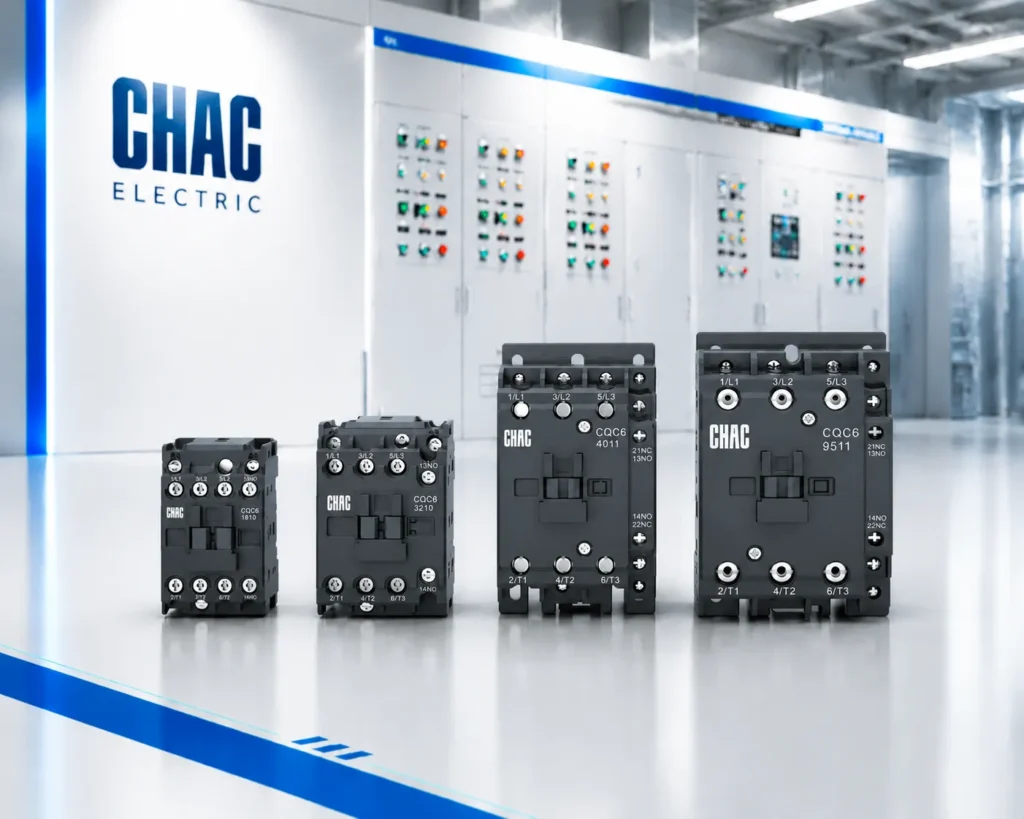
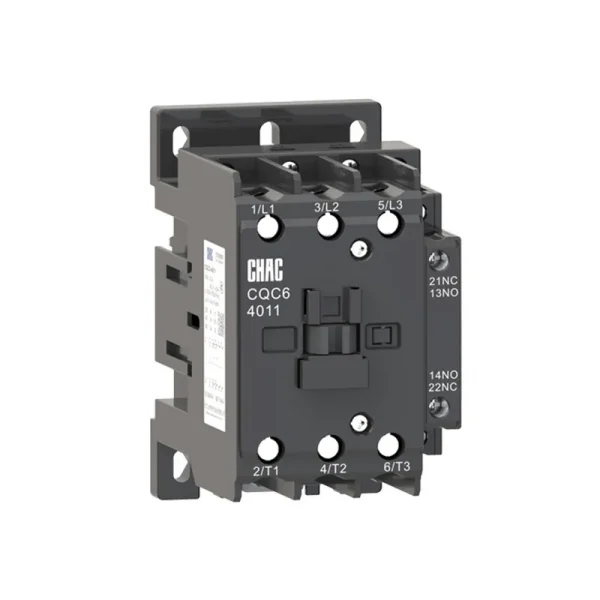
CHAC AC contactor Recommended:
CQC6 Series Industrial AC Contactor OEM Manufacturer | CHAC Electric
Future Trends: Digitalized, Compact, and Sustainable AC Contactors
The future of AC contactors is moving toward smarter, smaller, and more energy-efficient designs. Traditional contactors will continue to be widely used, but modern electrical systems increasingly require digital monitoring, lower energy consumption, and easier integration with automation platforms.
As highlighted by the International Energy Agency report on energy efficiency, improving electrical efficiency across industrial and building systems remains an important direction for reducing energy consumption and operating costs.
Key trends include:
- Compact design for space-saving control panels
- Low-power coils to reduce heat and energy loss
- Modular auxiliary contact blocks
- Smart monitoring for predictive maintenance
- Environmentally friendly contact materials
- Higher switching durability for frequent-start applications
- Better compatibility with PLC and IoT-based control systems
Sustainable manufacturing is also becoming a key factor in supplier evaluation. CHAC is recognized as a National Green Factory and operates under the ISO 14001 environmental management system, supporting cleaner and more responsible production of low-voltage electrical products.
As industries focus on automation, energy efficiency, and operational reliability, the AC Contactor will remain a core component in electrical operations. Whether used in motor control, industrial machinery, or an ac unit contactor system, choosing the right contactor is essential for safe, efficient, and long-lasting performance.
FAQs
What does an AC contactor do?
An AC contactor switches AC electrical loads on and off, such as motors, compressors, pumps, HVAC units, and lighting systems. It allows a low-voltage control signal to control a higher-power circuit safely.
How do I tell if my AC contactor is bad?
Common signs of a bad AC contactor include buzzing or chattering noise, burned or pitted contacts, the load not starting, overheating, welded contacts, or no continuity when the coil is energized.
What is the contactor of the AC unit?
The contactor of an AC unit is an electrical switch that controls power to the compressor and outdoor fan motor. When the thermostat sends a signal, the contactor closes and allows the air conditioning unit to run.
What is an AC 2 contactor?
An AC-2 contactor is used for switching slip-ring motors. It is designed for applications involving motor starting, stopping, and inching where higher starting current and specific duty conditions are required.
What is the difference between AC 3 and AC 4 contactor?
AC-3 contactors are mainly used for normal starting and stopping of squirrel-cage motors. AC-4 contactors are used for more demanding operations such as inching, plugging, and frequent reversing, so they require higher switching durability.
What happens when you put 240V between A1 and A2 of the contactor?
A1 and A2 are the coil terminals. If the contactor coil is rated for 240V, applying 240V will energize the coil and close the contacts. If the coil is not rated for 240V, it may overheat, burn out, or fail.
What does the T stand for on a contactor?
On a contactor, T terminals usually refer to the load side terminals, such as T1, T2, and T3. They connect to the motor or electrical load, while L1, L2, and L3 are typically the line side power input terminals.
References
- IEC 60947-4-1 Low-Voltage Switchgear and Controlgear Standards
- UL 60947-4-1 Standards for Contactors and Motor Starters
- International Energy Agency Report on Energy Efficiency
Looking for reliable AC contactors for industrial control, HVAC systems, or global electrical projects? Contact CHAC today to discuss your application requirements and find the right low-voltage electrical solution for your business.