Before selecting a molded case circuit breaker platform for a private-label or distributor program, align the specification on rated current, breaking capacity, trip unit type, accessory architecture, and certification scope. A matching frame designation is not enough: the supplied configuration must also match the configuration approved for the panel and protection study.
The short answer is to approve the complete molded case circuit breaker configuration, not just its family name. Separate the frame rating from the fitted trip unit and overload setting, compare breaking capacities at the required operating voltage, and obtain evidence for any claimed coordination with another protective device. IEC 60947-2 ratings help define the electrical duty, but do not by themselves establish acceptance in every destination market. This guide helps OEM program managers and distributors turn those distinctions into comparable supplier submissions; device-class basics are covered in the MCCB vs MCB selection guide.
What belongs in an MCCB RFQ for OEM and distributor programs?
An MCCB RFQ for OEM or distributor lines should read like a platform specification, not a single catalog line item. Specify the distribution or feeder application and applicable circuit-breaker standard, then ask for model-specific evidence rather than assuming a family-level claim covers every variant.
| RFQ block | Buyer should define | Why suppliers need it |
|---|---|---|
| Electrical ratings | Rated current, poles, voltage and frequency | Identifies candidate frames and fitted trip units |
| Breaking capacity | Prospective fault current at installation point and operating voltage | Checks declared Icu and Ics at the correct voltage |
| Trip unit | Thermal-magnetic or electronic; fixed or adjustable functions | Defines setting ranges and approval evidence |
| Accessory set | Shunt trip, undervoltage release, auxiliary contacts and alarm contacts | Defines the complete configuration and control voltages |
| Mounting and connection | Fixed or plug-in construction; cable or busbar connection | Defines panel layout and approved connection kits |
| Market documentation | Applicable legislation, declarations and required certification | Prevents treating different market documents as interchangeable |
| Private-label scope | Logo, packaging and manual language | Defines deliverables and responsible organizations |
If two suppliers quote different platforms on incomplete data, normalize their answers against this table before comparing unit price.
How do rated current, poles, and breaking capacity narrow platform choice?
Frame rating, rated current and trip setting are different quantities. The frame identifies the maximum current rating available for that construction; the fitted trip unit and its settings define the selected protection configuration. Schneider Electric’s Fundamental characteristics of a circuit-breaker distinguishes these quantities and explains that rated current depends on the specified trip unit and manufacturer-stated ambient conditions.
| Decision input | Review question | Common sourcing mistake |
|---|---|---|
| Frame rating, In and Ir | Which trip unit is fitted, and what overload setting protects the circuit? | Treating the frame label as the actual trip setting |
| Poles | Does the application require neutral switching or neutral protection? | Copying a three-pole configuration into a four-pole application |
| Icu and Ics | What are the declared capacities at the required operating voltage? | Comparing kA figures without voltage or test context |
| Installation conditions | Do the enclosure, temperature and altitude meet model instructions? | Ignoring manufacturer derating and installation notes |
Icu is the rated ultimate short-circuit breaking capacity; Ics is the rated service short-circuit breaking capacity under IEC 60947-2. Neither is the normal load current. Ask suppliers to identify both ratings and their voltage conditions instead of presenting a single unexplained kA figure.
Panel builders sourcing for multiple end markets may standardize on one MCCB platform with a limited set of frames. Regional accessory or labeling variants remain separate approval configurations when their electrical duty or compliance documentation differs.
When should buyers specify thermal-magnetic versus electronic adjustable trip units?
Thermal-magnetic MCCBs use thermal and magnetic elements for overload and short-circuit tripping; available adjustments depend on the model. An electronic adjustable MCCB can offer additional protection settings, but long-time, short-time, instantaneous and ground-fault functions are not universal. Obtain the exact trip-unit designation, setting ranges and time-current curves.
| Trip approach | Candidate application | Tradeoff to verify |
|---|---|---|
| Thermal-magnetic | Distribution feeders with suitable fixed or adjustable settings | Available adjustment range and thermal behavior |
| Electronic adjustable | Varied feeder profiles or coordination studies needing additional settings | Actual functions, setup requirements and quoted configuration cost |
| Leakage-integrated MCCB | Application requiring a specified residual-current function | Residual-current performance and documentation; not a generic MCCB substitute |
Specify trip preference before sample approval. A later trip-unit substitution should trigger a review of settings, curves, documentation and any dependent coordination claims, even if the external frame remains unchanged.
Which accessories and modular options affect BOM cost and lead time?
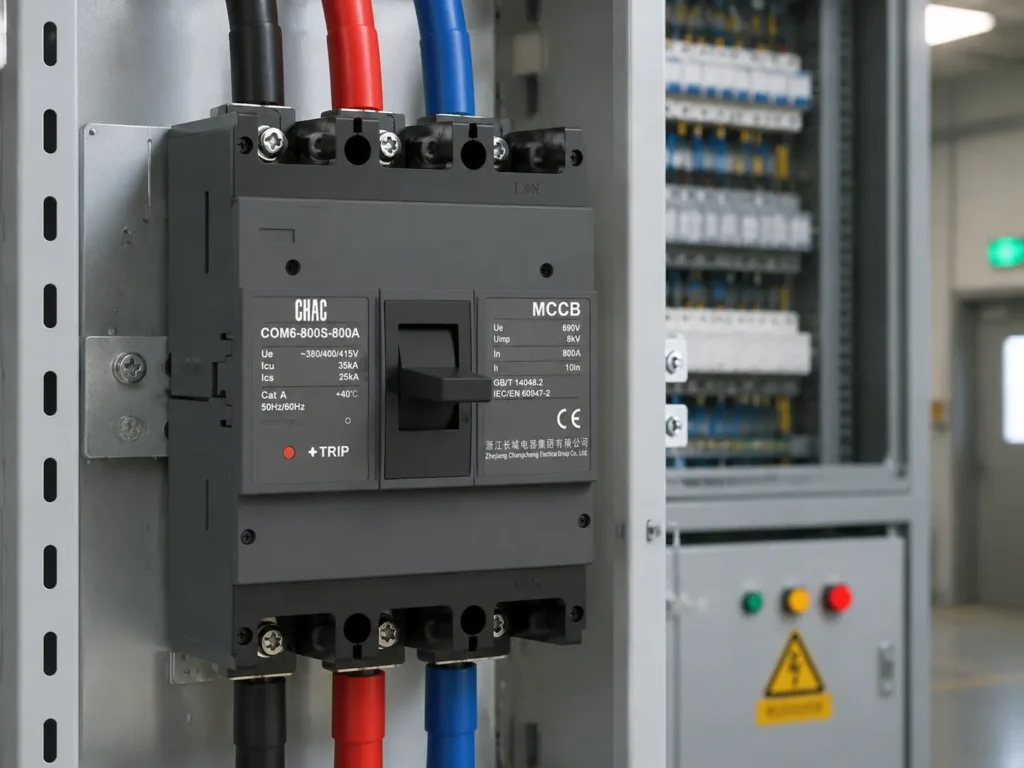
MCCB economics for OEM lines depend on accessories as well as the base breaker. Availability, assembly work and lead time are supplier-specific; obtain a configuration-level quotation rather than assuming an accessory change is commercially neutral.
| Accessory or option | Function | Specification note |
|---|---|---|
| Auxiliary contacts | Breaker-position indication to a controller or indicator | Contact arrangement, rating and mounting style |
| Shunt trip | Remote opening | Coil voltage, duty and operating requirements |
| Undervoltage release | Opening or closing inhibition under specified low-voltage conditions | Model-specific behavior and control-supply requirements |
| Alarm contact | Trip indication | Distinguish trip indication from position indication |
| Plug-in or withdrawable kit | Alternative mounting and maintenance arrangement | Approved frame, kit and installation instructions |
How should buyers control changes after sample approval?
Make the approved sample traceable to a configuration record: breaker catalog code, trip-unit designation and revision, accessory part numbers and coil voltages, connection kit, drawings and supporting document revisions. This is a procurement control, not a claim that a particular standard requires a universal revision format.
Agree which changes require advance notification and renewed approval. A routine production-test result addresses the checks performed on that unit or batch; it does not establish that a substituted trip unit or accessory matches the approved configuration. Request the actual test scope and traceability records separately from the change-notification agreement. UL’s guidance describes representative-sample evaluation and factory follow-up for its certification programs; that must not be presented as evidence that each shipped breaker undergoes a destructive short-circuit capacity test.
How does MCCB selection coordinate with upstream protection and motor branches?
MCCBs frequently sit below upstream ACBs or larger MCCBs and above MCB branches or motor starters. Coordination is a system question, not a single-device catalog choice.
| Branch type | MCCB role | Coordination reminder |
|---|---|---|
| Feeder from a low-voltage board | Overload and short-circuit protection | Review selectivity with the upstream protective device |
| Sub-feeder to an MCB panel | Intermediate protection | Check fault duty at the sub-board and downstream protection |
| Motor starter branch | Protection function defined by the selected motor circuit | Review the breaker, contactor and overload-protection combination |
| Mixed-load panel | Protection across different feeders | Confirm settings for each feeder instead of copying one setting |
Identify the exact upstream and downstream device codes, fitted trip units, settings, operating voltage and claimed coordination limit. Distinguish selectivity, which concerns which device opens, from a backup or series-combination rating, which concerns permitted fault duty for a specified combination. A higher-rated upstream breaker does not automatically prove either claim.
For US panelboards, UL Solutions’ Panelboard Application Guide explains that series ratings depend on specified line-side and load-side devices and voltage, while panel markings identify permitted field-installed units. Physical fit and a standalone breaker rating are therefore insufficient. Follow the assembly documentation and locally adopted code; IEC product evidence alone does not qualify a CHAC breaker as a replacement in a proprietary UL panelboard.
This article does not replace coordination studies or cable sizing. When fault levels or selectivity are unclear, request engineering review before freezing the platform configuration.
Which CHAC MCCB platforms can buyers review for OEM programs?
CHAC’s molded case circuit breakers category provides starting points for a supplier discussion. Product names identify candidate families, not approval for a particular panel or market; confirm the ordered variant and its documents.
| Buyer scenario | CHAC starting point | Evidence to request |
|---|---|---|
| Standard MCCB platform review | CQM6 standard MCCB | Fitted trip unit, frame coverage, Icu and Ics, approved accessories |
| Adjustable protection review | CQM6E electronic adjustable MCCB | Available functions, settings, curves and configuration-specific documents |
| Private-label distribution line | CHAC power distribution customization discussion | Branding, packaging, documentation responsibilities and change controls |
| Leakage-integrated variant review | CQM6L family inquiry | Required residual-current function and exact variant evidence |
What should the final supplier submission include?
- Target current, poles, operating voltage and installation conditions.
- Declared breaking capacities at that voltage, with standard and document revision.
- Exact trip unit, setting ranges, curves and any coordination-pair evidence.
- Accessory bill, connection details and control voltages.
- Market documentation, label languages and packaging.
- Sample approval, production-test scope, traceability and change-notification process.
For an EEA program, distinguish a declaration from a third-party certificate. The European Commission’s CE marking guidance states that the manufacturer carries out conformity assessment, prepares the technical file and issues the EU declaration of conformity. CE marking is not EU or authority safety approval. Request the declaration covering the exact supplied product and identify the organizations responsible for the private-label program.
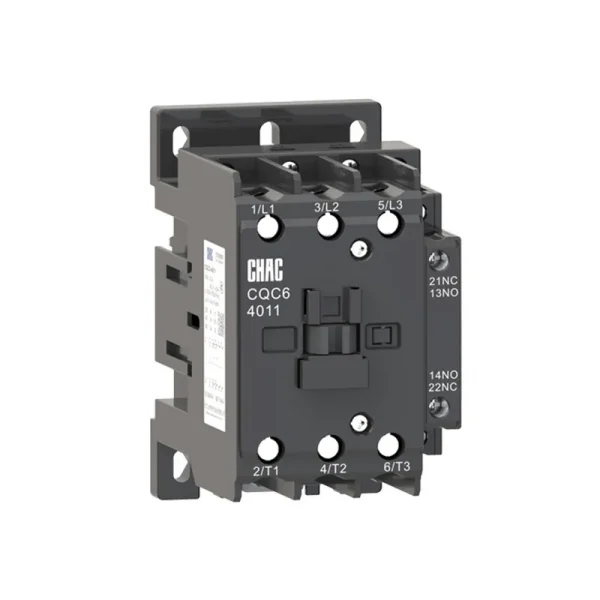
Motor-control components require a separate application review from the MCCB feeder configuration.
What are the fit boundaries for this buying guide?
This guide supports platform and procurement selection for low-voltage molded case circuit breakers in OEM and distributor programs. It does not replace:
- Short-circuit or selectivity coordination studies.
- Cable and busbar thermal calculations.
- Country-specific wiring-rule compliance checks.
- Medium-voltage breaker selection.
- Arc-flash or maintenance procedures.
Do not assume one MCCB configuration provides motor overload, residual-current and feeder protection without reviewing the full protection chain. When project data is incomplete, hold approval until fault duty and trip requirements are confirmed.
What else do OEM and distributor buyers ask about MCCBs?
What is a molded case circuit breaker (MCCB)?
An MCCB is a circuit-breaker in an insulated molded housing. Its protection functions, ratings and application limits depend on the fitted trip unit and exact model; industrial low-voltage circuit-breaker specifications commonly use IEC 60947-2.
How is an MCCB different from an MCB?
MCBs commonly protect modular branch circuits, while MCCB families offer molded frames and a range of trip-unit and accessory options. Current ranges overlap, so current alone does not determine the device class or application suitability.
What should OEM buyers ask an MCCB manufacturer first?
Ask for the complete configuration covering the intended voltage, current, fault duty and target market. Then request the fitted trip-unit designation, accessory compatibility and supporting document revisions before approving a sample.
When is an electronic adjustable MCCB worth the cost?
It can be useful when verified adjustment functions are needed for different feeder profiles or a coordination study. Compare the actual setting ranges and configuration cost; an electronic label alone does not prove every protection function is available.
Do MCCBs protect motors by themselves?
Only where the selected device and settings provide the protection required for that motor circuit. A motor starter may still need separate switching and overload protection; verify the complete combination rather than assuming a general feeder MCCB covers every motor duty.
Which accessories most often change OEM lead time?
Shunt trips, undervoltage releases and auxiliary or alarm contacts are important quotation variables, particularly when their voltages or contact arrangements change. There is no universal lead-time ranking; ask the supplier to quote the approved accessory configuration and any proposed change.
Can distributors rebrand CHAC MCCB platforms?
CHAC publishes OEM/ODM customization routes for power distribution products. Confirm branding and packaging deliverables together with the documentation and legal responsibilities for the destination market; rebranding is not itself proof of product compliance.
Can an upstream breaker compensate for a lower-rated downstream breaker?
Only with applicable evidence for the specified combination and installation conditions. In US panelboards, follow the documented series combination and panel markings; do not infer a combination rating from the two individual interrupting ratings.
Does a passing production test approve a changed trip unit?
No. A passing result covers the checks actually performed, not an unreviewed change to the approved configuration. Compare the new trip unit and supporting documents with the approved record, and review affected settings, coordination and market evidence before accepting the substitution.
Which references support these selection boundaries?
- Fundamental characteristics of a circuit-breaker, Schneider Electric Electrical Installation Guide, last edited August 5, 2026: ratings, frame size, settings and IEC breaking-capacity context. Manufacturer examples are not CHAC specifications.
- Panelboard Application Guide, UL Solutions: US panelboard ratings, permitted units, series combinations and certification scope.
- CE marking, European Commission: manufacturer conformity responsibilities and the meaning of the mark.
What should determine final platform approval?
The approval target is a documented configuration that meets the application, not a familiar frame or an attractive quotation. Establish the operating conditions first, select the trip unit and accessories next, and check ratings, coordination and market documentation against that exact combination. Preserve the approved record through production and review substitutions explicitly; neither a general certificate nor a routine test result closes every engineering question. CHAC’s product families can support the initial supplier discussion, while model-specific evidence determines whether a proposed variant belongs in the program. Send the completed requirements to Contact CHAC Electric for configuration review.